
Verwandte Artikel zu Stop Talking, Start Communicating: Counterintuitive...
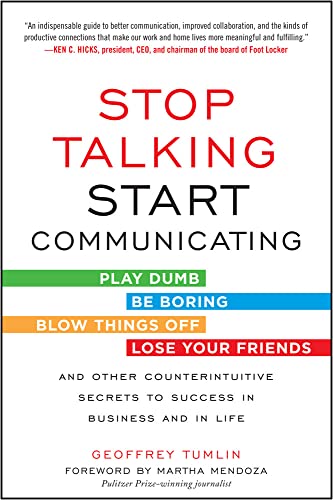
Stop Talking, Start Communicating: Counterintuitive Secrets to Success in Business and in Life, with a foreword by Martha Mendoza - Softcover
Inhaltsangabe
PLAY DUMB. BE BORING.
DON'T SOLVE PROBLEMS.
AND ABOVE ALL, DON'T BE YOURSELF.
Not exactly what you'd expect to hear from a communication expert, but these counterintuitive strategies are precisely what we need to interact productively and meaningfully in today's digital world. Our overreliance on quick, cheap, and easy means of "staying connected" is eroding our communication skills. Speed steamrolls thoughtfulness; self-expression trumps restraint. Errors and misunderstandings increase. And our relationships suffer.
With startling insights and a dash of humor, Stop Talking, Start Communicating combines scientific research with real-world strategies to deliver a proven approach to more effective communication.
"Only Geoffrey Tumlin could write a book about a serious problem--our mounting communication deficiencies--and make me laugh and learn all the way through it. Witty, smart, and 100 percent accurate, Stop Talking, Start Communicating points the way to a better conversational future." -- Tina Morris, managing director at Standard & Poor's
"An elegantly analytical, accessible, and enjoyable guide to improving interpersonal communication, Stop Talking, Start Communicating is a key resource for anyone who wants to be a difference-making leader, manager, or team member." -- Eduardo Sanchez, deputy chief medical officer of the American Heart Association
Die Inhaltsangabe kann sich auf eine andere Ausgabe dieses Titels beziehen.
Über die Autorin bzw. den Autor
Geoffrey Tumlin is CEO of Mouthpeace Consulting LLC, a communication consulting company, and president of On-Demand Leadership, a leadership development company. A portion of the author's royalties will be donated to Critical Skills Nonprofit, a 501(c)(3) public charity founded by the author to provide communication and leadership skills training to chronically underserved populations.
Auszug. © Genehmigter Nachdruck. Alle Rechte vorbehalten.
STOP TALKING, START COMMUNICATING
Counterintuitive Secrets to Success in Business and in Life, with a foreword by Martha Mendoza
By GEOFFREY TUMLINMcGraw-Hill Education
Copyright © 2013 Geoffrey Tumlin
All rights reserved.
ISBN: 978-0-07-181304-4All rights reserved.
Contents
| Foreword | |
| Introduction | |
| 1: Back Up to Go Forward | |
| 2: Invert Your Expectations | |
| 3: Lose Your "Friends" | |
| 4: Stop Talking | |
| 5: Don't Be Yourself | |
| 6: Play Dumb | |
| 7: Question Your Questions | |
| 8: Ignore Your (Telltale) Heart | |
| 9: Don't Solve Problems | |
| 10: Blow Things Off | |
| 11: Let Difficult People Win | |
| 12: Respond with Weakness | |
| 13: Change Your Change Plan | |
| 14: Take Things Off the Table | |
| 15: Be Boring | |
| 16: Give People What They Want | |
| Notes | |
| Recommended Reading | |
| Acknowledgments | |
| Index |
CHAPTER 1
BACK UP TO GO FORWARD
WE ARE NEGLECTING THREE VITAL COMMUNICATION HABITS
It was the conversation that he'd been waiting—and paying me—for. After monthsof work, I was ready to brief my client, a CEO who had asked me to help himdetermine why his vision for the company wasn't being supported by keyexecutives and employees. I'd spoken with almost every manager, and manyemployees, in the company, and in the course of those discussions, a clearstructural problem and two readily available solutions emerged. I was bringinghim very serious, but also very good, news.
The CEO welcomed me into his office, closed the door, and told me how anxious hewas to hear my findings. As soon as I began speaking, the CEO's cell phone rang.Apologizing, he looked at the number and ignored the call. Minutes later, afterI started sketching out the root cause of his organizational problem, hereceived a text message. Again, he looked at the screen and ignored it. Icontinued. So did the interruptions. He never answered a call or replied to atext, but I could see that his eyes—and his mind—were steadily drawn away fromthe significant organizational issues I was presenting and toward whatever wasmaking noise at his fingertips. Even though the discussion was very important tohim, digital distractions prevented him from devoting his full attention to ourconversation.
It's not just busy CEOs who struggle to have productive and meaningfulinteractions. My mom volunteers each weekend with probationers who are requiredto do community service. In groups of four, they plant trees, weed flower beds,trim bushes, and pick up trash. When break time comes, they all go to a fast-foodrestaurant and order a drink and a snack. The four probationers sittogether, and my mom and the other supervisors give them some space to talk andconnect with one another. But instead of a conversation about the morning's workor shared experiences, a connection-stifling pattern usually unfolds: one or twolook at their phones, which encourages a third person to put in earphones, andthen the fourth person, left with nothing else to do, joins the crowd, pulls outa phone, and stares at the screen. They all miss the discussion that they couldbe having. But it's hard for face-to-face communication—which is difficult,unpredicable, and filled with the risk of errors and slips—to compete withdevices that seem to effortlessly give us what we want, when we want it.
Today, most of us struggle to have meaningful interactions because of the power,allure, and distractions of our digital devices. It's easier than ever togratify our impulses with I-based personal communication and self-expressionbefore an online audience, but harder than ever for meaningful, we-basedinterpersonal communication. As personal and mass communication exploded in thedigital age, essential interpersonal communication skills were left behind.Better digital age communication requires us to retrieve three guiding habits:we need to listen like every sentence matters, talk like every word counts, andact like every interaction is important.
These three guiding habits can banish the hyper from our communication and canrestore effectiveness and meaning to the daily conversations that constitute ourrelationships and our lives.
Listen Like Every Sentence Matters
Perhaps you've seen the setup: a television producer selects someone from a TVstudio audience—let's call her Kate—to undergo a psychic reading. Kate has nevermet the psychic and has no deeply entrenched views about psychics or theirabilities. Likewise, the psychic has never met Kate and knows nothing about heruntil the cameras start rolling.
The reading is broadcast unedited to television viewers. The psychic talks toKate about her future, punctuating his delivery with questions, comments, andpredictions. When the reading is complete, a producer interviews Kate about theexperience.
She expresses genuine surprise, noting that while initially she was a bitskeptical, now she believes that the reading was prescient and accurate. Askedif the psychic could be a fraud or a fake, Kate disagrees. He knew too muchabout her. She believes this psychic has real gifts; he is the genuine article.
Then the producer lets Kate in on the secret: she's been fooled by psychic-busterIan Rowland, the archenemy of palm readers, mind readers, tarot carddiviners, and anyone else claiming to have psychic powers.
Rowland uses a technique he calls cold reading, which consists of asking goodquestions, making guesses that have a high probability of being correct, and,above all else, listening. Rowland doesn't use magical powers. He just payscareful attention and makes high-percentage predictions based on what he hears.
Yet it feels remarkably like he knows all about a person. And in a way, he does.With the cameras rolling and his professional reputation at stake with everytelevised reading, he has no choice but to listen carefully.
The first guiding habit for better communication in the digital age is to listenlike every sentence matters.
Psychic-busting isn't the only career where listening intently matters. In fact,it's hard to think of a job or activity where careful listening doesn't matter,because all interactions—with clients, colleagues, customers, children, andfriends—benefit when we pay close attention to the other person.
Listening certainly matters in my consulting work. Most of the solutions towhat's ailing a company, group, family, or marriage are within that company,group, family, or marriage. If I listen closely, I can help clients capturetheir own insights, and those insights can often change a company, reenergizeemployees, or rehabilitate a relationship.
When people know that they are being listened to about an important matter,their words pour out in a flood. You would think that these people hadn't beenlistened to for years. It may surprise you how well your own employees orcolleagues understand the problems and the potential of your company. No matterwhat kind of organization I visit, I don't find many of the clueless workers whoare standard fare for organizational cartoons and television shows. Instead ofDilberts,...
„Über diesen Titel“ kann sich auf eine andere Ausgabe dieses Titels beziehen.
Suchergebnisse für Stop Talking, Start Communicating: Counterintuitive...

Beispielbild für diese ISBN
Stop Talking, Start Communicating: Counterintuitive Secrets to Success in Business and in Life, with a foreword by Martha Mendoza
Verlag:
McGraw-Hill Education - Europe, 2013
ISBN 10: 0071813047
ISBN 13: 9780071813044
Gebraucht
Paperback
Anbieter: World of Books (was SecondSale), Montgomery, IL, USA
Verkäuferbewertung 5 von 5 Sternen

Paperback. Zustand: Very Good. Describes how quality communication has been degraded by overuse of quick, cheap, and easy digital communication such as e-mails, texts, and social media. This book includes counter-intuitive methods such as, Don't Be Yourself; Don't Solve Problems; and, Play Dumb. Artikel-Nr. 00108663219
Gebraucht kaufen
EUR 5,15
Versand gratis
Versand innerhalb von USA
Versand innerhalb von USA
Anzahl: 2 verfügbar
Beispielbild für diese ISBN
Stop Talking, Start Communicating: Counterintuitive Secrets to Success in Business and in Life, with a foreword by Martha Mendoza
Verlag:
McGraw-Hill Education - Europe, 2013
ISBN 10: 0071813047
ISBN 13: 9780071813044
Gebraucht
Paperback
Anbieter: World of Books (was SecondSale), Montgomery, IL, USA
Verkäuferbewertung 5 von 5 Sternen
Paperback. Zustand: Good. Describes how quality communication has been degraded by overuse of quick, cheap, and easy digital communication such as e-mails, texts, and social media. This book includes counter-intuitive methods such as, Don't Be Yourself; Don't Solve Problems; and, Play Dumb. Artikel-Nr. CIN0071813047G
Gebraucht kaufen
EUR 5,15
Versand gratis
Versand innerhalb von USA
Versand innerhalb von USA
Anzahl: 1 verfügbar
Beispielbild für diese ISBN
Stop Talking, Start Communicating: Counterintuitive Secrets to Success in Business and in Life, with a Foreword by Martha Mendoza
Anbieter: ThriftBooks-Atlanta, AUSTELL, GA, USA
Verkäuferbewertung 5 von 5 Sternen
Paperback. Zustand: Fair. No Jacket. Readable copy. Pages may have considerable notes/highlighting. ~ ThriftBooks: Read More, Spend Less. Artikel-Nr. G0071813047I5N00
Gebraucht kaufen
EUR 6,30
Versand gratis
Versand innerhalb von USA
Versand innerhalb von USA
Anzahl: 1 verfügbar
Beispielbild für diese ISBN
Stop Talking, Start Communicating: Counterintuitive Secrets to Success in Business and in Life, with a Foreword by Martha Mendoza
Anbieter: ThriftBooks-Dallas, Dallas, TX, USA
Verkäuferbewertung 5 von 5 Sternen
Paperback. Zustand: Fair. No Jacket. Readable copy. Pages may have considerable notes/highlighting. ~ ThriftBooks: Read More, Spend Less. Artikel-Nr. G0071813047I5N00
Gebraucht kaufen
EUR 6,30
Versand gratis
Versand innerhalb von USA
Versand innerhalb von USA
Anzahl: 1 verfügbar
Beispielbild für diese ISBN
Stop Talking, Start Communicating: Counterintuitive Secrets to Success in Business and in Life, with a Foreword by Martha Mendoza
Anbieter: ThriftBooks-Phoenix, Phoenix, AZ, USA
Verkäuferbewertung 5 von 5 Sternen
Paperback. Zustand: Good. No Jacket. Pages can have notes/highlighting. Spine may show signs of wear. ~ ThriftBooks: Read More, Spend Less. Artikel-Nr. G0071813047I3N00
Gebraucht kaufen
EUR 6,30
Versand gratis
Versand innerhalb von USA
Versand innerhalb von USA
Anzahl: 2 verfügbar
Beispielbild für diese ISBN
Stop Talking, Start Communicating: Counterintuitive Secrets to Success in Business and in Life, with a Foreword by Martha Mendoza
Anbieter: ThriftBooks-Atlanta, AUSTELL, GA, USA
Verkäuferbewertung 5 von 5 Sternen
Paperback. Zustand: Good. No Jacket. Pages can have notes/highlighting. Spine may show signs of wear. ~ ThriftBooks: Read More, Spend Less. Artikel-Nr. G0071813047I3N00
Gebraucht kaufen
EUR 6,30
Versand gratis
Versand innerhalb von USA
Versand innerhalb von USA
Anzahl: 3 verfügbar
Beispielbild für diese ISBN
Stop Talking, Start Communicating: Counterintuitive Secrets to Success in Business and in Life, with a Foreword by Martha Mendoza
Anbieter: ThriftBooks-Dallas, Dallas, TX, USA
Verkäuferbewertung 5 von 5 Sternen
Paperback. Zustand: Good. No Jacket. Pages can have notes/highlighting. Spine may show signs of wear. ~ ThriftBooks: Read More, Spend Less. Artikel-Nr. G0071813047I3N00
Gebraucht kaufen
EUR 6,30
Versand gratis
Versand innerhalb von USA
Versand innerhalb von USA
Anzahl: 3 verfügbar
Beispielbild für diese ISBN
Stop Talking, Start Communicating: Counterintuitive Secrets to Success in Business and in Life, with a Foreword by Martha Mendoza
Anbieter: ThriftBooks-Dallas, Dallas, TX, USA
Verkäuferbewertung 5 von 5 Sternen
Paperback. Zustand: Very Good. No Jacket. May have limited writing in cover pages. Pages are unmarked. ~ ThriftBooks: Read More, Spend Less. Artikel-Nr. G0071813047I4N00
Gebraucht kaufen
EUR 6,30
Versand gratis
Versand innerhalb von USA
Versand innerhalb von USA
Anzahl: 1 verfügbar
Beispielbild für diese ISBN
Stop Talking, Start Communicating: Counterintuitive Secrets to Success in Business and in Life, with a Foreword by Martha Mendoza
Anbieter: ThriftBooks-Reno, Reno, NV, USA
Verkäuferbewertung 5 von 5 Sternen
Paperback. Zustand: Good. No Jacket. Pages can have notes/highlighting. Spine may show signs of wear. ~ ThriftBooks: Read More, Spend Less. Artikel-Nr. G0071813047I3N00
Gebraucht kaufen
EUR 6,30
Versand gratis
Versand innerhalb von USA
Versand innerhalb von USA
Anzahl: 2 verfügbar
Beispielbild für diese ISBN
Stop Talking, Start Communicating: Counterintuitive Secrets to Success in Business and in Life, with a foreword by Martha Mendoza
Anbieter: Books From California, Simi Valley, CA, USA
Verkäuferbewertung 4 von 5 Sternen

Paperback. Zustand: Very Good. Artikel-Nr. mon0003810855
Gebraucht kaufen
EUR 3,66
EUR 4,45 Versand
Versand innerhalb von USA
Versand innerhalb von USA
Anzahl: 2 verfügbar