
Verwandte Artikel zu Conversational Capacity: The Secret to Building Successful...
Conversational Capacity: The Secret to Building Successful Teams That Perform When the Pressure Is On - Softcover
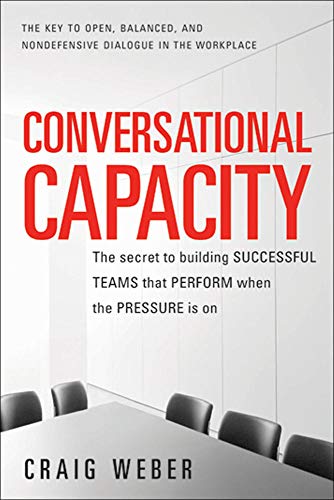
Inhaltsangabe
OPEN, BALANCED DIALOGUE--THE KEY TO PEAK TEAM PERFORMANCE
In a world of rapid-fire change, it's more important than ever to build teams that work well when the pressure is on-and quality communication can mean the difference between success and failure.
Conversational Capacity provides the communication tools you need to ensure that your team remains on track even when dealing with its most troublesome issues, that it responds to tough challenges with agility and skill, and performs brilliantly in circumstances that would incapacitate less disciplined teams.
Praise for Conversational Capacity:
"This book blows the lid off everything you have learned about team building and will have you asking, 'Why didn't someone show me this before?'" -- Rick Woodcock, Chief Technology Officer of the US Naval Institute, Annapolis
"Easy to implement, Craig Weber's techniques will transform your organization. We put these principles into practice and saw immediate results." -- Scott Goodey, CEO, Greenpoint Technologies
"A must-read for leaders and those who aspire to lead. It's one of the most influential books on the value of teaming." -- Benjamin Ola Akande, PhD, Professor of Economics and Dean of the George Herbert Walker School of Business and Technology, Webster University
"Conversational Capacity is one of those rare books that will forever change how you see yourself and the people with whom you work. Read it. Recommend it to your boss, your team, and your friends." -- Jan Wilmott, Director of Leadership Development at the Royal Bank of Canada
"This book provides a practical roadmap to learning the single most important skill that any leader can and should master. Conversational Capacity will change the way you lead and transform your relationships--at work and at home." -- Andy Restivo, President and CEO of Creative Channel Services, an Omnicom Group Company
"Conversational Capacity shows leadership teams how to think actively and adapt quickly. Better yet, the simplicity of the book enables the reader to apply the concepts and ideas in any leadership position." -- Mark Milliner, CEO of Personal Insurance at Suncorp
"Craig Weber has a gift for connecting what it means to build healthy relationships with the nuts and bolts of running an organization. In Conversational Capacity he brings a refreshing combination of practical tools, personal examples, and wisdom from having worked with hundreds of leaders over the years. If you are a leader or someone interested in getting better at what you do, Conversational Capacity is a must read." -- Rob McKenna, PhD, Executive Director of the Center for Leadership Research and Development and author of Dying to Lead
"Craig Weber challenges us to think differently about the way we talk to each other. Not since the seminal work of Chris Argyris have I read a book that so well documents the promise and the peril of dialogue. Readers will learn to develop conversational competence with team members and with leaders at all levels. You will learn to become more mindful in difficult situations, appreciate the power of curiosity, and develop ways to experiment, compare, reframe, and reengage with renewed commitment. We need this book, now more than ever. Once you read it, you will want to share it as soon as possible!" -- Frank J. Barrett, PhD, Professor of Management and Organizational Behavior, Global Public Policy, at the Graduate School of Business and Public Policy, Naval Postgraduate School and author of Yes to the Mess
"This book has transformed the way I lead, teach, and facilitate. Weber captures the essence of team effectiveness and provides a well-researched and tested model that supports the other building blocks of leadership." -- Dr. Tony Herrera, Direct of Partner Development at Schreiber Foods
"Required reading! Improving the conversational capacity of your team and organization is invaluable. These same skills are needed to address the broader issues we face as a society. Get this book! Share it with your colleagues, friends, and family." -- Chris Soderquist, President of Pontifex Consulting and author of The Strategic Forum
"Craig Weber's Conversational Capacity works. It works to build an internal culture that allows our organization to focus on the work at hand--without the drama, emotions, and egos that often get in the way of creating a high-functioning organization. It also works when building relationships with funders, stakeholders, and other clients, allowing our team to listen for commonalities and to find areas of true agreement." -- Michele Lueck, President and CEO of the Colorado Health Institute
"Those who aspire to use a conversational process to facilitate and deliver high-impact team results have come to the right place. Having worked with Craig Weber to design training programs for colleagues, I can personally attest to his brilliance in using narratives to capture our attention and emotional intelligence with evidence-based methods to build our conversational skills. With clarity, practicality, and case examples, this book will help you find the sweet spot in any conversation while ensuring a productive outcome." -- Dr. Kathleen Keil, Senior Manager of Learning and Development at Pfizer Animal Health
"Craig Weber's Conversational Capacity reduces organizational fear through a simple, effective technique that increases trust and maximizes creativity. It will help any organization realize new levels of confidence, creativity, and success. The tools within these pages may very well be the most important keys to both change and growth in the twenty-first century." -- Scott Eck, President of Leadership Masters
"We often see the need for collaboration but do not have the tools and skills required to make it happen. Using Craig Weber's techniques to build conversational capacity is exactly what we need in both our professional and personal lives." -- Karen Minyard, PhD, Director of the Georgia Health Policy Center at the Andrew Young School of Public Policy, Georgia State University
"The ideas in these pages are profound, life changing, and applicable to every area of life. My nonprofit team acquired a new set of skills that increased our capacity to tackle governance, interpersonal relationships, and the future in a dynamic and changing economy. Don't miss this opportunity to learn from a master the tools required to elevate awareness, skill, and discipline to achieve desired--and amazing--results." -- Jane Soderquist, Board Chair of the Upper Valley Waldorf School
Die Inhaltsangabe kann sich auf eine andere Ausgabe dieses Titels beziehen.
Über die Autorin bzw. den Autor
Craig Weber is an international consultant specializing in team and leadership development. His clients include Boeing, Pfizer, Novo Nordisk, the Royal Bank of Canada, NASA, and the Centers for Disease Control.
Auszug. © Genehmigter Nachdruck. Alle Rechte vorbehalten.
CONVERSATIONAL CAPACITY
The Secret to Building Successful Teams That Perform When the Pressure Is On
By CRAIG WEBERThe McGraw-Hill Companies, Inc.
Copyright © 2013 Craig Weber. Inc.
All rights reserved.
ISBN: 978-0-07-180712-8All rights reserved.
Contents
| Acknowledgments | |
| Introduction: Standing on the Shoulders of Giants | |
| Chapter 1: Conversational Capacity: The Missing Piece of the Puzzle | |
| Chapter 2: Intentional Conflict: Why Good Intentions Are Never Enough | |
| Chapter 3: Beyond Fight and Flight: A More Intentional Mindset | |
| Chapter 4: Intentional Dialogue: Skills for Balancing Candor and Curiosity | |
| Chapter 5: Cultivating Our Better Angels | |
| Chapter 6: Conversational Capacity and the Value of Conflict | |
| Chapter 7: Conversational Capacity and Adaptive Learning | |
| Chapter 8: The Work of Building a Disciplined Team | |
| Chapter 9: Conversational Capacity and the Challenge of Team Leadership | |
| Conclusion: The Road Less Traveled | |
| Notes | |
| Index |
Excerpt
CHAPTER 1
Conversational Capacity
THE MISSING PIECE OF THE PUZZLE
Management's business isbuilding organizations that work
JOAN MAGRETTA
In elementary school I had a friend named David. One sunny day at recess, David,an epileptic, fell to the ground in the grips of a violent seizure. By the timeI noticed what was happening, not only was David in physical distress, he wasalso surrounded by a group of students who were laughing at him, calling himnames, and making fun. It was an ugly scene.
Shocked, I raced over with the clearest of intentions—to help David getthrough the seizure without injuring himself and to defend him from those kidsgiving him grief. I knew what to do and I had every intention of doing it, butas I reached my friend, a disturbing thing happened: I froze in my tracks. Ididn't say a word. I didn't help my friend.
I didn't know it then, but I had fallen victim to a powerful dilemma that oftencauses our intentions and our behavior to part ways. On the one hand, my goalwas to help my friend, but on the other, it was to avoid being ridiculed andcriticized. I wanted to speak up and help, but I also wanted to remain safe andsecure. It's clear now that the latter intention was the more powerful of thetwo, and that there were two seizures on the playground that day—David'sepileptic seizure and my intentional seizure.
At the time I thought it was just me, that I suffered from some unrecognizeddisability with which most people are unencumbered. Or even worse, I worriedthat I was simply a coward, too afraid to take a stand for my friend when itcounted most. I've since learned that my painful episode on the playgroundreflects a nearly universal human experience. And, after years of academic studyand in-depth work with a wide variety of organizations, I realize my reactionthat day was a symptom of a problem affecting all manner of teams and workrelationships.
This problem is not just a minor trifle causing mere inconvenience orembarrassment on playgrounds. Its significance is evident in the experience ofColonel Mike Mullane, a weapons and navigational systems officer on a U.S. AirForce F-111 "Aardvark," a fighter-bomber. Early in his career he was on amission with a pilot with thousands of hours of experience flying this aircraft.When they reached "bingo fuel," the critical point at which there is just enoughfuel to return to base, Mullane saw no response from the pilot. Mullane's firstinstinct was to speak up, to point out that they needed to turn the aircraftaround and head home. At risk, after all, was not just their mission and theirplane, but also their lives.
But then, like me on the playground, he experienced an intentional conflict. Onthe one hand, a "little voice" in the back of his brain urged him to raise hisconcern; on the other hand, he didn't want to be labeled a troublemaker, anon–team player, or a "high-maintenance" flight operations officer. Evenworse, what if he had been misreading the situation and it was not actuallybingo fuel? He might've looked ignorant or incompetent. So despite the obviousdanger, Mullane covered up his concern and said nothing. The consequences weresevere. Running out of fuel on their way back to base, they ejected from the F-111. Rather than end their mission by landing on a runway as they intended, theyinstead found themselves swinging under the canopy of a parachute as theirmultimillion-dollar aircraft crashed into the ground.
Building Teams That Work
These experiences provide a clue to a major problem affecting teams, teammembers, and teamwork, a problem that is routinely overlooked, underappreciated,and, therefore, undermanaged. This lack of awareness costs us dearly. In ourworld of mounting complexity and rapid-fire change, there's a growing demand forteams that work well when the pressure is on. But while we're good at buildingteams that perform when facing routine problems, building teams that performwhen things get tough remains an elusive and frustrating goal.
It's not that we haven't been trying. We've been systematically studying how tobuild more effective and efficient organizations since the late nineteenthcentury when Frederick Taylor broke new ground with his time and motion studies,ushering in a new era of scientific management. But Taylor would barelyrecognize the world in which we're working today. Vastly more complex andinterconnected, our world moves in chaotic and unpredictable ways. A torrent ofchange—technological, economic, political, and environmental—roarsat us with increasing volume and velocity.
But, while it's more vital than ever to build teams that can thrive in thesedifficult circumstances, it's clear we're missing something important. Despitethe billions of dollars spent every year on strategy formulation, training,restructuring, personality assessments, off-sites, workshops, and all manner ofteam and organizational development, only 15 percent of mergers and acquisitiondeals succeed, and executives report a rapidly growing gap between the need forchange in their organizations and their ability to effectively orchestrate thatchange. Research shows that 9 out of 10 strategic initiatives fail to delivertheir intended results, and among executives who believe they have the rightstrategies in place, only a small fraction feel they are implementing themeffectively. As Lawrence Hrebiniak puts it, "making strategy work is moredifficult than strategy making."
Not only are our teams routinely ineffective, they're often inhumane. Researchshows that working and getting ahead in a wide range of teams and organizationsresults in "various disturbances—genuine emotional conflicts—thatrange from mild distress to feelings of self-betrayal, to stress and burnout, toacute psychiatric symptoms and irrationality." Teamwork, it turns out, can behazardous to our health.
Our efforts to build reliably effective teams yield such poor results becauseour focus is overly technical. While we espouse our allegiance to the human sideof the enterprise, our actions reveal different priorities. We're far morelikely to focus our attention and resources on strategy, structure, systems,policy, process, and procedure, delegating the "softer" people stuff to HR,training, or...
„Über diesen Titel“ kann sich auf eine andere Ausgabe dieses Titels beziehen.
Suchergebnisse für Conversational Capacity: The Secret to Building Successful...

Beispielbild für diese ISBN
Conversational Capacity: The Secret to Building Successful Teams That Perform When the Pressure Is On
Verlag:
McGraw-Hill Education - Europe, 2013
ISBN 10: 0071807128
ISBN 13: 9780071807128
Gebraucht
Paperback
Anbieter: World of Books (was SecondSale), Montgomery, IL, USA
Verkäuferbewertung 5 von 5 Sternen

Paperback. Zustand: Good. Provides the communication tools you need to ensure that your team remains on track even when dealing with its troublesome issues, that it responds to tough challenges with agility and skill, and performs brilliantly in circumstances that would incapacitate less disciplined teams. Artikel-Nr. 00094911092
Gebraucht kaufen
EUR 4,03
Versand gratis
Versand innerhalb von USA
Versand innerhalb von USA
Anzahl: 14 verfügbar
Beispielbild für diese ISBN
Conversational Capacity: The Secret to Building Successful Teams That Perform When the Pressure Is On
Verlag:
McGraw-Hill Education - Europe, 2013
ISBN 10: 0071807128
ISBN 13: 9780071807128
Gebraucht
Paperback
Anbieter: World of Books (was SecondSale), Montgomery, IL, USA
Verkäuferbewertung 5 von 5 Sternen
Paperback. Zustand: Very Good. Provides the communication tools you need to ensure that your team remains on track even when dealing with its troublesome issues, that it responds to tough challenges with agility and skill, and performs brilliantly in circumstances that would incapacitate less disciplined teams. Artikel-Nr. 00098111996
Gebraucht kaufen
EUR 4,03
Versand gratis
Versand innerhalb von USA
Versand innerhalb von USA
Anzahl: 2 verfügbar
Beispielbild für diese ISBN
Conversational Capacity: The Secret to Building Successful Teams That Perform When the Pressure Is On
Verlag:
McGraw Hill (edition 1), 2013
ISBN 10: 0071807128
ISBN 13: 9780071807128
Gebraucht
Paperback
Anbieter: BooksRun, Philadelphia, PA, USA
Verkäuferbewertung 5 von 5 Sternen
Paperback. Zustand: Very Good. 1. It's a well-cared-for item that has seen limited use. The item may show minor signs of wear. All the text is legible, with all pages included. It may have slight markings and/or highlighting. Artikel-Nr. 0071807128-11-1
Gebraucht kaufen
EUR 5,21
Versand gratis
Versand innerhalb von USA
Versand innerhalb von USA
Anzahl: 1 verfügbar
Beispielbild für diese ISBN
Conversational Capacity: The Secret to Building Successful Teams That Perform When the Pressure Is On
Verlag:
McGraw Hill (edition 1), 2013
ISBN 10: 0071807128
ISBN 13: 9780071807128
Gebraucht
Paperback
Anbieter: BooksRun, Philadelphia, PA, USA
Verkäuferbewertung 5 von 5 Sternen
Paperback. Zustand: Very Good. 1. It's a well-cared-for item that has seen limited use. The item may show minor signs of wear. All the text is legible, with all pages included. It may have slight markings and/or highlighting. Artikel-Nr. 0071807128-11-18
Gebraucht kaufen
EUR 5,47
Versand gratis
Versand innerhalb von USA
Versand innerhalb von USA
Anzahl: 2 verfügbar
Beispielbild für diese ISBN
Conversational Capacity: The Secret to Building Successful Teams That Perform When the Pressure Is on
Anbieter: ThriftBooks-Reno, Reno, NV, USA
Verkäuferbewertung 5 von 5 Sternen
Paperback. Zustand: Very Good. No Jacket. May have limited writing in cover pages. Pages are unmarked. ~ ThriftBooks: Read More, Spend Less. Artikel-Nr. G0071807128I4N00
Gebraucht kaufen
EUR 6,06
Versand gratis
Versand innerhalb von USA
Versand innerhalb von USA
Anzahl: 1 verfügbar
Beispielbild für diese ISBN
Conversational Capacity: The Secret to Building Successful Teams That Perform When the Pressure Is on
Anbieter: ThriftBooks-Atlanta, AUSTELL, GA, USA
Verkäuferbewertung 5 von 5 Sternen
Paperback. Zustand: Very Good. No Jacket. May have limited writing in cover pages. Pages are unmarked. ~ ThriftBooks: Read More, Spend Less. Artikel-Nr. G0071807128I4N00
Gebraucht kaufen
EUR 6,08
Versand gratis
Versand innerhalb von USA
Versand innerhalb von USA
Anzahl: 1 verfügbar
Beispielbild für diese ISBN
Conversational Capacity: The Secret to Building Successful Teams That Perform When the Pressure Is on
Anbieter: ThriftBooks-Atlanta, AUSTELL, GA, USA
Verkäuferbewertung 5 von 5 Sternen
Paperback. Zustand: Very Good. No Jacket. Former library book; May have limited writing in cover pages. Pages are unmarked. ~ ThriftBooks: Read More, Spend Less. Artikel-Nr. G0071807128I4N10
Gebraucht kaufen
EUR 6,08
Versand gratis
Versand innerhalb von USA
Versand innerhalb von USA
Anzahl: 1 verfügbar
Beispielbild für diese ISBN
Conversational Capacity: The Secret to Building Successful Teams That Perform When the Pressure Is On
Anbieter: Books From California, Simi Valley, CA, USA
Verkäuferbewertung 4 von 5 Sternen

Paperback. Zustand: Good. minor wear and creasing. Artikel-Nr. mon0004093740
Gebraucht kaufen
EUR 4,61
EUR 4,47 Versand
Versand innerhalb von USA
Versand innerhalb von USA
Anzahl: 1 verfügbar
Beispielbild für diese ISBN
Conversational Capacity: The Secret to Building Successful Teams That Perform When the Pressure Is On (BUSINESS BOOKS)
Anbieter: AwesomeBooks, Wallingford, Vereinigtes Königreich
Verkäuferbewertung 5 von 5 Sternen
paperback. Zustand: Very Good. Conversational Capacity: The Secret to Building Successful Teams That Perform When the Pressure Is On (BUSINESS BOOKS) This book is in very good condition and will be shipped within 24 hours of ordering. The cover may have some limited signs of wear but the pages are clean, intact and the spine remains undamaged. This book has clearly been well maintained and looked after thus far. Money back guarantee if you are not satisfied. See all our books here, order more than 1 book and get discounted shipping. Artikel-Nr. 7719-9780071807128
Gebraucht kaufen
EUR 4,58
EUR 4,88 Versand
Versand von Vereinigtes Königreich nach USA
Versand von Vereinigtes Königreich nach USA
Anzahl: 2 verfügbar
Beispielbild für diese ISBN
Conversational Capacity: The Secret to Building Successful Teams That Perform When the Pressure Is On (BUSINESS BOOKS)
Anbieter: Bahamut Media, Reading, Vereinigtes Königreich
Verkäuferbewertung 4 von 5 Sternen
paperback. Zustand: Very Good. This book is in very good condition and will be shipped within 24 hours of ordering. The cover may have some limited signs of wear but the pages are clean, intact and the spine remains undamaged. This book has clearly been well maintained and looked after thus far. Money back guarantee if you are not satisfied. See all our books here, order more than 1 book and get discounted shipping. Artikel-Nr. 6545-9780071807128
Gebraucht kaufen
EUR 4,92
EUR 8,26 Versand
Versand von Vereinigtes Königreich nach USA
Versand von Vereinigtes Königreich nach USA
Anzahl: 2 verfügbar