
Verwandte Artikel zu Investment Mistakes Even Smart Investors Make and How...
Inhaltsangabe
EVERYONE MAKES MISTAKES. THIS BOOK SHOWS YOU HOW TO MAKE MONEY.
“Swedroe and Balaban show you how to avoid being your own worst enemy and how to win the investment game by not losing.”
—Burton G. Malkiel, author of A Random Walk Down Wall Street
“Sure, we’ve all made mistakes, and they can be pretty expensive, even the first time. This wonderful volume will pay for itself a thousand times over.”
—William Bernstein, author of A Splendid Exchange and The Investor’s Manifesto
“In his new book, Larry Swedroe—America’s preeminent writer on passive investing—shows you how to recognize your mistakes and, more importantly, how to avoid future mistakes to secure a worry-free financial future. This book will prove to be a classic blueprint on sidestepping the blunders made by even the smartest of investors.”
—Bill Schultheis, author of The New Coffeehouse Investor
“This is a book that does not belong on your bookshelf; it belongs in your hands. Buy it, read it (and it’s fun reading), and prosper.”
—Harold Evensky, President, Evensky & Katz Wealth Management
“Swedroe’s tour through the world of money and psychology is a trip every investor should take.”
—Gary Belsky, coauthor, Why Smart People Make Big Money Mistakes...And How to Correct Them
With a Foreword by Meir Statman, author of award-winning What Investors Really Want
Even the most experienced investors in the world can screw up—and don’t let anyone tell you otherwise. Whether you’re an old pro with a well-designed portfolio or a newbie investor just starting out, bestselling author Larry Swedroe with RC Balaban can show you how to “live and learn” from others’ mistakes—and invest in good times and bad.
By answering the key questions every investor should ask, you’ll learn how to avoid:
Mistake #1: Feeling too confident in your investing skills
Mistake #6: Allowing yourself to be swayed by popular opinion
Mistake #11: Holding on to assets because of the price you paid
Mistake #15: Letting friendships influence your choice of advisors
Mistake #31: Expecting miracles from hedge fund managers
Mistake #48: Confusing speculation with investing
Mistake #60: Underestimating the number of stocks you need to diversify
Mistake #71: Forgetting that you can be too conservative
Mistake #77: Repeating the same mistake
Be warned: This groundbreaking guide will shatter the myths about money you’ve come to accept and challenge the conventional wisdom you’ve received from friends, advisors, and other “experts.”
By exposing these all-too-common mistakes, one by one, you’ll be able to rethink your strategy and reinvest in your future with confidence. You’ll discover the truth about misleading demographics, “high-return” investments, active managers, and other resources you should—or shouldn’t—trust.
You’ll learn the actual devastating effect taxes can have on your returns if you use the wrong strategy. You’ll learn the wrong way and the right way to build your portfolio, diversify your accounts, and plan for your family’s future. Most important, this book will show you how to avoid making the investment mistakes you used to make and how to give yourself the best chance of achieving your financial goals.
Filled with insider insight, need-to-know advice, and revealing case studies, this is the one book smart investors can learn from—and even smarter investors can invest in.
Die Inhaltsangabe kann sich auf eine andere Ausgabe dieses Titels beziehen.
Über die Autorin bzw. den Autor
Larry E. Swedroe is the bestselling author of the The Only Guide series and other successful investment guides. He writes the blog “Wise Investing” for CBS MoneyWatch.com and speaks frequently at financial conferences. He is also a principal and Director of Research for The Buckingham Family of Financial Services, which includes Buckingham Asset Management and BAM Advisor Services. In addition, he has held executive-level positions at Prudential Home Mortgage, Citicorp, and CBS.
RC Balaban is a former journalist and currently the media specialist for The Buckingham Family of Financial Services, which includes Buckingham Asset
Auszug. © Genehmigter Nachdruck. Alle Rechte vorbehalten.
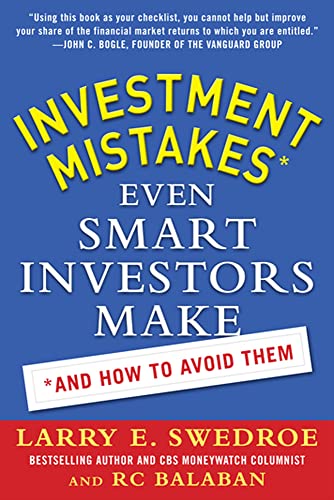
Investment Mistakes Even Smart Investors Make and How to Avoid Them
By Larry E. Swedroe RC BalabanMcGraw-Hill
Copyright © 2012 Larry E. Swedroe and RC BalabanAll right reserved.
ISBN: 978-0-07-178682-9
Contents
Chapter One
MISTAKE 1 Are You Overconfident of Your Skills?
People exaggerate their own skills. They are optimistic about their prospects and overconfident about their guesses, including which managers to pick. —Richard Thaler
Jonathan Burton, in his book Investment Titans, invited his readers to ask themselves the following questions:
* Am I better than average in getting along with people?
* Am I a better-than-average driver?
Burton noted that if you are like the average person, you probably answered yes to both questions. In fact, studies typically find that about 90 percent of respondents answer positively to those types of questions. Obviously, 90 percent of the population cannot be better than average in getting along with others, and 90 percent of the population cannot be better-than-average drivers.
While, by definition, only half the people can be better than average at getting along with people, and only half the people can be better-than-average drivers, most people believe they are above average. Overconfidence in our abilities may in some ways be a healthy attribute. It makes us feel good about ourselves, creating a positive framework with which to get through life's experiences. Unfortunately, being overconfident of our investment skills can lead to investment mistakes.
The following illustrates this effect. A survey of investors about expectations of returns found they persistently forecasted that their portfolios would outperform the market.
Another great example is a February 1998 survey by Montgomery Asset Management. It found that 74 percent of investors interviewed expected their funds to consistently outperform the market. It is simply impossible for the average investor to beat the market since investors collectively are the market. The logic is inescapable: the average investor must, by definition, earn market rates of return, less the expenses of his or her efforts.
In a New York Times article, Professors Richard Thaler and Robert J. Shiller noted that individual investors and money managers persist in their belief that they are endowed with more and better information than others and that they can profit by picking stocks. This insight helps explain why individual investors believe they can
* Pick stocks that will outperform the market
* Time the market so they're in when it is rising and out when it is falling
* Identify the few active managers who will beat their respective benchmarks
Even when individuals think that it is hard to beat the market, they are confident they themselves can be successful. Here is what the noted economist Peter Bernstein had to say: "Active management is extraordinarily difficult, because there are so many knowledgeable investors and information does move so fast. The market is hard to beat. There are a lot of smart people trying to do the same thing. Nobody's saying that it's easy. But possible? Yes." That slim possibility keeps hope alive. Overconfidence leads investors to believe they will be one of the few who succeed.
Remember that to profit from the market's mistakes, either you must have information the market doesn't have (and remember, if it is inside information, you cannot legally trade on it), or you must interpret the information better than the collective wisdom of the market. Obviously, not everyone can be above average in doing so. And to beat the market, you must be well above average since you incur expenses in the effort.
Let's take a look at some further evidence on investor overconfidence. Brad Barber and Terrance Odean have done a series of studies on investor behavior and performance. The following is a list of their main findings:
* Individual investors underperform appropriate benchmarks.
* Though the stock selections of women do not outperform those of men, women produce higher net returns due to lower turnover (lower trading costs). Also, married men outperform single men. The obvious explanation is that single men do not have the benefit of the spouse's sage counsel to temper their overconfidence. It appears that a common characteristic of human behavior is that, on average, men have confidence in skills they don't have, while women simply know better.
* Individuals who traded the most (presumably due to misplaced confidence) produced the lowest net returns.
Overconfidence causes investors to see other people's decisions as the result of mood, feelings, intuition, and emotion. Of course, they see their own decisions resulting from objective and rational thought. Overconfidence also causes investors to seek only evidence confirming their own views and ignore contradicting evidence. The late John Liscio, respected veteran bond reporter and founder of the Liscio Report, put it this way:
Forecasters, by definition, are biased and untrustworthy recorders of current economic events. In other words, they tend to uncover evidence that supports their forecasts, and they ignore or analytically dismiss anything that challenges it. And, even if the headline data appear to contradict their disclosure of the universe, they will undoubtedly uncover some statistic or extenuating circumstance that dovetails neatly with their worldview.
Examining the results of the Mensa (a high-IQ society) investment club provides an amusing bit of evidence on over-confidence. If any people deserve to be confident of their skills, it seems logical to believe that it should be the members of this group. Yet the June 2001 issue of SmartMoney reported that the Mensa investment club returned just 2.5 percent over the previous 15 years, underperforming the S&P 500 Index by almost 13 percent per year. Warren Smith, an investor for 35 years, reported that his original investment of $5,300 had turned into $9,300. A similar investment in the S&P 500 Index would have produced almost $300,000. One investor described his strategy as buy low, sell lower. The Mensa members were overconfident that their superior intellectual skills could be translated into superior investment returns.
Wall Street Journal columnist Jonathan Clements made the following observation: "Beat the market? The idea is ludicrous. Very few investors manage to beat the market. But in an astonishing triumph of hope over experience, millions of investors keep trying." Overconfidence helps explain this triumph of hope over experience. Investors may even recognize the difficulty of the task, and yet they still believe they can succeed with a high degree of probability. As author and personal finance journalist James Smalhout put it, "Psychologists have long documented the tendency of Homo sapiens to overrate his own abilities and prospects for success. This is particularly true of the subspecies that invests in stocks and, accordingly, tends to overtrade."
Recognizing our limited ability to predict the future is an important ingredient of the winning investment strategy. Being aware of the tendency toward overconfidence, you can avoid the mistake of trying to outperform the market. Meir Statman, a finance professor at Santa Clara University, provided the following advice on how to avoid the mistake of overconfidence: "Start keeping a diary. Write down every time you are convinced the market is going to go up or down. After a few years, you will realize that your insights are worth nothing....
„Über diesen Titel“ kann sich auf eine andere Ausgabe dieses Titels beziehen.
Suchergebnisse für Investment Mistakes Even Smart Investors Make and How...

Beispielbild für diese ISBN
Investment Mistakes Even Smart Investors Make and How to Avoid Them
Anbieter: World of Books (was SecondSale), Montgomery, IL, USA
Verkäuferbewertung 5 von 5 Sternen

Zustand: Good. Item in good condition. Textbooks may not include supplemental items i.e. CDs, access codes etc. Artikel-Nr. 00107938054
Gebraucht kaufen
EUR 5,56
Versand gratis
Versand innerhalb von USA
Versand innerhalb von USA
Anzahl: 1 verfügbar
Beispielbild für diese ISBN
Investment Mistakes Even Smart Investors Make and How to Avoid Them
Anbieter: World of Books (was SecondSale), Montgomery, IL, USA
Verkäuferbewertung 5 von 5 Sternen
Zustand: Very Good. Item in very good condition! Textbooks may not include supplemental items i.e. CDs, access codes etc. Artikel-Nr. 00105299264
Gebraucht kaufen
EUR 5,56
Versand gratis
Versand innerhalb von USA
Versand innerhalb von USA
Anzahl: 1 verfügbar
Beispielbild für diese ISBN
Investment Mistakes Even Smart Investors Make and How to Avoid Them
Anbieter: ThriftBooks-Phoenix, Phoenix, AZ, USA
Verkäuferbewertung 5 von 5 Sternen
Hardcover. Zustand: Good. No Jacket. Pages can have notes/highlighting. Spine may show signs of wear. ~ ThriftBooks: Read More, Spend Less. Artikel-Nr. G0071786821I3N00
Gebraucht kaufen
EUR 6,17
Versand gratis
Versand innerhalb von USA
Versand innerhalb von USA
Anzahl: 1 verfügbar
Beispielbild für diese ISBN
Investment Mistakes Even Smart Investors Make and How to Avoid Them
Anbieter: ThriftBooks-Atlanta, AUSTELL, GA, USA
Verkäuferbewertung 5 von 5 Sternen
Hardcover. Zustand: Good. No Jacket. Former library book; Pages can have notes/highlighting. Spine may show signs of wear. ~ ThriftBooks: Read More, Spend Less. Artikel-Nr. G0071786821I3N10
Gebraucht kaufen
EUR 6,20
Versand gratis
Versand innerhalb von USA
Versand innerhalb von USA
Anzahl: 1 verfügbar
Beispielbild für diese ISBN
Investment Mistakes Even Smart Investors Make and How to Avoid Them
Anbieter: ThriftBooks-Atlanta, AUSTELL, GA, USA
Verkäuferbewertung 5 von 5 Sternen
Hardcover. Zustand: Very Good. No Jacket. Missing dust jacket; May have limited writing in cover pages. Pages are unmarked. ~ ThriftBooks: Read More, Spend Less. Artikel-Nr. G0071786821I4N01
Gebraucht kaufen
EUR 6,20
Versand gratis
Versand innerhalb von USA
Versand innerhalb von USA
Anzahl: 1 verfügbar
Beispielbild für diese ISBN
Investment Mistakes Even Smart Investors Make and How to Avoid Them
Anbieter: ThriftBooks-Atlanta, AUSTELL, GA, USA
Verkäuferbewertung 5 von 5 Sternen
Hardcover. Zustand: Good. No Jacket. Pages can have notes/highlighting. Spine may show signs of wear. ~ ThriftBooks: Read More, Spend Less. Artikel-Nr. G0071786821I3N00
Gebraucht kaufen
EUR 6,20
Versand gratis
Versand innerhalb von USA
Versand innerhalb von USA
Anzahl: 1 verfügbar
Beispielbild für diese ISBN
Investment Mistakes Even Smart Investors Make and How to Avoid Them
Verlag:
McGraw-Hill Education, 2011
ISBN 10: 0071786821
ISBN 13: 9780071786829
Gebraucht
Hardcover
Erstausgabe
Anbieter: Better World Books, Mishawaka, IN, USA
Verkäuferbewertung 5 von 5 Sternen
Zustand: Good. 1st Edition. Former library copy. Pages intact with minimal writing/highlighting. The binding may be loose and creased. Dust jackets/supplements are not included. Includes library markings. Stock photo provided. Product includes identifying sticker. Better World Books: Buy Books. Do Good. Artikel-Nr. 5992902-6
Gebraucht kaufen
EUR 7,51
Versand gratis
Versand innerhalb von USA
Versand innerhalb von USA
Anzahl: 1 verfügbar
Beispielbild für diese ISBN
Investment Mistakes Even Smart Investors Make and How to Avoid Them
Verlag:
McGraw-Hill Education, 2011
ISBN 10: 0071786821
ISBN 13: 9780071786829
Gebraucht
Hardcover
Erstausgabe
Anbieter: Better World Books: West, Reno, NV, USA
Verkäuferbewertung 5 von 5 Sternen
Zustand: Fine. 1st Edition. Used book that is in almost brand-new condition. May contain a remainder mark. Better World Books: Buy Books. Do Good. Artikel-Nr. 4059915-75
Gebraucht kaufen
EUR 7,51
Versand gratis
Versand innerhalb von USA
Versand innerhalb von USA
Anzahl: 1 verfügbar
Beispielbild für diese ISBN
Investment Mistakes Even Smart Investors Make and How to Avoid Them
Verlag:
McGraw-Hill Education, 2011
ISBN 10: 0071786821
ISBN 13: 9780071786829
Gebraucht
Hardcover
Erstausgabe
Anbieter: Better World Books, Mishawaka, IN, USA
Verkäuferbewertung 5 von 5 Sternen
Zustand: Fine. 1st Edition. Used book that is in almost brand-new condition. May contain a remainder mark. Better World Books: Buy Books. Do Good. Artikel-Nr. 4059915-75
Gebraucht kaufen
EUR 7,51
Versand gratis
Versand innerhalb von USA
Versand innerhalb von USA
Anzahl: 1 verfügbar
Beispielbild für diese ISBN
Investment Mistakes Even Smart Investors Make and How to Avoid Them (BUSINESS BOOKS)
Anbieter: WorldofBooks, Goring-By-Sea, WS, Vereinigtes Königreich
Verkäuferbewertung 5 von 5 Sternen
Paperback. Zustand: Very Good. The book has been read, but is in excellent condition. Pages are intact and not marred by notes or highlighting. The spine remains undamaged. Artikel-Nr. GOR007815072
Gebraucht kaufen
EUR 17,53
EUR 6,52 Versand
Versand von Vereinigtes Königreich nach USA
Versand von Vereinigtes Königreich nach USA
Anzahl: 2 verfügbar