
Verwandte Artikel zu Complete Canadian Small Business Guide
Inhaltsangabe
The Definitive Guide to Owning and Running a Successful Small Business
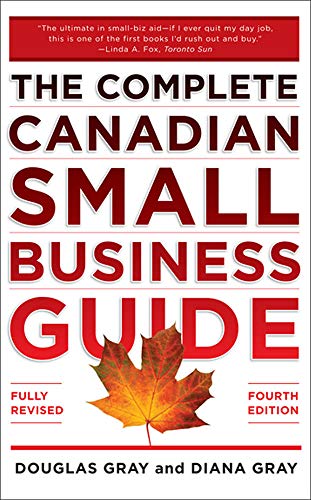
The Complete Canadian Small Business Guide ist seit seiner ersten Veröffentlichung im Jahr 1988 das erste Buch für Tausende kanadischer Unternehmer. Jetzt in seiner vierten Ausgabe informiert Sie dieser wichtige Leitfaden über alles, was Sie wissen müssen, um die neuesten Änderungen in Technologie, Recht, Ressourcen und bewährten Praktiken der heutigen kleinen Unternehmen zu verstehen, zu verwalten und zu nutzen.
Renommierte Experten auf ihrem Gebiet, Douglas Gray und Diana Gray bieten eine vollständige Referenz für jede Frage, die Sie haben, und bieten Street-Smart-Tipps, die Ihrem kleinen Unternehmen einen Wettbewerbsvorteil verschaffen.
The Complete Canadian Small Business Guide, Fourth Edition, beantwortet alle Ihre Fragen zum Starten, Betrieb und zur Erweiterung Ihres Unternehmens, einschließlich:
- Soll ich ein Unternehmen, ein Franchise kaufen oder bei Null anfangen?
- Wo bekomme ich Finanzierung, wie viel brauche ich und wie zahle ich es zurück?
- Wie erhalte ich Guthaben von meinen Lieferanten und wann sollte ich es auf meine Kunden erweitern?
- Wie maximiere ich den Wert meines Anwalts, Buchhalters, Bankiers und Versicherungsmaklers?
- Wie verwende ich Internet-Marketing, SEO und soziale Medien, um mein Geschäft zu verbessern?
- Wie stelle ich die besten Mitarbeiter ein – und behalte sie?
Der Complete Canadian Small Business Guide ist leicht zu lesen und vollständig aktuell und bietet die Informationen, die Sie in praktisch jeder Situation benötigen.
Douglas Gray, LLB, ist Kanadas führende Autorität für Kleinunternehmen. Früher praktizierender Anwalt ist er Autor von 25 Bestseller-Büchern für Wirtschaft und persönliche Finanzen. Er lebt in Vancouver, B.C. Besuchen Sie www.smallbiz.ca
Diana Gray ist eine erfahrene Geschäftsinhaberin und Beraterin. Ihr Unternehmen bietet zentralisierte Unternehmensdienstleistungen für kleine und mittlere Unternehmen sowie private Unternehmen.
Die Inhaltsangabe kann sich auf eine andere Ausgabe dieses Titels beziehen.
Auszug. © Genehmigter Nachdruck. Alle Rechte vorbehalten.
THE COMPLETE CANADIAN SMALL BUSINESS GUIDE
By DOUGLAS GRAY, DIANA GRAYThe McGraw-Hill Companies, Inc.
Copyright © 2013 Douglas A. Gray
All rights reserved.
ISBN: 978-0-07-178471-9All rights reserved.
Contents
| Acknowledgments | |
| Preface to the Fourth Edition | |
| Preface to Previous Editions | |
| List of Samples and Checklists | |
| Chapter 1 Starting a Small Business | |
| Chapter 2 Business Planning | |
| Chapter 3 Understanding Financial Statements | |
| Chapter 4 Selecting Professional Advisors | |
| Chapter 5 Legal Considerations | |
| Chapter 6 Tax Considerations | |
| Chapter 7 Buying a Business | |
| Chapter 8 Buying a Franchise | |
| Chapter 9 Location and Leases | |
| Chapter 10 Raising Financing | |
| Chapter 11 Personnel | |
| Chapter 12 Business Communication Equipment | |
| Chapter 13 Marketing | |
| Chapter 14 Export/Import | |
| Chapter 15 Credit and Collection | |
| Chapter 16 Understanding the Litigation Process | |
| Chapter 17 Insolvency, Bankruptcy, and Receivership | |
| Chapter 18 Patent, Trademark, Copyright and Industrial Design | |
| Chapter 19 Using the Internet for Business Success | |
| Chapter 20 Insuring Your Business's Future | |
| Chapter 21 Time and Stress Management | |
| Conclusion | |
| Samples and Checklists | |
| Appendix A Master Checklist | |
| Appendix B Sources of Further Information | |
| Appendix C Website Resources | |
| Appendix D Key Government and Other Contact Sources | |
| Glossary | |
| About the Authors and Reader Input, Seminars, and Consulting Services | |
| Index | |
| Praise from Book Reviewers |
Excerpt
CHAPTER 1
Starting a Small Business
Enthusiasm finds the opportunities, and energy makes the most of them.
— Henry S. Haskins
There are many reasons why you might be reading this book. Maybe you have alwaysdreamed about having your own business, and the timing is now right for you toconsider it more seriously. Possibly you have been recently laid off or havejust retired. Friends of yours may have started up a business part-time or outof their home, and have been talking to you about it. It may be you are justfrustrated at the insecurity, lack of challenge, or potential for advancement inworking for a large institution. Possibly you already own your own business andwant to be better informed in areas that are important to you.
The decision to go into your own business may be one of the most importantcareer decisions you make, with implications affecting all aspects of your life.Many people are impeded from proceeding any further than the dream by fear offailure, risk, or uncertainty. Fear of failure is a legitimate concern, asstudies indicate that over 75% of all new firms will fail within 3 years ofstart-up. One of the main reasons is lack of knowledge. This book will thereforeprovide you with that survival edge.
Small business in Canada is a vital part of the economy and fabric of oursociety. The small business sector accounts for a massive portion of thecountry's gross national product (GNP), and creates the majority of all newjobs. Approximately 85% of all employment is created by small business. Onaverage, over 350,000 small businesses register for the first time every year.This number, of course, varies depending on the economy and other factors, andincludes proprietorships, partnerships, and corporations. The estimate is basedon statistics from provincial government proprietorship and partnershipregistrations, as well as provincial and federal new incorporations. In manycases, the small business person does not show up in provincial or federalstatistics because he or she is self-employed and has no employees, or has notregistered the business. At the same time, there are a substantial number ofbusinesses that cease to operate every year, many of which do not show up instatistics.
The small business sector is a dynamic, innovative, and growing force thatprovides challenge, fulfillment, and financial security to over one millionsmall business owners in Canada. Studies show that over 75% of these smallbusinesses have fewer than five employees. There are many definitions of whatconstitutes a small business. The Canadian Federation of Independent Business(CFIB) generally uses the number of employees as a yardstick, with independentlyowned firms with up to twenty employees considered as small businesses.
This book has attempted to minimize the potential risk in starting up a smallbusiness. It will not only be a practical guide for you, but a reference sourcefor future needs as your business grows. Not all the chapters may be appropriatefor your needs at this stage, and the chapters do not have to be read insequence. Other parts of the book are designed to provide you with furtherpractical assistance, including the appendices, glossary, samples, andchecklists. At the very back of the book, there is a section entitled "ReaderInput." Our contact numbers, e-mail, and address are noted, as is our website.We would appreciate any feedback you have for improvement. You also might likemore information about our seminars or consulting services.
This chapter will cover:
• the advantages and disadvantages of small business ownership
• the traits of successful entrepreneurs
• self-assessment
• recognizing consumer and business trends
• sources and types of business opportunities
• evaluating business opportunities
• choosing a business
• women in business
• home-based businesses
• dealing with growth and expansion of your business.
ADVANTAGES AND DISADVANTAGES OF SMALL BUSINESS OWNERSHIP
Many people have an idealized picture of the rewards of running your ownbusiness. There are benefits, of course, but there are also risks andfrustrations. It is important to objectively look at both sides in order to makerealistic decisions.
Advantages of Going into Business
You have the opportunity of making more money working for yourself than by beingan employee. You have no ceiling on your potential income, as it is limited onlyby your energy, management skill, and good judgment. However, studies show thatmaking money is not one of the main motivating factors of small business owners.
• You have the opportunity to satisfy your creative drive. Studies show thatsmall businesses are more creative, productive, and responsive to changingconditions in the marketplace than are large corporations.
• You can't be laid off. In that sense, you have job security as long as yourbusiness is successful.
• You have definite tax advantages over people who are not self-employed.
• You set your own priorities as the decision-maker. You have control over yourown destiny, as you are the only person responsible for the success of yourcompany.
• Your workday will not be routine, as you are...
„Über diesen Titel“ kann sich auf eine andere Ausgabe dieses Titels beziehen.
Suchergebnisse für Complete Canadian Small Business Guide

Beispielbild für diese ISBN
Complete Canadian Small Business Guide
Anbieter: World of Books (was SecondSale), Montgomery, IL, USA
Verkäuferbewertung 5 von 5 Sternen

Zustand: Very Good. Item in very good condition! Textbooks may not include supplemental items i.e. CDs, access codes etc. Artikel-Nr. 00103639298
Gebraucht kaufen
EUR 4,05
Versand gratis
Versand innerhalb von USA
Versand innerhalb von USA
Anzahl: 1 verfügbar
Beispielbild für diese ISBN
Complete Canadian Small Business Guide 4/e
Anbieter: Better World Books, Mishawaka, IN, USA
Verkäuferbewertung 5 von 5 Sternen
Zustand: Good. Former library copy. Pages intact with minimal writing/highlighting. The binding may be loose and creased. Dust jackets/supplements are not included. Includes library markings. Stock photo provided. Product includes identifying sticker. Better World Books: Buy Books. Do Good. Artikel-Nr. 5808583-6
Gebraucht kaufen
EUR 6,69
Versand gratis
Versand innerhalb von USA
Versand innerhalb von USA
Anzahl: 1 verfügbar
Beispielbild für diese ISBN
Complete Canadian Small Business Guide
Anbieter: ThriftBooks-Phoenix, Phoenix, AZ, USA
Verkäuferbewertung 5 von 5 Sternen
Hardcover. Zustand: Very Good. No Jacket. May have limited writing in cover pages. Pages are unmarked. ~ ThriftBooks: Read More, Spend Less. Artikel-Nr. G0071784713I4N00
Gebraucht kaufen
EUR 7,40
Versand gratis
Versand innerhalb von USA
Versand innerhalb von USA
Anzahl: 1 verfügbar
Beispielbild für diese ISBN
Complete Canadian Small Business Guide
Anbieter: ThriftBooks-Reno, Reno, NV, USA
Verkäuferbewertung 5 von 5 Sternen
Hardcover. Zustand: Very Good. No Jacket. May have limited writing in cover pages. Pages are unmarked. ~ ThriftBooks: Read More, Spend Less. Artikel-Nr. G0071784713I4N00
Gebraucht kaufen
EUR 7,40
Versand gratis
Versand innerhalb von USA
Versand innerhalb von USA
Anzahl: 1 verfügbar
Beispielbild für diese ISBN
Complete Canadian Small Business Guide
Anbieter: ThriftBooks-Atlanta, AUSTELL, GA, USA
Verkäuferbewertung 5 von 5 Sternen
Hardcover. Zustand: As New. No Jacket. Pages are clean and are not marred by notes or folds of any kind. ~ ThriftBooks: Read More, Spend Less. Artikel-Nr. G0071784713I2N00
Gebraucht kaufen
EUR 7,40
Versand gratis
Versand innerhalb von USA
Versand innerhalb von USA
Anzahl: 1 verfügbar
Beispielbild für diese ISBN
Complete Canadian Small Business Guide
Anbieter: ThriftBooks-Dallas, Dallas, TX, USA
Verkäuferbewertung 5 von 5 Sternen
Hardcover. Zustand: Fair. No Jacket. Readable copy. Pages may have considerable notes/highlighting. ~ ThriftBooks: Read More, Spend Less. Artikel-Nr. G0071784713I5N00
Gebraucht kaufen
EUR 7,40
Versand gratis
Versand innerhalb von USA
Versand innerhalb von USA
Anzahl: 1 verfügbar
Beispielbild für diese ISBN
Complete Canadian Small Business Guide
Anbieter: ThriftBooks-Atlanta, AUSTELL, GA, USA
Verkäuferbewertung 5 von 5 Sternen
Hardcover. Zustand: Very Good. No Jacket. May have limited writing in cover pages. Pages are unmarked. ~ ThriftBooks: Read More, Spend Less. Artikel-Nr. G0071784713I4N00
Gebraucht kaufen
EUR 7,40
Versand gratis
Versand innerhalb von USA
Versand innerhalb von USA
Anzahl: 1 verfügbar
Beispielbild für diese ISBN
Complete Canadian Small Business Guide
Anbieter: ThriftBooks-Atlanta, AUSTELL, GA, USA
Verkäuferbewertung 5 von 5 Sternen
Hardcover. Zustand: Fair. No Jacket. Readable copy. Pages may have considerable notes/highlighting. ~ ThriftBooks: Read More, Spend Less. Artikel-Nr. G0071784713I5N00
Gebraucht kaufen
EUR 7,40
Versand gratis
Versand innerhalb von USA
Versand innerhalb von USA
Anzahl: 1 verfügbar
Beispielbild für diese ISBN
Complete Canadian Small Business Guide
Anbieter: ThriftBooks-Dallas, Dallas, TX, USA
Verkäuferbewertung 5 von 5 Sternen
Hardcover. Zustand: Very Good. No Jacket. May have limited writing in cover pages. Pages are unmarked. ~ ThriftBooks: Read More, Spend Less. Artikel-Nr. G0071784713I4N00
Gebraucht kaufen
EUR 7,40
Versand gratis
Versand innerhalb von USA
Versand innerhalb von USA
Anzahl: 1 verfügbar
Beispielbild für diese ISBN
Complete Canadian Small Business Guide
Anbieter: Books From California, Simi Valley, CA, USA
Verkäuferbewertung 4 von 5 Sternen

Hardcover. Zustand: Good. minor wear and creasing. Artikel-Nr. mon0003552935
Gebraucht kaufen
EUR 21,06
EUR 4,45 Versand
Versand innerhalb von USA
Versand innerhalb von USA
Anzahl: 1 verfügbar