
Verwandte Artikel zu Conversations for Creating Star Performers: Go Beyond...
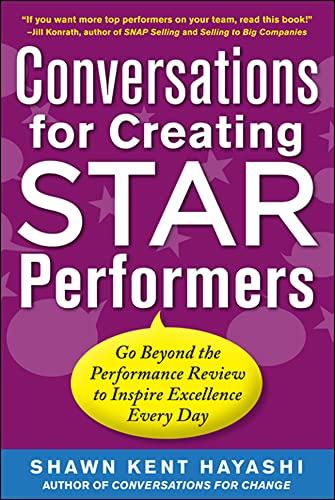
Conversations for Creating Star Performers: Go Beyond the Performance Review to Inspire Excellence Every Day - Softcover
Inhaltsangabe
Inspire Star Performance through Meaningful Conversations with Your Team
“If you want more top performers on your team, read this book!”
—Jill Konrath, author of SNAP Selling and Selling to Big Companies
The performance review is an important part of your job as a manager or coach. But it is only a part. In order to develop team members effectively, you have to be proactive on a daily basis. This means having conversations—and not just about the weather or the game last night. Create ongoing conversations throughout the year that focus on:
- Developing team members to a higher level of ability
- Triggering the insight and inspiration within your team members to grow in new ways
- Building the skills that will enable others to accomplish their established goals
- Preparing yourself and others for the performance review discussion
- Keeping people motivated and moving forward toward the goals
Conversations for Creating Star Performers is a vital tool for keeping team members motivated, engaged, and moving ahead every day—not just the days before an annual review.
Die Inhaltsangabe kann sich auf eine andere Ausgabe dieses Titels beziehen.
Über die Autorin bzw. den Autor
Shawn Kent Hayashi is an executive coach whose clients include Fortune 500 giants, such as American Express, Aqua, Cigna, The Federal Reserve Bank, and Merck as well as small entrepreneurial companies.
Auszug. © Genehmigter Nachdruck. Alle Rechte vorbehalten.
Conversations for Creating STAR Performers
Go Beyond the Performance Review to Inspire Excellence Every Day
By SHAWN KENT HAYASHIThe McGraw-Hill Companies, Inc.
Copyright © 2012 Shawn Kent Hayashi
All rights reserved.
ISBN: 978-0-07-177994-4All rights reserved.
Contents
| Acknowledgments | |
| Introduction | |
| Chapter 1 Engaging Star Performers | |
| Chapter 2 Conversations for Building Awareness | |
| Chapter 3 Conversations for Identifying Motivators | |
| Chapter 4 Conversations for Identifying What Your Team Members Do Well | |
| Chapter 5 Conversations for Creating Development Plans | |
| Chapter 6 Conversations for Developing New Skills | |
| Chapter 7 Conversations for Getting Back on Track | |
| Chapter 8 Conversations for Accountability | |
| Chapter 9 Conversations for Performance Reviews | |
| Chapter 10 Conversations for Recognition | |
| Chapter 11 Conversations for Succession Planning | |
| Chapter 12 Inspiring Excellence | |
| Appendix Creating Star Performers with a Focus on 24 Vital Skills for Success | |
| Index |
Excerpt
CHAPTER 1
Engaging Star Performers
Imagine yourself having fun—what comes to mind?
Now, consider what causes you to want to perform well at work. Does work triggerthe same emotions that playing does for you?
I've asked these questions of hundreds of people. One conversation jumps out atme as I reflect on all the ways people have answered these questions. A bit ofbackground before I share the conversation I had with John as I was volunteeringat an Odyssey of the Mind (OM) state competition. I am a passionate volunteerfor Odyssey of the Mind. OM is a national creativity building competition forteams that are focused on solving long-term and spontaneous problems. On thisparticular day, I was matched with a partner whom I had never metbefore—this was John. He was 20-something and a recent college graduate.In our volunteer role, we were responsible for checking in teams for events andgiving them the details about what they would need next. John had a very casualstyle of communicating, and he often appeared uninterested in whatever he wasdoing. However, after observing him for a while, I realized he really was on topof every detail and knew where each team was in the lineup and what informationthe team needed next. Despite the opposite appearance, he did feel a sense ofaccomplishment in what he was doing. John had the process and pace down pat eventhough he was not projecting himself confidently. His communication and bodylanguage with people did not match the results he was producing. He was a starat the tactical work we were doing, but no one would have thought that during anindividual conversation with him.
Sometimes John and I were very busy. Other times there was nothing to do. Thatis when I asked the question, "John, in your work, what causes you to want toperform well?" I could tell from the flash of his smile that he knew his answerimmediately: "When my boss is watching, or when the girl I have a crush on iswatching. The girl I want to date works in the same place I do." I asked, "Ifthey were here today, what would have been different?" He replied, "Oh, ... um,I would have shown that I knew what I was doing, and I would have been morefriendly to everyone who came up to our table for information." Then I asked,"John, when you are working, do you feel the same feelings that you do when youare playing?" He immediately said, "No! Work is work. I am glad when it is timeto go so I can then relax and have fun."
In these conversations in which I've asked people what causes them to want toperform well, I've received two types of responses. Some people, like John, havesaid they wanted to please or perform for others. John paid attention to hisimpact only on those he wanted to impress, to people outside himself.
Other people have said they wanted to perform well because they had their owninternal standard to live up to. When I asked Olivia the question, "What causesyou to want to perform well?" she pulled out a personal statement about what sheis committed to in everything she does. Her statement included these points:"Deliver outstanding service in everything I do, remember that I have choicesand I can make my own decisions, and be aware of my own feelings and allow themto inform my actions rather than create reactions." Her statement has been areminder to her of the person she aspires to be every day. She has beeninternally motivated by this commitment she made to herself. Keeping thecommitment has been like a game she plays with herself. For Olivia, it has beenfun. She knows she is capable of being a star for her own enjoyment of thefeeling that comes from having lived up to her own standards. Olivia has had aconversation with herself about the person she wants to be and how she wants toperform. She has used this personal commitment to meet her own standard for herown performance, while John has been using someone else's views of him todetermine his star-ability.
Olivia is playing, and John is working.
John was not focused on or aware of challenging or impressing himself, whileOlivia wanted to challenge and impress herself every day. In the long term,Olivia's consistent commitment will cause her to surpass John's level ofproductivity. As a manager, coach, or leader, what can you do to help your teammembers internalize the desire to perform well? Ask them! Ask, "What causes youto want to perform well?" After you have heard everything they have to say, ask,"When was the last time you had fun at work? What were you doing?"
Can you get a picture in your mind of your favorite coach?
If you are a manager or a leader who is responsible for developing people,imagine yourself as a coach. Why? Coaches are focused on the following:
• Building effective teams
• Engaging people in their own growth and learning
• Building new skills
• Developing high-potential performers
• Helping performers who want to achieve higher levels of success
Coaches ask questions like the ones I've been asking so that reflective learningoccurs. They also explain and demonstrate how to accomplish desired goals. Beinga great coach and manager requires knowing how to focus your team members on theright things to produce the desired results.
An Emotional Wake
When I was 20-something, I had a boss who asked me and the other members of theteam to write our own individual statement for what each of us wanted toaccomplish in the upcoming year. He asked us to think about what we wanted to beoutstanding at doing and to write a personal statement of commitment. Then heasked us to use the Be, Do, Then Have formula. Who would we need to be,what would we need to do, so that we could have the desiredresults? A week later, the boss videotaped each team member sharing his or herown Be, Do, Then Have statement. We watched the videos together, and he gave usour own copy. This activity enabled each person to internalize his or her ownmotivation to be the kind of performer who would produce the desired results nomatter who was watching. It made our work seem like playing a game that was fun.Our emotions were engaged in achieving our goals at...
„Über diesen Titel“ kann sich auf eine andere Ausgabe dieses Titels beziehen.
Suchergebnisse für Conversations for Creating Star Performers: Go Beyond...

Beispielbild für diese ISBN
Conversations for Creating Star Performers: Go Beyond the Performance Review to Inspire Excellence Every Day
Verlag:
McGraw-Hill Education - Europe, 2012
ISBN 10: 0071779949
ISBN 13: 9780071779944
Gebraucht
Paperback
Anbieter: World of Books (was SecondSale), Montgomery, IL, USA
Verkäuferbewertung 5 von 5 Sternen

Paperback. Zustand: Very Good. In order to develop team members effectively, you have to be proactive on a daily basis. This title helps you to create ongoing conversations throughout the year that focus on: developing team members to a higher level of ability; triggering the insight and inspiration within your team members to grow in new ways; and, more. Artikel-Nr. 00110184902
Gebraucht kaufen
EUR 5,94
Versand gratis
Versand innerhalb von USA
Versand innerhalb von USA
Anzahl: 1 verfügbar
Beispielbild für diese ISBN
Conversations for Creating Star Performers: Go Beyond the Performance Review to Inspire Excellence Every Day
Verlag:
McGraw-Hill Education - Europe, 2012
ISBN 10: 0071779949
ISBN 13: 9780071779944
Gebraucht
Paperback
Anbieter: World of Books (was SecondSale), Montgomery, IL, USA
Verkäuferbewertung 5 von 5 Sternen
Paperback. Zustand: Good. In order to develop team members effectively, you have to be proactive on a daily basis. This title helps you to create ongoing conversations throughout the year that focus on: developing team members to a higher level of ability; triggering the insight and inspiration within your team members to grow in new ways; and, more. Artikel-Nr. 00101635111
Gebraucht kaufen
EUR 5,94
Versand gratis
Versand innerhalb von USA
Versand innerhalb von USA
Anzahl: 3 verfügbar
Beispielbild für diese ISBN
Conversations for Creating Star Performers: Go Beyond the Performance Review to Inspire Excellence Every Day
Anbieter: ThriftBooks-Dallas, Dallas, TX, USA
Verkäuferbewertung 5 von 5 Sternen
Paperback. Zustand: Very Good. No Jacket. May have limited writing in cover pages. Pages are unmarked. ~ ThriftBooks: Read More, Spend Less. Artikel-Nr. G0071779949I4N00
Gebraucht kaufen
EUR 5,98
Versand gratis
Versand innerhalb von USA
Versand innerhalb von USA
Anzahl: 1 verfügbar
Beispielbild für diese ISBN
Conversations for Creating Star Performers: Go Beyond the Performance Review to Inspire Excellence Every Day
Verlag:
McGraw-Hill Education, 2012
ISBN 10: 0071779949
ISBN 13: 9780071779944
Gebraucht
Softcover
Erstausgabe
Anbieter: Better World Books, Mishawaka, IN, USA
Verkäuferbewertung 5 von 5 Sternen
Zustand: Good. 1st Edition. Former library copy. Pages intact with minimal writing/highlighting. The binding may be loose and creased. Dust jackets/supplements are not included. Includes library markings. Stock photo provided. Product includes identifying sticker. Better World Books: Buy Books. Do Good. Artikel-Nr. 6237102-6
Gebraucht kaufen
EUR 6,19
Versand gratis
Versand innerhalb von USA
Versand innerhalb von USA
Anzahl: 1 verfügbar
Beispielbild für diese ISBN
Conversations for Creating Star Performers: Go Beyond the Performance Review to Inspire Excellence Every Day
Verlag:
McGraw-Hill Education, 2012
ISBN 10: 0071779949
ISBN 13: 9780071779944
Gebraucht
Softcover
Erstausgabe
Anbieter: Better World Books, Mishawaka, IN, USA
Verkäuferbewertung 5 von 5 Sternen
Zustand: Very Good. 1st Edition. Former library copy. Pages intact with possible writing/highlighting. Binding strong with minor wear. Dust jackets/supplements may not be included. Includes library markings. Stock photo provided. Product includes identifying sticker. Better World Books: Buy Books. Do Good. Artikel-Nr. GRP97869413
Gebraucht kaufen
EUR 6,19
Versand gratis
Versand innerhalb von USA
Versand innerhalb von USA
Anzahl: 1 verfügbar
Beispielbild für diese ISBN
Conversations for Creating Star Performers: Go Beyond the Performance Review to Inspire Excellence Every Day
Verlag:
McGraw-Hill Education, 2012
ISBN 10: 0071779949
ISBN 13: 9780071779944
Gebraucht
Softcover
Erstausgabe
Anbieter: Better World Books, Mishawaka, IN, USA
Verkäuferbewertung 5 von 5 Sternen
Zustand: Good. 1st Edition. Pages intact with minimal writing/highlighting. The binding may be loose and creased. Dust jackets/supplements are not included. Stock photo provided. Product includes identifying sticker. Better World Books: Buy Books. Do Good. Artikel-Nr. 3096849-6
Gebraucht kaufen
EUR 6,19
Versand gratis
Versand innerhalb von USA
Versand innerhalb von USA
Anzahl: 1 verfügbar
Beispielbild für diese ISBN
Conversations for Creating Star Performers: Go Beyond the Performance Review to Inspire Excellence Every Day
Anbieter: Revaluation Books, Exeter, Vereinigtes Königreich
Verkäuferbewertung 5 von 5 Sternen
Paperback. Zustand: Brand New. 1st edition. 256 pages. 9.10x5.70x0.60 inches. In Stock. Artikel-Nr. zk0071779949
Neu kaufen
EUR 30,63
EUR 11,81 Versand
Versand von Vereinigtes Königreich nach USA
Versand von Vereinigtes Königreich nach USA
Anzahl: 1 verfügbar