
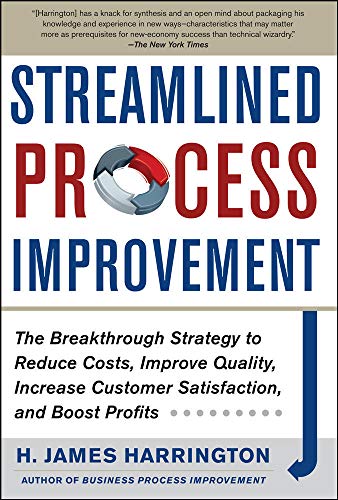
Streamlined Process Improvement: The Breakthrough Strategy to Reduce Costs, Improve Quality, Increase Customer Satisfaction and Boost Profits - Hardcover
Inhaltsangabe
"The Business Process Improvement methodology established by Dr. H. James Harrington and his group brings revolutionary improvement not only in quality of products and services, but also in the business processes."
-Professor Yoshio Kondo
The Book That Goes Beyond Six Sigma and Lean . . . The Next Evolutionary Step in Business Process Management
"Don't design for Six Sigma-design for maximum performance."
H. James Harrington
How would you like to streamline your operations, lower your costs, improve your quality, and increase your profits-all at the same time?
It's not an impossible dream. It's the next evolutionary breakthrough in process improvement that goes beyond Process Reengineering, TRIZ, Six Sigma, and Lean to deliver actual, quantifiable results. And now it's yours.
Streamlined Process Improvement (SPI) is the powerful new program developed by H. James Harrington. After 40 years of improving processes for IBM, Ernst & Young, the Chinese government, and many other private and governmental organizations, Harrington has become the go-to leader in the field. His revolutionary guide shows you how to:
- Discover the latest process tools-to make faster, more dramatic improvements using the revolutionary PASIC improvement methodology
- Use walk-through questionnaires and checklists-to streamline your job, resulting in optimum value to your stakeholders
- Use the newest methodologies-including simulation modeling, risk analysis, Five Ss, Process Innovation, Information Technology, Lean, and Six Sigma-to take your business to the next level
- Increase innovation-to drive growth and profits for many years to come
Harrington's groundbreaking system is organized and explained step by step to help you achieve maximum results with a minimum of stress. His simple PASIC approach shows you how to Plan, Analyze, Streamline, Implement, and Continuously Improve throughout the entire process.
He walks you through the basics of how to analyze each process, how to decide which to focus on first, and how to prepare for organizational change. You'll be surprised by just how quickly you can make things run more efficiently and effectively.
With Harrington's proven techniques, you can sell your products and services at a lower price, satisfy your customers, make work more enjoyable for your employees, and still earn greater profits than your competitors.
This powerful process guide is the definitive handbook for operations managers, quality consultants, Six Sigma practitioners, knowledge workers, and Lean thinkers for a new generation.
Die Inhaltsangabe kann sich auf eine andere Ausgabe dieses Titels beziehen.
Über die Autorin bzw. den Autor
H. James Harrington, Ph.D., the visionary International Quality Advisor for Ernst & Young, added Business Process Improvement to today's business lexicon. with over 15 books to his credit and more than 45 years of experience, Dr. Harrington is considered one of the world's Performance Improvement gurus.
Von der hinteren Coverseite
Six Sigma can reduce process variation, but it doesn’t account for process improvements. Lean is effective, but it fails to address the need for major improvements in key processes. Both of these failed to use modern IT as part of their improvement methodologies. Now, renowned consultant and former ASQ president, international quality advisor to E&Y, and quality advisor to the Chinese Quality Association, H. James Harrington provides the solution—a revolutionary step-by-step method for streamlining and improving business processes that can:
- Cut cost and cycle time by 60 percent
- Improve customer and employee satisfaction
- Boost quality by 100 percent
- Analyze, streamline, and refine key processes more quickly and efficiently than ever before
Filled with checklists, questionnaires, and key process tools, this book is designed to help you streamline your systems—and to continue to improve—using a refined combination of the most effective methods available. It’s all you need to be leaner, meaner, and significantly more profitable for years to come.
Auszug. © Genehmigter Nachdruck. Alle Rechte vorbehalten.
STREAMLINED PROCESS IMPROVEMENT
The Breakthrough Strategy to Reduce Costs, Improve Quality, Increase Customer Satisfaction, and Boost Profits
By H. JAMES HARRINGTONThe McGraw-Hill Companies, Inc.
Copyright © 2012 The McGraw-Hill Companies, Inc.
All rights reserved.
ISBN: 978-0-07-176863-4All rights reserved.
Contents
| Acknowledgments | |
| 1 Introduction to Streamlined Process Improvement (SPI) | |
| 2 What Is Streamlined Process Improvement? | |
| 3 Phase I: Planning for Improvement | |
| 4 Phase II: Analyzing the Process | |
| 5 Phase III: Streamlining the Process | |
| 6 Phase IV: Implementing the New Process and Phase V: Continuous Improvement | |
| Appendix A: Typical Business Processes Where SPI Can Be Applied | |
| Appendix B: Process Walk-Through Questionnaire | |
| Appendix C: Some Process Simulation Tool Suppliers | |
| Appendix D: Definitions | |
| Appendix E: Other Simulation Symbols | |
| Appendix F: Typical Government Processes | |
| Appendix G: Nonmanufacturing Typical Processes Measurements | |
| Appendix H: HU Diagrams | |
| References | |
| Bibliography | |
| Index |
Excerpt
CHAPTER 1
Introduction to Streamlined Process Improvement (SPI)
Business Process Improvement (methodology) investigated and established byDr. H. James Harrington and his group [represents] some of the new strategieswhich bring revolutionary improvement not only in [the] quality of products andservices, but also [in] the business processes which yield the excellent qualityof the output.
—Professor Yoshio Kondo,the leading Japanese quality authority
Introduction
We have more opportunities to improve our processes than we have problems tosolve.
—H. James Harrington
This book is designed to help you streamline your processes, making themmore efficient and effective. This will allow you to sell your products andservices at a lower price and still make more profit than your competitors. Incar design, streamlining reduces an auto's air resistance, making it operatemore effectively and making it more attractive to customers. On the other hand,a lean car has only the essentials.
When you streamline your processes, they operate at lower cost and cycle timeand at increased efficiency and effectiveness. (See Figure 1.1.) Inaddition, the resulting changes are implemented with much less resistance andgreater acceptance by the management team and the employees than processesredesigned using reengineering, DMADV, or Design for Six Sigma methodologies.
Today we hear a lot about Lean Six Sigma—it is the removal of all wastefrom the organization. Currently, most organizations could be represented by theoverweight person in Figure 1.2.
Our processes are full of bureaucracy and waste. As we run into a problem, wejust add more and more bureaucracy so that the problem will not reoccur. Thisjust wastes time and money. A Lean Six Sigma organization could be representedby the person in Figure 1.3.
As you can see, the person in the figure is very lean; all fat has been removed.People who are that thin have often gone to extremes to lose the fat and keep itoff, but in doing so, they have thrown their body's meaningful checks andbalances out of kilter. They have often lost their natural protection fromdisease (problems) and are susceptible to any and all of the diseases that comealong. Toyota got into its quality and recall problems because it got too lean.The streamlined organization can be represented by the figure in Figure1.4.
With streamlining you may start out as the person depicted in Figure1.2, but after beginning an exercise program, you lose (remove) the wasteand transform fat into muscle. You feel better, are healthier, and are morecreative. You streamlined not only the processes, but also the way you think andgo about doing business.
Streamlining Fundamentals
The following are the key fundamentals that must be considered when youundertake to streamline a process:
1. The process to be streamlined should be chosen based on how valuable it is tothe organization, how badly the process is broken, and what the impact upon theorganization would be if the process were improved.
2. It is a mistake to try to improve too many processes at the same time. Doonly three or four at a time.
3. A good database that measures performance of the current process should be inplace before you make changes to the process. This is necessary so that you willbe able to accurately measure the impact that the future-state solution has onthe organization.
4. The way to begin is to ask the question, Is the process essential to theorganization?
5. Simplification is better than computerization.
6. The real value of a process is how well it interacts with the otherprocesses.
7. The best-designed process is worthless if it is not accepted by the peoplewho will be using it.
8. Excellent communication and trust are key elements in making the streamlinedprocess methodology a success.
9. The executive team needs to understand and fully support the SPI methodologyand the output from the Process Improvement Team (PIT).
10. The external customer is the one who defines what the output from theprocess needs to be.
11. The combination of the process and the internal customer requirements mustprovide the organization with the best overall value. Internal customers'desires may not be honored unless they add value to the organization.
12. The white-collar processes have potential for quantum improvement.
13. The processes that service the external customers should be optimized, andthe others should be designed to support them.
14. The total process key measurements need to be improved, not the measurementsthat are related to subprocesses within the major process.
15. The key process improvement indicators are increased external customersatisfaction, reduced output costs, reduced cycle time, and increased employeemorale.
16. The people who will be key players in using the process should be includedin the SPI projects.
17. The risks have to be understood before any changes are made to the process.
18. Streamlining requires resources; it can't be accomplished without a budgetand people assigned to it. The employees assigned to the PIT should have theirworkload in other areas reduced by 20 to 40 percent.
19. The variation in the cycle time and output quality should be minimized.
Technology Warning
All too often, organizations jump to automate their processes without evaluatinghow effective the processes can function without being automated. This isusually a major error, as technology should serve the processes, not the otherway around. Frequently, technology will speed up your processes so that you areable to make more errors faster than ever before. In other words, if the processis bad, automating it just causes an automated mess. Since technology is anenabler, rather than a process driver, it should only be applied after theprocess is streamlined. Far too often we automate a process or use technology toexpedite the process when we should be...
„Über diesen Titel“ kann sich auf eine andere Ausgabe dieses Titels beziehen.
Suchergebnisse für Streamlined Process Improvement: The Breakthrough Strategy...

Beispielbild für diese ISBN
Streamlined Process Improvement: The Breakthrough Strategy to Reduce Costs, Improve Quality, Increase Customer Satisfaction, and Boost Profits (BUSINESS BOOKS)
Anbieter: WorldofBooks, Goring-By-Sea, WS, Vereinigtes Königreich
Verkäuferbewertung 5 von 5 Sternen

Paperback. Zustand: Very Good. The book has been read, but is in excellent condition. Pages are intact and not marred by notes or highlighting. The spine remains undamaged. Artikel-Nr. GOR011227687
Gebraucht kaufen
EUR 10,58
EUR 6,49 Versand
Versand von Vereinigtes Königreich nach USA
Versand von Vereinigtes Königreich nach USA
Anzahl: 1 verfügbar
Beispielbild für diese ISBN
Streamlined Process Improvement
Anbieter: ThriftBooks-Atlanta, AUSTELL, GA, USA
Verkäuferbewertung 5 von 5 Sternen
Hardcover. Zustand: Good. No Jacket. Pages can have notes/highlighting. Spine may show signs of wear. ~ ThriftBooks: Read More, Spend Less. Artikel-Nr. G0071768637I3N00
Gebraucht kaufen
EUR 34,20
Versand gratis
Versand innerhalb von USA
Versand innerhalb von USA
Anzahl: 1 verfügbar