
Verwandte Artikel zu Building High Performance Government Through Lean Six...
Building High Performance Government Through Lean Six Sigma: A Leader's Guide to Creating Speed, Agility, and Efficiency - Hardcover
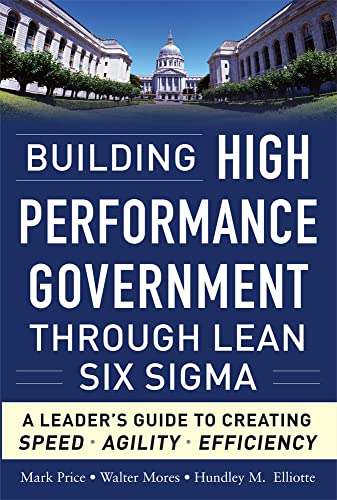
Inhaltsangabe
Private Sector Strategies for Public Service Leaders
No corner of the government or public sector has been spared from budget turmoil in recent years. Among budget cuts, increased requirements, and new threats and challenges, governments typically balance the scales through (1) increased funding and/ or (2) rationalizing services or service levels.
This book gives you a third option. It’s called high performance, and it’s been implemented in the private sector—with great success—for more than two decades. This hands-on guide, written by the global consultants from Accenture, shows you how to apply these business principles in any public organization. Learn how to:
- Improve the outcomes you deliver— while lowering the cost to deliver them.
- Streamline your operations—by increasing speed, agility, and efficiency.
- Build a high-performance “anatomy” to strengthen your organization.
- Manage assets, decrease risks and losses, and deliver true excellence.
Featuring case studies from the public sector, including federal, state, local, agencies, bureaus, and departments, this unique guide takes you inside government organizations, where high performance “anatomy” is already making a difference. You’ll discover low-cost techniques deployed by the Naval Air Systems Command and the IRS, as well as high-performance solutions for problems as diverse as homeland security, disaster response, health care costs, and dwindling resources. High Performance Government provides a proven method for adapting to the “New Normal” of lower budgets by showing you how to do even more with even less—creating a learning, working environment that reacts to change. This is how the top companies in the world increase productivity and profits through any market conditions.
From Wall Street to Washington and Main Street, real success is driven by execution excellence. This book gives you the solutions you need to lower cost and create a leaner more efficient organization.
Praise for Building High Performance Government
“Building High Performance Government is a fast read with a big message. It explains how the inevitable downsizing of governments at all levels—federal, state, local—doesn’t have to also mean fewer or lower-quality services. This book highlights viable strategies already in use today to create better alignment and greater productivity in government.”
—Graham Richards, Former Mayor of Fort Wayne, Indiana
“Every level of government is experiencing a budget crunch these days, and that always results in slashing services. This book can help public sector leaders find another option—how to deliver on their core mission at a much lower cost.”
—Sean O’Keefe, CEO , EADS North America, former Administrator of NASA, former Secretary of the Navy and former chancellor of Louisiana State University (LSU)
“A solid read for federal, state, and local government leaders wondering how to ‘do more, without more.’ Building High Performance Government focuses on the main things that leaders can do to help their organization get more out of each tax dollar while also improving quality and speed—an absolutely essential requirement in today’s fiscally constrained environment.”
—David Melcher, Senior Vice President, ITT Corporation; President, ITT Defense & Information Solutions, US Army Lieut enant General (Ret.) formerly the Army’s Military Deputy for Budget and Deputy Chief of Staff for Programs in the Pentagon
Die Inhaltsangabe kann sich auf eine andere Ausgabe dieses Titels beziehen.
Über die Autorin bzw. den Autor
Mark Price is a senior executive—Accenture Management Consulting and coauthor of the bestselling The Lean Six Sigma Pocket Toolbook.
Walter Mores is a senior executive—Accenture Management Consulting supporting Health & Public Service clients.
Hundley M. Elliotte is a senior executive and leads the Process Performance Global Offering Group within Accenture Management Consulting.
Accenture, one of Fortune’s 50 Most Admired Companies, has more than 211,000 employees serving clients in more than 120 countries. The firm is an established leader in management consulting, helping public sector clients achieve high performance across the globe. Drawing on the extensive experience of its 13,000 management consultants globally, Accenture Management Consulting helps clients move from issue to outcome with pace, certainty, and strategic agility. The firm’s home page is accenture.com.
Auszug. © Genehmigter Nachdruck. Alle Rechte vorbehalten.
Building High Performance Government Through Lean Six Sigma
A Leader's Guide to Creating Speed, Agility, and Efficiency
By Mark Price, Walt Mores, Hundley M. ElliotteThe McGraw-Hill Companies, Inc.
Copyright © 2011 Accenture
All rights reserved.
ISBN: 978-0-07-176571-8All rights reserved.
Contents
| Prologue The Third Lever | |
| Chapter 1 Building the Anatomy for High Performance | |
| Part I Leading the Way to Operational Excellence | |
| Introduction to Part I | |
| Spotlight A Do You Know Who Your Customers Are? | |
| Chapter 2 Aligning Outputs to Desired Outcomes | |
| Chapter 3 Creating an Action Road Map | |
| Part II Agility: Responsiveness and Innovation | |
| Introduction to Part II | |
| Spotlight B Understanding Agility in the Public Sector | |
| Chapter 4 Knowing What's Coming Before It Happens | |
| Chapter 5 The Innovation Imperative | |
| Spotlight C The Need for Disruptive Innovation | |
| Part III Culture and Workforce | |
| Introduction to Part III | |
| Chapter 6 Leadership to Galvanize Your Workforce | |
| Chapter 7 Ready, Willing, and Able | |
| Chapter 8 What Gets Measured Gets Done | |
| Spotlight D Managing Change | |
| Part IV Performance-Oriented Deployment | |
| Introduction to Part IV | |
| Chapter 9 Making the Future a Reality | |
| Spotlight E Scenario Analysis | |
| Chapter 10 Next-Generation Deployment Strategies | |
| Notes | |
| Index | |
| About Us |
Excerpt
CHAPTER 1
Building the Anatomy for High Performance
Because of its ability to withstand attack by improvised explosive devices(IEDs, including homemade bombs), the mine-resistant, ambush-protected vehicle(MRAP) has become a critical asset in protecting our warfighters across theglobe. Demand for MRAP vehicles increased virtually overnight, from about 200vehicles for the U.S. Marine Corps in late 2006 to more than 15,000 vehicles forthe combined services by early 2007. In response to growing public concern aboutthe adequacy of U.S. warfighters' field resources and protection, the U.S.Congress mandated delivery to Iraq of 1,500 MRAP vehicles by December 31, 2007.
Achieving this mandate required a rapid acceleration in production from 10vehicles per month to 50 vehicles per day. The Navy and Marineswere faced with a seemingly impossible challenge: increase output by a factor of150, as quickly as possible. Building more facilities was out of the questionbecause it would take too long. Simply throwing more and more bodies at theproblem wouldn't generate the results needed (at one point the final assemblyplant did reach maximum staffing and operated 24/7 but still fell far short ofthe 50-vehicle-per-day goal).
The leaders of the effort realized they needed a new approach that wouldgenerate greater productivity within the resource and time constraintsthey faced. There were three main components to the path they followed:
• Adopting practices for achieving Operational Excellence. Theseincluded continuous process improvement (CPI) methods that eliminate waste andimproved quality throughout a process (key to increasing productivity 150 timeswithout requiring 150 times more resources). Most importantly, the leadersapproached the challenge with an enterprise view of the productionprocesses, meaning they looked at how to make all the pieces of the puzzle worktogether most effectively, end to end.
• Driving a rapid response (agility). The leadership committedits own workforces and budgets appropriately. Recognizing the congressionallymandated timeline, the leaders brought in outside experts who guided decisionmaking and drove innovation while internal resources were being brought up tospeed.
• Shifting the culture. This will create a learning environmentin which workers were encouraged and supported in their efforts to obtain andapply new skills and tools for attaining Operational Excellence and agility.
Together, these three components—building Operational Excellence,developing agility, and creating a supportive culture and workforce—setthe foundation for increasing output and quality while reducing the amount ofresources and cost needed. These components give an organization the rightanatomy for achieving high performance: the capability to continuallyimprove productivity and to deliver more mission for the cost.
Targeted improvements in the MRAP assembly operation were launched in August2007. Production had reached 10 vehicles per week by that time, thanks to acombination of increasing the number of workers (= higher budget) and someinitial Operational Excellence improvements. Unfortunately, production was stillfar below the target.
Only by adding in the other two components of Performance anatomy—agilityand culture—did MRAP production reach its 50-vehicle-per-day goal justfour months later, in December 2007. (Published accounts cite 2008 productionfigures that occasionally rose even higher, to 70 vehicles per day.)
This book looks at the three components of a Performance anatomy from aleadership perspective, examining key leverage points in each area. To lay thefoundation, here is a quick overview of each component.
Component 1: Operational Excellence
It is likely that you have heard the term Operational Excellence before, perhapsframed as the ultimate goal of adopting a particular continuous improvementmethodology. Some related terms you may be familiar with are processimprovement, Lean Six Sigma (LSS), Lean Transformation, and businessreengineering.
We use the term Operational Excellence in its broadest sense to meanmaximizing outcomes for the cost. That definition describes a comparisonthat is not yet widely recognized in the public sector: that the valuedelivered by an organization will always be judged against the cost to deliverit. Operational Excellence means you can continue to deliver more and morevalue for less and less cost.
The comparison between value and cost is important for every organization and isbecoming increasingly important in the public sector. Managers and leaders areunder constant pressure to decide where and how to best allocate shrinking orlimited resources. In government organizations, the investment decisions areoften complicated by regulatory requirements that mandate how portions of thefunding must be allocated. This further pressures the organization to createfavorable outcomes within prescribed funding limits.
Key attributes of organizations that achieve Operational Excellence include:
• They understand and communicate what is important. They have a clearsense of mission, have identified their customers (the people and groups who usetheir services or products), and have expended the effort to deeply understandwhat those customers value most.
• They are constantly evaluating their own performance. They haveidentified metrics linked to strategic and operational goals and monitor themetrics regularly to evaluate progress and...
„Über diesen Titel“ kann sich auf eine andere Ausgabe dieses Titels beziehen.
Suchergebnisse für Building High Performance Government Through Lean Six...

Beispielbild für diese ISBN
Building High Performance Gove
Anbieter: World of Books (was SecondSale), Montgomery, IL, USA
Verkäuferbewertung 5 von 5 Sternen

Zustand: Good. Item in good condition. Textbooks may not include supplemental items i.e. CDs, access codes etc. Artikel-Nr. 00103691903
Gebraucht kaufen
EUR 4,05
Versand gratis
Versand innerhalb von USA
Versand innerhalb von USA
Anzahl: 1 verfügbar
Beispielbild für diese ISBN
Building High Performance Gove
Anbieter: World of Books (was SecondSale), Montgomery, IL, USA
Verkäuferbewertung 5 von 5 Sternen
Zustand: Very Good. Item in very good condition! Textbooks may not include supplemental items i.e. CDs, access codes etc. Artikel-Nr. 00101153399
Gebraucht kaufen
EUR 4,05
Versand gratis
Versand innerhalb von USA
Versand innerhalb von USA
Anzahl: 2 verfügbar
Beispielbild für diese ISBN
Building High Performance Government Through Lean Six Sigma: a Leader's Guide to Creating Speed, Agility, and Efficiency
Anbieter: Better World Books, Mishawaka, IN, USA
Verkäuferbewertung 5 von 5 Sternen
Zustand: Very Good. Former library copy. Pages intact with possible writing/highlighting. Binding strong with minor wear. Dust jackets/supplements may not be included. Includes library markings. Stock photo provided. Product includes identifying sticker. Better World Books: Buy Books. Do Good. Artikel-Nr. 6062760-6
Gebraucht kaufen
EUR 6,56
Versand gratis
Versand innerhalb von USA
Versand innerhalb von USA
Anzahl: 1 verfügbar
Beispielbild für diese ISBN
Building High Performance Government Through Lean Six Sigma: a Leader's Guide to Creating Speed, Agility, and Efficiency
Anbieter: Better World Books, Mishawaka, IN, USA
Verkäuferbewertung 5 von 5 Sternen
Zustand: Very Good. Pages intact with possible writing/highlighting. Binding strong with minor wear. Dust jackets/supplements may not be included. Stock photo provided. Product includes identifying sticker. Better World Books: Buy Books. Do Good. Artikel-Nr. 11386182-6
Gebraucht kaufen
EUR 6,56
Versand gratis
Versand innerhalb von USA
Versand innerhalb von USA
Anzahl: 1 verfügbar
Beispielbild für diese ISBN
Building High Performance Government Through Lean Six Sigma: a Leader's Guide to Creating Speed, Agility, and Efficiency
Anbieter: Better World Books: West, Reno, NV, USA
Verkäuferbewertung 5 von 5 Sternen
Zustand: Very Good. Pages intact with possible writing/highlighting. Binding strong with minor wear. Dust jackets/supplements may not be included. Stock photo provided. Product includes identifying sticker. Better World Books: Buy Books. Do Good. Artikel-Nr. 11386182-6
Gebraucht kaufen
EUR 6,56
Versand gratis
Versand innerhalb von USA
Versand innerhalb von USA
Anzahl: 1 verfügbar
Beispielbild für diese ISBN
Building High Performance Government Through Lean Six Sigma: A Leader's Guide to Creating Speed, Agility, and Efficiency
Anbieter: ThriftBooks-Atlanta, AUSTELL, GA, USA
Verkäuferbewertung 5 von 5 Sternen
Hardcover. Zustand: As New. No Jacket. Pages are clean and are not marred by notes or folds of any kind. ~ ThriftBooks: Read More, Spend Less. Artikel-Nr. G0071765719I2N00
Gebraucht kaufen
EUR 8,70
Versand gratis
Versand innerhalb von USA
Versand innerhalb von USA
Anzahl: 1 verfügbar
Beispielbild für diese ISBN
Building High Performance Government Through Lean Six Sigma: A Leader's Guide to Creating Speed, Agility, and Efficiency
Anbieter: ThriftBooks-Dallas, Dallas, TX, USA
Verkäuferbewertung 5 von 5 Sternen
Hardcover. Zustand: Very Good. No Jacket. Former library book; May have limited writing in cover pages. Pages are unmarked. ~ ThriftBooks: Read More, Spend Less. Artikel-Nr. G0071765719I4N10
Gebraucht kaufen
EUR 8,70
Versand gratis
Versand innerhalb von USA
Versand innerhalb von USA
Anzahl: 1 verfügbar
Foto des Verkäufers
Building High Performance Government Through Lean Six Sigma
Anbieter: Hamelyn, Madrid, M, Spanien
Verkäuferbewertung 5 von 5 Sternen
Zustand: As New. : Este libro ofrece estrategias del sector privado para líderes del sector público. Explica cómo aplicar los principios empresariales para mejorar los resultados, agilizar las operaciones y fortalecer las organizaciones gubernamentales. Incluye estudios de casos del sector público, mostrando técnicas de bajo costo y soluciones de alto rendimiento para diversos problemas, desde la seguridad nacional hasta la respuesta a desastres y la gestión de costos de atención médica. Proporciona un método probado para adaptarse a presupuestos más bajos, permitiendo hacer más con menos y fomentando un entorno de aprendizaje y trabajo que reaccione al cambio. EAN: 9780071765718 Tipo: Libros Categoría: Negocios y Economía|Tecnología Título: Building High Performance Government Through Lean Six Sigma Autor: Mark Price| Walter Mores| Hundley Elliotte Editorial: McGraw Hill Idioma: en Páginas: 192 Formato: tapa dura. Artikel-Nr. Happ-2023-09-07-9fa98d4b
Gebraucht kaufen
EUR 6,27
EUR 11,99 Versand
Versand von Spanien nach USA
Versand von Spanien nach USA
Anzahl: 1 verfügbar
Foto des Verkäufers
Building High Performance Government Through Lean Six Sigma: A Leader's Guide to Creating Speed, Agility, and Efficiency
Anbieter: Bookbot, Prague, Tschechien
Verkäuferbewertung 5 von 5 Sternen
Hardcover. Zustand: Fine. Leichte Gebrauchsspuren. Private Sector Strategies for Public Service Leaders No corner of the government or public sector has been spared from budget turmoil in recent years. Among budget cuts, increased requirements, and new threats and challenges, governments typically balance the scales through (1) increased funding and/ or (2) rationalizing services or service levels. This book gives you a third option. It's called high performance, and it's been implemented in the private sector--with great success--for more than two decades. This hands-on guide, written by the global consultants from Accenture, shows you how to apply these business principles in any public organization. Learn how. Artikel-Nr. cee16a36-42ed-4d70-b81a-e1d35d5505b7
Gebraucht kaufen
EUR 3,80
EUR 18,99 Versand
Versand von Tschechien nach USA
Versand von Tschechien nach USA
Anzahl: 1 verfügbar
Beispielbild für diese ISBN
Lean Six Sigma for Federal Services
Verlag:
The McGraw-Hill Company, 2011
ISBN 10: 0071765719
ISBN 13: 9780071765718
Gebraucht
Hardcover
Anbieter: Majestic Books, Hounslow, Vereinigtes Königreich
Verkäuferbewertung 4 von 5 Sternen

Zustand: Used. pp. 192. Artikel-Nr. 5495384
Gebraucht kaufen
EUR 22,68
EUR 7,69 Versand
Versand von Vereinigtes Königreich nach USA
Versand von Vereinigtes Königreich nach USA
Anzahl: 1 verfügbar