
Verwandte Artikel zu Trenchless Technology: Planning, Equipment, and Methods
Inhaltsangabe
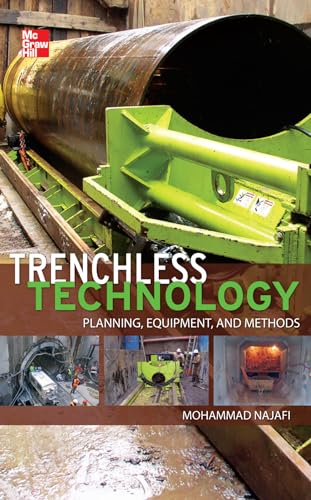
The complete guide to trenchless technology project management, planning, costs, and methods Written by an expert in the field of pipeline system engineering, this book describes how to plan, schedule, and implement efficient, cost-effective trenchless technology piping projects. Filled with detailed illustrations and real-world examples, Trenchless Technology: Planning, Equipment, and Methods explains how to accurately compare the costs of trenchless projects, considering geotechnical and rock mass impacts, drilling fluids, and locating and tracking equipment. This in-depth reference provides important information on how to estimate the cost of labor and equipment and schedule trenchless piping projects. A wide range of trenchless technology methods suitable for various ground and project conditions are discussed in this practical resource. Coverage includes: Cost comparison of trenchless technology methods Planning for trenchless technology projects Project delivery methods Geotechnical considerations Rock mass properties impacts on trenchless project feasibility Tracking, locating, and planning tools for horizontal directional drilling Drilling and lubricating fluids Planning and construction requirements for horizontal direction drilling Horizontal auger boring Pipe ramming Microtunneling methods Pilot tube (or pilot tube microtunneling) method Pipe/box jacking and utility tunneling Cured-in-place-pipe method Sliplining Lateral renewal Localized repair Planning and construction requirements for pipe bursting Panel linings Spray-in-place pipe
Die Inhaltsangabe kann sich auf eine andere Ausgabe dieses Titels beziehen.
Über die Autorin bzw. den Autor
Director, Center for Underground Infrastructure Research (CUIR) University of Texas at Arlington, Texas
Auszug. © Genehmigter Nachdruck. Alle Rechte vorbehalten.
Trenchless Technology
Planning, Equipment, and MethodsBy Mohammad NajafiMcGraw-Hill Companies, Inc.
Copyright © 2013 The McGraw-Hill Companies, Inc.All right reserved.
ISBN: 978-0-07-176245-8
Contents
Chapter One
Introduction and Conceptual Cost Comparison of Trenchless Technology Methods1.1 Introduction
Trenchless technologies (TTs) are alternatives or methods of choice for the construction and renewal of buried pipelines, such as oil and gas pipelines, water distribution and sewer collection systems, as well as drainage structures and culverts. Specifically, TTs are used when other traditional methods, such as open-cut methods are not physically possible. Other reasons for TT methods to be increasingly adopted by owners, engineers, and contractors are their low environmental impacts and, based on the project and the site conditions, lower costs per foot of installed pipe, making these technologies much more efficient and versatile with final results within a shorter time span.
Cost is the bottom line! Throughout a project's programming, planning, design, and construction phases, important decisions are made based on the anticipated costs. The total cost of a construction project includes not only the direct, indirect and operation and maintenance costs but also the social costs. For this reason, an accurate estimate of life- cycle costs of the project is necessary to select the appropriate construction methods. Using a literature review and with statistical analysis of the collected data, this chapter shows how TTs can be more cost effective than open-cut methods. While the open-cut method requires a higher cost of operation for continuous excavation and safety measures along the pipeline alignment, trenchless methods require excavation only at the entry and exit shafts and pits, therefore reducing the costs of unnecessary work.
The total cost of a pipeline project varies depending on many factors, such as the pipe size (diameter), material, length and depth of installation. It varies also according to project location, surface and subsurface conditions, pipeline application, level of risks involved, and weather conditions, which can affect the overall cost of the project. Using the traditional open-cut method, approximately 70 percent of the total cost of a project is spent on activities such as detouring traffic, trench excavation and shoring, and backfilling and compaction, instead of focusing efforts on the main activity, which is the pipe installation itself.
Because of the importance of the costs, this chapter presents a cost comparison among different trenchless methods. The cost data is based on bid tabs of projects in the United States and Canada collected by the Center for Underground Infrastructure Research and Education (CUIRE) (www.cuire.org). While every effort was made to ensure the accuracy of the cost data, the reader is advised of the following, when considering the cost information presented in this chapter:
• Each project is unique, and the actual cost depends on many parameters, which were not consistently provided in the cost data used.
• The cost data presented in this chapter are the total construction (contractor's) direct and indirect costs, and they do not include pre- and postconstruction, social, and other project owner's costs.
• The costs are in U.S. dollars ($), diameter is in inches (in.), and project length is in feet (ft).
• Raw cost data compiled by CUIRE are construction bid tabs from projects in different years, and they were modified for the year 2012, using the Historical Cost Indexes published by R.S. Means' Building Construction Cost Data (R.S. Means, 2012).
• The cost analysis in this chapter is based on pipe diameter and project length. To find the mathematical relationship between diameter and length variables, and the response variable (cost), statistical software called Minitab 15 was used. Once the data are inserted, a statistical regression option is obtained, considering cost as the response (dependent) variable and diameter and length as the predictor (independent) variables.
• Once the scatter plots were set up, a significant fitted curve was found based on the relationship between each variable and the project cost. As there are different regression methods, i.e., linear, logarithmic, power, and exponential, it was important to decide which curve is the best fit trend line within the scatter plots.
• The assumed criterion for the relationship between above parameters is R square (R2); the higher the R2 value, the more accurate the trend line that was obtained. While low R2 may not have provided a meaningful relationship, it was included for information only.
1.1.1 Background
There are two main divisions of TT methods: trenchless construction methods (TCMs) and trenchless renewal methods (TRMs), as shown in Fig. 1.1.
TCM includes all methods for new installation of utilities and pipelines. TRM includes all methods for renewing, renovating, and/ or replacing an existing pipeline or a utility system. Each of these divisions is subdivided into different installation methods that will depend on the accuracy, maximum installation length, diameter range, and type of application. Table 1.1 presents each method categorized by division, along with its diameter ranges.
1.2 Trenchless Construction Methods
Trenchless construction methods (TCM) for installation of new pipelines include all methods of installing new below-grade utility systems without direct installation into an open-cut trench. Their applications include pressure and gravity pipes; and culverts, and drainage structures under roads, railroads; and river crossings as well as installation of cables and telecommunication ducts. Different applications and methods are illustrated in Fig. 1.2.
1.3 Microtunneling Method
The microtunneling method is mainly used for the installation of a gravity pipeline such as a sanitary or storm sewer. Microtunneling boring machines (MTBMs) are laser-guided, remotely-controlled machines, in which the alignment and grade can be adjusted as the work proceeds, so the pipe can be installed with an accuracy of w1 in. This method can be used for pipes with diameter ranges between 12 in. (commonly 24 in.) and 136 in. (commonly 96 in.) and requires a driveshaft for jacking the pipe and an exit shaft for retrieving the MTBM.
Table 1.2 indicates the main characteristics of the microtunneling method (Najafi, 2010).
Since the diameter and the length are among the main factors that affect the price of the trenchless methods, Fig. 1.4a illustrates the cost ($/ft) depending on the pipe size in inches, while Fig. 1.4b indicates the cost ($/ft) based on pipeline length. The equations and the related R2 for each regression type are shown in Table 1.3. Because of the highest ratio in the exponential regression type, the equation that best fits the scatter plot is y = 483.29e0.0334x and R2 = 0.37, where y is the cost and x is the diameter of the pipe.
The same process is carried out to obtain the relationship between cost variable and length from the collected data. Figure 1.6 illustrates the best fit regression trend line of the possible four types of trends on the cost versus...
„Über diesen Titel“ kann sich auf eine andere Ausgabe dieses Titels beziehen.
Suchergebnisse für Trenchless Technology: Planning, Equipment, and Methods

Beispielbild für diese ISBN
Trenchless Technology: Planning, Equipment, And Methods
Anbieter: Romtrade Corp., STERLING HEIGHTS, MI, USA
Verkäuferbewertung 5 von 5 Sternen

Zustand: New. This is a Brand-new US Edition. This Item may be shipped from US or any other country as we have multiple locations worldwide. Artikel-Nr. ABBB-91248
Beispielbild für diese ISBN
Trenchless Technology
Verlag:
The McGraw-Hill Company, 2013
ISBN 10: 0071762450
ISBN 13: 9780071762458
Gebraucht
Hardcover
Anbieter: Majestic Books, Hounslow, Vereinigtes Königreich
Verkäuferbewertung 4 von 5 Sternen

Zustand: Used. pp. 496. Artikel-Nr. 38583390
Gebraucht kaufen
EUR 146,31
EUR 7,69 Versand
Versand von Vereinigtes Königreich nach USA
Versand von Vereinigtes Königreich nach USA
Anzahl: 1 verfügbar
Beispielbild für diese ISBN
Trenchless Technology
Verlag:
The McGraw-Hill Company, 2013
ISBN 10: 0071762450
ISBN 13: 9780071762458
Gebraucht
Hardcover
Anbieter: Biblios, Frankfurt am main, HESSE, Deutschland
Verkäuferbewertung 4 von 5 Sternen
Zustand: Used. pp. 496. Artikel-Nr. 1837421963
Gebraucht kaufen
EUR 147,33
EUR 9,95 Versand
Versand von Deutschland nach USA
Versand von Deutschland nach USA
Anzahl: 1 verfügbar