
Verwandte Artikel zu BACKPACKERS HB 4E
Inhaltsangabe
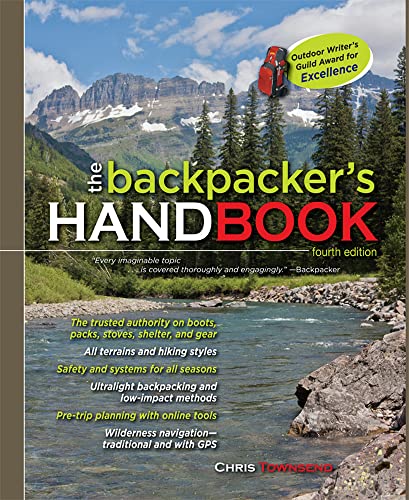
What you need to know before you hit the trails
Whether you are backpacking for the first time or a veteran follower of the trails, this enormously practical guide includes everything you need to know, from essential techniques such as map and compass work to the skills needed for more remote wilderness journeys. The Backpacker's Handbook also gives you the latest information on gear. You'll find the last word on:
- How to choose packs and footwear-and make sure they fit
- What clothing to take on the trail
- Tents, tarps, stoves, water purifiers, and other gear
- GPS, cell phones, and other electronic devices
- And much more
Reviews from previous editions
"The most up-to-date and comprehensive guide to equipment and technique available anywhere."
--Backpack (UK)
"A clear and comprehensive primer on backpacking gear. Townsend's knowledge is immense."
--Sierra
"Belongs in every bookcase dealing with outdoor topics. . . . Chockablock full of useful, practical, commonsense info. . . . If you tramp the outdoors, get this book."
-Maine Sportsman
"For those thinking of taking a backpack journey, The Backpacker's Handbook is required reading."
-Daily Local News (West Chester, PA)
Die Inhaltsangabe kann sich auf eine andere Ausgabe dieses Titels beziehen.
Über die Autorin bzw. den Autor
Chris Townsend (Granton-on-Spey, Scotland), an internationally recognized rough-terrain hiker, is the author of several books, including Wilderness Skiing and Winter Camping and Backpacker's Handbook, Second Edition.
Auszug. © Genehmigter Nachdruck. Alle Rechte vorbehalten.
the backpacker's HANDBOOK
By Chris TownsendMcGraw-Hill
Copyright © 2012 Chris TownsendAll right reserved.
ISBN: 978-0-07-175489-7
Contents
Chapter One
preparing for the trailFarewell we call to hearth and hall! Though wind may blow and rain may fall, We Must away ere break of day far over wood and mountain tall. —J.R.R. Tolkien, The Lord of the Rings
Backpacking isn't difficult, but it does require both physical and mental preparation. Every year, first-time hikers set off along the trail unfit, ill equipped, and with unrealistic expectations. Many of them never venture into the wilderness again. The better your planning, the more enjoyable your trip will be. You need not know exactly how far you'll walk each day, or precisely where you'll camp each night (though such detailed planning is useful for beginners), but you should know your capabilities and desires well enough to tailor your trip to them. Setting out to carry 65 pounds twenty-five miles a day through steep, mountainous terrain just about guarantees exhaustion, frustration, and disappointment unless you are extremely fit and know beforehand that you can do it.
FITNESS
Backpacking requires fitness. You need aerobic, or cardiovascular, fitness to walk and climb all day without having your heart pound and your lungs gasp for air. Without muscular fitness, particularly of the legs, you'll be stiff and aching all over on the second day out. Also, if you set out unfit, you're much more susceptible to strains and muscle tears.
Getting fit takes time. I know people who claim they'll get fit over the first few days of an annual backpacking trip. They usually suffer for most of the walk; yet with a little preparation, they could enjoy every day.
The best way to train for carrying heavy loads over rough terrain is to carry heavy loads over rough terrain—what sports trainers call specific training. Although this isn't always practical, you'd be surprised what you can do if you really want to, even if you live and work in a city. In Journey Through Britain, John Hillaby wrote that he trained for his 1,100-mile, end-to-end walk across Britain by spending the three months before the trip walking the six miles "from Hampstead to the City [London] each day and farther at the weekends. On these jaunts I carried weight lifters' weights sewn high up in a flat rucksack that didn't look too odd among people making their way to the office in the morning."
At the very least, spend a few weekends getting used to walking with a load before setting off on a longer trip. Walk as much as you can during the week—including up and down stairs. Brisk strolls or runs in the evening help too, especially if there are hills. In fact, trail running in hilly country is probably the best way to improve both your aerobic fitness and your leg power in a short time.
I trained at a fitness center once, before a through-hike of the Canadian Rockies. For six months I did hour-long circuit sessions on the weight machines three times a week and hour-long runs on the days between, with one day off a week. It helped, but probably no more than if I'd hiked regularly with a pack and exercised in the woods and fields, which I prefer. I haven't followed an exercise program since. Good advice on training is contained in Courtney and Doug Schurman's The Outdoor Athlete. The main thing I learned from fitness center training was that you need rest from strenuous exercise and that you need to pace yourself. I'd never heard of overtraining before, having never regarded backpacking or hiking as a "sport." But once I discovered that pushing yourself too hard results, unsurprisingly, in excess stress to the body and reduced performance, I understood why, after hiking all day every day for two weeks or more, I often felt tired and run-down instead of superfit. Now on walks longer than two weeks I aim to take a rest day every week to twelve days. I don't stick to a rigid timetable—a day off every week, say—but rather pay attention to my body and my mind. If I feel lethargic or uninterested, develop aches and pains, or find myself being clumsy and careless, I know I need to rest. Resting while training is important—if you force yourself to train hard every day because you've got a big trip coming up, you may burn out before the hike starts.
After my brief bout with the fitness center, I abandoned formal training and returned to short, brisk hikes in the local woods and fields, the occasional 5-to 10-mile cycle ride, and as an aim if not in reality, at least one full day a week walking or skiing in the mountains. This is apart from the two- to three-day backpacking trips I try to take once a month or so between longer walks.
If you haven't exercised for some time, return to it gradually, especially if you're over thirty-five. Preparing for a walk takes time anyway. You can't go from being unfit to toting a heavy load all day in a week or even a month.
THE ART OF WALKING
While the simple act of putting one foot in front of the other seems to require no instruction or comment, there are, in fact, good and bad ways to walk, and good and bad walkers. Good walkers can walk effortlessly all day, while bad ones may be exhausted after a few hours.
To make walking seem effortless, walk slowly and steadily, finding a rhythm that lets you glide along and a pace you can keep up for hours. Without a comfortable rhythm, every step seems tiring, which is one reason that crossing boulder fields, brush-choked forest, and other broken terrain is so exhausting. Inexperienced walkers often start off at a rapid pace, leaving the experienced plodding slowly behind. As in Aesop's ancient fable of the tortoise and the hare, slower walkers often pass exhausted novices long before a day's walk is complete.
The ability to maintain a steady pace hour after hour has to be developed. If you need a rest, take one; otherwise you'll wear yourself out.
The difference between novices and experts was graphically demonstrated to me when I was leading backpacking treks for an Outward Bound school in the Scottish Highlands. I let the students set their own pace, often following them or traversing at a higher level than the group. But one day the course supervisor, an experienced mountaineer, turned up and said he'd lead the day's walk—and he meant lead. Off he tramped, the group following in his footsteps, while I brought up the rear. Initially, we followed a flat river valley, and soon the students were muttering impatiently about the supervisor's slow pace. The faint trail began to climb after a while, and on we went at the same slow pace, with some of the students close to rebellion. Eventually we came to the base of a steep, grassy slope with no trail. The supervisor didn't pause—he just headed up as if the terrain hadn't altered. After a few hundred yards, the tenor of the students' response changed. "Isn't he ever going to stop?" they complained. One or two fell behind. Intercepting a trail, we turned up it, switchbacking steadily to a high pass. By now some of the students seemed in danger of collapse, so I hurried ahead to the supervisor and said they needed a rest. He seemed surprised. "I'll see you later then," he said, and started down, his pace unaltered, leaving the students slumping in relief.
This story also reveals one of the problems of walking in a group: each person has his or her own pace. The best way to deal with this is not to walk as a large group but to establish pairs or small groups of...
„Über diesen Titel“ kann sich auf eine andere Ausgabe dieses Titels beziehen.
Suchergebnisse für BACKPACKERS HB 4E

Foto des Verkäufers
The Backpacker's Handbook, 4th Edition
Verlag:
International Marine/Ragged Mountain Press, 2011
ISBN 10: 007175489X
ISBN 13: 9780071754897
Gebraucht
Softcover
Anbieter: Dream Books Co., Denver, CO, USA
Verkäuferbewertung 5 von 5 Sternen

Zustand: good. Gently used with minimal wear on the corners and cover. A few pages may contain light highlighting or writing, but the text remains fully legible. Dust jacket may be missing, and supplemental materials like CDs or codes may not be included. May be ex-library with library markings. Ships promptly! Artikel-Nr. DBV.007175489X.G
Gebraucht kaufen
EUR 5,83
Versand gratis
Versand innerhalb von USA
Versand innerhalb von USA
Anzahl: 1 verfügbar
Beispielbild für diese ISBN
The Backpacker's Handbook
Verlag:
McGraw-Hill Education - Europe, 2011
ISBN 10: 007175489X
ISBN 13: 9780071754897
Gebraucht
Paperback
Anbieter: World of Books (was SecondSale), Montgomery, IL, USA
Verkäuferbewertung 5 von 5 Sternen
Paperback. Zustand: Good. Everything readers need to know about backpacking before they hit the trails. Artikel-Nr. 00100160780
Gebraucht kaufen
EUR 6,21
Versand gratis
Versand innerhalb von USA
Versand innerhalb von USA
Anzahl: 3 verfügbar
Beispielbild für diese ISBN
The Backpacker's Handbook, 4th Edition
Verlag:
International Marine Publishing, 2011
ISBN 10: 007175489X
ISBN 13: 9780071754897
Gebraucht
Paperback
Anbieter: ThriftBooks-Atlanta, AUSTELL, GA, USA
Verkäuferbewertung 5 von 5 Sternen
Paperback. Zustand: Good. No Jacket. Pages can have notes/highlighting. Spine may show signs of wear. ~ ThriftBooks: Read More, Spend Less. Artikel-Nr. G007175489XI3N00
Gebraucht kaufen
EUR 7,08
Versand gratis
Versand innerhalb von USA
Versand innerhalb von USA
Anzahl: 1 verfügbar
Beispielbild für diese ISBN
The Backpacker's Handbook, 4th Edition
Verlag:
International Marine Publishing, 2011
ISBN 10: 007175489X
ISBN 13: 9780071754897
Gebraucht
Paperback
Anbieter: ThriftBooks-Dallas, Dallas, TX, USA
Verkäuferbewertung 5 von 5 Sternen
Paperback. Zustand: Good. No Jacket. Pages can have notes/highlighting. Spine may show signs of wear. ~ ThriftBooks: Read More, Spend Less. Artikel-Nr. G007175489XI3N00
Gebraucht kaufen
EUR 7,08
Versand gratis
Versand innerhalb von USA
Versand innerhalb von USA
Anzahl: 1 verfügbar
Beispielbild für diese ISBN
The Backpacker's Handbook, 4th Edition
Verlag:
International Marine Publishing, 2011
ISBN 10: 007175489X
ISBN 13: 9780071754897
Gebraucht
Paperback
Anbieter: ThriftBooks-Dallas, Dallas, TX, USA
Verkäuferbewertung 5 von 5 Sternen
Paperback. Zustand: Very Good. No Jacket. May have limited writing in cover pages. Pages are unmarked. ~ ThriftBooks: Read More, Spend Less. Artikel-Nr. G007175489XI4N00
Gebraucht kaufen
EUR 7,08
Versand gratis
Versand innerhalb von USA
Versand innerhalb von USA
Anzahl: 1 verfügbar
Beispielbild für diese ISBN
The Backpacker's Handbook, 4th Edition (INTERNATIONAL MARINE-RMP)
Verlag:
International Marine/Ragged Mountain Press, 2011
ISBN 10: 007175489X
ISBN 13: 9780071754897
Gebraucht
Paperback
Anbieter: WorldofBooks, Goring-By-Sea, WS, Vereinigtes Königreich
Verkäuferbewertung 5 von 5 Sternen
Paperback. Zustand: Very Good. The book has been read, but is in excellent condition. Pages are intact and not marred by notes or highlighting. The spine remains undamaged. Artikel-Nr. GOR005437892
Gebraucht kaufen
EUR 3,90
EUR 6,62 Versand
Versand von Vereinigtes Königreich nach USA
Versand von Vereinigtes Königreich nach USA
Anzahl: 5 verfügbar
Beispielbild für diese ISBN
The Backpacker's Handbook, 4th Edition
Verlag:
McGraw-Hill Professional Publishing, 2011
ISBN 10: 007175489X
ISBN 13: 9780071754897
Gebraucht
Softcover
Anbieter: Better World Books: West, Reno, NV, USA
Verkäuferbewertung 5 von 5 Sternen
Zustand: Very Good. Former library copy. Pages intact with possible writing/highlighting. Binding strong with minor wear. Dust jackets/supplements may not be included. Includes library markings. Stock photo provided. Product includes identifying sticker. Better World Books: Buy Books. Do Good. Artikel-Nr. 5043610-20
Gebraucht kaufen
EUR 10,65
Versand gratis
Versand innerhalb von USA
Versand innerhalb von USA
Anzahl: 1 verfügbar
Beispielbild für diese ISBN
The Backpacker's Handbook, 4th Edition
Verlag:
International Marine/Ragged Mountain Press, 2011
ISBN 10: 007175489X
ISBN 13: 9780071754897
Gebraucht
paperback
Anbieter: Magers and Quinn Booksellers, Minneapolis, MN, USA
Verkäuferbewertung 5 von 5 Sternen
paperback. Zustand: Very Good. 4th Edition. May have light to moderate shelf wear and/or a remainder mark. Complete. Clean pages. Artikel-Nr. 1357942
Gebraucht kaufen
EUR 7,58
EUR 3,56 Versand
Versand innerhalb von USA
Versand innerhalb von USA
Anzahl: 1 verfügbar
Beispielbild für diese ISBN
The Backpacker's Handbook, 4th Edition
Verlag:
McGraw-Hill Professional Publishing, 2011
ISBN 10: 007175489X
ISBN 13: 9780071754897
Gebraucht
Softcover
Anbieter: Better World Books Ltd, Dunfermline, Vereinigtes Königreich
Verkäuferbewertung 5 von 5 Sternen
Zustand: Good. Pages intact with minimal writing/highlighting. The binding may be loose and creased. Dust jackets/supplements are not included. Stock photo provided. Product includes identifying sticker. Better World Books: Buy Books. Do Good. Artikel-Nr. 6261800-20
Gebraucht kaufen
EUR 6,05
EUR 5,91 Versand
Versand von Vereinigtes Königreich nach USA
Versand von Vereinigtes Königreich nach USA
Anzahl: 1 verfügbar
Foto des Verkäufers
The Backpacker's Handbook, 4th Edition (INTERNATIONAL MARINE-RMP)
Verlag:
International Marine/Ragged Mountain Press, 2011
ISBN 10: 007175489X
ISBN 13: 9780071754897
Gebraucht
paperback
Anbieter: WeBuyBooks, Rossendale, LANCS, Vereinigtes Königreich
Verkäuferbewertung 5 von 5 Sternen
paperback. Zustand: Good. Most items will be dispatched the same or the next working day. A copy that has been read but remains in clean condition. All of the pages are intact and the cover is intact and the spine may show signs of wear. The book may have minor markings which are not specifically mentioned. Artikel-Nr. rev9406603114
Gebraucht kaufen
EUR 3,13
EUR 10,17 Versand
Versand von Vereinigtes Königreich nach USA
Versand von Vereinigtes Königreich nach USA
Anzahl: 1 verfügbar