
Verwandte Artikel zu Benjamin Graham and the Power of Growth Stocks: Lost...
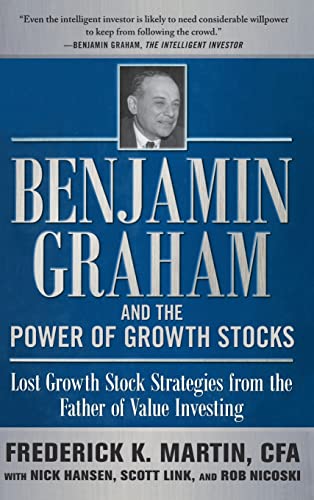
Benjamin Graham and the Power of Growth Stocks: Lost Growth Stock Strategies from the Father of Value Investing - Hardcover
Inhaltsangabe
Use a master's lost secret to pick growth companies bound for success
In 1948, legendary Columbia University professor Benjamin Graham bought a major stake in the Government Employees Insurance Corporation. In a time when no one trusted the stock market, he championed value investing and helped introduce the world to intrinsic value. He had a powerful valuation formula.
Now, in this groundbreaking book, long-term investing expert Fred Martin shows you how to use value-investing principles to analyze and pick winning growth-stock companies-just like Graham did when he acquired GEICO.
Benjamin Graham and the Power of Growth Stocks is an advanced, hands-on guide for investors and executives who want to find the best growth stocks, develop a solid portfolio strategy, and execute trades for maximum profitability and limited risk. Through conversational explanations, real-world case studies, and pragmatic formulas, it shows you step-by-step how this enlightened trading philosophy is successful. The secret lies in Graham's valuation formula, which has been out of print since 1962-until now. By calculating the proper data, you can gain clarity of focus on an investment by putting on blinders to variables that are alluring but irrelevant.
This one-stop guide to growing wealth shows you how to:
- Liberate your money from the needs of mutual funds and brokers
- Build a reasonable seven-year forecast for every company considered for your portfolio
- Estimate a company's future value in four easy steps
- Ensure long-term profits with an unblinking buy-and-hold strategy
This complete guide shows you why Graham's game-changing formula works and how to use it to build a profitable portfolio. Additionally, you learn tips and proven techniques for unlocking the formula's full potential with disciplined research and emotional control to stick by your decisions through long periods of inactive trading. But even if your trading approach includes profiting from short-term volatility, you can still benefit from the valuation formula and process inside by using them to gain an advantageous perspective on stock prices.
Find the companies that will grow you a fortune with Benjamin Graham and the Power of Growth Stocks.
Die Inhaltsangabe kann sich auf eine andere Ausgabe dieses Titels beziehen.
Über die Autorin bzw. den Autor
Frederick K. Martin is the president and chief investment officer of Disciplined Growth Investors, which currently manages more than $2.5 billion of assets for institutions and individuals.
Von der hinteren Coverseite
Benjamin Graham is the father of value investing, but his greatest investment success came from one growth stock that increased his net worth more than all his other investments combined. Benjamin Graham and the Power of Growth Stocks helps you rediscover the legendary economist’s forgotten growth-investing strategy through a cutting-edge approach to capturing profits in today’s volatile markets.
Inside, leading investment manager Fred Martin shares the investing approach that was founded on Graham’s long-lost valuation formula. Martin’s method lets you accurately and confidently value growth companies for a buy-and-hold strategy that mitigates risk and positions your portfolio for superior long-term returns. Benjamin Graham and the Power of Growth Stocks puts everything you need at your fingertips, including:
- Effective guidance and techniques for zeroing in on the critical factors of making good investment decisions
- The three key rules for creating a margin of safety when investing in growth companies
- Tips for identifying the hidden “barriers” and “handcuffs” that signal doom for a company’s growth
- Insightful best practices and pitfalls to avoid from the author’s personal experience
- Graham’s most useful and straightforward treatise on growth-stock investing—in its entirety—for the first time since 1962
If you want your wealth to serve you—not your broker and mutual funds—start acquiring the dream-team companies for your portfolio today withBenjamin Graham and the Power of Growth Stocks.
Auszug. © Genehmigter Nachdruck. Alle Rechte vorbehalten.
BENJAMIN GRAHAM AND THE POWER OF GROWTH STOCKS
LOST GROWTH STOCK STRATEGIES FROM THE FATHER OF VALUE INVESTING
By Frederick K. Martin, Nick Hansen, Scott Link, Rob NicoskiThe McGraw-Hill Companies, Inc.
Copyright © 2012 The McGraw-Hill Companies, Inc.
All rights reserved.
ISBN: 978-0-07-175389-0All rights reserved.
Contents
| Foreword by Craig R. Weflen | |
| Acknowledgments | |
| 1. Benjamin Graham and the Evolution of Value Investing | |
| 2. Value versus Growth | |
| 3. Graham's Valuation Formula (Includes Chapter 39 from 1962 edition of Security Analysis) | |
| 4. The Power of the Purchase Decision | |
| 5. Building a Margin of Safety for Growth Stocks | |
| 6. Characteristics of a "Great" Growth Company: Identifying Sustainable Competitive Advantage | |
| 7. Down in the Trenches: Putting the Principles into Action | |
| 8. The Few, the Proud: Why So Few Investors Use Ben Graham's Principles and Methodology | |
| 9. Getting the Most from This Book | |
| Appendix. Renting Out Your Money | |
| Index |
Excerpt
CHAPTER 1
Benjamin Graham and the Evolution of Value Investing
During an investment career that spanned more than half a century, BenjaminGraham had a greater influence over the way stocks are analyzed, bought, andsold than any other investor in the history of the stock market. Grahampracticed his trade during an era in which the stock market evolved from aninvestment that was utilized almost exclusively by the very wealthy to apervasive investment that was used by almost everyone with a job and aretirement savings account. As a professor, author, and stock market trader,Graham turned stock market investing from a frenzied, speculative practice basedon intuition, emotion, and momentum to a precise science that relied on strictformulas, meticulous analysis, and methodical timing.
Graham, who died in 1976 at the age of 82, has been referred to as the "Dean ofWall Street," the "Father of Security Analysis," and the "Father of ValueInvesting." As an author, he expounded on his methodology in two of the mostsuccessful investment books ever published: Security Analysis, which hewrote in 1934 with David Dodd, and The Intelligent Investor, which hewrote in 1949. Both books have been periodically updated and still sell brisklytoday.
To understand Graham's impact on the financial world, all you really need toknow is that he was Warren Buffett's mentor for more than two decades beforeBuffett struck out on his own.
Graham is probably most widely recognized for his contribution to valueinvesting, a methodology that relies on strict analysis and timing to acquireundervalued stocks when they're trading at a discount to their intrinsic valueand sell them once they've earned a suitable return.
But until now, one of Graham's most brilliant revelations has been all but lostto the investing public. Although his name is nearly synonymous with valueinvesting, Graham also began to see the value of growth stock investing late inhis career. He even developed a formula and a methodology for growth stockinvesting that he introduced in the 1962 edition of Security Analysis ina chapter entitled "Newer Methods for Valuing Growth Stocks." Unfortunately,although Security Analysis was reissued in 1988, 1996, and 2009, thischapter was omitted from all the subsequent editions.
There's no real explanation for why this chapter was removed—a decision,oddly enough, that was made long after Graham's death in 1976. (The chapter isreprinted in Chapter 3 of this book.) Regardless of the reasons for theomission, investors who have read the newer editions of Graham's book over thepast two decades have been denied one of the most significant investmentinsights ever offered by Graham.
The primary objective of this book is to unlock Graham's lost formula andmethodology so that investors—both individual and professional— cantake advantage of his insights on analyzing and buying growth stocks. I considermyself one of the fortunate few investment managers to have come across Graham'sformula early in my career, and I have used it with great success ever since.
THE MAN AND HIS METHODOLOGY
Graham's investment philosophy was rooted in two important premises: that asecurity should be analyzed independently of its price, and that the futureperformance of any security is uncertain. He suggested that intelligentinvestors should aim to purchase a security at a discount to its assessed valuein order to provide a margin of safety that can protect their investment againstloss. Both the risk and the return of the investment are dependent on thequality of the analysis and this "margin of safety."
Graham did not stop there. With these principles firmly in hand, he laid out acomprehensive series of treatises on successful investing for the professionaland lay investor alike. In Security Analysis, he focused primarily onthe proper emphases and techniques to apply in the selection of investmentsecurities. In The Intelligent Investor, which is widely considered hismost influential work, Graham turned his attention to the investors themselvesand laid out his philosophy of investment.
If the power of Graham's work was due to the simple truth at its foundation, itstimelessness has been due to the quality of the craft Graham built upon it. Hedidn't construct a philosophy of investment in an academic vacuum; he derived itfrom long years of hard experience.
Graham was born in England in 1894 and moved with his parents to America thenext year, where his father opened an import business. But the business failed,and his father died while Ben was still a child. In 1907, an economic crisiswiped out what little was still left of his mother's savings. But Grahamexcelled as a student and was able to get into Columbia University, where hegraduated as class salutatorian at the age of 20. Columbia offered him a jobteaching mathematics, English, or Greek and Latin philosophy, but he declinedthe offer to seek his fortune on Wall Street. He began working there forNewburger, Henderson & Loeb in 1914, and rose quickly in the firm. Within fiveyears, he was making more than half a million dollars a year—a vast sumfor a 25-year-old in 1919.
But that fortune didn't last. Graham and Jerome Henderson, who became Graham'sbusiness partner in the 1920s, nearly lost their business in the crash of 1929.But with the help of friends and the sale of most of their personal assets,Graham and Henderson were able to retain their business and rebuild it from theground up. The lessons Graham learned from his early mistakes shaped hisinvestment philosophy for the rest of his life.
Graham worked until the 1950s and continued writing into the 1970s, and duringthis period, he endured some of the greatest price dislocations and economicupheavals in modern history. Throughout, he refined his understanding andinsight in subsequent editions of his published work. He was a successfulpractitioner and brilliant thinker living through extraordinary times, and heleft us one of the most important bodies of work on investing ever written.
Not only was Graham a groundbreaking investment manager and prolific author, buthe also taught evening classes in finance at Columbia from 1928 to 1955. One ofhis students was...
„Über diesen Titel“ kann sich auf eine andere Ausgabe dieses Titels beziehen.
Suchergebnisse für Benjamin Graham and the Power of Growth Stocks: Lost...

Beispielbild für diese ISBN
Benjamin Graham and the Power of Growth Stocks: Lost Growth Stock Strategies from the Father of Value Investing
Anbieter: World of Books (was SecondSale), Montgomery, IL, USA
Verkäuferbewertung 5 von 5 Sternen

Zustand: Good. Item in good condition. Textbooks may not include supplemental items i.e. CDs, access codes etc. Artikel-Nr. 00109928384
Gebraucht kaufen
EUR 19,30
Versand gratis
Versand innerhalb von USA
Versand innerhalb von USA
Anzahl: 1 verfügbar
Beispielbild für diese ISBN
Benjamin Graham and the Power of Growth Stocks: Lost Growth Stock Strategies from the Father of Value Investing
Anbieter: ThriftBooks-Atlanta, AUSTELL, GA, USA
Verkäuferbewertung 5 von 5 Sternen
Hardcover. Zustand: Good. No Jacket. Former library book; Pages can have notes/highlighting. Spine may show signs of wear. ~ ThriftBooks: Read More, Spend Less. Artikel-Nr. G0071753893I3N10
Gebraucht kaufen
EUR 22,90
Versand gratis
Versand innerhalb von USA
Versand innerhalb von USA
Anzahl: 1 verfügbar
Foto des Verkäufers
Benjamin Graham and the Power of Growth Stocks: Lost Growth Stock Strategies from the Father of Value Investing
Anbieter: Goodwill Northern Illinois, Rockford, IL, USA
Verkäuferbewertung 5 von 5 Sternen
Zustand: acceptable. The book has obvious signs of wear which may include some damage to the cover, deeper corner dings, markings, or creases, but its integrity is intact. The binding may also be slightly damaged but its integrity is intact. There may also be possible writing in the margins and underlining and highlighting of text, but there are no missing pages or anything that would compromise the legibility or understanding of the text. The imagery is a stock photo of the item. Artikel-Nr. NIV.0071753893.A
Gebraucht kaufen
EUR 22,94
Versand gratis
Versand innerhalb von USA
Versand innerhalb von USA
Anzahl: 1 verfügbar
Beispielbild für diese ISBN
Benjamin Graham and the Power of Growth Stocks: Lost Growth Stock Strategies from the Father of Value Investing
Anbieter: medimops, Berlin, Deutschland
Verkäuferbewertung 5 von 5 Sternen
Zustand: good. Befriedigend/Good: Durchschnittlich erhaltenes Buch bzw. Schutzumschlag mit Gebrauchsspuren, aber vollständigen Seiten. / Describes the average WORN book or dust jacket that has all the pages present. Artikel-Nr. M00071753893-G
Gebraucht kaufen
EUR 38,18
EUR 10,00 Versand
Versand von Deutschland nach USA
Versand von Deutschland nach USA
Anzahl: 1 verfügbar