
Verwandte Artikel zu Perfect Phrases for Performance Reviews 2/E (Perfect...
Perfect Phrases for Performance Reviews 2/E (Perfect Phrases Series): Hundreds of Ready-to-use Phrases for Desecribing Employee Performance - Softcover
Buch 54 von 70: Perfect Phrases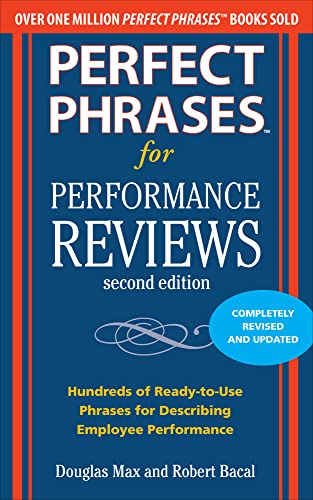
Inhaltsangabe
THE RIGHT PHRASE FOR EVERY SITUATION . . . EVERY TIME
The ability to craft an employee review that is meaningful and change-driven is what separates average supervisors from great managers. How often, though,have you struggled to find the most appropriate words for your needs?
This completely revised and updated second edition of Perfect Phrases for Performance Reviews provides hundreds of ready-made phrases you can use to clearly communicate any employee's performance in 74 different skill areas. Learn the most effective language for:
- Crafting an accurate, carefully worded assessment
- Documenting behaviors and accomplishments
- Guiding and developing promising workers
- Conducting face-to-face interviews
Die Inhaltsangabe kann sich auf eine andere Ausgabe dieses Titels beziehen.
Über die Autorin bzw. den Autor
McGraw-Hill authors represent the leading experts in their fields and are dedicated to improving the lives, careers, and interests of readers worldwide
Auszug. © Genehmigter Nachdruck. Alle Rechte vorbehalten.
PERFECT PHRASES for PERFORMANCE REVIEWS
Hundreds of Ready-to-Use Phrases for Describing Employee Performance
By Douglas Max, Robert BacalThe McGraw-Hill Companies, Inc.
Copyright © 2011 The McGraw-Hill Companies
All rights reserved.
ISBN: 978-0-07-174507-9All rights reserved.
Contents
| The Most Important Preface You Will Ever Read | |
| Acknowledgments | |
| Part One. Background for Conducting Performance Reviews | |
| How to Plan, Conduct, and Write a Performance Review | |
| Part Two. Examples of Forms for Performance Reviews | |
| Performance Review Forms | |
| Part Three. Perfect Phrases for Performance Reviews | |
| Topics Listed Alphabetically | |
| Topics by Job Category | |
| General Job Skills/Traits | |
| Technical Skills | |
| Productivity | |
| Management/Leadership/Supervisory | |
| Management | |
| Communications/Interpersonal | |
| Personal Qualities/Characteristics | |
| Appendix A. Ten Mistakes Managers Make When Conducting Performance Appraisals | |
| Appendix B. Seven Mistakes Employees Make During Performance Appraisals |
Excerpt
CHAPTER 1
How to Plan, Conduct, and Write a Performance Review
Undertaking formal performance appraisals is not an activity most managersrelish, but it's an important part of the job of a manager. You have anopportunity, by reviewing performance effectively, to directly and positivelyaffect the future productivity of your employees. Conducting an effectiveappraisal means more than just filling out the form your company uses, however.What goes on before you fill out the form is critical to getting the resultsyou're looking for.
If all you want to do is get forms filled out, skip ahead to Part Two. If youwant to accomplish something worthwhile that will make your life easier,continue reading.
As part of the appraisal process in many organizations, the manager and employeehave a meeting where the manager explains the appraisal process and the criteriafor judging performance. If the process involves goals, the manager and employeediscuss and agree on what they both would like to see achieved over a certaintime period (usually a year) and, perhaps, the kind of resources the employeewill need to succeed. If you are responsible for defining employee goals, thenuse the initial meeting to explain these goals (and how you will work togetherto achieve those goals, if appropriate).
Throughout the year, document significant behaviors that are worthy ofdiscussion during a performance review. Keep notes as you observe theperformance of your employees. It's simple and easy to do—far easier thanwaiting until the end of the year and then trying to recollect what happened.
Setting Performance Goals
What is a goal? It's an agreed-upon statement of what an employee willachieve in a specified period. A goals statement should also outline theresources necessary to achieve the goals and how you and your employee willmeasure success.
Each goal should be measurable, attainable, moderately difficult, and acceptedby the employee. Here are some examples:
* Number of rejected items from manufacturing line will not exceed 0.3 percentper week.
* Sales per quarter will increase by 5 percent.
* Expense account will not exceed budget.
* Sign up five new customers per month.
In other words, goals should be measurable and aimed at improving theperformance of the employee. Well, so the theory goes. Actually the tricky partis "measurable." It turns out that the things that are easy to measure areusually trivial, and the things that are hard to measure are what separate agood employee from a lesser one. That doesn't mean we give up on measurablegoals. It does mean that perfection is not possible.
Why do we write goals? Written goals allow you to both measure andrecognize achievement. They also let you identify and correct performanceproblems, and they enable you to identify and focus on your top priorities. Aimto limit the number of long-term goals to no more than five. You can writeadditional short-term goals for projects that can be completed in a few weeks ormonths.
How do you write goals? To write goals, you first need to collectinformation from your own records and those of your employees. The next sectionexplains the kind of information you might use.
What kind of information will you need? You and your employees can bestanswer this question because it depends on the specific situation and each job.Some guidelines:
Most goals that relate to productivity are generally expressed in terms thatinclude:
* Volume of work
* Accuracy of work
* Time to produce X
* Cost per unit of X
Volume measures the amount of work performed, for example, the numberof:
* Orders entered
* Cartons packed
* Requisitions written
* Documents filed
Accuracy measures the degree to which the work is performed free oferror, or the quality of the work, for example, the percentage of:
* Orders entered accurately vs. inaccurately
* Cartons packed correctly vs. incorrectly
* Requisitions written correctly vs. incorrectly
* Documents filed accurately vs. inaccurately
Time measures the duration of work performed, per hour, per day, perweek, per month, or per year. Examples include:
* Claims processed per hour/day/week
* Requisitions received and written on the first day/second day/third day
* Documents received and filed on the first day/second day/third day
Cost measures the dollars spent for work performed. For example:
What if goal achievement is difficult to measure? There may be timeswhen an employee has goals that you cannot easily measure. This does not meanthat you should not have such goals. Just be certain to have some criteria forevaluating the level of achievement. Here are some examples:
* Monthly reports. "Performance is acceptable when I turn in completedmonthly reports no more than two times late in any four-month period, withoutmore than one incident of it being more than one week late in any six-monthperiod, and when it is accepted by my boss in all cases with no more than tworevisions that are completed in no more than one week."
* Forecasting. "I will not fail to bring to my boss's attention adversetrends in my performance before the failure point is reached. This will happenno more than two times in any 12-month period."
* Employee development. "Performance is acceptable when training,motivation, and appraisal are discussed during at least two meetings annuallybetween me and each of my direct reports."
Documenting Critical Incidents and Significant Behaviors
An important part of the appraisal process involves recording incidents andbehaviors that are out of the ordinary. These are referred to as "criticalincidents" and "significant behaviors." A critical incident is behavior that isusually extreme (either good or bad) and that should be recorded for legalreasons, for disciplinary measures, or for purposes of recognizing exemplaryactions "above and beyond the call of duty." A significant behavior is one thatcan make a real...
„Über diesen Titel“ kann sich auf eine andere Ausgabe dieses Titels beziehen.
Suchergebnisse für Perfect Phrases for Performance Reviews 2/E (Perfect...

Beispielbild für diese ISBN
Perfect Phrases for Performance Reviews 2/E
Verlag:
McGraw-Hill Education - Europe, 2010
ISBN 10: 0071745076
ISBN 13: 9780071745079
Gebraucht
Paperback
Anbieter: World of Books (was SecondSale), Montgomery, IL, USA
Verkäuferbewertung 5 von 5 Sternen

Paperback. Zustand: Fair. More than 1 million books sold in the Perfect Phrases series! An updated and revised edition of one of the series's hottest sellers. Artikel-Nr. 00100007850
Gebraucht kaufen
EUR 3,95
Versand gratis
Versand innerhalb von USA
Versand innerhalb von USA
Anzahl: 4 verfügbar
Beispielbild für diese ISBN
Perfect Phrases for Performance Reviews 2/E
Verlag:
McGraw-Hill Education - Europe, 2010
ISBN 10: 0071745076
ISBN 13: 9780071745079
Gebraucht
Paperback
Anbieter: World of Books (was SecondSale), Montgomery, IL, USA
Verkäuferbewertung 5 von 5 Sternen
Paperback. Zustand: Good. More than 1 million books sold in the Perfect Phrases series! An updated and revised edition of one of the series's hottest sellers. Artikel-Nr. 00081890131
Gebraucht kaufen
EUR 3,95
Versand gratis
Versand innerhalb von USA
Versand innerhalb von USA
Anzahl: Mehr als 20 verfügbar
Beispielbild für diese ISBN
Perfect Phrases for Performance Reviews 2/E
Verlag:
McGraw-Hill Education - Europe, 2010
ISBN 10: 0071745076
ISBN 13: 9780071745079
Gebraucht
Paperback
Anbieter: World of Books (was SecondSale), Montgomery, IL, USA
Verkäuferbewertung 5 von 5 Sternen
Paperback. Zustand: Very Good. More than 1 million books sold in the Perfect Phrases series! An updated and revised edition of one of the series's hottest sellers. Artikel-Nr. 00102537393
Gebraucht kaufen
EUR 3,95
Versand gratis
Versand innerhalb von USA
Versand innerhalb von USA
Anzahl: 12 verfügbar
Foto des Verkäufers
Perfect Phrases for Performance Reviews 2/E (Perfect Phrases Series)
Anbieter: Dream Books Co., Denver, CO, USA
Verkäuferbewertung 5 von 5 Sternen
Zustand: good. Gently used with minimal wear on the corners and cover. A few pages may contain light highlighting or writing, but the text remains fully legible. Dust jacket may be missing, and supplemental materials like CDs or codes may not be included. May be ex-library with library markings. Ships promptly! Artikel-Nr. DBV.0071745076.G
Gebraucht kaufen
EUR 5,61
Versand gratis
Versand innerhalb von USA
Versand innerhalb von USA
Anzahl: 2 verfügbar
Beispielbild für diese ISBN
Perfect Phrases for Performance Reviews 2/E (Perfect Phrases Series)
Verlag:
McGraw Hill (edition 2), 2010
ISBN 10: 0071745076
ISBN 13: 9780071745079
Gebraucht
Paperback
Anbieter: BooksRun, Philadelphia, PA, USA
Verkäuferbewertung 5 von 5 Sternen
Paperback. Zustand: Very Good. 2. It's a well-cared-for item that has seen limited use. The item may show minor signs of wear. All the text is legible, with all pages included. It may have slight markings and/or highlighting. Artikel-Nr. 0071745076-11-18
Gebraucht kaufen
EUR 5,93
Versand gratis
Versand innerhalb von USA
Versand innerhalb von USA
Anzahl: 1 verfügbar
Beispielbild für diese ISBN
Perfect Phrases for Performance Reviews
Anbieter: ThriftBooks-Atlanta, AUSTELL, GA, USA
Verkäuferbewertung 5 von 5 Sternen
Paperback. Zustand: Good. No Jacket. Pages can have notes/highlighting. Spine may show signs of wear. ~ ThriftBooks: Read More, Spend Less. Artikel-Nr. G0071745076I3N00
Gebraucht kaufen
EUR 6,26
Versand gratis
Versand innerhalb von USA
Versand innerhalb von USA
Anzahl: 1 verfügbar
Beispielbild für diese ISBN
Perfect Phrases for Performance Reviews
Anbieter: ThriftBooks-Atlanta, AUSTELL, GA, USA
Verkäuferbewertung 5 von 5 Sternen
Paperback. Zustand: As New. No Jacket. Pages are clean and are not marred by notes or folds of any kind. ~ ThriftBooks: Read More, Spend Less. Artikel-Nr. G0071745076I2N00
Gebraucht kaufen
EUR 6,26
Versand gratis
Versand innerhalb von USA
Versand innerhalb von USA
Anzahl: 1 verfügbar
Beispielbild für diese ISBN
Perfect Phrases for Performance Reviews 2/e
Anbieter: Better World Books, Mishawaka, IN, USA
Verkäuferbewertung 5 von 5 Sternen
Zustand: Good. 2nd Edition. Pages intact with minimal writing/highlighting. The binding may be loose and creased. Dust jackets/supplements are not included. Stock photo provided. Product includes identifying sticker. Better World Books: Buy Books. Do Good. Artikel-Nr. 8933169-6
Gebraucht kaufen
EUR 6,57
Versand gratis
Versand innerhalb von USA
Versand innerhalb von USA
Anzahl: 1 verfügbar
Beispielbild für diese ISBN
Perfect Phrases for Performance Reviews 2/e
Anbieter: Better World Books: West, Reno, NV, USA
Verkäuferbewertung 5 von 5 Sternen
Zustand: Good. 2nd Edition. Former library copy. Pages intact with minimal writing/highlighting. The binding may be loose and creased. Dust jackets/supplements are not included. Includes library markings. Stock photo provided. Product includes identifying sticker. Better World Books: Buy Books. Do Good. Artikel-Nr. 5007756-6
Gebraucht kaufen
EUR 6,57
Versand gratis
Versand innerhalb von USA
Versand innerhalb von USA
Anzahl: 2 verfügbar
Beispielbild für diese ISBN
Perfect Phrases for Performance Reviews 2/e
Anbieter: Better World Books, Mishawaka, IN, USA
Verkäuferbewertung 5 von 5 Sternen
Zustand: Good. 2nd Edition. Former library copy. Pages intact with minimal writing/highlighting. The binding may be loose and creased. Dust jackets/supplements are not included. Includes library markings. Stock photo provided. Product includes identifying sticker. Better World Books: Buy Books. Do Good. Artikel-Nr. 5007756-6
Gebraucht kaufen
EUR 6,57
Versand gratis
Versand innerhalb von USA
Versand innerhalb von USA
Anzahl: 1 verfügbar