
Verwandte Artikel zu Wave Theory for Alternative Investments: Riding the...
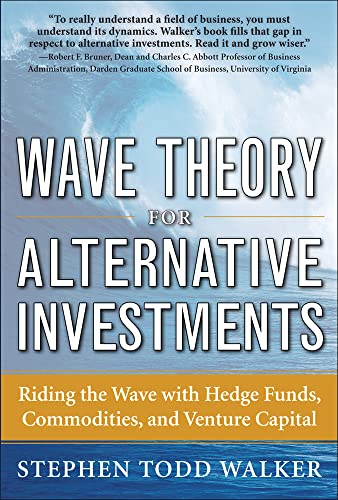
Wave Theory for Alternative Investments: Riding the Wave with Hedge Funds, Commodities, and Venture Capital - Hardcover
Inhaltsangabe
A Strategy That Helps You Weather Any Economic Storm
"Wave Theory for Alternative Investments is not just a guide; it is the holy grail for understanding alternative investments." -- Matt Emmens, Chairman, President, CEO of Vertex and Chairman of the Board of Shire
"Walker's book provides investors and managers with an intriguing walk through the history of venture capital as an alternative asset class, while demonstrating the important contribution VCs have made and continue to make to innovation, economic growth, and job creation." -- Bryan Pearce, Americas Director, Ernst & Young Venture Capital Advisory Group
"If you want to learn about alternative investments, there is one book which must be on the very top of your reading list, Wave Theory for Alternative Investments. The author delves behind mere analytics and algorithms with a behaviorably based, verifiable tool." -- Stephen M. Goodman, Senior Partner and Cofounder of the Emerging Growth Practice, Morgan Lewis & Bockius LLP
"If you want to understand the history of venture capital in the context of its current manifestation, there is only one book: Wave Theory for Alternative Investments." -- Bo Peabody, Managing General Partner, Village Ventures
"Venture capital helps fuel the growth of America's finest companies, the leaders of tomorrow. Wave Theory for Alternative Investments is a must-read for [entrepreneurs and] those who wish to invest in the technologies of the future through the venturecapital process." -- Mark Heesen, President, National Venture Capital Association
The 2008 crash taught quite a few intelligent, high-net-worth, and institutional investors the hard lesson thatequities and bonds can carry a fair degree of risk. Many of these investors mistakenly cashed out of their plummeting investments at precisely the wrong time--and completely missed the recent wave of recovery.
Wave Theory for Alternative Investments helps avoid poor decision making and costly mistakes. Consistently ranked among the nation's top wealth managers, Stephen Todd Walker explains how to catch the waves of potentially lucrative yet volatile alternative markets--and ride them to unprecedented profits.
Wave Theory for Alternative Investments is an insider's guidebook to some of the fastest-growing segments of the investment world, including hedge funds, commodities, and venture capital. Wave Theory for Alternative Investments is your first lesson in usingalternatives to keep surfing--and avoid wiping out in the next financial meltdown. This excellent resource includes:
- A brief history of alternative investments
- Numerous risk/return profiles
- Critical tools, including fundamental and technical analysis
Walker shares his extensive knowledge, top-tier experience, and proven strategies to help you maximize return-on-investment on a consistent basis.
The complex process of alternative investing can take years of practice to master. Wave Theory for Alternative Investments helps you adjust your approach right now, so that you'll be in prime position to catch the best waves in the next financial storm.
Die Inhaltsangabe kann sich auf eine andere Ausgabe dieses Titels beziehen.
Über die Autorinnen und Autoren
Stephen Todd Walker's clients include Forbes 400 members and some of the most affluent families in the world. During his 20-plus years in finance, he was one of the youngest directors in Alex. Brown history. He served as a Senior Vice President, Corporate Client Group Director and was a member of Morgan Stanley’s Chairman’s group. In 2009 and 2010, Barron’s listed Walker among theTop 1,000 Advisors in the United States. The author lives in Bryn Mawr, Pennsylvania.
Please visit the author at Stephentoddwalker.com
Stephen Todd Walker's clients include Forbes 400 members and some of the most affluent families in the world. During his 20-plus years in finance, he was one of the youngest directors in Alex. Brown history. He served as a Senior Vice President, Corporate Client Group Director and was a member of Morgan Stanley’s Chairman’s group. In 2009 and 2010, Barron’s listed Walker among theTop 1,000 Advisors in the United States. The author lives in Bryn Mawr, Pennsylvania.
Please visit the author at Stephentoddwalker.com
Auszug. © Genehmigter Nachdruck. Alle Rechte vorbehalten.
Wave Theory for Alternative Investments
Riding the Wave with Hedge Funds, Commodities, and Venture Capital
By STEPHEN TODD WALKERThe McGraw-Hill Companies, Inc.
Copyright © 2011 Stephen Todd Walker
All rights reserved.
ISBN: 978-0-07-174286-3All rights reserved.
Contents
| Acknowledgments | |
| Disclaimers and Disclosures | |
| Introduction | |
| PART 1 Waves | |
| Chapter 1 Wave Theory | |
| Chapter 2 Surfing Alternatives Waves | |
| Chapter 3 Wave Action, Reflection, and Mastery | |
| PART 2 Venture Capital | |
| Chapter 4 Defining Venture Capital | |
| Chapter 5 The History of Venture Capital | |
| Chapter 6 Venture Capital Market Dynamics | |
| Chapter 7 Private Equity: Venture Capital Advantages and Disadvantages | |
| Chapter 8 Venture Capital Performance | |
| Chapter 9 Venture Capital Investment Vehicles | |
| PART 3 Commodities 235 | |
| Chapter 10 Commodity Overview | |
| Chapter 11 Commodity Investing | |
| PART 4 Precious Metals (Gold) | |
| Chapter 12 Gold Overview | |
| Chapter 13 Gold Waves and Investments | |
| PART 5 Hedge Funds | |
| Chapter 14 Hedge Fund Overview | |
| Chapter 15 The Hedge Fund Market | |
| Chapter 16 Hedge Fund Advantages and Disadvantages | |
| Chapter 17 Hedge Fund Performance | |
| Chapter 18 Hedge Fund Investment Vehicles | |
| Notes | |
| Index |
Excerpt
CHAPTER 1
Wave Theory
Wave theory is simply the belief that all securities move in waves (patterns,cycles, or trends). History sometimes repeats itself, but with alternatives aninvestor can typically see similar waves repeating themselves. Equities move inwaves. Fixed income moves in waves. Cash moves in waves. There is now enoughdata to support the notion that alternatives also move in waves. Besides theseasset classes, there can even be styles such as "value" or "growth" investingthat move in waves. Securities can also move in tandem, forming huge waves inepic downturns or sharp rallies. Realizing this, one can either make a lot ofmoney or lose a lot of money while investing. After the Dow Jones dropped from14,164 to 6,469, many investors sold securities at precisely the wrong time andlost trillions of dollars. Ironically, when the market started to recover andpassed 10,000, many of these same investors attempted to jump back in and chasethe market after they sold at the very bottom of the market. The individual whocoined the expression "buy low, sell high" was not unintelligent. Yet investors(ones who are not paying attention to waves) frequently follow the news mediaand make the erroneous mistake of buying high and selling low.
Waves are found among all asset classes, including the fastest growing andcompelling asset class: alternatives. In other words, there are distinct wavesfound within the alternatives asset class. Since more data became available inrecent years, it is apparent that waves exist with alternatives. Those of themain alternative groups—hedge funds, commodities, and private equity(venture capital) — all have identifiable waves. One must be cognizant ofwaves found with alternatives to lower risk and maximize returns. Otherwise, theresults can be lackluster if not devastating.
Mergers and Acquisition Waves
There is very little written about waves in finance, and although severalindividuals have touched on the subject, none have written about alternativesand waves. Alternatives are a relatively new asset class and can be difficult tounderstand. Those who have discussed waves in the past tend to review them withregard to various aspects of finance, not asset classes. For example, Allen,Brealey, and Myers's Principles of Corporate Finance explained thatthere are merger and acquisition waves:
Mergers come in waves. The first episode of intense merger activity occurred atthe start of the 20th century and the second occurred in the 1920s. There was afurther boom from 1967 to 1969 and then again in the 1980s and 1990s (1999 and2000 were record years). Each episode coincided with a period of buoyant stockprices, though there were substantial differences in the types of companies thatmerged and the ways they went about it.
Robert F. Bruner also wrote about waves in Applied Mergers andAcquisitions, in which he describes "five periods of heightened mergeractivity; hereafter, I will call these 'waves'." The fifth wave, or his Wave 4b(which I will call Wave 5), was caused by a few large scale mergers andacquisitions (M&A) deals. According to Bruner, "Following the 1990-91 recession,M&A activity increased briskly in all segments of the economy and all sizecategories. The announcement of a few large deals signaled to some observers a'paradigm shift' in M&A where old rules about strategy, size, and deal designwere being replaced with new rules."
The graph in Figure 1.1 shows M&A activity in terms of deals and depictsone of the M&A waves described by Bruner. If one combines all of the M&A wavesover the last century, Figure 1.2 depicts a long-term trend of M&A waves(patterns, cycles, or trends).
Long before Bruner, Joseph Schumpeter noted "cycles" with M&A activity.Schumpeter originated the concept of creative destruction. His ideas have beenwidely applied to theories of evolutionary economics. Understanding M&A waveswith economics is helpful because of their effect on alternatives. Alternativeasset classes (such as venture capital or leveraged buyout funds) depend on theM&A market because it is an exit strategy or a means to take a profit or cashout. The M&A market has shown distinct waves, especially over the past 30 years(Figure 1.3).
Whether one measures the number of M&A deals or the dollar value of these deals,it is apparent that waves exist.
Initial Public Offering Waves
The discovery of waves with alternatives might be beneficial to a plethora ofinvestors from retail and high net worth to institutional investors. Also, waveswith alternatives might assist venture capital-backed private companiescontemplating going public as well as investors in venture capital (pre-initialpublic offering [IPO]) or even buyers of IPOs. Wave Theory can help a lot ofdifferent people, including entrepreneurs who would like to take a companypublic. Chief executive officers (CEOs) of fast-growing emerging companies(e.g., health care, technology, consumer), should be aware of the point at whichthey are approaching a wave before going public. Depending on where a venturecapital-backed company stands with regard to a wave, the CEO or venture firmmight decide to wait or hold off for a more opportune time to gopublic—that is, be one of the first to go catch the wave. IPOs at thepinnacle of any market tend to have precipitous drops.
Similar to M&A, there are distinct waves with the IPO market. Whether oneexamines the number of IPOs or value in IPO deals, it is quite apparent that theIPO market (like the M&A market) travels in distinct waves as depicted inFigure 1.4. Hilary Kramer wrote the following about...
„Über diesen Titel“ kann sich auf eine andere Ausgabe dieses Titels beziehen.
Suchergebnisse für Wave Theory for Alternative Investments: Riding the...

Beispielbild für diese ISBN
Wave Theory for Alternative Investments: Riding the Wave with Hedge Funds, Commodities, and Venture Capital
Anbieter: ThriftBooks-Dallas, Dallas, TX, USA
Verkäuferbewertung 5 von 5 Sternen

Hardcover. Zustand: Good. No Jacket. Pages can have notes/highlighting. Spine may show signs of wear. ~ ThriftBooks: Read More, Spend Less. Artikel-Nr. G0071742867I3N00
Gebraucht kaufen
EUR 27,91
Versand gratis
Versand innerhalb von USA
Versand innerhalb von USA
Anzahl: 1 verfügbar
Beispielbild für diese ISBN
Wave Theory for Alternative Investments: Riding the Wave with Hedge Funds, Commodities, and Venture Capital
Verlag:
McGraw-Hill Education Ltd, 2010
ISBN 10: 0071742867
ISBN 13: 9780071742863
Gebraucht
Hardcover
Anbieter: Studibuch, Stuttgart, Deutschland
Verkäuferbewertung 5 von 5 Sternen
hardcover. Zustand: Gut. 503 Seiten; 9780071742863.3 Gewicht in Gramm: 1. Artikel-Nr. 1055101
Gebraucht kaufen
EUR 6,99
EUR 62,30 Versand
Versand von Deutschland nach USA
Versand von Deutschland nach USA
Anzahl: 1 verfügbar