
Verwandte Artikel zu Writing Winning Business Proposals, Third Edition
Writing Winning Business Proposals, Third Edition - Softcover
Buch 30 von 36: BUSINESS SKILLS AND DEVELOPMENT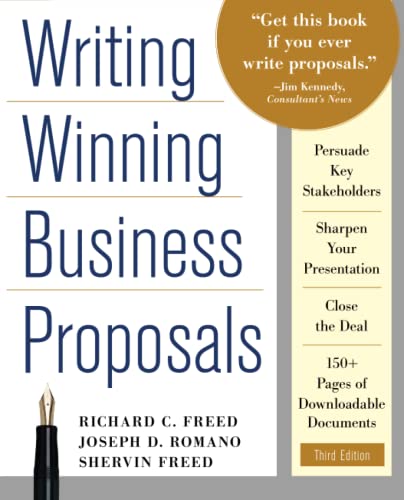
Inhaltsangabe
Winning proposals that turn prospects into clients Based on the proposal-writing system used at A.T. Kearney and KPMG Peat Marwick, Writing Winning Business Proposals features proven strategies, along with worksheets and other tools that clearly show clients what they want and will easily seal the deal. Thoroughly updated, the third edition offers general guidelines that apply to all business proposals making this the must-have proposal-writing book to have on hand. Writing Winning Business Proposals features: Winning formula from top consultants proven to work for any proposal Complete step-by-step process, walking you through all the difficulties Up-to-date, user-friendly redesign with new worksheets and charts Updates on fees and collaboration If you're seeking approval for projects, or want a client to buy, invest or do something, Writing Winning Business Proposals is the reference you need to get you to get them to do what you want.
Die Inhaltsangabe kann sich auf eine andere Ausgabe dieses Titels beziehen.
Über die Autorin bzw. den Autor
McGraw-Hill authors represent the leading experts in their fields and are dedicated to improving the lives, careers, and interests of readers worldwide
Auszug. © Genehmigter Nachdruck. Alle Rechte vorbehalten.
Writing Winning Business Proposals
By RICHARD C. FREED, JOSEPH D. ROMANO, SHERVIN FREEDThe McGraw-Hill Companies, Inc.
Copyright ©2011 The McGraw-Hill Companies, Inc.
All rights reserved.
ISBN: 978-0-07-174232-0All rights reserved.
Contents
| Preface | |
| Introduction | |
| PART 1 Proposal Logics | |
| CHAPTER 1 Understanding Generic Structure Logic | |
| CHAPTER 2 Understanding the Baseline Logic | |
| CHAPTER 3 Aligning the Baseline Logic | |
| CHAPTER 4 Using a Measurable-Results Orientation | |
| CHAPTER 5 Using Logic Trees to Construct Your Methodology | |
| PART 2 Proposal Psychologics | |
| CHAPTER 6 Analyzing the Buyers | |
| CHAPTER 7 Identifying, Selecting, and Developing Themes: Determining What to Weave in Your Web of Persuasion | |
| CHAPTER 8 Green Team Reviews: Collaborating to Improve Your Odds of Winning | |
| PART 3 Proposal Preparation | |
| CHAPTER 9 Writing the Situation and Objectives Slots | |
| CHAPTER 10 Writing the Methods Slot | |
| CHAPTER 11 Writing the Qualifications Slot | |
| CHAPTER 12 Writing the Benefits Section | |
| CHAPTER 13 Writing the Fees Slot | |
| CHAPTER 14 Summary: The Proposal Development Process | |
| APPENDIX A Paramount Consulting's Proposal Opportunity at the ABC Company: A Case Study | |
| APPENDIX B Worksheets | |
| APPENDIX C Paramount's Proposal Letter to the ABC Company | |
| APPENDIX D Internal Proposals (Make Certain They're Not Reports) | |
| APPENDIX E A Few Comments About Writing Effective Sentences (and Paragraphs) | |
| APPENDIX F Using the Right Voice: Determining How Your Proposal Should "Speak" | |
| APPENDIX G Reading RFPs | |
| APPENDIX H A Worksheet for Qualifying Your Lead | |
| Notes and Citations | |
| Index |
Excerpt
CHAPTER 1
Understanding Generic Structure Logic
Like most people, I like stories, so let me begin by telling you a very shortstory—after which I'll ask you several questions.
Paula was hungry. After she entered and ordered a pastrami sandwich, it wasserved to her quickly. She left the waitress a big tip.
* Where was Paula?
* What did she eat?
* Who made the sandwich?
* Who took the order?
* Who served the sandwich?
* Why did Paula leave a big tip?
How is it that you could answer those questions rather easily even thoughnothing in the story explicitly provides the information necessary for youranswers? Because you have a schema for the concept of "restaurant."
Schemas are knowledge structures that you have built and stored in your memoryas patterns, as analytical frameworks. Schemas represent generic concepts suchas restaurant or airplane or house. Each schema has "slots" that exist in anetwork of relations. Your schema for restaurant may have slots for "ordering,""eating," "tipping," and "paying." Your schema for house may contain slots for"family room," "kitchen," "living room," and "bathroom." A slot for "homeoffice" is also possible, but probably not for "boardroom" or "conference room,"since such spaces typically are not found in residences. Therefore, you don'texpect to find a boardroom or a conference room in someone's house.
You also have schemas for different kinds of texts, and these schemas createexpectations. In a novel, for example, you expect character and plot andsetting. In a particular type of novel, such as a spy novel, you may expect thatthe hero will be betrayed and captured, only to escape and triumph. In a eulogy,you expect some account of the deceased person's character and accomplishments;in a personal letter, some account of your friend's life and feelings; in asermon, some moral based on a religious belief. If the sermon consisted solelyof an analysis of price-earnings ratios or bills of materials or variousstrategies for penetrating new markets, your expectations would be denied, andyou'd be suspicious of the speaker's competence and reliability, maybe even hisor her sanity.
Proposals and other business documents also carry with them schemas and sets ofexpectations. If I asked you to submit a proposal to me, I'd be surprised if thedocument contained findings, conclusions, and recommendations. These are slotsI'd expect in a report, not a proposal. Potential clients like me, then, havecertain expectations, and as a writer, you're at some risk if you don't meetthose expectations. If your reader is in a proposal-reading situation, you'dbetter deliver a document that fits your reader's proposal schema, not theschema for a report or a eulogy or a novel.
Your schema for a proposal also has slots, and those slots make up what I call aproposal's generic structure. No matter how different one proposal may be fromanother, something generic makes them both proposals, and that something istheir generic structure.
The Slots in a Proposal's Generic Structure
Most of your proposal opportunities exist because I, your potential client, havean unsolved problem or an unrealized opportunity. Therefore, your primary taskis to convince me, both logically and psychologically, that you can help meaddress my problem or opportunity and, in competitive situations, that you'll doso better than anyone else.
Your entire proposal needs to communicate that message in one seamless argument(which may happen to be divided into sections or even volumes for myconvenience). Your argument is suggested by the following propositions, each ofwhich is preceded by the proposal slot that contains it. (See Figure1.1.)
Slots Speaking to Slots
Although the preceding statements might suggest that your proposal's argumentflows only one way—from top to bottom—the argument should be sotight that the logic also can flow from bottom to top:
These are the benefits or value you will receive
considering the costs you will incur
given our qualifications
for performing these methods
that will achieve your objectives
and therefore improve your situation.
Now, I've never seen a proposal organized that way, but however the proposal isorganized, every generic structure slot needs to "speak" to all the others. Noslot exists in isolation: Each contributes to your communicating the proposal'sprimary message. In later chapters, I'll show you specific techniques forassuring that each slot in your proposal speaks to every other one.
Slots Are Not Necessarily Sections
You've probably noticed that I've been referring to OBJECTIVES, METHODS,BENEFITS, and so on, as "slots," even though many proposals might designatethose parts of the proposal by using section headings of the same name. I'vebeen calling these elements slots rather than sections because in any givenproposal it is possible that:
* No slot could be used as a section heading. That's the case if youdon't use headings in your document or if your headings are different from...
„Über diesen Titel“ kann sich auf eine andere Ausgabe dieses Titels beziehen.
Suchergebnisse für Writing Winning Business Proposals, Third Edition

Beispielbild für diese ISBN
Writing Winning Business Proposals, Third Edition
Anbieter: Better World Books: West, Reno, NV, USA
Verkäuferbewertung 5 von 5 Sternen

Zustand: Very Good. Pages intact with possible writing/highlighting. Binding strong with minor wear. Dust jackets/supplements may not be included. Stock photo provided. Product includes identifying sticker. Better World Books: Buy Books. Do Good. Artikel-Nr. GRP91107631
Gebraucht kaufen
EUR 6,13
Versand gratis
Versand innerhalb von USA
Versand innerhalb von USA
Anzahl: 1 verfügbar
Beispielbild für diese ISBN
Writing Winning Business Proposals, Third Edition
Anbieter: Better World Books: West, Reno, NV, USA
Verkäuferbewertung 5 von 5 Sternen
Zustand: Good. Former library copy. Pages intact with minimal writing/highlighting. The binding may be loose and creased. Dust jackets/supplements are not included. Includes library markings. Stock photo provided. Product includes identifying sticker. Better World Books: Buy Books. Do Good. Artikel-Nr. 7846273-6
Gebraucht kaufen
EUR 6,13
Versand gratis
Versand innerhalb von USA
Versand innerhalb von USA
Anzahl: 2 verfügbar
Beispielbild für diese ISBN
Writing Winning Business Proposals, Third Edition
Anbieter: ThriftBooks-Atlanta, AUSTELL, GA, USA
Verkäuferbewertung 5 von 5 Sternen
Paperback. Zustand: Good. No Jacket. Pages can have notes/highlighting. Spine may show signs of wear. ~ ThriftBooks: Read More, Spend Less. Artikel-Nr. G0071742328I3N00
Gebraucht kaufen
EUR 6,54
Versand gratis
Versand innerhalb von USA
Versand innerhalb von USA
Anzahl: 1 verfügbar
Beispielbild für diese ISBN
Writing Winning Business Proposals, Third Edition
Anbieter: ThriftBooks-Dallas, Dallas, TX, USA
Verkäuferbewertung 5 von 5 Sternen
Paperback. Zustand: Very Good. No Jacket. May have limited writing in cover pages. Pages are unmarked. ~ ThriftBooks: Read More, Spend Less. Artikel-Nr. G0071742328I4N00
Gebraucht kaufen
EUR 6,54
Versand gratis
Versand innerhalb von USA
Versand innerhalb von USA
Anzahl: 1 verfügbar
Beispielbild für diese ISBN
Writing Winning Business Proposals, Third Edition
Anbieter: ThriftBooks-Dallas, Dallas, TX, USA
Verkäuferbewertung 5 von 5 Sternen
Paperback. Zustand: Good. No Jacket. Pages can have notes/highlighting. Spine may show signs of wear. ~ ThriftBooks: Read More, Spend Less. Artikel-Nr. G0071742328I3N00
Gebraucht kaufen
EUR 6,54
Versand gratis
Versand innerhalb von USA
Versand innerhalb von USA
Anzahl: 1 verfügbar
Beispielbild für diese ISBN
Writing Winning Business Proposals, Third Edition
Anbieter: ThriftBooks-Reno, Reno, NV, USA
Verkäuferbewertung 5 von 5 Sternen
Paperback. Zustand: Good. No Jacket. Pages can have notes/highlighting. Spine may show signs of wear. ~ ThriftBooks: Read More, Spend Less. Artikel-Nr. G0071742328I3N00
Gebraucht kaufen
EUR 6,54
Versand gratis
Versand innerhalb von USA
Versand innerhalb von USA
Anzahl: 1 verfügbar
Beispielbild für diese ISBN
Writing Winning Business Proposals, Third Edition
Anbieter: ThriftBooks-Atlanta, AUSTELL, GA, USA
Verkäuferbewertung 5 von 5 Sternen
Paperback. Zustand: Very Good. No Jacket. May have limited writing in cover pages. Pages are unmarked. ~ ThriftBooks: Read More, Spend Less. Artikel-Nr. G0071742328I4N00
Gebraucht kaufen
EUR 6,54
Versand gratis
Versand innerhalb von USA
Versand innerhalb von USA
Anzahl: 1 verfügbar
Beispielbild für diese ISBN
Writing Winning Business Proposals, Third Edition
Anbieter: ThriftBooks-Reno, Reno, NV, USA
Verkäuferbewertung 5 von 5 Sternen
Paperback. Zustand: Very Good. No Jacket. May have limited writing in cover pages. Pages are unmarked. ~ ThriftBooks: Read More, Spend Less. Artikel-Nr. G0071742328I4N00
Gebraucht kaufen
EUR 6,54
Versand gratis
Versand innerhalb von USA
Versand innerhalb von USA
Anzahl: 1 verfügbar
Beispielbild für diese ISBN
Writing Winning Business Proposals, Third Edition
Anbieter: World of Books (was SecondSale), Montgomery, IL, USA
Verkäuferbewertung 5 von 5 Sternen
Zustand: Very Good. Item in very good condition! Textbooks may not include supplemental items i.e. CDs, access codes etc. Artikel-Nr. 00106815753
Gebraucht kaufen
EUR 9,07
Versand gratis
Versand innerhalb von USA
Versand innerhalb von USA
Anzahl: 1 verfügbar
Beispielbild für diese ISBN
Writing Winning Business Proposals: Your Guide to Sealing the Deal, from Concept to Approval
Anbieter: medimops, Berlin, Deutschland
Verkäuferbewertung 5 von 5 Sternen
Zustand: good. Befriedigend/Good: Durchschnittlich erhaltenes Buch bzw. Schutzumschlag mit Gebrauchsspuren, aber vollständigen Seiten. / Describes the average WORN book or dust jacket that has all the pages present. Artikel-Nr. M00071742328-G
Gebraucht kaufen
EUR 14,58
EUR 10,00 Versand
Versand von Deutschland nach USA
Versand von Deutschland nach USA
Anzahl: 1 verfügbar