
Inhaltsangabe
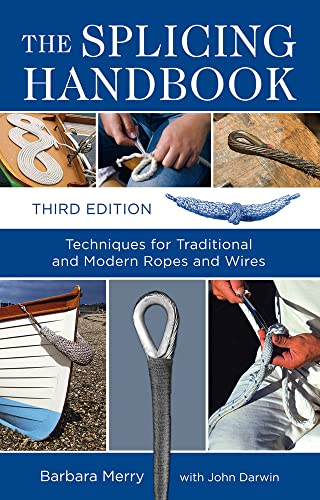
The only reference devoted entirely to splicing today's ropes The Splicing Handbook includes step-by-step illustrations and explanations for the most useful and popular splices in traditional twisted and modern braided ropes, and it covers every kind of splicing project you are likely to encounter, including modern cordage such as Spectra; mainstream rope materials such as Dacron and nylon; and wire and rope-to-wire splices. Covers all the standard rope constructions using Dacron and nylon, including solid braid, double braid, parallel core, plaited, and three-strand Explains how to splice wire for sailboat shrouds and halyards Shows how to make a broad range of useful onboard projects--and several that will find uses around the home as well, including dog collars, netting, rope railings, and lanyards.
Die Inhaltsangabe kann sich auf eine andere Ausgabe dieses Titels beziehen.
Über die Autorin bzw. den Autor
Barbara Merry is a marine rope worker with twenty years of expierence in the splicing trade. Dounder and owner of the MArlinspike Artist in Wakefield, Rhode Island, she has worked on projects for boats of all sizes, from small traditional sialing craft and working schooners to commercial fishing vessels and U.S. Coast Guard cutters. She has taught at the WooderBoat School and the Northeast Maritime Institute, and has written on rope and rope technology for WoodenBoat and Invention and Technology.
Auszug. © Genehmigter Nachdruck. Alle Rechte vorbehalten.
THE SPLICING HANDBOOK
Techniques for Traditional and Modern Ropes and Wires
By Barbara Merry, John DarwinThe McGraw-Hill Companies, Inc.
Copyright © 2011 International Marine/The McGraw-Hill Companies, Inc.
All rights reserved.
ISBN: 978-0-07-173604-6All rights reserved.
Contents
| Acknowledgments | |
| Preface to the Third Edition | |
| PART ONE SPLICING AND SEIZING MODERN ROPES | |
| 1. Introduction to Splicing | |
| 2. Three-Strand Twisted Rope | |
| 3. Three-Strand Splicing Projects | |
| 4. Double-Braid Rope | |
| 5. Solid-Braid Splice | |
| 6. Braid with Three-Strand Core | |
| 7. Braid with Parallel Core | |
| 8. Hollow Braid | |
| 9. Copolymer End-to-End Splice | |
| 10. Eight-Plait Rope | |
| 11. Eight-Plait Rope-to-Chain Splice | |
| 12. Twelve-Plait Rope | |
| 13. Whipping and Seizing | |
| 14. Sew-and-Serve Eye Splice | |
| PART TWO SPLICING WIRE ROPE | |
| 15. Introduction to Wire Rope | |
| 16. Liverpool Wire Splice | |
| 17. Tugboat Splice | |
| 18. Lap Wire Splice | |
| 19. Mill Valley Splice | |
| 20. Lizards | |
| PART THREE ROPEWORK PROJECTS | |
| 21. Traditional Rope Fenders | |
| 22. Dressing Up a Vinyl Fender | |
| 23. Bow Puddings | |
| 24. Baggywrinkle | |
| 25. A Cargo Net | |
| 26. Making Your Own Rope | |
| 27. Quick and Easy Knots | |
| Glossary | |
| Index |
Excerpt
CHAPTER 1
Introduction to Splicing
Rope in use is attached to something else—to another rope, to an object tobe moved or prevented from moving, or to an object that prevents the rope frommoving. The attachment can be accomplished with a knot, but knots are bulky and,by their nature, cut the breaking strength of the rope in half. The alternativeis a splice, which is capable of attaining a rope's full strength.
Splicing teaches you not only about the splice itself, but also about theconstruction and quality of the raw material. The knowledge gained frompracticing the splices in this handbook should enable you to splice anygeneral-purpose rope. But remember the wise advice, as true today as it ever hasbeen: "Measure twice, cut once."
No single splicing technique can work on all rope because the constructions varyconsiderably. Rope designers, who are functional artists much like architects,seek a perfect construction using the characteristics of various fibers:strengths, abrasion resistance, weight, shrinkage, and elasticity. They mustconsider resistance to heat, cold, sunlight, chemicals, water, dye, andmicroorganisms, as well as construction possibilities such as braiding,twisting, knitting, plaiting, wrapping, and gluing.
ROPE CONSTRUCTION
Egyptians on the Mediterranean worked with twisted and braided ropes 3,000 yearsago, as did seamen 12,000 miles away in Asia. Their ropes, knots, and spliceswere much like those we use today, except that ropes of strong synthetic fibershave all but replaced plant fibers over the past few decades. With increasedinternational shipping, ropes from all over the world are now evident in largecommercial harbors.
Any rope is a bundle of textile fibers combined in a usable form. For example, a½-inch-diameter (12 mm) nylon rope might have 90,000 tiny fibers, each witha tensile strength of 2 ounces (56.7 g), giving it a potential breaking strengthof 11,000 pounds (4,950 kg) if the fibers could be pulled in such a way thateach achieved its maximum strength. The 90,000 fibers can be bonded, twisted(laid), or braided, or these construction techniques can be combined in onerope. Regardless of the construction, the actual breaking strength of thefinished rope will be less than the potential strength of its aggregate fibersdue to a shearing action on the twisted fibers when the rope is loaded. Thiseffect is most extreme in laid rope: the U.S. standard for ½-inch (12 mm)three-strand nylon rope, for example, is a breaking strength of 5,800 pounds(2,610 kg); for ½-inch nylon double-braid, it's 15 percent higher.
The old standby, three-strand twisted nylon rope, is the most economical ropeavailable today, at about half the cost of double-braided nylon. It consists offibers (often nylon, but sometimes polyester or polypropylene) spun into yarns,which are then formed into the strands. Nylon three-strand is commonly used foranchor rodes and mooring and docking lines—applications where itsstrength, pronounced stretchiness, resistance to chafe, and reasonable cost areall appreciated.
Double-braid rope came into use with the discovery that careful design andconstruction could induce a braided core to share a load equally with itsbraided cover. When you work with this rope, you must preserve the originalcoat-to-core spatial relationship to retain its inherent strength, so tie theSlip Knot—called for in the splice directions for thisconstruction—both properly and tightly.
Dacron double-braid is stronger than three-strand twisted nylon rope (or three-strandor single-braid Dacron, for that matter), but it is also nearly doublethe price for ½-inch (12 mm) rope, and the difference in cost should beconsidered against the line's intended use. (Dacron is a DuPont trade name forpolyester, and the two terms are often used interchangeably.) Whenever thebreaking strength of a rope is critical, the manufacturer's specificationsshould be consulted. Some low-cost rope on the market is made to look likedouble-braid, but it is not, so check the product carefully and deal withreputable suppliers.
Polyester double-braid rope is low-stretch and resists kinking and hockling; ithandles well and is good for halyards and sheets.
Single-braid (also known as solid-braid) polyester is more supple, lessexpensive, stretchier, and somewhat less strong and durable than double-braid.It's useful for multipart mainsheets or vangs where ease of handling is prizedand minimizing stretch matters less than it does for, say, jibsheets.
Braid with three-strand core is another common rope for running rigging onyachts. As its name implies, the outer cover is braided, in this case with 16plaits or braids. The core, a three-strand twist, carries most of the strength.Often called Marlow, for its English manufacturer (Marlow Ropes, Ltd.), it issold with standard and fuzzy covers, the latter being soft on the hands andholding knots well. The covers are available in colors—a convenience when,for example, one must find a halyard quickly in a maze of running rigging.Marlow can be difficult to find in some areas.
Dacron braid with a Dacron parallel-fiber core is another rope with most of thestrength in the core. It stretches much less than double-braid and, pound forpound, it is as strong as stainless steel wire (see Wire Halyard ReplacementChart), so there is a trend toward using it to replace wire on recreationalnonracing sailboats. In the United States, Sta-Set X (New England Ropes) is apopular brand. This rope is also stiff and a poor choice where bend and flex...
„Über diesen Titel“ kann sich auf eine andere Ausgabe dieses Titels beziehen.
Suchergebnisse für The Splicing Handbook, Third Edition: Techniques For...

Beispielbild für diese ISBN
The Splicing Handbook, Third Edition: Techniques for Modern and Traditional Ropes
Verlag:
International Marine/Ragged Mountain Press, 2010
ISBN 10: 0071736042
ISBN 13: 9780071736046
Gebraucht
Softcover
Anbieter: World of Books (was SecondSale), Montgomery, IL, USA
Verkäuferbewertung 5 von 5 Sternen

Zustand: Good. Item in good condition. Textbooks may not include supplemental items i.e. CDs, access codes etc. Artikel-Nr. 00102508669
Gebraucht kaufen
EUR 13,14
Versand gratis
Versand innerhalb von USA
Versand innerhalb von USA
Anzahl: 1 verfügbar
Beispielbild für diese ISBN
The Splicing Handbook: Techniques for Traditional and Modern Ropes and Wires
Verlag:
International Marine Publishing, 2010
ISBN 10: 0071736042
ISBN 13: 9780071736046
Gebraucht
Paperback
Anbieter: ThriftBooks-Atlanta, AUSTELL, GA, USA
Verkäuferbewertung 5 von 5 Sternen
Paperback. Zustand: Good. No Jacket. Pages can have notes/highlighting. Spine may show signs of wear. ~ ThriftBooks: Read More, Spend Less. Artikel-Nr. G0071736042I3N00
Gebraucht kaufen
EUR 13,15
Versand gratis
Versand innerhalb von USA
Versand innerhalb von USA
Anzahl: 1 verfügbar
Beispielbild für diese ISBN
The Splicing Handbook: Techniques Fro Traditional and Modern Ropes and Wires
Anbieter: Revaluation Books, Exeter, Vereinigtes Königreich
Verkäuferbewertung 5 von 5 Sternen
Paperback. Zustand: Brand New. 3rd edition. 246 pages. 8.25x5.25x0.50 inches. In Stock. Artikel-Nr. x-0071736042
Neu kaufen
EUR 30,45
EUR 11,53 Versand
Versand von Vereinigtes Königreich nach USA
Versand von Vereinigtes Königreich nach USA
Anzahl: 2 verfügbar
Beispielbild für diese ISBN
Splicing Handbook, Third Edition
Verlag:
INTERNATIONAL MARINE PUBLISHING CO (1/2011), 2010
ISBN 10: 0071736042
ISBN 13: 9780071736046
Gebraucht
Softcover
Anbieter: BOOKIT!, Genève, Schweiz
Verkäuferbewertung 3 von 5 Sternen

Zustand: Used: Like New. LIVRE A L?ETAT DE NEUF. EXPEDIE SOUS 3 JOURS OUVRES. NUMERO DE SUIVI COMMUNIQUE AVANT ENVOI, EMBALLAGE RENFORCE. EAN:9780071736046. Artikel-Nr. SLIVCN-9780071736046
Gebraucht kaufen
EUR 69,26
EUR 53,50 Versand
Versand von Schweiz nach USA
Versand von Schweiz nach USA
Anzahl: 1 verfügbar