
Verwandte Artikel zu Accelerating out of the Great Recession: How to Win...
Inhaltsangabe
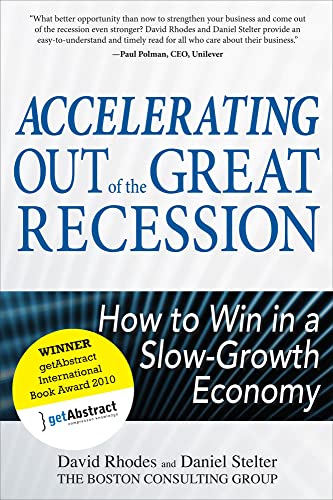
"What better opportunity than now to strengthen your business and come out of the recession even stronger? David Rhodes and Daniel Stelter provide an easy-to-understand perspective on the current economic environment, and some practical strategies to help readers come out ahead. A timely read for all who care about their business."
—Paul Polman, CEO, Unilever
"This is the most comprehensive assessment of the global economy that I've seen and is a must-read for any business, economic, or governmental-related leader".
Jeff M. Fettig, Chairman & CEO, Whirlpool Corporation
“A fascinating account of the causal factors of the meltdown and what we can do to avoid repetition.”
Sanjay Khosla, Executive Vice President and President, International for Kraft Foods
"This book combines brilliant analysis and strategic insight with a clear message: Companies that want to play a role in tomorrow's markets must act immediately. There's no place for complacency. The opportunities in the post-crisis world are good--and better than many might think."
Dr. Jürgen Hambrecht, CEO, BASF
"The lessons from companies that came out winners during past recessions are invaluable in the current context. Rhodes and Stelter strike a welcome note of optimism in today's tough times by showing that companies can do a lot to thrive when the global economy is struggling."
Dr. Dieter Zetsche, CEO, Daimler
"There are great lessons for today's chief executives: well-managed companies can prosper in the downturn and accelerate faster than their competitors in the upturn. Rhodes and Stelter have dug deep into history to vividly show how companies can do it."
Dr. Martin C. Halusa, CEO, Apax Partners Worldwide LLP
From the world's leading business strategy consultancy comes this essential guide to prospering in the aftermath of what is being called the Great Recession
Accelerating Out of the Great Recession, by The Boston Consulting Group's David Rhodes and Daniel Stelter, is a call to action for today's executives. It shows how companies can win in a slow-growth economy by seizing the initiative--differentiating themselves from less fleet-footed rivals and executing their strategies with single-minded determination.
It combines comprehensive and big-picture analysis of the global economic meltdown with smart management advice on how to win in an era of greater competition. The book is underpinned by a historical review of great companies that survived and thrived in past downturns, along with two new surveys of top executives and insights drawn from discussions with corporate leaders around the world. As such, it offers the clearest, most authoritative assessment yet of some present-day trends and "new realities"--and what they mean for business.
Accelerating Out of the Great Recession shows today's executives how to:
- Learn from the decisive actions taken by companies such as General Electric, IBM, and Proctor & Gamble in order to accelerate out of past downturns
- Take the fight to your competitors--diversify and expand now, while other businesses are affected by the downtown
- Shake off conventional wisdom to protect and grow your market share
- Develop a new managerial mindset for today's tough times
Backed by exceptional research and outstanding, up-to-the-minute advice, Accelerating Out of the Great Recession explains the magnitude and enduring nature of changes that have taken place in the global economy and how you can outperform today to create and sustain an advantage over your competitors for the long haul.
Die Inhaltsangabe kann sich auf eine andere Ausgabe dieses Titels beziehen.
Über die Autorin bzw. den Autor
David Rhodes is a senior partner and managing director of the London office of The Boston Consulting Group and the global leader of the Financial Institutions practice.
Daniel Stelter is a senior partner and managing director of the firm’s Berlin office and the global leader of the Corporate Development practice.
Auszug. © Genehmigter Nachdruck. Alle Rechte vorbehalten.
ACCELERATING OUT of the GREAT RECESSION
How to Win in a Slow-Growth Economy
By David Rhodes, Daniel StelterThe McGraw-Hill Companies, Inc.
Copyright © 2010 The Boston Consulting Group, Inc.
All rights reserved.
ISBN: 978-0-07-171814-1All rights reserved.
Contents
| ACKNOWLEDGMENTS | |
| INTRODUCTION In the Aftermath of the Great Recession | |
| PART ONE What Happened and What Happens Next | |
| CHAPTER 1 | |
| CHAPTER 2 | |
| PART TWO What To Do | |
| CHAPTER 3 | |
| CHAPTER 4 | |
| CHAPTER 5 | |
| CHAPTER 6 | |
| APPENDIX A About Our Methodology and Sources | |
| APPENDIX B About Our Surveys | |
| NOTES | |
| BIBLIOGRAPHY | |
| INDEX |
Excerpt
CHAPTER 1
The Damaged Economy
It is tempting to say that the crisis is over. The "Great Recession," as it isbeing called, did not turn into a second Great Depression. Unprecedentedintervention by central banks and governments averted worldwide economiccatastrophe.
And signs of stabilization have appeared: optimistic experts increasinglyoutnumber pessimistic experts, the slump has bottomed out, and pockets of growthhave emerged.
So why not declare an end to this gloomy chapter and get back to normal?
Because, unfortunately, the fundamental problems of the world economy have notyet been resolved. The dependence on heavy-spending consumers (particularly U.S.consumers) remains; many important banks are still weak, and it will take yearsbefore they return to full health; and the economic scoreboard shows a drop ineconomic activity not seen since World War II.
According to recent estimates from the International Monetary Fund (IMF), theworld economy shrank by 1.1 percent in 2009. The advanced economies (especiallythe exporting ones such as Germany, Japan, and Korea) suffered the most,shrinking by 3.4 percent during this period.
But even the emerging economies fared poorly—except China, whose growthrate (buoyed by fiscal stimulus) slowed to 8.5 percent in 2009 from 9.0 percentin 2008 and 13.0 percent in 2007. Russia contracted by 7.5 percent, having grownby 5.6 percent in 2008 and by 8.1 percent in 2007. Brazil fell by 0.7 percent,having enjoyed growth of 5.1 percent in 2008 and 5.7 percent in 2007. And Indiasaw growth of 5.4 percent, down from 7.3 percent in 2008 and 9.4 percent in2007.
The impact of the crisis on world economies would have been even worse withoutthe drastic measures taken by governments and central banks. Governmentsmobilized an unprecedented amount of money in an attempt to right their economicships. Estimates range from a massive $5 trillion to a truly staggering $18trillion to stabilize the financial sector and $2.5 trillion to stimulate demandin the "real economy"—where the production and consumption of goods andnonfinancial services takes place. The IMF puts the estimate at an impressive 29percent of 2008 gross domestic product for the advanced economies. Meanwhile,leading central banks have lowered interest rates and taken aggressive measuressuch as quantitative easing—the direct purchasing of financialassets such as government bonds. As a result, the balance sheets of the centralbanks have grown significantly since the crisis started in the summer of 2007.The U.S. Federal Reserve's balance sheet grew by 229 percent from July 2007 toJuly 2009.
These measures have arrested a slump that was, until the summer of 2009, lookingvery similar to the Great Depression of the 1930s. This was the picture paintedby Professors Barry Eichengreen of the University of California, Berkeley, andKevin H. O'Rourke of Trinity College in Dublin in their paper, "A Tale of TwoDepressions." Between 2007 and 2009, production and world trade dropped evenfaster than they did in the Great Depression. The major difference between thenand now has been the fiscal and monetary policy and the aggressive measurestaken to stabilize the global financial system. In making these moves,politicians and bankers did, in fact, heed the lessons of the Great Depressionand the Lost Decade in Japan. In so doing, they were acting on therecommendations of Depression-era economists such as Irving Fisher and JohnMaynard Keynes. Thanks to these coordinated efforts, a second Great Depressionwas avoided.
Even so, we need to recognize that the initiatives to "reflate" the globaleconomy amount to an unprecedented and historic experiment. Some of thesemeasures, although discussed theoretically, have not been put into practicebefore. So the big question remains: Is this the end of the crisis, or will thecrisis simply follow a different pattern?
To answer this question, we need to examine the background of the currentfinancial and economic upheaval since it burst into the public consciousness in2007.
How It Happened
We all know that a crash in U.S. property prices triggered a leverage crisis inthe subprime-mortgage securitization market. This, in turn, triggered a globalliquidity crisis, which itself contributed to a solvency crisis among some banksand an increase in the pressure to deleverage. When this led to a furtherdecline in asset prices, the whole cycle repeated itself.
It was inevitable that such enormous financial dislocation would lead tosignificant collateral damage to the real economy. Falling asset prices and theprospect of an economic slowdown dented consumer confidence. Lower demand and ashortage of credit—because of the liquidity squeeze—combined todrive companies toward conserving cash, reducing output, lowering capitalexpenditure, and laying off workers. Small and medium-sized enterprises wereparticularly affected as banks cut back their lending in an effort to stabilizetheir balance sheets, which, in turn, made a bad situation worse and drove somecompanies into bankruptcy.
The bottom line: the subprime crisis led to a solvency crisis in the financialsector. This, in turn, led to a recession in the real economy, which furtheramplified the problems for the financial sector as credit losses increased. Andas losses continue to increase and credit tightens, the constraints in thefinancial system collide with an increasing number of personal and corporateloan defaults that naturally follow when economic conditions deteriorate. Thetwo cycles feed off each other.
If there is one phenomenon that best characterizes the irrational behavior thatunderpins the crisis, it is the history of home values in the United States. AsRobert Shiller, an economics professor at Yale University, has demonstrated,U.S. house prices in any given year up to 1997 had virtually always been withinabout 15 percent of house prices in 1890, when adjusted for inflation (the onlyexception being the 25 percent drop between the two world wars). In 1997,though, U.S. house prices started to rise dramatically. In just 10 years, theinflation-adjusted price of a U.S. house doubled. In 2006, at the peak of thebubble, Shiller's index reached 202.9 (in 1890, the index stood at 100).
The increase in U.S. house prices was underpinned by the ready availability ofdebt, particularly after interest rates were cut to 1 percent in order tostimulate a faltering economy in the wake of the 9/11 terrorist attacks. From2005 to 2007, additional impetus was provided, first, in the form of aggressiverisk taking by highly leveraged financial...
„Über diesen Titel“ kann sich auf eine andere Ausgabe dieses Titels beziehen.
Suchergebnisse für Accelerating out of the Great Recession: How to Win...

Beispielbild für diese ISBN
Accelerating Out of the Great Recession: How to Win in a Slow-Growth Economy
Anbieter: Better World Books: West, Reno, NV, USA
Verkäuferbewertung 5 von 5 Sternen

Zustand: Good. Former library copy. Pages intact with minimal writing/highlighting. The binding may be loose and creased. Dust jackets/supplements are not included. Includes library markings. Stock photo provided. Product includes identifying sticker. Better World Books: Buy Books. Do Good. Artikel-Nr. 45103278-75
Gebraucht kaufen
EUR 8,80
Versand gratis
Versand innerhalb von USA
Versand innerhalb von USA
Anzahl: 1 verfügbar
Beispielbild für diese ISBN
Accelerating Out of the Great Recession: How to Win in a Slow-Growth Economy
Anbieter: Better World Books Ltd, Dunfermline, Vereinigtes Königreich
Verkäuferbewertung 5 von 5 Sternen
Zustand: Good. Pages intact with minimal writing/highlighting. The binding may be loose and creased. Dust jackets/supplements are not included. Stock photo provided. Product includes identifying sticker. Better World Books: Buy Books. Do Good. Artikel-Nr. 48396398-75
Gebraucht kaufen
EUR 5,57
EUR 5,82 Versand
Versand von Vereinigtes Königreich nach USA
Versand von Vereinigtes Königreich nach USA
Anzahl: 1 verfügbar
Beispielbild für diese ISBN
Accelerating Out of the Great Recession: How to Win in a Slow-Growth Economy
Anbieter: Better World Books Ltd, Dunfermline, Vereinigtes Königreich
Verkäuferbewertung 5 von 5 Sternen
Zustand: Very Good. Pages intact with possible writing/highlighting. Binding strong with minor wear. Dust jackets/supplements may not be included. Stock photo provided. Product includes identifying sticker. Better World Books: Buy Books. Do Good. Artikel-Nr. 39146167-20
Gebraucht kaufen
EUR 5,57
EUR 5,82 Versand
Versand von Vereinigtes Königreich nach USA
Versand von Vereinigtes Königreich nach USA
Anzahl: 1 verfügbar
Beispielbild für diese ISBN
Accelerating Out of the Great Recession
Anbieter: Hamelyn, Madrid, M, Spanien
Verkäuferbewertung 5 von 5 Sternen
Zustand: Como nuevo. : En 'Accelerating Out of the Great Recession: How to Win in a Slow-Growth Economy', David Rhodes y Daniel Stelter, del Boston Consulting Group, ofrecen una guía esencial para prosperar tras la Gran Recesión. Este libro es una llamada a la acción para los ejecutivos, mostrando cómo las empresas pueden diferenciarse de sus competidores y ejecutar estrategias con determinación. Combina análisis exhaustivos de la economía global con consejos de gestión inteligente, respaldado por una revisión histórica de empresas exitosas y encuestas a líderes corporativos. Aprenda de las acciones decisivas de empresas como General Electric, IBM y Procter & Gamble para superar las crisis, diversifique y expanda su negocio, y desarrolle una nueva mentalidad gerencial para tiempos difíciles. EAN: 9780071718141 Tipo: Libros Categoría: Negocios y Economía Título: Accelerating Out of the Great Recession Autor: David Rhodes| Daniel Stelter Editorial: McGraw Hill Idioma: en Páginas: 224 Formato: tapa dura. Artikel-Nr. Happ-2025-03-12-61082c84
Gebraucht kaufen
EUR 5,99
EUR 12,99 Versand
Versand von Spanien nach USA
Versand von Spanien nach USA
Anzahl: 1 verfügbar
Beispielbild für diese ISBN
Accelerating Out of the Great Recession: How to Win in a Slow-Growth Economy
Anbieter: medimops, Berlin, Deutschland
Verkäuferbewertung 5 von 5 Sternen
Zustand: good. Befriedigend/Good: Durchschnittlich erhaltenes Buch bzw. Schutzumschlag mit Gebrauchsspuren, aber vollständigen Seiten. / Describes the average WORN book or dust jacket that has all the pages present. Artikel-Nr. M00071718141-G
Gebraucht kaufen
EUR 4,37
EUR 20,00 Versand
Versand von Deutschland nach USA
Versand von Deutschland nach USA
Anzahl: 2 verfügbar
Beispielbild für diese ISBN
Accelerating Out of the Great Recession: How to Win in a Slow-Growth Economy
Anbieter: medimops, Berlin, Deutschland
Verkäuferbewertung 5 von 5 Sternen
Zustand: very good. Gut/Very good: Buch bzw. Schutzumschlag mit wenigen Gebrauchsspuren an Einband, Schutzumschlag oder Seiten. / Describes a book or dust jacket that does show some signs of wear on either the binding, dust jacket or pages. Artikel-Nr. M00071718141-V
Gebraucht kaufen
EUR 4,37
EUR 20,00 Versand
Versand von Deutschland nach USA
Versand von Deutschland nach USA
Anzahl: 4 verfügbar
Beispielbild für diese ISBN
Accelerating Out of the Great Recession: How to Win in a Slow-Growth Economy
Anbieter: medimops, Berlin, Deutschland
Verkäuferbewertung 5 von 5 Sternen
Zustand: as new. Wie neu/Like new. Artikel-Nr. M00071718141-N
Gebraucht kaufen
EUR 4,37
EUR 20,00 Versand
Versand von Deutschland nach USA
Versand von Deutschland nach USA
Anzahl: 1 verfügbar
Beispielbild für diese ISBN
Accelerating Out of the Great Recession
Verlag:
The McGraw-Hill Company, 2010
ISBN 10: 0071718141
ISBN 13: 9780071718141
Gebraucht
Hardcover
Anbieter: Majestic Books, Hounslow, Vereinigtes Königreich
Verkäuferbewertung 4 von 5 Sternen

Zustand: Used. pp. xix + 202. Artikel-Nr. 8281991
Gebraucht kaufen
EUR 22,21
EUR 7,57 Versand
Versand von Vereinigtes Königreich nach USA
Versand von Vereinigtes Königreich nach USA
Anzahl: 1 verfügbar
Beispielbild für diese ISBN
Accelerating Out Of The Great Recession: How To Win In A Slow-growth Economy
Anbieter: Romtrade Corp., STERLING HEIGHTS, MI, USA
Verkäuferbewertung 5 von 5 Sternen
Zustand: New. This is a Brand-new US Edition. This Item may be shipped from US or any other country as we have multiple locations worldwide. Artikel-Nr. ABBB-94451
Beispielbild für diese ISBN
Accelerating Out of the Great Recession
Verlag:
The McGraw-Hill Company, 2010
ISBN 10: 0071718141
ISBN 13: 9780071718141
Gebraucht
Hardcover
Anbieter: Biblios, Frankfurt am main, HESSE, Deutschland
Verkäuferbewertung 4 von 5 Sternen
Zustand: Used. pp. xix + 202. Artikel-Nr. 18647250
Gebraucht kaufen
EUR 23,09
EUR 9,95 Versand
Versand von Deutschland nach USA
Versand von Deutschland nach USA
Anzahl: 1 verfügbar