
Verwandte Artikel zu Cultures and Organizations: Software of the Mind, Third...
Cultures and Organizations: Software of the Mind, Third Edition: Intercultural Cooperation and Its Importance for Survival - Softcover
Buch 20 von 36: BUSINESS SKILLS AND DEVELOPMENT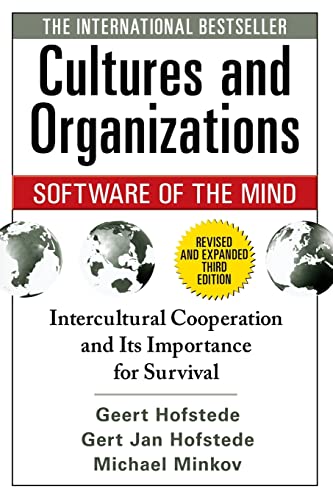
Inhaltsangabe
The revolutionary study of how the place where we grew up shapes the way we think, feel, and act-- with new dimensions and perspectives
Based on research conducted in more than seventy countries over a forty-year span, Cultures and Organizations examines what drives people apart—when cooperation is so clearly in everyone’s interest. With major new contributions from Michael Minkov’s analysis of data from the World Values Survey, as well as an account of the evolution of cultures by Gert Jan Hofstede, this revised and expanded edition:
- Reveals the “moral circles” from which national societies are built and the unexamined rules by which people think, feel, and act
- Explores how national cultures differ in the areas of inequality, assertiveness versus modesty, and tolerance for ambiguity
- Explains how organizational cultures differ from national cultures—and how they can be managed
- Analyzes stereotyping, differences in language, cultural roots of the 2008 economic crisis, and other intercultural dynamics
Die Inhaltsangabe kann sich auf eine andere Ausgabe dieses Titels beziehen.
Über die Autorin bzw. den Autor
McGraw-Hill authors represent the leading experts in their fields and are dedicated to improving the lives, careers, and interests of readers worldwide
Von der hinteren Coverseite
A study of how the place where we grew up shapes the way we think, feel, and act - with new dimensions and perspectives. Based on research conducted in more than seventy countries over a forty-year span, this title examines what drives people apart - when cooperation is so clearly in everyone's interest.
Auszug. © Genehmigter Nachdruck. Alle Rechte vorbehalten.
Cultures and Organizations
SOFTWARE OF THE MIND Intercultural Cooperation and Its Importance for Survival
By Geert Hofstede, Gert Jan Hofstede, Michael MinkovThe McGraw-Hill Companies, Inc.
Copyright © 2010 Geert Hofstede BV
All rights reserved.
ISBN: 978-0-07-166418-9All rights reserved.
Contents
| Preface | |
| PART I The Concept of Culture | |
| 1 The Rules of the Social Game | |
| 2 Studying Cultural Differences | |
| PART II Dimensions of National Cultures | |
| 3 More Equal than Others | |
| 4 I, We, and They | |
| 5 He, She, and (S)he | |
| 6 What Is Different Is Dangerous | |
| 7 Yesterday, Now, or Later? | |
| 8 Light or Dark? | |
| PART III Cultures in Organizations | |
| 9 Pyramids, Machines, Markets, and Families: Organizing Across Nations | |
| 10 The Elephant and the Stork: Organizational Cultures | |
| PART IV Implications | |
| 11 Intercultural Encounters | |
| 12 The Evolution of Cultures | |
| Notes | |
| Glossary | |
| Bibliography | |
| Name Index | |
| Subject Index |
Excerpt
CHAPTER 1
The Rules of the Social Game
11th juror: (rising) "I beg pardon, in discussing ..."
10th juror: (interrupting and mimicking) "I beg pardon. What are you sogoddam polite about?"
11th juror: (looking straight at the 10th juror) "For the same reasonyou're not. It's the way I was brought up."
—Reginald Rose, Twelve Angry Men
Twelve Angry Men is an American theater piece that became a famous motionpicture, starring Henry Fonda. The play was published in 1955. The scene consistsof the jury room of a New York court of law. Twelve jury members who nevermet before have to decide unanimously on the guilt or innocence of a boy from aslum area, accused of murder. The quote cited is from the second and final actwhen emotions have reached the boiling point. It is a confrontation between thetenth juror, a garage owner, and the eleventh juror, a European-born, probablyAustrian, watchmaker. The tenth juror is irritated by what he sees as theexcessively polite manners of the other man. But the watchmaker cannot behaveotherwise. Even after many years in his new home country, he still behaves theway he was raised. He carries within himself an indelible pattern of behavior.
Different Minds but Common Problems
The world is full of confrontations between people, groups, and nations whothink, feel, and act differently. At the same time these people, groups, andnations, just as with our twelve angry men, are exposed to common problems thatdemand cooperation for their solution. Ecological, economical, political,military, hygienic, and meteorological developments do not stop at national orregional borders. Coping with the threats of nuclear warfare, global warming,organized crime, poverty, terrorism, ocean pollution, extinction of animals,AIDS, or a worldwide recession demands cooperation of opinion leaders frommany countries. They in their turn need the support of broad groups of followers inorder to implement the decisions taken.
Understanding the differences in the ways these leaders and their followersthink, feel, and act is a condition for bringing about worldwide solutions thatwork. Questions of economic, technological, medical, or biological cooperationhave too often been considered as merely technical. One of the reasons why somany solutions do not work or cannot be implemented is that differences inthinking among the partners have been ignored.
The objective of this book is to help in dealing with the differences inthinking, feeling, and acting of people around the globe. It will show thatalthough the variety in people's minds is enormous, there is a structure in this varietythat can serve as a basis for mutual understanding.
Culture as Mental Programming
Every person carries within him- or herself patterns of thinking, feeling, andpotential acting that were learned throughout the person's lifetime. Much of itwas acquired in early childhood, because at that time a person is mostsusceptible to learning and assimilating. As soon as certain patterns ofthinking, feeling, and acting have established themselves within a person's mind,he or she must unlearn these patterns before being able to learn somethingdifferent, and unlearning is more difficult than learning for the first time.
Using the analogy of the way computers are programmed, this book will call suchpatterns of thinking, feeling, and acting mental programs, or, as per thebook's subtitle, software of the mind. This does not mean, ofcourse, that people are programmed the way computers are. A person's behavior isonly partially predetermined by his or her mental programs: he or she has a basicability to deviate from them and to react in ways that are new, creative,destructive, or unexpected. The software of the mind that this book is aboutonly indicates what reactions are likely and understandable, given one's past.
The sources of one's mental programs lie within the social environments in whichone grew up and collected one's life experiences. The programming starts withinthe family; it continues within the neighborhood, at school, in youthgroups, at the workplace, and in the living community. The European watchmakerfrom the quote at the beginning of this chapter came from a country and asocial class in which polite behavior is still at a premium today. Most people inthat environment would have reacted as he did. The American garage owner, whoworked himself up from the slums, acquired quite different mental programs. Mentalprograms vary as much as the social environments in which they were acquired.
A customary term for such mental software is culture. This word hasseveral meanings, all derived from its Latin source, which refers to the tillingof the soil. In most Western languages culture commonly means"civilization" or "refinement of the mind" and in particular the results of suchrefinement, such as education, art, and literature. This is culture in the narrowsense. Culture as mental software, however, corresponds to a much broaderuse of the word that is common among sociologists and, especially,anthropologists: this is the meaning that will be used throughout this book.
Social (or cultural) anthropology is the science of human societies—inparticular (although not only) traditional or "primitive" ones. In socialanthropology, culture is a catchword for all those patterns of thinking,feeling, and acting referred to in the previous paragraphs. Not only activitiessupposed to refine the mind are included, but also the ordinary and menialthings in life: greeting, eating, showing or not showing feelings, keeping acertain physical distance from others, making love, and maintaining body hygiene.
Culture is always a collective phenomenon, because it is at least partly sharedwith people who live or lived within the same social environment, which is whereit was learned. Culture consists of the unwritten rules of the social game.It is the collective programming of the mind that distinguishes the membersof one group or category of people from others.
Culture is learned, not...
„Über diesen Titel“ kann sich auf eine andere Ausgabe dieses Titels beziehen.
Suchergebnisse für Cultures and Organizations: Software of the Mind, Third...

Beispielbild für diese ISBN
Cultures and Organizations: Software of the Mind, Third Edition
Verlag:
McGraw-Hill Education - Europe, 2010
ISBN 10: 0071664181
ISBN 13: 9780071664189
Gebraucht
Paperback
Anbieter: World of Books (was SecondSale), Montgomery, IL, USA
Verkäuferbewertung 5 von 5 Sternen

Paperback. Zustand: Very Good. A study of how the place where we grew up shapes the way we think, feel, and act - with new dimensions and perspectives. Based on research conducted in more than seventy countries over a forty-year span, this title examines what drives people apart - when cooperation is so clearly in everyone's interest. Artikel-Nr. 00109597718
Gebraucht kaufen
EUR 5,58
Versand gratis
Versand innerhalb von USA
Versand innerhalb von USA
Anzahl: 1 verfügbar
Beispielbild für diese ISBN
Cultures and Organizations: Software of the Mind, Third Edition
Verlag:
McGraw-Hill Education - Europe, 2010
ISBN 10: 0071664181
ISBN 13: 9780071664189
Gebraucht
Paperback
Anbieter: World of Books (was SecondSale), Montgomery, IL, USA
Verkäuferbewertung 5 von 5 Sternen
Paperback. Zustand: Good. A study of how the place where we grew up shapes the way we think, feel, and act - with new dimensions and perspectives. Based on research conducted in more than seventy countries over a forty-year span, this title examines what drives people apart - when cooperation is so clearly in everyone's interest. Artikel-Nr. 00105336686
Gebraucht kaufen
EUR 5,58
Versand gratis
Versand innerhalb von USA
Versand innerhalb von USA
Anzahl: 11 verfügbar
Beispielbild für diese ISBN
Cultures and Organizations: Software of the Mind, Third Edition
Verlag:
McGraw-Hill Education - Europe, 2010
ISBN 10: 0071664181
ISBN 13: 9780071664189
Gebraucht
Paperback
Anbieter: World of Books (was SecondSale), Montgomery, IL, USA
Verkäuferbewertung 5 von 5 Sternen
Paperback. Zustand: Fair. A study of how the place where we grew up shapes the way we think, feel, and act - with new dimensions and perspectives. Based on research conducted in more than seventy countries over a forty-year span, this title examines what drives people apart - when cooperation is so clearly in everyone's interest. Artikel-Nr. 00101326659
Gebraucht kaufen
EUR 5,58
Versand gratis
Versand innerhalb von USA
Versand innerhalb von USA
Anzahl: 1 verfügbar
Foto des Verkäufers
Cultures and Organizations: Software of the Mind, Third Edition
Anbieter: Dream Books Co., Denver, CO, USA
Verkäuferbewertung 5 von 5 Sternen
Zustand: acceptable. This copy has clearly been enjoyedâ"expect noticeable shelf wear and some minor creases to the cover. Binding is strong, and all pages are legible. May contain previous library markings or stamps. Artikel-Nr. DBV.0071664181.A
Gebraucht kaufen
EUR 5,59
Versand gratis
Versand innerhalb von USA
Versand innerhalb von USA
Anzahl: 1 verfügbar
Foto des Verkäufers
Cultures and Organizations: Software of the Mind, Third Edition
Anbieter: Dream Books Co., Denver, CO, USA
Verkäuferbewertung 5 von 5 Sternen
Zustand: good. Gently used with minimal wear on the corners and cover. A few pages may contain light highlighting or writing, but the text remains fully legible. Dust jacket may be missing, and supplemental materials like CDs or codes may not be included. May be ex-library with library markings. Ships promptly! Artikel-Nr. DBV.0071664181.G
Gebraucht kaufen
EUR 5,59
Versand gratis
Versand innerhalb von USA
Versand innerhalb von USA
Anzahl: 1 verfügbar
Beispielbild für diese ISBN
Cultures and Organizations: Software of the Mind, Third Edition
Anbieter: Better World Books: West, Reno, NV, USA
Verkäuferbewertung 5 von 5 Sternen
Zustand: Very Good. Pages intact with possible writing/highlighting. Binding strong with minor wear. Dust jackets/supplements may not be included. Stock photo provided. Product includes identifying sticker. Better World Books: Buy Books. Do Good. Artikel-Nr. 7927586-6
Gebraucht kaufen
EUR 10,66
Versand gratis
Versand innerhalb von USA
Versand innerhalb von USA
Anzahl: 1 verfügbar
Beispielbild für diese ISBN
Cultures and Organizations: Software of the Mind, Third Edition
Anbieter: Better World Books, Mishawaka, IN, USA
Verkäuferbewertung 5 von 5 Sternen
Zustand: Good. Pages intact with minimal writing/highlighting. The binding may be loose and creased. Dust jackets/supplements are not included. Stock photo provided. Product includes identifying sticker. Better World Books: Buy Books. Do Good. Artikel-Nr. 5472922-6
Gebraucht kaufen
EUR 10,66
Versand gratis
Versand innerhalb von USA
Versand innerhalb von USA
Anzahl: 1 verfügbar
Beispielbild für diese ISBN
Cultures and Organizations: Software of the Mind, Third Edition: Software of the Mind: Intercultural Cooperation and Its Importance for Survival (BUSINESS SKILLS AND DEVELOPMENT)
Anbieter: WorldofBooks, Goring-By-Sea, WS, Vereinigtes Königreich
Verkäuferbewertung 5 von 5 Sternen
Paperback. Zustand: Very Good. The book has been read, but is in excellent condition. Pages are intact and not marred by notes or highlighting. The spine remains undamaged. Artikel-Nr. GOR005712641
Gebraucht kaufen
EUR 5,40
EUR 6,71 Versand
Versand von Vereinigtes Königreich nach USA
Versand von Vereinigtes Königreich nach USA
Anzahl: 2 verfügbar
Beispielbild für diese ISBN
Cultures and Organizations: Software of the Mind, Third Edition
Anbieter: Better World Books Ltd, Dunfermline, Vereinigtes Königreich
Verkäuferbewertung 5 von 5 Sternen
Zustand: Very Good. Former library copy. Pages intact with possible writing/highlighting. Binding strong with minor wear. Dust jackets/supplements may not be included. Includes library markings. Stock photo provided. Product includes identifying sticker. Better World Books: Buy Books. Do Good. Artikel-Nr. GRP101935520
Gebraucht kaufen
EUR 6,61
EUR 5,99 Versand
Versand von Vereinigtes Königreich nach USA
Versand von Vereinigtes Königreich nach USA
Anzahl: 1 verfügbar