
Verwandte Artikel zu The Master Swing Trader Toolkit: The Market Survival...
Inhaltsangabe
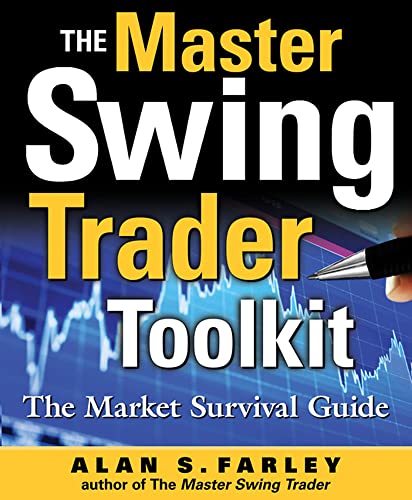
With more than 50,000 copies sold, Alan Farley's The Master Swing Trader has become the definitive guide for maximizing profit from short-term price moves. Now in his highly anticipated companion volume, The Master Swing Trader Toolkit: The Market Survival Guide, Farley builds on his proven strategies and techniques and delivers new tips for consistently beating the markets- today and in the future. The Master Swing Trader Toolkit is a powerful application-oriented handbook that shows you how to identify and grow wealth from the opportunities resulting from the steep market crash. Additionally, this full-service volume offers prescriptions for prospering in the postcrash environment and provides guidance for finding new, reduced-risk market prospects during virtually any economic scenario to come. The author's trading style has evolved since the publication of The Master Swing Trader. This follow-up companion helps you adapt and gain an edge as the author has, specifically in the vein of "defensive trading," to achieve profitability in the modern electronic markets. Because The Master Swing Trader Toolkit is a survival guide for the real world, Farley presents an abundance of authentic case studies to show his defensive trading strategies in action, and he illustrates a broad variety of other patterns and observations acting in specific market scenarios. The Master Swing Trader Toolkit prepares you for success in the financial landscape of today and tomorrow with insightful, up-todate coverage on: Cross-market analysis Convergence-divergence relationships Relative strength Managing multiple positions Remote trading Risk management At its core, The Master Swing Trader Toolkit: The Market Survival Guide is a book about tape reading. The ticker tape is immune from manipulation, deconstruction, regulation, and fragmentation, which makes it the most powerful tool for attaining wealth. Get the most out of what you read by starting with The Master Swing Trader Toolkit.
Die Inhaltsangabe kann sich auf eine andere Ausgabe dieses Titels beziehen.
Über die Autorin bzw. den Autor
Alan S. Farley (Denver, CO) is publisher and editor of HardRightEdge.com, an online trader's resource covering technical analysis, short-term trading tactics, an more. A professional trader with more than 14 years experience, Farley has been featured in Barron's, SmartMoney, Tech Week, and TheStreet.com.
Von der hinteren Coverseite
Master today’s volatile stock markets—and profit in the years to come
If you’re a trader or an investor who was beaten up by the financial crash, this book waswritten for you. So dust yourself off, get back in the game, and start reading this brilliantnew companion to the bestselling investing guide The Master Swing Trader.
This expert playbook is packed with rock-solid advice for winning in today’s markets andpositioning yourself for future opportunities. Learn how to take advantage of new marketplays with reduced risk, make profitable decisions with the help of market-tested investingstrategies, and master the art of defensive trading to hold on to gains in volatile markets.The Master Swing Trader Toolkit shows you how to:
- Evolve core principles into brand-new marketstrate gies for this decade
- Become a “survivalist trader”
- Read the market clock and anticipate market seasonality
- Achieve greater gains throughconvergence-divergence relationships
The Master Swing Trader Toolkit gives you a set of up-to-date tools for seeing past theinefficiencies of today’s follow-the-herd markets and profiting from the resulting highprobabilitytrade setups before they disappear. With The Master Swing Trader Toolkit, you’llnever be caught short again when the market is running.
Auszug. © Genehmigter Nachdruck. Alle Rechte vorbehalten.
THE Master Swing Trader Toolkit
The Market Survival Guide
By ALAN S. FARLEYThe McGraw-Hill Companies, Inc.
Copyright © 2010 The McGraw-Hill Companies, Inc.
All rights reserved.
ISBN: 978-0-07-166400-4All rights reserved.
Contents
| Foreword | |
| Preface | |
| Acknowledgments | |
| PART ONE PARSING THE MODERN MARKETS | |
| Chapter 1 Prospering in the Postcrash Environment | |
| Chapter 2 The Crooked Playing Field | |
| PART TWO CYCLES, SHOCKS, AND SEASONALITY | |
| Chapter 3 Revisiting the Market Clock | |
| Chapter 4 Relative Strength | |
| PART THREE REDISCOVERING PROFITABILITY | |
| Chapter 5 The Nature of Winning | |
| Chapter 6 survivalist Trading strategies | |
| PART FOUR MANAGING OPPORTUNITY | |
| Chapter 7 Market Entry | |
| Chapter 8 Positions, Markets, and Trading styles | |
| PART FIVE CONTROLLING EXPOSURE | |
| Chapter 9 Position Management | |
| Chapter 10 Mastering the Intraday Market | |
| PART SIX MANAGING RISK AND REWARD | |
| Chapter 11 The Nature of Losing | |
| Chapter 12 Capital Preservation | |
| Glossary | |
| Bibliography | |
| Index |
Excerpt
CHAPTER 1
PROSPERING IN THE POSTCRASH ENVIRONMENT
The markets have never been a pretty place. Just ask those Dutch traders whobought into the tulip mania back in the seventeenth century. You think the realestate bubble was bad? Imagine paying the modern day equivalent of $10,000 for asingle tulip bulb, sight unseen. Where were the attorneys general and the SECenforcers back then, when they were really needed?
To be frank, I like my markets just the way they are, warts and all. And I'mconvinced that world capitalism would get a lot worse if we didn't have a goodplace to make bad decisions, at least between 9:30 a.m. and 4:00 p.m. New Yorktime. Maybe that's why I cringe whenever government bureaucrats or stateprosecutors step onto our sacred ground.
You see, we earn a living when other people put on their dumb hats and buy toohigh or sell too low. No, folks like us don't build bridges, sell suits, or leadtheir flocks to salvation. To be realistic, we contribute absolutely nothing tosociety except pure liquidity and an aggressive attitude. And you know what? Iwouldn't have it any other way, because the trading game works directly with themachine language of the world monetary system and is the only profession I knowthat doesn't depend on a boss, a company, or an economy. At its core, our uniquebusiness feeds ruthlessly off the excesses of the marketplace, and it justwouldn't be the same without all the manipulation, misinformation, and monkeybusiness.
Many former investors now hate the financial markets and anyone who prospersthrough trading or speculation. With biblical fervor, these folks believe thatjustice must rain down on the greedy bastards who still appreciate themarketplace or prosper from its existence. Amazingly, many of these self-righteous critics still follow the market's every twist and turn through theirfavorite news channel or Web portal. Talk about hypocrisy!
I have a standard response whenever I get attacked for my continued faith intrading, capitalism, and the modern markets. It goes something like this: Whywaste your time if you're getting angry and upset reading the financial news?Take up knitting instead, or, better yet, join a political party. I'm sureyou'll be much happier in your misery, and Mr. Market will be a much kindergentleman without your daily attendance.
To quote a famous fictional trader, greed is good. Greed pays the bills and getsthe kids through college. Greed also performs an important community service. Itrelieves the misinformed of their excess capital and gives it to those moredeserving of its ownership. Indeed, pure unadulterated greed greases the engineof worldwide market inefficiency. And, without question, the twenty-first-century trader must be greedy in order to develop the predatory style requiredto prosper in our modern electronic markets. This fact of life may bedistasteful to folks who still believe in the tooth fairy or in Robin Hood, butthe rest of us understand there will be a loser for every winner, and everyonewho plays the financial markets has to choose whether to take—or gettaken.
THE PARADOX
The next two declarations are true on multiple levels, but they're also totallycontradictory. The markets (a) are the same now as they were one hundred yearsago, with timeless principles moving the tape, and (b) have changed radically inthe last decade and no longer operate according to timeless principles. Thereinlies the challenge for traders at all levels as we head into the second decadeof the new millennium. In a nutshell, we've read all the technical analysisbooks, attended all the seminars, and listened to all the market gurus andtalking heads. But nothing, absolutely nothing, has prepared us for the surrealscience fiction landscape we're now forced to navigate each day.
Of course, it starts with the trading bots. We knew the influence of programtrading would grow when we saw its handiwork between 3 and 4 p.m. New York timeback in the 1990s. But who could have predicted that coldhearted algorithmswould become the overriding force in price development, on a daily basis, just10 years later. On the surface, computerized trading is a great addition to themarketplace because it adds significant liquidity to the ticker tape. But thesealgorithms lack the singular force of nature we could always count on throughoutour years of flipping stocks, futures, and currencies: they operate without thetwin emotions of greed or fear.
That's right, trading bots won't panic when they find themselves on the wrongside of the market and won't get euphoric after good news delivers a windfallprofit. In other words, they don't act or react to the financial markets likeyou or I, our neighbors, or those suits on Wall Street. They're cold,calculating, and totally focused on their one-minded goal to move the markets intheir favor. Sadly, today's state-of-the-art algorithms wouldn't work with suchdiabolical precision if the market's historic center of gravity still existed.For all our complaints in the 1990s about the NYSE specialists and Nasdaq marketmakers, those savvy middlemen kept the trading bots in a controlled space, fromwhich we flesh-and-blood players could coexist in an uneasy peace.
That delicate balance was lost, perhaps forever, when electronic executionsystems killed the middlemen around 2005 and replaced their overriding role inmaintaining orderly markets with the ephemeral barrage of bid-ask prices thatnow flash across our screens at the speed of light. Retail traders like you andme have been forced to operate since that time in a desolate Mad Max landscapethat has become the centerpiece of our twenty-first-century auction place.
Wait a second. If things are really that out of control, why don't weall just give up and find another moneymaking hobby, like poker or macramé?Well, as it turns out, you can only screw around so much with the modern marketenvironment before it bites back. Whenever the tape gets a little too crazy,manipulated, or downright...
„Über diesen Titel“ kann sich auf eine andere Ausgabe dieses Titels beziehen.
Suchergebnisse für The Master Swing Trader Toolkit: The Market Survival...

Beispielbild für diese ISBN
The Master Swing Trader Toolkit: The Market Survival Guide
Verlag:
McGraw-Hill Education - Europe, 2010
ISBN 10: 0071664009
ISBN 13: 9780071664004
Gebraucht
Hardcover
Anbieter: World of Books (was SecondSale), Montgomery, IL, USA
Verkäuferbewertung 5 von 5 Sternen

Hardback. Zustand: Good. The highly anticipated "sequel" to one of our bestselling trading guides. Artikel-Nr. 00110619059
Gebraucht kaufen
EUR 15,31
Versand gratis
Versand innerhalb von USA
Versand innerhalb von USA
Anzahl: 3 verfügbar
Beispielbild für diese ISBN
The Master Swing Trader Toolkit: The Market Survival Guide
Anbieter: ThriftBooks-Dallas, Dallas, TX, USA
Verkäuferbewertung 5 von 5 Sternen
Hardcover. Zustand: Very Good. No Jacket. May have limited writing in cover pages. Pages are unmarked. ~ ThriftBooks: Read More, Spend Less. Artikel-Nr. G0071664009I4N00
Gebraucht kaufen
EUR 18,95
Versand gratis
Versand innerhalb von USA
Versand innerhalb von USA
Anzahl: 1 verfügbar
Beispielbild für diese ISBN
The Master Swing Trader Toolkit: The Market Survival Guide
Anbieter: WorldofBooks, Goring-By-Sea, WS, Vereinigtes Königreich
Verkäuferbewertung 5 von 5 Sternen
Hardback. Zustand: Very Good. The book has been read, but is in excellent condition. Pages are intact and not marred by notes or highlighting. The spine remains undamaged. Artikel-Nr. GOR007856519
Gebraucht kaufen
EUR 71,76
EUR 6,68 Versand
Versand von Vereinigtes Königreich nach USA
Versand von Vereinigtes Königreich nach USA
Anzahl: 1 verfügbar