
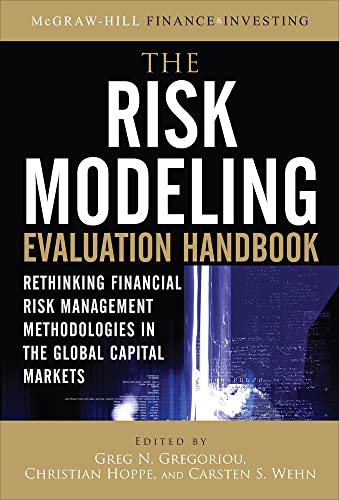
The Risk Modeling Evaluation Handbook: Rethinking Financial Risk Management Methodologies in the Global Capital Markets - Hardcover
Inhaltsangabe
The first in-depth analysis ofinherent deficiencies in present practices
“A book like this helps reduce the chance of a future breakdown in risk management.”
Professor Campbell R. Harvey, the Fuqua School of Business, Duke University
“A very timely and extremely useful guide to the subtle and often difficultissues involved in model risk—a subject which is only now gaining theprominence it should always have had.”
Professor Kevin Dowd, Nottingham University Business School, the University of Nottingham
“This book collects authoritative papers on a timely and important topic . . .and should lead to many new insights.”
Professor Philip Hans Franses, Erasmus School of Economics, Erasmus University
“Inadequate valuation and risk management models have played their part intriggering the recent economic turmoil felt around the world. This timely book,written by experts in the field of model risk, will surely help risk managers andfinancial engineers measure and manage risk effectively.”
Dr. Fabrice Douglas Rouah, Vice President, State Street Corporation
“This invaluable handbook has been edited by experts . . . and should prove to beof great value to investment finance and credit risk modelers in a wide range ofdisciplines related to portfolio risk, risk modeling in finance, international moneyand finance, country risk, and macroeconomics.”
Professor Michael McAleer, Erasmus School of Economics, Erasmus University
About the Book:
If we have learned anything from the globalfinancial collapse of 2008, it is this: themathematical risk models currently used byfinancial institutions are no longer adequatequantitative measures of risk exposure.
In The Risk Modeling Evaluation Handbook,an international team of 48 experts evaluatesthe problematic risk-modeling methodsused by large financial institutions and breaksdown how these models contributed to thedecline of the global capital markets. Theirconclusions enable you to identify the shortcomingsof the most widely used risk modelsand create sophisticated strategies for properlyimplementing these models into your investingportfolio.
Chapters include:
- Model Risk: Lessons from Past Catastrophes(Scott Mixon)
- Effect of Benchmark Misspecification on RiskadjustedPerformance Measures (Laurent Bodsonand George Hübner)
- Carry Trade Strategies and the Information Content ofCredit Default Swaps (Raphael W. Lam andMarco Rossi)
- Concepts to Validate Valuation Models(Peter Whitehead)
- Beyond VaR: Expected Shortfall and Other CoherentRisk Measures (Andreas Krause)
- Model Risk in Credit Portfolio Modeling(Matthias Gehrke and Jeffrey Heidemann)
- Asset Allocation under Model Risk (Pauline M. Barrieuand Sandrine Tobolem)
This dream team of the masters of riskmodeling provides expansive explanations ofthe types of model risk that appear in riskmeasurement, risk management, and pricing,as well as market-tested techniques formitigating risk in loan, equity, and derivativeportfolios.
The Risk Modeling Evaluation Handbook is thego-to guide for improving or adjusting yourapproach to modeling financial risk.
Die Inhaltsangabe kann sich auf eine andere Ausgabe dieses Titels beziehen.
Über die Autorin bzw. den Autor
Greg N. Gregoriou is professor of finance in theSchool of Business and Economics at StateUniversity of New York (Plattsburgh). He isthe author of numerous financial books andcoeditor for the Journal of Derivatives andHedge Funds.
Christian Hoppe is group head of credit solutionsin the corporate banking division of CommerzbankAG Frankfurt. He is cofounder andCEO of the Anleihen Finder GmbH.
Carsten S. Wehn is head of market risk control atDekaBank, Frankfurt, where he is responsiblefor measuring market and liquidity risk,developing risk methods and models, andvalidating the adequacy of the respective riskmodels.
Auszug. © Genehmigter Nachdruck. Alle Rechte vorbehalten.
THE RISK MODELING EVALUATION HANDBOOK
Rethinking Financial Risk Management Methodologies in the Global Capital MarketsThe McGraw-Hill Companies, Inc.
Copyright © 2010 The McGraw-Hill Companies, Inc.All right reserved.
ISBN: 978-0-07-166370-0
Contents
Chapter One
MODEL RISK Lessons from Past Catastrophes
Scott Mixon
ABSTRACT
Financial engineers should study past crises and model breakdowns rather than simply extrapolate from recent successes. The first part of this chapter reviews the 2008 disaster in convertible bonds and convertible arbitrage. Next, activity in nineteenth-century option markets is examined to explore the importance of modern theory in pricing derivatives. The final section reviews the linkage between theory and practice in bridge building. The particularly interesting analogy is the constructive direction taken by engineers after the highly visible, catastrophic failure of the Tacoma Narrows Bridge in Washington in 1940. Engineers were reminded that highly realistic models may increase the likelihood of failure if they reduce the buffer against factors ignored by the model. Afterward, they focused efforts on making bridges robust enough to withstand eventualities they did not fully understand and could not forecast with accuracy.
MODEL RISK: LESSONS FROM PAST CATASTROPHES
The holddown cables stabilizing the bridge began to vibrate in the wind around 3:30 in the morning, as the storm increased. The bridge was oscillating by 8 a.m., allowing a driver to watch the car up ahead disappear into a trough. Yet this was nothing new for the bridge nicknamed "Galloping Gertie." An hour later, the tiedown cables cracked like whips as they alternately tightened and slackened.
The twisting began around 10 a.m. Winds were only 45 miles per hour, but the bridge was pivoting around the center line of the two-lane roadway. One lane would lift up 45 degrees, and the other would twist down by the same amount. The bridge was twisting itself to pieces. A major section of roadway, hundreds of feet long, fell into Gig Harbor at 11 a.m. Ten more minutes and the remainder of the bridge (plus two abandoned cars and a dog) was gone. Leon Moisseiff, prominent engineering theorist and designer of the bridge, was completely at a loss to explain the disaster.
The collapse of the Tacoma Narrows Bridge took with it the entire trajectory and hubris of the suspension bridge building industry. The bridge lasted just four months, and it failed in winds less than half the 100 miles per hour for which it was designed to withstand. The dramatic collapse was captured on film, so the world saw the images repeated over and over in newsreels.
Suspension bridges had become longer and thinner in the decades before the Tacoma Narrows collapse in 1940. The George Washington Bridge, spanning the Hudson River into New York City, epitomized this trend. Built according to the most advanced theories, it had doubled the length of the longest suspension span extant before its 1931 completion. Engineers were under pressure from the economic realities of the Great Depression to reduce costs, while theoretical advances showed that conventional bridge designs were considerably overengineered. Suspension bridges had moved from designs in which the suspending cables were superfluous to ones in which cables were the dominant element.
Moisseiff and Lienhard's (1933) extension of existing theory meant that wind loads carried by the suspended structure of the George Washington Bridge, for example, were 80 percent lower than previously thought. The cables carried the weight. It was only natural that Moisseiff's Tacoma Narrows design would incorporate this economically appealing feature. The bridge had a width to span ratio of 1:72, even though a more traditional ratio was 1:30. It was a narrow, two-lane highway suspended in the sky, and it was theoretically justified to carry its loads adequately. For four months, it did.
Engineers had built little margin of safety into the Tacoma Narrows Bridge. It was elegant, economical, and theoretically justified. Moving to more realistic theories of load bearing ironically led to catastrophic failure, since the theories provided little buffer against risk factors not considered in the models. Henry Petroski (1994) has noted that the reliance on theory, with little first-hand experience of the failures from decades before, led to a design climate in which elements of recent successes were extended beyond their limits. Petroski therefore recommended that engineers carefully study past design failures in order to improve their current design process. This chapter adopts Petroski's logic to model risk evaluation for financial engineers.
INTRODUCTION
First, we discuss the disaster in the convertible bond market during 2008 and pay particular attention to the difficulties faced by the model-intensive convertible arbitrage strategy. Next, we review the activity in option markets in the nineteenth century to explore the importance of modern theory in pricing derivatives. This is followed by a section reviewing the linkage between theory and practice in bridge building. It highlights the direction taken by the engineering profession after the highly visible, catastrophic failure of the Tacoma Narrows Bridge in 1940. The final section provides concluding thoughts.
The goal of bringing together such disparate topics is to provide a broad perspective on model risk. Some of the key issues addressed are: (1) How can we best frame themes regarding model breakdowns during market crises? (2) What can the careful study of the evolution of derivatives markets and no-arbitrage pricing models suggest for robustifying market practice against traumatic shocks? (3) What can be learned from the experiences of other disciplines that have suffered catastrophic failures when moving from theory to reality?
There are some straightforward conclusions for this chapter. First, financial engineers should study past crises and model breakdowns rather than simply extrapolate from recent successes. Second, theoretical advances have had a profound impact on the pricing of derivative securities and the mindset for financial engineering, but the real world is tricky. Highly realistic models may increase the likelihood of failure if they reduce the buffer against factors glossed over by the model. For example, highly complex no-arbitrage models may fail miserably when trading is not continuous and arbitrage opportunities exist for a period of time (i.e., when liquidity disappears).
Financial engineers can look to the experience of the civil engineering profession after the traumatic failure of the Tacoma Narrows suspension bridge in 1940. Bridge builders could have concluded that their theories were too naïve to build economical bridges as long as the ones proposed. They did not throw out the models or abandon the practice of bridge construction. Rather, they focused efforts at making bridges robust enough to withstand eventualities they did not fully understand and could not forecast with accuracy.
Faced with calamities such as the recent one in the financial markets, one could take the position that highly quantitative models are dangerous and should be thrown out. This idea is completely unjustified. A key idea running through this chapter is that some of the assumptions behind derivatives modeling, such as continuous, frictionless trading at a single market price (i.e., the absence of arbitrage) can fail at critical moments. Engineers (and drafters of legal documentation) should seek ways to...
„Über diesen Titel“ kann sich auf eine andere Ausgabe dieses Titels beziehen.
Suchergebnisse für The Risk Modeling Evaluation Handbook: Rethinking Financial...

Beispielbild für diese ISBN
The Risk Modeling Evaluation Handbook: Rethinking Financial Risk Management Methodologies in the Global Capital Markets
Anbieter: Zubal-Books, Since 1961, Cleveland, OH, USA
Verkäuferbewertung 5 von 5 Sternen

Zustand: New. 528 pp., hardcover, new in a new dust jacket. - If you are reading this, this item is actually (physically) in our stock and ready for shipment once ordered. We are not bookjackers. Buyer is responsible for any additional duties, taxes, or fees required by recipient's country. Artikel-Nr. ZB1314332
Neu kaufen
EUR 36,76
EUR 3,87 Versand
Versand innerhalb von USA
Versand innerhalb von USA
Anzahl: 1 verfügbar