
Verwandte Artikel zu Boundary Spanning Leadership: Six Practices for Solving...
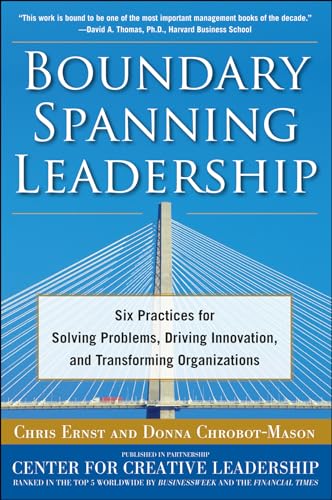
Boundary Spanning Leadership: Six Practices for Solving Problems, Driving Innovation, and Transforming Organizations - Hardcover
Inhaltsangabe
PRAISE FOR BOUNDARY SPANNING LEADERSHIP
"Fostering a culture of teamwork among business units and partners is crucial for bottom-line success. This groundbreaking book, packed with practical examples and based on solid research, shows us how to get started." -- Marc Noel, Chairman, Noël Group LLC
"In this deeply insightful look at the demands on 21st-century leaders, Ernst and Chrobot-Mason outline six boundary spanning leadership practices derived from case studies and research with thousands of participating managers. This work is bound to be one of the mostimportant management books of the decade." -- David A. Thomas, Ph.D., H. Naylor Fitzhugh Professor ofBusiness Administration at Harvard Business School
"Few books capture the needs and narrative of today's business and so elegantly lay out a plan to address its challenges. Boundary Spanning Leadership nails this . . . Consume it and play your role!" -- Andy Stefanovich, Chief Curator and Provocateur, Prophet
"Boundary Spanning Leadership draws on rigorous global research and real-world experience to help leaders move into new frontiers where they can find answers and practices for creating success." -- Jack Stahl, former CEO, Revlon, and President /COO, Coca-Cola
"The future will be punctuated by new spans across old boundaries. This book shows you how to improve your span ability." -- Bob Johansen, Ph.D., Distinguished Fellow, Institute for the Future, and bestselling author ofGet There Early and Leaders Make the Future
Catalyze collaboration, drive innovation, transform your organization--with Boundary Spanning Leadership you can put it ALL together!
We live in a world of vast collaborative potential. Yet all too often, powerful boundaries create barriers that can splinter groups. And this can lead to uninspiring results. To transform borders into frontiers in today's global, multistakeholder organizations, you needBoundary Spanning Leadership.
Powered by a decade of global research and practice by the top-ranked Center for Creative Leadership (CCL), this book takes you from rural towns in the United States to Hong Kong's skyline and from a modernizing South Africa to the bustling streets of India, showing you how to build bridges across boundaries.
Through compelling stories and practical tools and tactics, you’ll learn how to apply the six boundary spanning practices that occur at the nexus where groups collide, intersect, and link:
- Buffering defines boundaries to create safety
- Reflecting creates understanding of boundaries to foster respect
- Connecting suspends boundaries to build trust
- Mobilizing reframes boundaries to develop community
- Weaving interlaces boundaries to advance interdependence
- Transforming cross-cuts boundaries to enable reinvention
Together, these practices combine to create what authors Chris Ernst and Donna Chrobot-Mason call the Nexus Effect. The Nexus Effect allows groups to be more agile in response to changing markets; be more flexible in devising and deploying cross-functional learning and problem-solvingcapabilities; work with partners in deeper, more open relationships; empower virtual teams; and create a welcoming, diverse, and inclusive organization that brings out everybody's best.
Boundaries exist. What matters most is how you work to bridge these divides and transform your organization's wide-ranging talents and knowledge to deliver value. With Boundary Spanning Leadership, the possibilities are limitless.
For more about the book and free resources, visit www.spanboundaries.com.
Die Inhaltsangabe kann sich auf eine andere Ausgabe dieses Titels beziehen.
Über die Autorinnen und Autoren
Chris Ernst is a Senior Enterprise faculty member for the Center for Creative Leadership, the leading global nonprofit institution dedicated exclusively to leadership. He is a coauthor of Success for the New Global Manager:How to Work across Distances, Countries, and Cultures. He lives in Raleigh, NC.
Donna Chrobot-Mason is an associate professor in the psychology department at the University of Cincinnati and director of the Center for Organizational Leadership. She has presented at nearly 50 conferences and has published numerous journal articles on diversity andleadership topics. She lives near Cincinnati, OH.
Today's world spans boundaries. So, too, must leadership. Read the book, then join the conversation at www.spanboundaries.com.
Chris Ernst is a Senior Enterprise faculty member for the Center for Creative Leadership, the leading global nonprofit institution dedicated exclusively to leadership. He is a coauthor of Success for the New Global Manager:How to Work across Distances, Countries, and Cultures. He lives in Raleigh, NC.
Donna Chrobot-Mason is an associate professor in the psychology department at the University of Cincinnati and director of the Center for Organizational Leadership. She has presented at nearly 50 conferences and has published numerous journal articles on diversity andleadership topics. She lives near Cincinnati, OH.
Today's world spans boundaries. So, too, must leadership. Read the book, then join the conversation at www.spanboundaries.com.
Auszug. © Genehmigter Nachdruck. Alle Rechte vorbehalten.
BOUNDARY SPANNING LEADERSHIP
SIX PRACTICES FOR SOLVING PROBLEMS, DRIVING INNOVATION, AND TRANSFORMING ORGANIZATIONSBy CHRIS ERNST DONNA CHROBOT-MASONThe McGraw-Hill Companies, Inc.
Copyright © 2011 Chris Ernst and Donna Chrobot-MasonAll right reserved.
ISBN: 978-0-07-163887-6
Contents
Chapter One
THE SHIFTING LEADERSHIP LANDSCAPE
Today's most pressing challenges span boundaries, and so too must leadership. A recent Center for Creative Leadership (CCL) survey paints a compelling picture of the many boundaries leaders must navigate in today's environment. We see a shifting leadership landscape that is rocky and jagged, filled with many turns and sharp curves, and constantly in flux. It is a landscape that is cause for concern and action. Among the 128 senior-level executives who participated in the CCL survey, 86 percent told us that it is "extremely important" that they collaborate effectively across boundaries in their current leadership roles. However, just 7 percent of those executives believed they were "very effective" at doing so. That's a 79 percent "critical gap," the largest anyone can ever recall in our decades of collecting senior executive participant data at the Center for Creative Leadership (see Figure 1.1). These leaders are the CEOs, presidents, senior vice presidents, and directors of the world's best companies. Their candor serves as a call to action for us all.
In the CCL research, we also asked the 128 senior executives to describe the types of boundaries they needed to work across. The boundaries they described were multifaceted and distinct, but there was considerable overlap. They included spanning vertical boundaries between hierarchical levels of the organization, horizontal boundaries between functions, stakeholder boundaries with customers and suppliers, demographic boundaries in working with people from diverse groups, and geographic boundaries of distance and region (see Figure 1.2).
Our research at CCL, along with the work of others in the field, allows us to state confidently that these five types of boundaries are universal, transcending cultures, contexts, and time. They've been an integral aspect of organizational life in the past, they're with us today, and they'll be here tomorrow. But as the senior executives made clear, today's shifting leadership landscape requires thinking and acting beyond limiting borders and embracing new frontiers where wide-ranging expertise, diverse experiences, and varied identities collide. When we asked the executives why it was important for them to work across the five types of boundaries, they spoke about human relationships. The boundaries that keep leaders up at night are not those which can be solved by simply restructuring the organizational chart or reconfiguring distribution channels. The boundaries that are the most challenging to leaders today are more psychological in nature. They involve relationships and thus are associated with strong emotions such as loyalty, pride, respect, and trust.
Here's a snapshot of various executives' responses in their own words:
"Positive relationships are necessary for the integration of tasks."
"We must find a way to create paths of communication across silos."
"In order to implement any large-scale initiative, I need support and commitment from all levels in the company."
"Collaboration and integrating diverse viewpoints are the keys to improving performance."
"Building coalitions with stakeholders is essential to get the work done."
"You must work across boundaries to see the full picture."
"You need to bring people together and create buy-in. Collaboration makes the difference between average and great results."
"Trying to find synergy and areas of mutual interest is a constant challenge."
"As a leader, you need to cross over boundaries all day, every day."
The Five Boundaries of Leadership
Below, we describe the five boundary dimensions associated with boundary spanning leadership. Although we conceptually separate the five dimensions for ease of discussion, they are closely linked. For each boundary type, we provide a definition and examples, an explanation of the management origins of the boundary, and a discussion of how boundary spanning leaders are going beyond current borders to lead across new frontiers at the nexus between groups.
"We have a boundary that runs up and down the organizational chart," laments the senior vice president of a retail company. "We have work to do to create better interaction between senior executives and middle to entry management." Today's shifting leadership landscape requires the establishment of direction, alignment, and commitment between groups from different levels and ranks in the organizational hierarchy. Vertical boundaries are the floors and ceilings that separate groups by title, rank, power, and privilege. Common terms within your organization that convey vertical boundaries may include span of control, hierarchy chart, seniority, top-down/bottom-up, superior/subordinate, exempt/nonexempt, and cascade through the ranks. The separation of groups into layers of top, middle, and entry level, each with corresponding levels of authority, is a ubiquitous feature in nearly all organizations. "I've grown up in an environment where perfection and information were subtle power tools—the old adage of information is power," explains a commander working in a division of the U.S. military. "There is a reluctance to change to an inclusive environment as you move up the hierarchy."
Span of control—the dividing of lower-level subordinates under a higher- level supervisor—is the traditional approach for managing the boundaries between levels. Strategy flows down, with production flowing up. "Within the big banks, the hierarchies are still very rigid and bureaucratic," explained the general manager of a state-owned bank in China. "Senior managers will go to great effort to maintain their boundaries." Yes, hierarchy endures.
Yet without question, today's shifting leadership landscape is transforming vertical boundaries, enabling new levels of interaction up and down the organizational chart. For example, the drive for innovation requires engaging the heads, hearts, and minds of people across levels. Expanding globally necessitates ongoing dialogue between senior executives at headquarters and country managers in the field. Rapid change in information and communication technologies has sped up the pace, increased the reach, reduced the cost, and dramatically leveled the playing field in organizations today. This much is clear: The shifting leadership landscape is redefining the "control" long associated with span of control.
Leading beyond borders, boundary spanning leadership seeks to create shared direction, alignment, and commitment across the lines of power and authority. In the CCL research, we found that executives are calling for a clear shift from hierarchy to partnership and from a culture of leadership at the top to a culture of leadership as shared responsibility. Less concerned with traditional issues of rank, power, and status, boundary spanners hunt for ideas and skills wherever they may be located in the organization. The practice of leadership is no longer tethered to the belief that authority is unidirectional, flowing from top to bottom. Rather, the authority to think and act is multidirectional in that talented people must be empowered to collaborate and make an impact at all levels. The result is that...
„Über diesen Titel“ kann sich auf eine andere Ausgabe dieses Titels beziehen.
Suchergebnisse für Boundary Spanning Leadership: Six Practices for Solving...

Beispielbild für diese ISBN
Boundary Spanning Leadership: Six Practices for Solving Problems, Driving Innovation, and Transforming Organizations
Verlag:
McGraw-Hill Education - Europe, 2010
ISBN 10: 0071638873
ISBN 13: 9780071638876
Gebraucht
Hardcover
Anbieter: World of Books (was SecondSale), Montgomery, IL, USA
Verkäuferbewertung 5 von 5 Sternen

Hardback. Zustand: Fair. Tools, techniques and more--for managers who need to drive innovation across cultural, organizational, and geographic boundaries. Artikel-Nr. 00107818776
Gebraucht kaufen
EUR 6,29
Versand gratis
Versand innerhalb von USA
Versand innerhalb von USA
Anzahl: 1 verfügbar
Beispielbild für diese ISBN
Boundary Spanning Leadership: Six Practices for Solving Problems, Driving Innovation, and Transforming Organizations
Verlag:
McGraw-Hill Education - Europe, 2010
ISBN 10: 0071638873
ISBN 13: 9780071638876
Gebraucht
Hardcover
Anbieter: World of Books (was SecondSale), Montgomery, IL, USA
Verkäuferbewertung 5 von 5 Sternen
Hardback. Zustand: Very Good. Tools, techniques and more--for managers who need to drive innovation across cultural, organizational, and geographic boundaries. Artikel-Nr. 00087395408
Gebraucht kaufen
EUR 6,29
Versand gratis
Versand innerhalb von USA
Versand innerhalb von USA
Anzahl: 1 verfügbar
Beispielbild für diese ISBN
Boundary Spanning Leadership : Six Practices for Solving Problems, Driving Innovation, and Transforming Organizations
Verlag:
McGraw-Hill Education, 2010
ISBN 10: 0071638873
ISBN 13: 9780071638876
Gebraucht
Hardcover
Erstausgabe
Anbieter: Better World Books, Mishawaka, IN, USA
Verkäuferbewertung 5 von 5 Sternen
Zustand: Good. 1st Edition. Pages intact with minimal writing/highlighting. The binding may be loose and creased. Dust jackets/supplements are not included. Stock photo provided. Product includes identifying sticker. Better World Books: Buy Books. Do Good. Artikel-Nr. 5780109-6
Gebraucht kaufen
EUR 6,35
Versand gratis
Versand innerhalb von USA
Versand innerhalb von USA
Anzahl: 1 verfügbar
Beispielbild für diese ISBN
Boundary Spanning Leadership : Six Practices for Solving Problems, Driving Innovation, and Transforming Organizations
Verlag:
McGraw-Hill Education, 2010
ISBN 10: 0071638873
ISBN 13: 9780071638876
Gebraucht
Hardcover
Erstausgabe
Anbieter: Better World Books: West, Reno, NV, USA
Verkäuferbewertung 5 von 5 Sternen
Zustand: Very Good. 1st Edition. Pages intact with possible writing/highlighting. Binding strong with minor wear. Dust jackets/supplements may not be included. Stock photo provided. Product includes identifying sticker. Better World Books: Buy Books. Do Good. Artikel-Nr. 249505-6
Gebraucht kaufen
EUR 6,35
Versand gratis
Versand innerhalb von USA
Versand innerhalb von USA
Anzahl: 2 verfügbar
Beispielbild für diese ISBN
Boundary Spanning Leadership : Six Practices for Solving Problems, Driving Innovation, and Transforming Organizations
Verlag:
McGraw-Hill Education, 2010
ISBN 10: 0071638873
ISBN 13: 9780071638876
Gebraucht
Hardcover
Erstausgabe
Anbieter: Better World Books, Mishawaka, IN, USA
Verkäuferbewertung 5 von 5 Sternen
Zustand: Very Good. 1st Edition. Pages intact with possible writing/highlighting. Binding strong with minor wear. Dust jackets/supplements may not be included. Stock photo provided. Product includes identifying sticker. Better World Books: Buy Books. Do Good. Artikel-Nr. 249505-6
Gebraucht kaufen
EUR 6,35
Versand gratis
Versand innerhalb von USA
Versand innerhalb von USA
Anzahl: 2 verfügbar
Beispielbild für diese ISBN
Boundary Spanning Leadership: Six Practices for Solving Problems, Driving Innovation, and Transforming Organizations
Anbieter: ThriftBooks-Phoenix, Phoenix, AZ, USA
Verkäuferbewertung 5 von 5 Sternen
Hardcover. Zustand: Very Good. No Jacket. May have limited writing in cover pages. Pages are unmarked. ~ ThriftBooks: Read More, Spend Less. Artikel-Nr. G0071638873I4N00
Gebraucht kaufen
EUR 6,69
Versand gratis
Versand innerhalb von USA
Versand innerhalb von USA
Anzahl: 1 verfügbar
Beispielbild für diese ISBN
Boundary Spanning Leadership: Six Practices for Solving Problems, Driving Innovation, and Transforming Organizations
Anbieter: ThriftBooks-Dallas, Dallas, TX, USA
Verkäuferbewertung 5 von 5 Sternen
Hardcover. Zustand: Very Good. No Jacket. May have limited writing in cover pages. Pages are unmarked. ~ ThriftBooks: Read More, Spend Less. Artikel-Nr. G0071638873I4N00
Gebraucht kaufen
EUR 6,69
Versand gratis
Versand innerhalb von USA
Versand innerhalb von USA
Anzahl: 2 verfügbar
Beispielbild für diese ISBN
Boundary Spanning Leadership: Six Practices for Solving Problems, Driving Innovation, and Transforming Organizations
Anbieter: ThriftBooks-Reno, Reno, NV, USA
Verkäuferbewertung 5 von 5 Sternen
Hardcover. Zustand: Very Good. No Jacket. May have limited writing in cover pages. Pages are unmarked. ~ ThriftBooks: Read More, Spend Less. Artikel-Nr. G0071638873I4N00
Gebraucht kaufen
EUR 6,69
Versand gratis
Versand innerhalb von USA
Versand innerhalb von USA
Anzahl: 1 verfügbar
Beispielbild für diese ISBN
Boundary Spanning Leadership: Six Practices for Solving Problems, Driving Innovation, and Transforming Organizations
Anbieter: ThriftBooks-Atlanta, AUSTELL, GA, USA
Verkäuferbewertung 5 von 5 Sternen
Hardcover. Zustand: Good. No Jacket. Pages can have notes/highlighting. Spine may show signs of wear. ~ ThriftBooks: Read More, Spend Less. Artikel-Nr. G0071638873I3N00
Gebraucht kaufen
EUR 6,69
Versand gratis
Versand innerhalb von USA
Versand innerhalb von USA
Anzahl: 1 verfügbar
Beispielbild für diese ISBN
Boundary Spanning Leadership: Six Practices for Solving Problems, Driving Innovation, and Transforming Organizations
Anbieter: ThriftBooks-Atlanta, AUSTELL, GA, USA
Verkäuferbewertung 5 von 5 Sternen
Hardcover. Zustand: Very Good. No Jacket. May have limited writing in cover pages. Pages are unmarked. ~ ThriftBooks: Read More, Spend Less. Artikel-Nr. G0071638873I4N00
Gebraucht kaufen
EUR 6,69
Versand gratis
Versand innerhalb von USA
Versand innerhalb von USA
Anzahl: 2 verfügbar