
Verwandte Artikel zu Benjamin Graham, Building a Profession: The Early Writings...
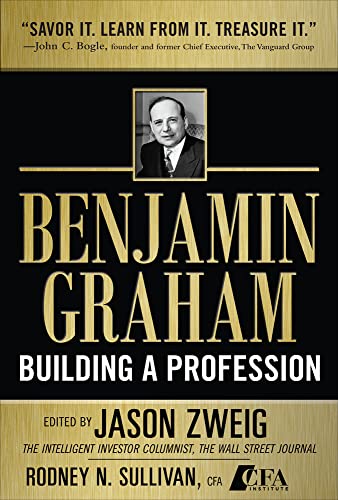
Benjamin Graham, Building a Profession: The Early Writings of the Father of Security Analysis: Classic Writings of the Father of Security Analysis - Hardcover
Inhaltsangabe
How One Man Created a Profession-and Entirely Transformed the World of Investing
"The small list of investment books that must grace the library of any serious investor-not to gather dust, but to be opened over and over again-just grew by one. This wonderful compilation of the wit and wisdom of Benjamin Graham is the new addition. Savor it. Learn from it. Treasure it."
John C. Bogle, founder and former Chief Executive, The Vanguard Group
"If youth is measured by creativity and excitement about new ideas and a thirst for learning, then Ben Graham-in his early 80s-was the youngest guy in the room when two-dozen stellar investment managers met for three days to explain the inner workings of investment management."
Charles D. Ellis, CFA, Bestselling Author of Winning the Loser's Game
"These writings, spanning over 30 years, help us understand even better the remarkable achievement of this visionary man and his lasting influence on the finance profession."
Burton Malkiel, Princeton University, Bestselling Author of A Random Walk Down Wall Street
"Investing involves the intelligent triangulation between fundamentals, psychology, and prices. Benjamin Graham, Building a Profession . . . illustrates how this investment legend never stopped thinking about this multi-dimensional challenge."
Seth Klarman, The Baupost Group
"Serious professionals in the investment business will delight in pouring over this and checking their own thoughts against those of the master."
Jeffrey J. Diermeier, CFA, Diermeier Family Foundation, and former CFA Institute president and CEO
"This is a must-read for anyone interested in the history and development of our profession and the importance of critical investment thinking."
Gary P. Brinson, CFA, GP Brinson Investments
"Some investors ('the happy few') know that Ben Graham's writings on financial analysis give them a leg up. So they will want to read this book, and other investors should."
Jean-Marie Eveillard, First Eagle Funds
"The CFA Institute and Jason Zweig have performed an invaluable service to our profession in collecting these [writings] in one volume."
William H. Miller, CFA, Legg Mason Funds Management
About the Book:
When Benjamin Graham began workingon Wall Street in 1914, the centerof American finance resembled a lawless frontier.The concept of regulatory laws was in itsinfancy, the SEC wouldn't see the light of dayfor 20 years, and many firms hid assets andearnings from nosy outsiders.
And security analysts didn't exist as weknow them. They were called "diagnosticians,"and they didn't do much analyzing. These investorsprided themselves on going with the"feel" of the market, and most of them rarelylooked at a financial statement.
Appalled by the lack of research and quantification,Benjamin Graham set out to changeall this-and ended up creating the disciplineof modern security analysis.
A collection of rare writings by and interviewswith one of financial history's most brilliantvisionaries, Benjamin Graham, Building aProfession presents Graham's evolution of ideason security analysis spanning five decades.Articles include:
- "Should Security Analysts Have aProfessional Rating? The Affirmative Case"
Financial Analysts Journal (1945) - "Toward a Science of Security Analysis"
Financial Analysts Journal (1952) - "Inflated Treasuries and DeflatedStockholders: Are CorporationsMilking Their Owners?"
Forbes (1932) - "The Future of Financial Analysis"
Financial Analysts Journal (1963) - "Controlling versus OutsideStockholders"
Virginia Law Weekly (1953)
These pages reveal the revolutionary ideas of aman who didn't so much find his calling as hecreated it from scratch-and opened the doorfor entire generations of investors.
Die Inhaltsangabe kann sich auf eine andere Ausgabe dieses Titels beziehen.
Über die Autorin bzw. den Autor
Jason Zweig writes the "Intelligent Investor" column for The Wall Street Journal. He has been a senior writer at Money, mutual funds editor at Forbes, and guest columnist at Time and CNN.com. Zweig is the editor of the 2003 revised edition of Benjamin Graham's book The Intelligent Investor and the author of Your Money and Your Brain (2007).
Rodney N. Sullivan, CFA, head of publications for CFA Institute, serves as editor of the Financial Analysts Journal and several other leading publications. He was director of research for Trigon Healthcare, Inc. (now Anthem Healthcare, Inc.) and a senior portfolio analyst for Aris Corporation.
Auszug. © Genehmigter Nachdruck. Alle Rechte vorbehalten.
BENJAMIN GRAHAM BUILDING A PROFESSION
CLASSIC WRITINGS OF THE FATHER OF SECURITY ANALYSISThe McGraw-Hill Companies, Inc.
Copyright © 2010 CFA InstituteAll right reserved.
ISBN: 978-0-07-163326-0
Contents
Chapter One
Should Security Analysts Have a Professional Rating?The Affirmative Case
INTRODUCTORY STATEMENT
In 1942, the Committee on Standards of the New York Society of Security Analysts proposed to the membership that a rating or professional title be established for security analysts. This rating was designated tentatively as "Qualified Security Analyst" or "Q.S.A." The proposed machinery included the following: A Board of Qualifiers was to be set up by the Society and cooperating agencies—e.g., the Association of Stock Exchange Firms, insurance companies, investment counsel, etc. The Board would confer the rating upon applicants who met designated standards, including those relating to:
a—Character
b—Education and experience
c—Passing of an examination
The latter test might be waived for suitable reasons. Application for the rating would be on a voluntary basis and would be motivated by the desire for prestige and practical advantage. Eventually, however, it might be expected that the Q.S.A. rating would become necessary for those doing the work of a senior security analyst having direct or indirect contact with the public.
No final action has been taken on the Committee's findings. The following articles analyze the arguments for and against the proposal. The Editors will welcome expressions of opinion from the members.
Editors' Note: In part two of this article, Lucien O. Hooper made the case against a professional designation, "The Negative Case."
Reprinted from The Analysts Journal, vol. 1, no. 1 (1945): 37–41 with permission.
The issues involved in this rating proposal are comparatively simple and may be argued largely by analogy. Some fifty years ago, trained accountants were wrestling with a similar idea, and at that time the difficulties and drawbacks of the proposed C.P.A. designation no doubt appeared quite serious to many of them. Today the need for a professional rating in that field and in many others is taken for granted. It takes no prophet to predict that once we surmount the initial hurdles involved in a rating for security analysts, the procedure will establish itself firmly and will come to be considered as indispensable to the public interest.
For purposes of this discussion, a security analyst is defined as one whose function it is to advise others respecting the purchase and sale of specific securities. This definition would exclude the following:
1. Junior statisticians or analysts who merely assemble data
2. Business or financial analysts and economists who do not deal with specific security values
3. Teachers and students of theory as such
Strictly considered, this definition would also exclude stock market analysts since they ordinarily do not advise about specific securities. The writer believes, however, that ultimately, if not now, market analysis will be regarded as a special department of security analysis and that every competent market analyst will be grounded in security analysis.
In any event, by security analysts in this context are meant those giving advice or suggestions on security transactions to customers (and partners) of brokerage houses, investment bankers, banks, and trust companies; those engaged in investment counsel; and those having similar functions on the staff of investment companies, insurance companies, other corporations, philanthropic organizations, and the like. The field is wide and undoubtedly includes several thousand practitioners in this country.
Advantages of a Rating System
The advantages of a rating system may be summarized thus: Those dealing with a Q.S.A. will know he has met certain minimum requirements in regard to knowledge of his field and has professional competence. They will know also that to retain his designation of Q.S.A., the analyst will have to observe rules of ethical conduct which no doubt will become increasingly definite and stringent as time unfolds. These benefits will apply both to the direct employers of security analysts and to the clients of such employers.
The analyst who qualifies for the rating will have the obvious advantages of prestige, improved ability to get a job, and the chance for higher pay. In addition, he is likely to develop a more professional attitude towards his work and a keener interest in maintaining and advancing the standards of his calling.
Answers to Some Possible Objections
It would seem advisable to list the various objections advanced against the proposed rating and to comment briefly on them. These objections apply both to the underlying soundness of the idea and to its practical application.
OBJECTION 1. It is basically impossible to distinguish between qualified and nonqualified analysts, since skill in this field rests largely on judgment rather than on specific knowledge or technique. Good judgment cannot be tested by ordinary examinations.
ANSWER. While judgment plays an important role in security analysis, it requires the aid of well-established methods and of specialized knowledge and experience. More and more emphasis is being laid on sound techniques in analysis—by employers, by teachers, by those entering the field, and by the work of this Society.
Technical ability and adequate information may, of course, be determined by suitable tests, and this applies also to some of the more obvious judgment factors entering into security analysis.
OBJECTION 2. The Q.S.A. rating may mislead the public, because it indicates but cannot guarantee that its holder is a capable analyst.
ANSWER. This objection has a certain validity, but no more than the observation that an M.D. may be a poor doctor. As in similar fields, the Q.S.A. rating will purport to guarantee only that the holder has met certain minimum tests—not that he possesses maximum abilities. The chance of misconception is smaller here than in other fields because the typical analyst is employed by an executive with considerable practical knowledge of his own, and not by unsophisticated members of the general public.
OBJECTION 3. The Q.S.A. rating is a step in the direction of privilege for some and limited opportunity for others. It is a closed shop or cartel development.
ANSWER. There is no reason why the Q.S.A. rating should be denied to anyone who deserves it and wants it. It might result in the exclusion of unqualified practitioners from the field, but this would not be unfair or unsound. The right of every individual to practice his chosen trade is subject to the higher right of society to impose standards of fitness where these are advisable.
OBJECTION 4. The plan has administrative difficulties. Who would judge the competence of others and by what right? Who would give the necessary time to the task?
ANSWER. This rating proposal involves no more difficulties than are found in similar requirements imposed in other fields. Suitable people will be found to act as Qualifiers, as they are found for the Character Committees of the Bar Associations, for the Board of Psychiatric Examiners, etc. Public-spirited analysts of reputation will devote time to this task as to other nonprofit work.
The initiation of the program presents certain special problems. It might appear presumptuous for...
„Über diesen Titel“ kann sich auf eine andere Ausgabe dieses Titels beziehen.
Suchergebnisse für Benjamin Graham, Building a Profession: The Early Writings...

Beispielbild für diese ISBN
Benjamin Graham, Building a Profession: The Early Writings of the Father of Security Analysis
Anbieter: World of Books (was SecondSale), Montgomery, IL, USA
Verkäuferbewertung 5 von 5 Sternen

Zustand: Good. Item in good condition. Textbooks may not include supplemental items i.e. CDs, access codes etc. Artikel-Nr. 00104456067
Gebraucht kaufen
EUR 11,72
Versand gratis
Versand innerhalb von USA
Versand innerhalb von USA
Anzahl: 1 verfügbar
Beispielbild für diese ISBN
Benjamin Graham, Building a Profession: the Early Writings of the Father of Security Analysis
Verlag:
McGraw-Hill Education, 2010
ISBN 10: 007163326X
ISBN 13: 9780071633260
Gebraucht
Hardcover
Erstausgabe
Anbieter: Better World Books: West, Reno, NV, USA
Verkäuferbewertung 5 von 5 Sternen
Zustand: Very Good. 1st Edition. Former library copy. Pages intact with possible writing/highlighting. Binding strong with minor wear. Dust jackets/supplements may not be included. Includes library markings. Stock photo provided. Product includes identifying sticker. Better World Books: Buy Books. Do Good. Artikel-Nr. 39591497-6
Gebraucht kaufen
EUR 18,36
Versand gratis
Versand innerhalb von USA
Versand innerhalb von USA
Anzahl: 1 verfügbar