
Verwandte Artikel zu Training and Collaboration with Virtual Worlds: How...
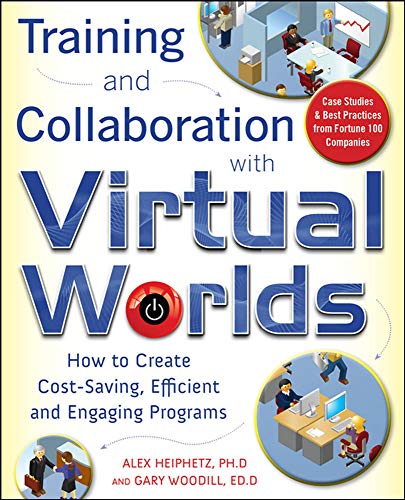
Training and Collaboration with Virtual Worlds: How To Create Cost-Saving, Efficient And Engaging Programs - Softcover
Inhaltsangabe
Team Building and Leadership Coaching with Virtual Worlds
New collaborative technologies to keep your company competitive, productive, and efficient
With the business landscape changing every day, companies need training solutions that are not only cost-efficient, but engaging, quantifiable and global. Learn how virtual worlds can help you create training and recruitment programs that attract quality talent, build great teams, and connect a global workforce - all for less than your current training budget. Training and Collaboration with Virtual Worlds walks you through the available technologies, helps you match virtual tools to your organizational needs, and shows why these programs have already taken off at leading companies.
Learn why leading companies like IBM, TMP Worldwide, Michelin, Intel, Microsoft and others are going virtual:
- Revitalize recruitment and new hire orientation to improve employee quality, productivity and retention
- Conduct worldwide training in real time, minimizing costs and time
- Reduce travel while efficiently managing geographically dispersed teams
- Break down dangerous or complex training procedures into manageable simulations
Experts agree that within five years, the 3D Internet will become as important to companies as the Web is today. Training and Collaboration with Virtual Worlds will put your company ahead of that curve - with great results.
Access the latest information and resources on www.TheVirtualWorldsBook.com
Die Inhaltsangabe kann sich auf eine andere Ausgabe dieses Titels beziehen.
Über die Autorin bzw. den Autor
Alex Heiphetz is founder and president of AHG, Inc., a software solution company specializing in business services to training companies and educational institutions: custom software, training simulations, audio and video production. Dr. Heiphetz consults with corporations and universities on the benefits and logistics of virtual training and education programs. He has presented on Second Life as related to corporate training at multiple conferences, such as Innovations in Learning 2007, the Distance Learning Association (2008), the Society for Applied Learning Technology (2008) and at SNY ASTD (2008). His papers have appeared in Distance Learning magazine, Training Magazine and other publications.Gary Woodill is Director of Research at Brandon Hall, a leading research firm focusing on learning, where he tracks emerging learning technologies. Brandon Hall's clients have included Microsoft, IBM, Cisco, GE, Motorola, Kraft, HP, Goldman Sachs, and Westinghouse, among others. He speaks frequently at conferences such as ASTD, CSTD and SALT, and blogs daily at Workplace Learning Today.
Auszug. © Genehmigter Nachdruck. Alle Rechte vorbehalten.
Training and Collaboration with Virtual Worlds
How to Create Cost-Saving, Efficient, and Engaging Programs
By ALEX HEIPHETZ, GARY WOODILLThe McGraw-Hill Companies, Inc.
Copyright © 2010 Alex Heiphetz
All rights reserved.
ISBN: 978-0-07-162802-0All rights reserved.
Contents
| Preface | |
| Acknowledgments | |
| Introduction | |
| 1 Virtual Worlds: What's in It for the Corporate World? | |
| 2 Enterprise Applications of Virtual Worlds | |
| 3 Virtual Worlds: Selecting the Best | |
| 4 Linden Lab and Second Life in Their Own Words: Enterprise-Related Developments and Future Plans | |
| 5 Deploying a Corporate Training Program in Second Life | |
| 6 First Steps in a Virtual World: Synchronous Training and Lectures | |
| 7 Teaching Complex Concepts in a New Way: The Michelin Group Case Study | |
| 8 Teamwork and Leadership in Virtual Worlds | |
| 9 Doing It Asynchronously: Training Simulations in Second Life | |
| 10 Procedural Training in Second Life: University of Kansas Medical Center Case Study | |
| 11 Recruiting and New-Hire Orientation: TMP Worldwide, EMC Corporation, and IBM Case Studies | |
| 12 Enterprise Collaboration: The Virtual World Application | |
| 13 The Future of Employee Training in Virtual Worlds | |
| References | |
| Index |
Excerpt
CHAPTER 1
Virtual Worlds: What's in It for the Corporate World?
You probably have plenty of technologies already at work in your organization.Do you even need to consider what virtual worlds (VWs, as we'll occasionallyrefer to them in this book) can offer you? In size and expenditures, your ITdepartment already rivals a small kingdom, and your staff is always asking formore. Why bother with a new, "unproven" technology? You have seen more than onepromising tool turn out to be a total fiasco.
Perhaps you've heard that virtual worlds can cut costs. Well, we'll be honestwith you: virtual worlds do not provide cost savings. You read itright—no cost savings. What they do provide is costavoidance. That's how they increase productivity and add to your bottomline—by eliminating opportunities to spend money. If this is not theresult you are looking for, do not waste your time reading this book. If it isof interest, let's see how we can avoid traditional costs without damagingexisting, time-tested processes and, in many cases, improving them.
The mere availability of a technology does not mean that you will benefit fromit; nor does it mean that those in a position to benefit will know how and whento use it. The good news is that, conceptually, virtual worlds are easy tounderstand, and integrating them into a corporate setting is in many wayssimilar to assimilating the Internet in the mid-to late 1990s. Corporatecommunications, information systems, training, marketing, customersupport—all of these changed drastically during that time. The same changemanagement methods that worked then are useful when deploying virtual worldstoday.
Dealing with business transformation often makes you wish you had an extra pairof eyes and ears, as so much attention is required across the enterprise. Wecannot recommend a method of growing extra eyes, but having an efficienttraining program that fully encompasses the entire production cycle will helpalmost as well. Besides fulfilling the need to train anybody and everybody,training deals with all levels of personnel, all kinds of human interactions,and all facets of technology. Therefore, in addition to its direct utility, itis a convenient, forward-looking indicator of the impact of any changes in anorganization, including adoption and acceptance of new technology. Given therecent shift toward always-accessible e-learning, student self-reliance,immersive learning, and simulations, using training as a sensor of change is allthe more attractive.
The Use of Simulations
Simulations have proved their worth since they became a cornerstone of trainingin areas as diverse as the space program and medicine. In this context,"simulations" mean expensive and expansive machinery and software thatreplicates "the real thing" by using complex technology to create a fullimpression of the reality of a process in a trainee's mind. Passenger jetsimulators, for example, use computer-generated, three-dimensional imagesreproducing views out of the flight deck windows. The hydraulic legs of thesemachines are capable of moving the simulator in all directions, and even brieflyaccelerating and decelerating. The expense of building and using complexsimulators—full-flight simulators cost up to $20 million to buy and $800an hour to "fly" (Boeing 1995)—precludes significant growth of their useoutside of the life-critical applications in a few industries.
Fortunately, the past ten years have seen development of simulations thatrequire only a computer and, perhaps, a high-speed network connection. Theystarted out as little more than a series of slides introducing a trainee to aneducational situation. The trainee had to find a solution by selecting answersfrom a menu. Within a few years of their introduction, these simulationsacquired the ability to use and reuse video and audio fragments, PowerPointslides, spreadsheets, and other documents.
As anybody who has ever faced doing several presentations over a short time willagree, recycling old slides can be a great idea, so it is easy to understand theappeal of using such simulations and the tools for creating them. The problem,however, is that these are not really simulations in the sense thatflight simulators are. Within the training context, simulation is a techniqueimitating experience in a real situation, interaction, or process via anartificially created guided experience. The experience does not have toreplicate reality in the way a flight simulator replicates the flight deckexperience. It must, however, have sufficient cognitive realism to work(Smith 1986; Herrington et al. 2007). That is, simulations must interactivelyevoke principal aspects of the real world, enabling and motivating students tolearn.
A simulation does not simply tell learners what and how to do something; rather,it encourages thinking, acting, testing different approaches, and pursuingdifferent strategies. Learners respond to the environment, questions, and otherstimuli so that they can discover solutions on their own after having workedthrough several iterations. This is something best done with an immersivesimulation—that is, a simulation presenting realistic models of anenvironment. Good immersive simulations allow for more than one path to success.Generally, they require (and, therefore, teach) flexibility as opposed to rigid,prescriptive behaviors that characterize other types of learning.
There's a whole alphabet of learning tools, from Adobe Captivate toWink. But virtual worlds are the only type of platform that allows youto create truly immersive situations and the only one where alreadyexisting tools—some of them free—allow nontechnical personnel tocreate highly technical simulations, again helping you avoid the costsof using competing technologies. Virtual worlds are in no way limited totraining: they can be used...
„Über diesen Titel“ kann sich auf eine andere Ausgabe dieses Titels beziehen.
Suchergebnisse für Training and Collaboration with Virtual Worlds: How...

Beispielbild für diese ISBN
Training and Collaboration with Virtual Worlds: How to Create Cost-Saving, Efficient and Engaging Programs
Verlag:
McGraw Hill (edition 1), 2010
ISBN 10: 0071628029
ISBN 13: 9780071628020
Gebraucht
Paperback
Anbieter: BooksRun, Philadelphia, PA, USA
Verkäuferbewertung 5 von 5 Sternen

Paperback. Zustand: Fair. 1. The item might be beaten up but readable. May contain markings or highlighting, as well as stains, bent corners, or any other major defect, but the text is not obscured in any way. Artikel-Nr. 0071628029-7-1
Gebraucht kaufen
EUR 7,16
Versand gratis
Versand innerhalb von USA
Versand innerhalb von USA
Anzahl: 1 verfügbar
Beispielbild für diese ISBN
Training and Collaboration with Virtual Worlds : How to Create Cost-Saving, Efficient and Engaging Programs
Anbieter: Better World Books, Mishawaka, IN, USA
Verkäuferbewertung 5 von 5 Sternen
Zustand: Good. Pages intact with minimal writing/highlighting. The binding may be loose and creased. Dust jackets/supplements are not included. Stock photo provided. Product includes identifying sticker. Better World Books: Buy Books. Do Good. Artikel-Nr. 8539358-6
Gebraucht kaufen
EUR 7,18
Versand gratis
Versand innerhalb von USA
Versand innerhalb von USA
Anzahl: 1 verfügbar
Beispielbild für diese ISBN
Training and Collaboration with Virtual Worlds : How to Create Cost-Saving, Efficient and Engaging Programs
Anbieter: Better World Books, Mishawaka, IN, USA
Verkäuferbewertung 5 von 5 Sternen
Zustand: Very Good. Former library copy. Pages intact with possible writing/highlighting. Binding strong with minor wear. Dust jackets/supplements may not be included. Includes library markings. Stock photo provided. Product includes identifying sticker. Better World Books: Buy Books. Do Good. Artikel-Nr. 9118010-6
Gebraucht kaufen
EUR 7,18
Versand gratis
Versand innerhalb von USA
Versand innerhalb von USA
Anzahl: 1 verfügbar
Beispielbild für diese ISBN
Training and Collaboration with Virtual Worlds : How to Create Cost-Saving, Efficient and Engaging Programs
Anbieter: Better World Books, Mishawaka, IN, USA
Verkäuferbewertung 5 von 5 Sternen
Zustand: Fine. Used book that is in almost brand-new condition. May contain a remainder mark. Better World Books: Buy Books. Do Good. Artikel-Nr. 53589981-6
Gebraucht kaufen
EUR 7,18
Versand gratis
Versand innerhalb von USA
Versand innerhalb von USA
Anzahl: 1 verfügbar
Beispielbild für diese ISBN
Training and Collaboration with Virtual Worlds: How to Create Cost-Saving, Efficient and Engaging Programs
Anbieter: ThriftBooks-Dallas, Dallas, TX, USA
Verkäuferbewertung 5 von 5 Sternen
Paperback. Zustand: Very Good. No Jacket. May have limited writing in cover pages. Pages are unmarked. ~ ThriftBooks: Read More, Spend Less. Artikel-Nr. G0071628029I4N00
Gebraucht kaufen
EUR 9,19
Versand gratis
Versand innerhalb von USA
Versand innerhalb von USA
Anzahl: 1 verfügbar
Beispielbild für diese ISBN
Training and Collaboration With Virtual Worlds: Get All the Benefits of In-person Training for a Fraction of the Cost
Anbieter: Revaluation Books, Exeter, Vereinigtes Königreich
Verkäuferbewertung 5 von 5 Sternen
Paperback. Zustand: Brand New. 1st edition. 272 pages. 9.00x7.30x0.66 inches. In Stock. Artikel-Nr. zk0071628029
Neu kaufen
EUR 53,77
EUR 11,82 Versand
Versand von Vereinigtes Königreich nach USA
Versand von Vereinigtes Königreich nach USA
Anzahl: 1 verfügbar