
Verwandte Artikel zu Beyond the Deal: A Revolutionary Framework for Successful...
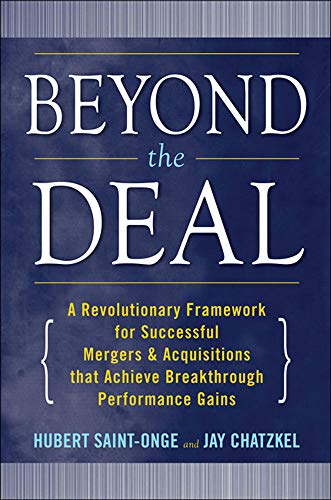
Beyond the Deal: A Revolutionary Framework for Successful Mergers & Acquisitions That Achieve Breakthrough Performance Gains - Hardcover
Inhaltsangabe
Mergers and acquisitions are happening in record numbers, with billions of dollars changing hands and major corporate deals making headlines every day. But the harsh reality is that most deals fail. Why? Because the companies didn't plan, didn't prepare, and didn't perform up to expectations.
They didn't think beyond the deal.
This revolutionary guide--written by two top consultants who've worked with some of the biggest companies in the world--goes beyond other books on the subject by giving you a complete, systematic “framework” of hands-on strategies for every step of the process. No matter which side of the acquisition you're on, what stage of the game you're at, or whatever level of management you're in, you will learn how to create new value for yourself, recognize new opportunities for your team--and inspire unprecedented levels of performance for your organization.
If you've got “the urge to merge” and the need to succeed, Beyond the Deal offers a wealth of ready-to-use tools and techniques, including:
- 6 essential keys to a smooth integration
- 4 steps to making a “quantum leap” in performance
- 3 common mistakes that lessen value
- 3 surefire ways to get your team on board
- Dozens of case examples, quizzes, checklists, and more
In addition to step-by-step planning strategies, the book shows you how to assess a company's full potential and--more specifically--how to motivate full-time workers as they face new challenges, take on new responsibilities, and work with new people. You'll also find crucial advice on corporate branding, customer service, company leadership, and knowledge management. And you'll be surprised to discover just how do-able--and profitable--mergers and acquisitions can be. The book also includes self-questionnaires to test your “acquisition readiness,” case-by-case examples of famous successes and notorious failures, and other tools.
Die Inhaltsangabe kann sich auf eine andere Ausgabe dieses Titels beziehen.
Über die Autorin bzw. den Autor
Hubert Saint-Onge is a leading practitioner of organization strategy, and creator of the Knowledge Assets Framework. He has spent over 25 years as an executive in the oil industry (at Shell) and in financial services (at CIBA and Clarica). He currently heads his own consulting firm, SAINTONGE Alliance.
Jay Chatzkel is Principal of Progressive Practices, where he assists orgainzations in transforming themselves into knowledge-based enterprises. He serves on the editorial boards of several magazines, including Journal of Knowledge Management, and has written extensively in the field.
Von der hinteren Coverseite
[BACK COVER]
Whether you're a CEO, senior executive, or middle manager…
Whether you're considering an acquisition, or are already in the middle of one…
This guide helps you increase your value, maximize your performance, and succeed...beyond the deal.
There's more to mergers and acquisitions than “the art of the deal.” To truly succeed, you need to inventory your knowledge assets and capabilities, integrate your resources, restructure systems, motivate employees, satisfy customers, and surpass expectations. This groundbreaking book by organization strategists Hubert Saint-Onge and Jay Chatzkel provides you with a comprehensive, step-by-step approach to the entire acquisition process-before, during, and after the deal.
“Hubert Saint-Onge and his colleague Jay Chatzkel have cracked the code on why most acquisitions fail to live up to their potential. Best of all, they provide step-by-step guidance to ensure success. Beyond the Deal should be required reading before the deal for anyone considering a merger or acquisition.”
—George H. Labovitz, founder and CEO, Organization Dynamics International
“A must read for anyone contemplating an acquisition doing the deal is usually the easy part!”
—John Shackleton, CEO, Open Text
Auszug. © Genehmigter Nachdruck. Alle Rechte vorbehalten.
BEYOND the DEAL
Mergers & Acquisitions that Achieve Breakthrough Performance GainsBy HUBERT SAINT-ONGE JAY CHATZKELThe McGraw-Hill Companies, Inc.
Copyright © 2009 The McGraw-Hill Companies, Inc.All right reserved.
ISBN: 978-0-07-155010-9
Contents
Chapter One
A New Approach to Acquisitions: Creating Value in Combined Companies
How many dollars, euros, and yen are left on the table when approximately two out of three of current acquisitions do not reach their goals? This is an enormous and often preventable waste. The reality is that the collective common wisdom on mergers and acquisitions (M&As) is not on the mark, especially in the knowledge era we are operating in. The question is: what can be done differently?
The high failure rate of mergers and acquisitions is the result of serious limitations in how companies approach M&As and carry them out. In too many cases, a company is unprepared when an acquisition opportunity arises. Not being ready leads to all of the following problems:
• A limited skill base to execute the acquisition
• A one-sided focus on financial synergies that underpins a limited view of the strategic gains from an acquisition
• Poor due diligence
• A weaker position in negotiating the deal
• Unrealistic expectations about getting regulatory approval
• A slow and ineffective integration of the acquirer and the acquiree into a newly combined company
This creates a situation of unwarranted high risks and low success rates.
For many companies, acquisitions are unique opportunities to make a quantum leap in performance. However, that quantum leap requires
• Building the capabilities to be ready for making an acquisition
• An approach that creates value and fully realizes both the financial and growth advantages that can occur when the resources of two companies are integrated to form an entirely new company
There is some evidence that the more frequently a company acquires other companies, the greater its success. Although this is true, companies that go through the acquisition process mechanistically are not necessarily incorporating the lessons they learned during earlier acquisitions, nor are they using their experience to transform their processes as they integrate. Instead, they are simply repeating the same process over and over, without taking their acquisitions to the next level and seeking the quantum leap gains that may well be possible.
For example, one North American bank carries out five acquisitions a year, each in very much the same manner, and it is efficient at getting the job done. The problem is that the bank is primarily having the same experience five times in the course of each year, instead of incorporating new knowledge and taking its acquisition process to new levels. The bank's leaders are seeking sequential growth, but they would have the opportunity to achieve an exponential quantum leap in performance if they used the value-creating approach that we describe in this book and introduce in this chapter.
This chapter describes how to determine whether or not your company is ready to acquire another company (or be acquired) and then shows how to get ready to acquire another company. It also reviews the two traditional approaches to M&As—one that focuses on cutting costs and one that focuses on growth—and then offers a third approach that fuses the two traditional approaches into one overall approach that focuses on creating value in the newly combined company. Finally, it describes what you need to do to acquire a company that will truly catapult you forward in your marketplace.
Why M&As Are More Important than Ever: The Increased Value of Knowledge and Intangible Assets
Merging with or acquiring another company is more important than ever because of several dramatic changes in the current business environment. First, the emergence of the knowledge era since the 1980s has brought significant change in both global and local markets. Second, the value of knowledge-based, intangible resources has grown geometrically in companies. These intangible assets include
• The experience and talents of your employees (human capital)
• Your relationships with your customers (customer capital)
• The specific structure of your company, including your processes, systems, and leadership approach, along with such intangible assets as patents, trademarks, brand value, business model, and business logic (structural capital)
These weightless assets now have a greater value in organizations than physical or financial assets have. This has been coupled with fundamental changes in legal, competitive, and global requirements.
For example, one such quantum shift is the advent of the European Union (EU), with its dismantling of boundaries and reduction of trade barriers. The emergence of the EU has also led to a shift in the regulatory environment in Europe, creating pressures to combine organizational strengths simply to be able to compete on a larger scale.
Another quantum shift in the importance of intangible assets is demonstrated by the rise of Chinese and Indian competitors in areas ranging from software outsourcing to manufacturing consumer and capital goods. Corporations now must have a "China strategy" and must also be ready to acquire emerging companies in India in order to maintain and grow their strategic position in world markets. Moreover, Indian and Chinese companies are not exempt from the effects of globalization. They are beginning to realize that they also need to consider actively acquiring companies in other parts of the world in order to have a more formidable competitive presence in the Americas, Europe, and the Middle East.
Knowledge, as a core organizational resource and the basis for the development of organizational capabilities, is playing a key role in driving these changes. Companies' knowledge-related capabilities are far more significant than they were even just a decade ago. Prior to the last several decades, leadership in organizations cared much more about tangible assets and attributed much less of the organization's value to intangible assets. There was substantially less concern about preserving knowledge or limiting knowledge leakage. The result was a marginal valuing of corporate knowledge and very limited efforts at building knowledge-based capabilities.
Currently, however, organizations are beginning to give more attention to their intangible assets—i.e., as listed earlier, their employees' experience and talents; the quality of their company's relationships with its customers; and their internal processes, systems, and leadership context (which will be discussed in more detail in Chapter 2). Companies are finally viewing these intangible assets as the catalysts for creating value and building competitive advantage. Furthermore, many firms are bringing their intangible and tangible resources together to generate and renew their corporate capabilities, enabling higher levels of performance. These capabilities are the link between a company's strategies and its performance.
Organizations can be seen as an amalgam of capabilities that they harness to achieve their strategies. In that perspective, a key challenge for companies is to shape the capabilities they need to meet their growth goals. Your company has two basic choices to achieve this:
1. You can grow organically.
2. You can acquire...
„Über diesen Titel“ kann sich auf eine andere Ausgabe dieses Titels beziehen.
Suchergebnisse für Beyond the Deal: A Revolutionary Framework for Successful...

Beispielbild für diese ISBN
Beyond the Deal: A Revolutionary Framework for Successful Mergers & Acquisitions That Achieve Breakthrough Performance Gains
Anbieter: ThriftBooks-Dallas, Dallas, TX, USA
Verkäuferbewertung 5 von 5 Sternen

Hardcover. Zustand: Very Good. No Jacket. May have limited writing in cover pages. Pages are unmarked. ~ ThriftBooks: Read More, Spend Less. Artikel-Nr. G0071550100I4N00
Gebraucht kaufen
EUR 15,38
Versand gratis
Versand innerhalb von USA
Versand innerhalb von USA
Anzahl: 1 verfügbar
Beispielbild für diese ISBN
Beyond the Deal: a Revolutionary Framework for Successful Mergers & Acquisitions That Achieve Breakthrough Performance Gains
Anbieter: Better World Books: West, Reno, NV, USA
Verkäuferbewertung 5 von 5 Sternen
Zustand: Very Good. Former library copy. Pages intact with possible writing/highlighting. Binding strong with minor wear. Dust jackets/supplements may not be included. Includes library markings. Stock photo provided. Product includes identifying sticker. Better World Books: Buy Books. Do Good. Artikel-Nr. 11219958-6
Gebraucht kaufen
EUR 15,43
Versand gratis
Versand innerhalb von USA
Versand innerhalb von USA
Anzahl: 1 verfügbar
Beispielbild für diese ISBN
Beyond the Deal: A Revolutionary Framework for Successful Mergers & Acquisitions That Achieve Breakthrough Performance Gains
Anbieter: Ammareal, Morangis, Frankreich
Verkäuferbewertung 5 von 5 Sternen
Hardcover. Zustand: Très bon. Ancien livre de bibliothèque avec équipements. Couverture différente. Edition 2008. Ammareal reverse jusqu'à 15% du prix net de cet article à des organisations caritatives. ENGLISH DESCRIPTION Book Condition: Used, Very good. Former library book. Different cover. Edition 2008. Ammareal gives back up to 15% of this item's net price to charity organizations. Artikel-Nr. I-543-981
Gebraucht kaufen
EUR 9,03
EUR 16,50 Versand
Versand von Frankreich nach USA
Versand von Frankreich nach USA
Anzahl: 1 verfügbar
Beispielbild für diese ISBN
Beyond the Deal: A Revolutionary Framework for Successful Mergers & Acquisitions That Achieve Breakthrough Performance Gains
Anbieter: Anybook.com, Lincoln, Vereinigtes Königreich
Verkäuferbewertung 5 von 5 Sternen
Zustand: Good. This is an ex-library book and may have the usual library/used-book markings inside.This book has hardback covers. Clean from markings. In good all round condition. No dust jacket. Please note the Image in this listing is a stock photo and may not match the covers of the actual item,750grams, ISBN:0071550100. Artikel-Nr. 8978093
Gebraucht kaufen
EUR 14,72
EUR 15,38 Versand
Versand von Vereinigtes Königreich nach USA
Versand von Vereinigtes Königreich nach USA
Anzahl: 1 verfügbar
Beispielbild für diese ISBN
Beyond The Deal
Anbieter: Romtrade Corp., STERLING HEIGHTS, MI, USA
Verkäuferbewertung 5 von 5 Sternen
Zustand: New. This is a Brand-new US Edition. This Item may be shipped from US or any other country as we have multiple locations worldwide. Artikel-Nr. ABBB-95853
Beispielbild für diese ISBN
Beyond the Deal
Verlag:
The McGraw-Hill Company, 2008
ISBN 10: 0071550100
ISBN 13: 9780071550109
Gebraucht
Hardcover
Anbieter: Majestic Books, Hounslow, Vereinigtes Königreich
Verkäuferbewertung 4 von 5 Sternen

Zustand: Used. Artikel-Nr. 8280738
Gebraucht kaufen
EUR 41,39
EUR 7,67 Versand
Versand von Vereinigtes Königreich nach USA
Versand von Vereinigtes Königreich nach USA
Anzahl: 1 verfügbar
Beispielbild für diese ISBN
Beyond the Deal
Verlag:
The McGraw-Hill Company, 2008
ISBN 10: 0071550100
ISBN 13: 9780071550109
Gebraucht
Hardcover
Anbieter: Biblios, Frankfurt am main, HESSE, Deutschland
Verkäuferbewertung 4 von 5 Sternen
Zustand: Used. Artikel-Nr. 18648567
Gebraucht kaufen
EUR 41,43
EUR 9,95 Versand
Versand von Deutschland nach USA
Versand von Deutschland nach USA
Anzahl: 1 verfügbar