
Verwandte Artikel zu Think Better: An Innovator's Guide to Productive...
Inhaltsangabe
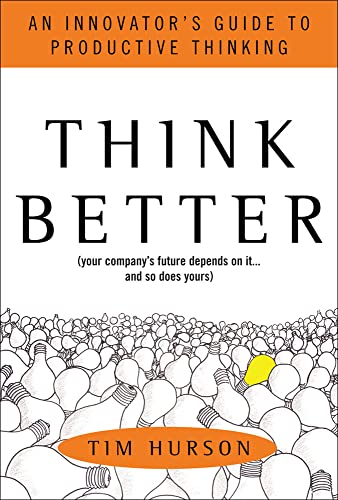
There are thousands of books about thinking. But there are very few books that provide clear how-to information that can actually help you think better. Think Better is about Productive Thinking - why it's important, how it works, and how to use it at work, at home, and at play. Productive Thinking is a game changer - a practical, easy-to-learn, repeatable process that helps people understand more clearly, think more creatively, and plan more effectively. It's based on the thinking strategies that people we celebrate for their creativity have been using for centuries. Tim Hurson brings Productive Thinking out of the closet and presents it in a way that makes it easy for anyone to grasp and use - so you can think better, work better, and do better in every aspect of your life. Think Better demonstrates how you can start with an intractable technical problem, an unmet consumer need, or a gaping chasm in your business strategy and, by following a clearly defined, practical thinking process, arrive at a robust, innovative solution. Many companies use the Productive Thinking model to generate fresh solutions for tough business problems, and many individuals rely on it to solve pressing personal problems. The principles you'll find in Think Better are straight-forward: separate your thinking into creative thinking and critical thinking; stay with the question; strive for the "third third" by generating lots and lots of ideas; and look for unexpected connections. The model consists of six interlocking steps: Step 1:What's Going On? Explore and truly understand the challenge. Step 2: What's Success? Envision the ideal outcome and establish success criteria. Step 3: What's the Question? Pinpoint the real problem or opportunity. Step 4: Generate Answers List many possible solutions. Step 5: Forge the Solution Decide which solution is best. Then make it better. Step 6: Align Resources Create an action plan. Tim Hurson starts by explaining how we all build inner barriers to effective thinking. He identifies our habits of thinking that severely limit our behavior, from "monkey mind" to "gator brain." Then he demonstrates how to overcome these barriers. More than anything, productive thinking is an attitude that will let you look at problems and convert them into opportunities. At the end of this disciplined brainstorming process, you'll have a concrete action plan, complete with timelines and deadlines. The book is filled with many of Hurson's original brainstorming tools that will empower you to generate, organize, and process ideas. For example, you can identify your best ideas using the five C's: Cull, Cluster, Combine, Clarify and Choose. And you can transform an embryonic idea into a robust solution with POWER, which stands for Positives, Objections, What else?, Enhancements and Remedies. To create the future, you first must be able to imagine it. Productive thinking is a way to help you do that.
Die Inhaltsangabe kann sich auf eine andere Ausgabe dieses Titels beziehen.
Über die Autorin bzw. den Autor
Tim Hurson is a founding partner of thinkx intellectual capital (www.thinkxic.com), a firm that provides global corporations with training, facilitation, and consultation in productive thinking and innovation. He's both a faculty member and Trustee of the Creative Education Foundation, and a founding director of Facilitators Without Borders.
Von der hinteren Coverseite
Want to Outsmart the Competition? Learn how to Think Better.
“Marvelously choreographed and insightful... A treasury of powerful ideas for anyone who wants to boost their own brand equity and contribute mightily to their company's success.”-Andy Boynton, Ph.D., Dean, Carroll School of Management, Boston College, and author of Virtuoso Teams
“If you want success in your career, in your business, or in your life, Think Better is for you. Buy it, read it, and don't look back.”-Roger J. Burns, Worldwide Partner Mercer Human Resource Consulting
“Brilliant, thought-provoking, easy-to-read, this book is one of the best creativity books I have read in 30 years. Buy it, read it, and change your life!!””-Arthur B VanGundy, Ph.D., Professor of Communication, University of Oklahoma, author of Getting to Innovation
“Get copies for everyone you work with, talk about it together, and then get on with inventing your future. This book will show you how.”-Ian Percy, author of The Profitable Power of Purpose
“A practical guide to the power and importance of productive thinking that should be read by everyone. Use it to unlock the full creative power of your mind.”-Glenn Bishop, Director, Engineering, Yahoo! Europe
“Tim will get your gray matter in an uproar. I can't stop thinking about Think Better. But you should. Stop thinking about buying this book and go buy it…NOW.-Stephen Shapiro, author 24/7 Innovation
“More than worthwhile - a must.”-Roger von Oech, author A Whack on the Side of the Head
Auszug. © Genehmigter Nachdruck. Alle Rechte vorbehalten.
THINK BETTER
AN INNOVATOR'S GUIDE TO PRODUCTIVE THINKINGBy TIM HURSONMcGraw-Hill
Copyright © 2008 The McGraw-Hill CompaniesAll right reserved.
ISBN: 978-0-07-149493-9
Contents
Chapter One
Why Think Better
Imagination is the beginning of creation: you imagine what you desire, you will what you imagine, and at last you create what you will. George Bernard Shaw
This book is about creating the future. It's about a way to see more clearly, think more creatively, and plan more effectively. It's about thinking better, working better, and doing better in every area of your life. All of us have the potential to think better. The first step is to free ourselves from the unproductive thinking patterns that hold us back.
There's an interesting little insect known as the processionary caterpillar that can teach us a lot about the stifling habits of everyday thinking. Processionaries got their name because of their distinctive behavior. When they leave their nests to forage for food, they travel in a line, like elephants in a circus, head to tail, head to tail. The lead caterpillar spins a fine trail of silk as it crawls along. The next caterpillar in line walks along the silk trail and adds its own. Processionaries can form trains hundreds of creatures long as they march through the forest.
There's nothing particularly distinctive about the lead caterpillar: It just happens to be at the front. It walks along for a while, pausing and raising its head occasionally, trying to sense which way the nearest food source is, and then continues the trek. If you remove the lead caterpillar, the second in line will take up the scouting duties without hesitation. The trailing caterpillars don't seem to care about the change in leadership.
Processionaries fascinated one of the world's great naturalists, Jean Henri Fabre, who is considered by many the father of modern entomology. He spent years studying them, both in his green house and in their natural environment. Fabre was an observer. He took nothing as given, nothing for granted, made no assumptions. He once wrote that his scientific credo was "the method of ignorance. I read very little.... I know nothing. So much the better: my queries will be all the freer, now in this direction, now in the opposite, according to the lights obtained."
Fabre was curious to see how powerful the processionaries' instinct to follow the leader could be. What would happen if he arranged the caterpillars in a circle? Would their instinct to follow force them to keep going round and round in an endless loop? On January 30, 1896, Fabre constructed an experiment in which he coaxed a chain of caterpillars around the rim of a large pot filled with earth. As soon as enough caterpillars had ascended to form a ring, he brushed away the ones at the end of the chain. He then nudged the lead caterpillar behind the trailing caterpillar to close the circle. Instantly, there was no more leader. Each caterpillar in the circle simply followed the threads laid down by those ahead of it, ignoring a cache of the caterpillars' favorite food that Fabre had placed within about 12 inches of the circle.
Six days later, on February 5, the caterpillars were still circling. Only after many started to collapse from exhaustion and starvation did the circle begin to break, allowing a few caterpillars with the strength to do so to escape. According to Fabre's calculations, the caterpillars had made over 500 circuits of the pot and traveled over a quarter of a mile. That's equivalent to a person walking about 90 miles, or completing three and a half marathons, without food, drink, or rest. Fabre concluded his description of the experiment with these words: "The caterpillars in distress, starved, shelterless, chilled with cold at night, cling obstinately to the silk ribbon covered hundreds of times, because they lack the rudimentary glimmers of reason which would advise them to abandon it."
If you've ever had the feeling that you have been in a procession of caterpillars—on your job, in your community, or at home—read on.
At some time in our lives we've all been processionary caterpillars, mindlessly following a trail of silk for no reason except that it's laid out before us. It's all too easy to be a part of the procession and not even realize we're in the parade. It's not the exceptional day that we find ourselves in the procession. It's most days. We go through our lives following the patterns we've grown comfortable with. We do things because that's the way they're done. Our routines seem so natural that it doesn't even occur to us that we're following patterns at all. We overlook opportunities, fail to see warning signs, or just plod along because we've kept our eye, not on the target, but on the routine. It happens to all of us.
As with the caterpillars in Fabre's experiments, sometimes the only thing that saves us is that things go so drastically wrong that we're forced out of our processions. Our pattern has been so counterproductive that the circle we've created can no longer sustain itself. It breaks apart. With no more circle, we're forced to find new ways of doing things. We change only when we're forced to.
How different are we from the processionary caterpillar?
* * *
At its heart productive thinking is about freedom. It's a way of escaping from the tyranny of the silken track. Sometimes, of course, there's real value in following the procession. It can be useful and efficient to do things the way they've always been done. Clearly, social conventions, thinking conventions, and best practices have very important and powerful places in our lives. They represent a type of thinking I call reproductive thinking, which I'll discuss in more detail in Chapter 3. In many areas of our lives there is nothing wrong with reproductive thinking. After all, the behavior of the processionary caterpillar has been a successful survival mechanism for millions of years.
Nevertheless, as Fabre observed, there are times when reproductive thinking can be counterproductive and even disastrous. As I will try to demonstrate throughout this book, all of us have the potential to think better, more productively, and more creatively. What we need is the incentive. The silken track is alluring: It's safe, it's easy, and in many cases it works just fine. Rarely will you be criticized for sticking to it. No wonder most people are content to play follow the leader. Thinking better is hard work. It can be risky. And it can certainly make you unpopular. So why bother?
I think there are three good reasons.
There's Plenty of Room for Improvement
Nothing is perfect. The word is full of things we can do better.
I once heard the systems thinker Dr. George Ainsworth-Land tell a story that changed my life. Land worked as a consulting psychologist to school systems throughout the country. In preparation for one assignment, he was given a tour of an Arizona high school by its principal. On their walk through the halls, they saw two boys fighting in front of their lockers. One of the boys was the aggressor, pounding furiously on the other boy, who was trying to defend himself. The principal grabbed both boys by the collar, marched them into his office, sat them down, calmed them down, then turned to the aggressor, and asked, "Why were you hitting Brian like that?"
The boy looked up and said, "Because I couldn't think of anything else to do."
I couldn't think of anything else to do. What a statement! How much misery do we cause and...
„Über diesen Titel“ kann sich auf eine andere Ausgabe dieses Titels beziehen.
Suchergebnisse für Think Better: An Innovator's Guide to Productive...

Beispielbild für diese ISBN
Think Better: An Innovator's G
Anbieter: World of Books (was SecondSale), Montgomery, IL, USA
Verkäuferbewertung 5 von 5 Sternen

Zustand: Acceptable. Item in acceptable condition! Textbooks may not include supplemental items i.e. CDs, access codes etc. Artikel-Nr. 00102910459
Gebraucht kaufen
EUR 3,73
Versand gratis
Versand innerhalb von USA
Versand innerhalb von USA
Anzahl: 1 verfügbar
Beispielbild für diese ISBN
Think Better: An Innovator's G
Anbieter: World of Books (was SecondSale), Montgomery, IL, USA
Verkäuferbewertung 5 von 5 Sternen
Zustand: Good. Item in good condition. Textbooks may not include supplemental items i.e. CDs, access codes etc. Artikel-Nr. 00093335633
Gebraucht kaufen
EUR 3,73
Versand gratis
Versand innerhalb von USA
Versand innerhalb von USA
Anzahl: 9 verfügbar
Beispielbild für diese ISBN
Think Better: An Innovator's G
Anbieter: World of Books (was SecondSale), Montgomery, IL, USA
Verkäuferbewertung 5 von 5 Sternen
Zustand: Very Good. Item in very good condition! Textbooks may not include supplemental items i.e. CDs, access codes etc. Artikel-Nr. 00102967938
Gebraucht kaufen
EUR 3,73
Versand gratis
Versand innerhalb von USA
Versand innerhalb von USA
Anzahl: 2 verfügbar
Beispielbild für diese ISBN
Think Better: an Innovator's Guide to Productive Thinking
Verlag:
McGraw-Hill Education, 2012
ISBN 10: 0071494936
ISBN 13: 9780071494939
Gebraucht
Hardcover
Erstausgabe
Anbieter: Better World Books, Mishawaka, IN, USA
Verkäuferbewertung 5 von 5 Sternen
Zustand: Good. 1st Edition. Pages intact with minimal writing/highlighting. The binding may be loose and creased. Dust jackets/supplements are not included. Stock photo provided. Product includes identifying sticker. Better World Books: Buy Books. Do Good. Artikel-Nr. 4359561-20
Gebraucht kaufen
EUR 6,59
Versand gratis
Versand innerhalb von USA
Versand innerhalb von USA
Anzahl: 2 verfügbar
Beispielbild für diese ISBN
Think Better: an Innovator's Guide to Productive Thinking
Verlag:
McGraw-Hill Education, 2012
ISBN 10: 0071494936
ISBN 13: 9780071494939
Gebraucht
Hardcover
Erstausgabe
Anbieter: Better World Books, Mishawaka, IN, USA
Verkäuferbewertung 5 von 5 Sternen
Zustand: Very Good. 1st Edition. Pages intact with possible writing/highlighting. Binding strong with minor wear. Dust jackets/supplements may not be included. Stock photo provided. Product includes identifying sticker. Better World Books: Buy Books. Do Good. Artikel-Nr. GRP81597469
Gebraucht kaufen
EUR 6,59
Versand gratis
Versand innerhalb von USA
Versand innerhalb von USA
Anzahl: 1 verfügbar
Beispielbild für diese ISBN
Think Better: An Innovator's Guide to Productive Thinking
Anbieter: ThriftBooks-Atlanta, AUSTELL, GA, USA
Verkäuferbewertung 5 von 5 Sternen
Hardcover. Zustand: Very Good. No Jacket. May have limited writing in cover pages. Pages are unmarked. ~ ThriftBooks: Read More, Spend Less. Artikel-Nr. G0071494936I4N00
Gebraucht kaufen
EUR 7,46
Versand gratis
Versand innerhalb von USA
Versand innerhalb von USA
Anzahl: 1 verfügbar
Beispielbild für diese ISBN
Think Better: An Innovator's Guide to Productive Thinking
Anbieter: ThriftBooks-Dallas, Dallas, TX, USA
Verkäuferbewertung 5 von 5 Sternen
Hardcover. Zustand: Very Good. No Jacket. May have limited writing in cover pages. Pages are unmarked. ~ ThriftBooks: Read More, Spend Less. Artikel-Nr. G0071494936I4N00
Gebraucht kaufen
EUR 7,46
Versand gratis
Versand innerhalb von USA
Versand innerhalb von USA
Anzahl: 1 verfügbar
Beispielbild für diese ISBN
Think Better: An Innovator's Guide to Productive Thinking
Verlag:
McGraw-Hill (edition 1), 2007
ISBN 10: 0071494936
ISBN 13: 9780071494939
Gebraucht
Hardcover
Anbieter: BooksRun, Philadelphia, PA, USA
Verkäuferbewertung 5 von 5 Sternen
Hardcover. Zustand: Very Good. 1. It's a well-cared-for item that has seen limited use. The item may show minor signs of wear. All the text is legible, with all pages included. It may have slight markings and/or highlighting. Artikel-Nr. 0071494936-11-1
Gebraucht kaufen
EUR 7,51
Versand gratis
Versand innerhalb von USA
Versand innerhalb von USA
Anzahl: 1 verfügbar
Beispielbild für diese ISBN
Think Better: An Innovator's Guide to Productive Thinking (MGMT & LEADERSHIP)
Anbieter: AwesomeBooks, Wallingford, Vereinigtes Königreich
Verkäuferbewertung 5 von 5 Sternen
Hardcover. Zustand: Very Good. Think Better: An Innovator's Guide to Productive Thinking (MGMT & LEADERSHIP) This book is in very good condition and will be shipped within 24 hours of ordering. The cover may have some limited signs of wear but the pages are clean, intact and the spine remains undamaged. This book has clearly been well maintained and looked after thus far. Money back guarantee if you are not satisfied. See all our books here, order more than 1 book and get discounted shipping. Artikel-Nr. 7719-9780071494939
Gebraucht kaufen
EUR 3,38
EUR 4,81 Versand
Versand von Vereinigtes Königreich nach USA
Versand von Vereinigtes Königreich nach USA
Anzahl: 2 verfügbar
Beispielbild für diese ISBN
Think Better: An Innovator's Guide to Productive Thinking (MGMT & LEADERSHIP)
Anbieter: WorldofBooks, Goring-By-Sea, WS, Vereinigtes Königreich
Verkäuferbewertung 5 von 5 Sternen
Hardback. Zustand: Very Good. The book has been read, but is in excellent condition. Pages are intact and not marred by notes or highlighting. The spine remains undamaged. Artikel-Nr. GOR003262934
Gebraucht kaufen
EUR 2,29
EUR 6,53 Versand
Versand von Vereinigtes Königreich nach USA
Versand von Vereinigtes Königreich nach USA
Anzahl: 3 verfügbar