
Verwandte Artikel zu ITS NOT A GLASS CEILING: Free Yourself from the Hidden...
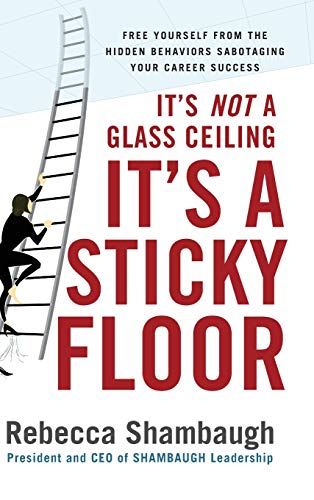
ITS NOT A GLASS CEILING: Free Yourself from the Hidden Behaviors Sabotaging Your Career Success - Hardcover
Inhaltsangabe
Turn the top 7 career breakers for women into career makers
Statistically, more than one-third of Fortune 500 managers are women-and yet we represent barely five percent of the top earners among executives. Usually, we blame it on men-those "old boy" networks that don't typically welcome women into "the club." But, according to leadership coach Rebecca Shambaugh, the real obstacle to women's advancement is not a "glass ceiling." It's the self-imposed career blocks that prevent us from moving up.
These are the 7 "sticky floors":
1. Balancing Your Work and Life
2. Embracing "Good Enough" in Your Work
3. Making the Break
4. Making Your Words Count
5. Forming Your Own Board of Directors
6. Capitalizing on Your Political Savvy
7. Asking for What You Want
Admit it: You've probably been "stuck" in at least one or more of these situations. Maybe you're a perfectionist who has trouble letting go of a task. Maybe you're so loyal to your company that you haven't explored other career options. Maybe you're afraid of speaking up in meetings. Or maybe you're so accommodating to others' needs that you never take care of your own.
This book will show you how to get unstuck from these common traps. You'll discover how other successful women have managed to break out of middle management jobs to grab the top leadership positions. You'll hear hard-won advice from working mothers who also happen to be CEOs, including proven tricks of the trade when it comes to juggling career and family. You'll learn how to conquer your insecurities, transform your thinking, tailor your behavior, and demand the kind of professional recognition you deserve. There's even a section of fill-in charts and checklists at the end of the book to help you stay on track, in control, and on the rise.
Once you've freed yourself from life's sticky floors, there's nowhere to go but up.
Die Inhaltsangabe kann sich auf eine andere Ausgabe dieses Titels beziehen.
Über die Autorin bzw. den Autor
Rebecca Shambaugh is the founder, president, and CEO of SHAMBAUGH Leadership, which was recently selected by Entrepreneur magazine as one of the top entrepreneurial companies in the Washington, D.C. area. She began her career as a human relations specialist at General Motors and has worked for several major corporations.
Her Web site is www.shambaughleadership.com.
Von der hinteren Coverseite
Break Through Your Fears-and Embrace Your Own Power
“Becky Shambaugh has written a wonderful book that should inspire women to believe in themselves and become great leaders in the 21st century. She believes women have to be courageous risk takers to reach their goals and to be self-motivating. She cites many of her own personal examples as the way to go. It's a great guidebook for women to step up the ladder.”-Helen Thomas, member, White House Press Corps., former White House Bureau Chief, UPI
“Insightful and thought provoking! Here is a guide to career and life success that is filled with practical tips to escape the career limiting 'sticky floors.' The effective use of real-world examples from strong leaders makes for a most enjoyable read. And the presentation of actionable items and practical tips sets her book apart from the many books in the market. As a hiring executive and a mentor I believe this is a must read for both businessmen and businesswomen!”-Tom Kendra, group president, Security & Data Management Group (SDMG), Symantec Corporation
“Becky Shambaugh's book, It's Not a Glass Ceiling, It's a Sticky Floor is a valuable new tool to help women unleash themselves from their own preconceived notions and move to new levels of leadership and significance.”-Frances Hesselbein, chairman and founding president, Leader to Leader Institute
Auszug. © Genehmigter Nachdruck. Alle Rechte vorbehalten.
IT'S NOT A GLASS CEILING IT'S A STICKY FLOOR
Free Yourself from the Hidden Behaviors Sabotaging Your Career SuccessBy Rebecca ShambaughThe McGraw-Hill Companies, Inc.
Copyright © 2008 Rebecca ShambaughAll right reserved.
ISBN: 978-0-07-149394-9
Contents
Chapter One
Know Yourself—Be Yourself"You must create your own roadmap to your chosen destination based on your values, beliefs, and strengths."
The Beginning ...
Things started out nicely enough. Shortly after graduating from Purdue University in the late 70s, I was offered a job as one of the first female managers on a General Motors production floor. But once I started, it didn't take long (by which I mean mere hours) to realize that I should have considered more carefully the role of gender in the workplace, and should have asked a few more questions during my job interview.
I arrived for my first day of work at 6:30 a.m. full of energy and excitement. I knew nothing about cars, except how to pull into a gas station and fill up my tank. That was not one of the job requirements, however. Instead I was expected to learn the 120 auto parts they used on this assembly line—and I had to succeed in an environment that had sent three previous managers packing in just 10 months.
I knew when I walked into the plant, and everything and everybody stopped, that I was in for a challenge. It was like one of those hushed movie moments. Everyone looked up and stared at me. At first, I wondered what was wrong with my appearance—did I have toilet paper dragging from my shoe or, worse yet, hanging from beneath my skirt? A glance down confirmed nothing was wrong; a glance up confirmed that I was the only woman in a sea of Teamster men.
The production manager waved me off with, "Good luck. See you at six!" By 9 a.m., the shop steward had come by with the first grievance against me. One of my quality control guys said he missed his coffee break because of a defect in one of the parts he caught running off the line. He had not missed a coffee break in 10 years and made it clear he wouldn't miss another one again. Later, after going through the third grievance procedure that morning, someone lit a fire in a garbage can in my department. By the end of the day, I had accumulated a record 25 grievances. Not much else could go wrong, right?
That afternoon, I walked into my first management meeting. Seventeen men in suits looked up. Seventeen mouths dropped open, and seventeen pens fell from their hands. I placed my meticulously prepared reports on the table in front of me, only to hear this: "Becky, you take notes."
That Which Doesn't Kill You ...
This experience was one of the greatest leadership development programs I could ever put myself in. At the tender age of 24, I had to learn how to build a diverse spectrum of relationships, to effectively manage the blue-collar men who were so different from me, and to play the middleman in negotiations between the union and management staff. You can bet my social and emotional intelligence were stretched daily—and I loved it. However, after three years and my fifth promotion, I realized that I had reached a peak at GM. I could have stayed on and advanced to be a head of plant production or even head of headquarters for human resources in Detroit, but in the long term, I didn't want to stay in manufacturing and production.
Fortunately I had a new opportunity presented to me. I was offered a job more aligned with my long-term goals at Amax Inc., a billion-dollar energy company, where I worked for its coal mining division located in Indianapolis. It provided me with broader human resources responsibilities, more opportunities to work with senior executives, and the chance to rotate through jobs that taught me about business activities company-wide. I had a supportive and experienced group of colleagues, mostly men, who served as helpful mentors along the way. I was fortunate to have a boss who was receptive to my ideas and willing to put me in a variety of diverse projects—all leading me to a promotion in my first year.
Then—4 years later, to my great surprise—I got a pink slip. I was shocked and in denial. Despite watching layoffs happen to others, I never thought I would be one of the victims.
How could this happen? Everything had gone so well. Like so many others in this situation, I was struck with self-doubt. I wondered about my abilities and my skills. And the problem was worse than it seemed. It was a bad economy, with a local unemployment rate of 15 percent—and Indianapolis wasn't exactly a booming metropolis in good times. What would I do?
Standing in the unemployment line with 50 folks who had many more years of experience than me, who were looking for the same type of jobs I was seeking, an important realization struck me. Job opportunities in that town were slim, and no one was going to single me out from that long line of talented and credentialed executives to hand me a golden opportunity. I needed to create change for myself and take responsibility for my future. I could use this as an opportunity to pursue my dream job. This was a chance to push out of my comfort zone, take a risk, and take control of my destiny. If I didn't, I would most likely be visiting the unemployment line for some time.
I knew this was what I needed to do to solve my immediate problem of getting a job. But I also had a glimmer of understanding that I was taking an important step toward building a career.
This was the beginning of my appreciation that it's important to have a vision of who you want to be and to continually take small, mindful steps toward that vision.
I began thinking of my job search as a process for self-evaluation and set out to learn about all the different aspects of who I was. What were my strengths, beliefs, fears, and motivations? I decided to pull over for about six months and take a hard look at what I wanted to do, as well as at my key drivers and decide how they would help to determine my next job. I found a book about managing your career and there was an exercise on identifying and living your values that I began to fill out. What was fascinating was that the top five values I had listed—relationships, creating and building new business opportunities, taking risks, continually learning, and helping others—were the very things that had motivated me in my first two jobs.
I then began to reflect back on the conversations I'd had with my father, Max Shambaugh, at the kitchen table when I was a little girl. I was always fascinated by the fact that he had built a third-generation family business into one of the largest construction companies in the country. My father instilled in me an approach to work that I still value today. Specifically, he encouraged me to take risks but to be prudent about it, to build on my strengths and relationships, and to follow through on things I'm passionate about.
I used these things I had discovered about myself to focus and expand my job search. And within six months I had three job offers—two in the Midwest and one on the East Coast. I ended up taking the job in Washington, D.C., as head of human resources for the corporate headquarters of Fairchild Industries.
It was a darn good decision that would set me on the long-term career path I really wanted for myself. I took the position knowing it was a leap of faith to move to a new city in order to accept a job for which I was not totally qualified. But the job at Fairchild had everything I was looking...
„Über diesen Titel“ kann sich auf eine andere Ausgabe dieses Titels beziehen.
Suchergebnisse für ITS NOT A GLASS CEILING: Free Yourself from the Hidden...

Beispielbild für diese ISBN
It's Not a Glass Ceiling, It's a Sticky Floor: Free Yourself From the Hidden Behaviors Sabotaging Your Career Success
Verlag:
McGraw-Hill Education - Europe, 2007
ISBN 10: 0071493948
ISBN 13: 9780071493949
Gebraucht
Hardcover
Anbieter: World of Books (was SecondSale), Montgomery, IL, USA
Verkäuferbewertung 5 von 5 Sternen

Hardback. Zustand: Good. Presents strategies to stop the hidden behaviors, assumptions, and beliefs that keep women from reaching the top. This book shows how to fight the instincts of perfectionism, people-pleasing, and other traps that keep women from being efficient managers, successful delegators, and executive candidates. Artikel-Nr. 00095776052
Gebraucht kaufen
EUR 3,95
Versand gratis
Versand innerhalb von USA
Versand innerhalb von USA
Anzahl: 2 verfügbar
Beispielbild für diese ISBN
It's Not a Glass Ceiling, It's a Sticky Floor: Free Yourself From the Hidden Behaviors Sabotaging Your Career Success
Verlag:
McGraw-Hill Education - Europe, 2007
ISBN 10: 0071493948
ISBN 13: 9780071493949
Gebraucht
Hardcover
Anbieter: World of Books (was SecondSale), Montgomery, IL, USA
Verkäuferbewertung 5 von 5 Sternen
Hardback. Zustand: Fair. Presents strategies to stop the hidden behaviors, assumptions, and beliefs that keep women from reaching the top. This book shows how to fight the instincts of perfectionism, people-pleasing, and other traps that keep women from being efficient managers, successful delegators, and executive candidates. Artikel-Nr. 00096732910
Gebraucht kaufen
EUR 3,95
Versand gratis
Versand innerhalb von USA
Versand innerhalb von USA
Anzahl: 1 verfügbar
Beispielbild für diese ISBN
It's Not a Glass Ceiling, It's a Sticky Floor: Free Yourself From the Hidden Behaviors Sabotaging Your Career Success
Verlag:
McGraw-Hill Education - Europe, 2007
ISBN 10: 0071493948
ISBN 13: 9780071493949
Gebraucht
Hardcover
Anbieter: World of Books (was SecondSale), Montgomery, IL, USA
Verkäuferbewertung 5 von 5 Sternen
Hardback. Zustand: Very Good. Presents strategies to stop the hidden behaviors, assumptions, and beliefs that keep women from reaching the top. This book shows how to fight the instincts of perfectionism, people-pleasing, and other traps that keep women from being efficient managers, successful delegators, and executive candidates. Artikel-Nr. 00086503067
Gebraucht kaufen
EUR 3,95
Versand gratis
Versand innerhalb von USA
Versand innerhalb von USA
Anzahl: 6 verfügbar
Beispielbild für diese ISBN
It's Not a Glass Ceiling, It's a Sticky Floor: Free Yourself From the Hidden Behaviors Sabotaging Your Career Success
Verlag:
McGraw Hill (edition 1), 2007
ISBN 10: 0071493948
ISBN 13: 9780071493949
Gebraucht
Hardcover
Anbieter: BooksRun, Philadelphia, PA, USA
Verkäuferbewertung 5 von 5 Sternen
Hardcover. Zustand: Very Good. 1. With dust jacket. It's a well-cared-for item that has seen limited use. The item may show minor signs of wear. All the text is legible, with all pages included. It may have slight markings and/or highlighting. Artikel-Nr. 0071493948-11-1-29
Gebraucht kaufen
EUR 4,77
Versand gratis
Versand innerhalb von USA
Versand innerhalb von USA
Anzahl: 1 verfügbar
Beispielbild für diese ISBN
It's Not a Glass Ceiling, It's a Sticky Floor: Free Yourself from the Hidden Behaviors Sabotaging Your Career Success
Anbieter: ThriftBooks-Phoenix, Phoenix, AZ, USA
Verkäuferbewertung 5 von 5 Sternen
Hardcover. Zustand: Very Good. No Jacket. May have limited writing in cover pages. Pages are unmarked. ~ ThriftBooks: Read More, Spend Less. Artikel-Nr. G0071493948I4N00
Gebraucht kaufen
EUR 6,34
Versand gratis
Versand innerhalb von USA
Versand innerhalb von USA
Anzahl: 1 verfügbar
Beispielbild für diese ISBN
It's Not a Glass Ceiling, It's a Sticky Floor: Free Yourself from the Hidden Behaviors Sabotaging Your Career Success
Anbieter: ThriftBooks-Dallas, Dallas, TX, USA
Verkäuferbewertung 5 von 5 Sternen
Hardcover. Zustand: As New. No Jacket. Pages are clean and are not marred by notes or folds of any kind. ~ ThriftBooks: Read More, Spend Less. Artikel-Nr. G0071493948I2N00
Gebraucht kaufen
EUR 6,35
Versand gratis
Versand innerhalb von USA
Versand innerhalb von USA
Anzahl: 1 verfügbar
Beispielbild für diese ISBN
It's Not a Glass Ceiling, It's a Sticky Floor: Free Yourself from the Hidden Behaviors Sabotaging Your Career Success
Anbieter: ThriftBooks-Dallas, Dallas, TX, USA
Verkäuferbewertung 5 von 5 Sternen
Hardcover. Zustand: Very Good. No Jacket. May have limited writing in cover pages. Pages are unmarked. ~ ThriftBooks: Read More, Spend Less. Artikel-Nr. G0071493948I4N00
Gebraucht kaufen
EUR 6,35
Versand gratis
Versand innerhalb von USA
Versand innerhalb von USA
Anzahl: 1 verfügbar
Beispielbild für diese ISBN
It's Not a Glass Ceiling, It's a Sticky Floor: Free Yourself from the Hidden Behaviors Sabotaging Your Career Success
Anbieter: ThriftBooks-Atlanta, AUSTELL, GA, USA
Verkäuferbewertung 5 von 5 Sternen
Hardcover. Zustand: Very Good. No Jacket. May have limited writing in cover pages. Pages are unmarked. ~ ThriftBooks: Read More, Spend Less. Artikel-Nr. G0071493948I4N00
Gebraucht kaufen
EUR 6,35
Versand gratis
Versand innerhalb von USA
Versand innerhalb von USA
Anzahl: 1 verfügbar
Beispielbild für diese ISBN
It's Not a Glass Ceiling, It's a Sticky Floor: Free Yourself From the Hidden Behaviors Sabotaging Your Career Success (MGMT & LEADERSHIP)
Anbieter: WorldofBooks, Goring-By-Sea, WS, Vereinigtes Königreich
Verkäuferbewertung 5 von 5 Sternen
Hardback. Zustand: Very Good. The book has been read, but is in excellent condition. Pages are intact and not marred by notes or highlighting. The spine remains undamaged. Artikel-Nr. GOR003469301
Gebraucht kaufen
EUR 3,95
EUR 6,67 Versand
Versand von Vereinigtes Königreich nach USA
Versand von Vereinigtes Königreich nach USA
Anzahl: 4 verfügbar
Foto des Verkäufers
It's Not a Glass Ceiling, It's a Sticky Floor: Free Yourself From the Hidden Behaviors Sabotaging Your Career Success (MGMT & LEADERSHIP)
Anbieter: WeBuyBooks, Rossendale, LANCS, Vereinigtes Königreich
Verkäuferbewertung 5 von 5 Sternen
hardcover. Zustand: Very Good. Most items will be dispatched the same or the next working day. A copy that has been read, but is in excellent condition. Pages are intact and not marred by notes or highlighting. The spine remains undamaged. Signed by Author(Unverified). Artikel-Nr. rev7580916337
Gebraucht kaufen
EUR 4,42
EUR 7,90 Versand
Versand von Vereinigtes Königreich nach USA
Versand von Vereinigtes Königreich nach USA
Anzahl: 1 verfügbar