
Verwandte Artikel zu The One-Minute Guide to the Nautical Rules of the Road...
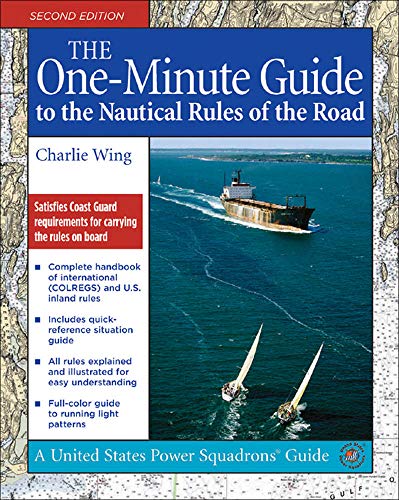
The One-Minute Guide to the Nautical Rules of the Road (United States Power Squadrons Guides) - Softcover
Inhaltsangabe
Your quick-access guide to international and U.S. boating rules The U.S. Coast Guard requires every boat more than 39-feet long to carry a copy of the nautical rules of the road onboard. Here's one that is convenient and handy enough for quick reference on the water. This bestselling guide includes the full text of the original rules, and Charlie Wing's clear, rule-by-rule translations make them easy to follow. It also includes a "One-Minute Guide Decision Tree" and a brief overview of the rules' intent to give you a good idea of what to do in any common situation.
Die Inhaltsangabe kann sich auf eine andere Ausgabe dieses Titels beziehen.
Über die Autorin bzw. den Autor
Charlie Wing received his Ph.D. in oceanography from MIT, where he later worked as a research scientist. Since then his career has been explaining how things work--teaching physics at Bowdoin College, founding America's first two do-it-yourself house-building schools (the Shelter Institute and Cornerstone), hosting a PBS series on energy conservation, and writing a dozen top-selling books on home building, home maintenance, and remodeling. Wing lived aboard a cruising sailboat for six years, during which time he wrote the first edition of this book on a solar-powered Macintosh computer. He is the author of four other IM books.
Auszug. © Genehmigter Nachdruck. Alle Rechte vorbehalten.
The One-Minute Guide to the Nautical Rules of the Road
By Charlie WingThe McGraw-Hill Companies, Inc.
Copyright © 2007 International Marine
All rights reserved.
ISBN: 978-0-07-147923-3All rights reserved.
Contents
| Introduction | |
| How to Use this Book | |
| Part One What Every Boater Needs to Know | |
| Important Definitions | |
| Do the Rules Apply to Me? | |
| How Am I Responsible? | |
| Does My Boat Need a Lookout? | |
| What Is a Safe Speed? | |
| Determining Risk of Collision | |
| Action to Avoid Collision | |
| In a Narrow Channel or Fairway | |
| Traffic Separation Schemes | |
| Overtaking | |
| Power-Driven Vessels Meeting Head-On | |
| Power-Driven Vessels Crossing | |
| Two Sailboats Meeting | |
| Mixed Vessel Types—The Pecking Order | |
| Fog Situation | |
| Sounds—Blow Your Own Horn | |
| Lights—What Can They Tell You? | |
| VHF Radio | |
| Part Two International and Inland Rules | |
| General | |
| Steering and Sailing Rules | |
| Lights and Shapes | |
| Sound and Light Signals | |
| Annexes | |
| Annex I: Positioning and Technical Details of Lights and Shapes | |
| Annex II: Additional Signals for Fishing Vessels Fishing in Close Proximity | |
| Annex III: Technical Details of Sound Signal Appliances | |
| Annex IV: Distress Signals | |
| Annex V: Pilot Rules (Inland Only) | |
| Interpretive Rules | |
| COLREGS Demarcation Lines | |
| Penalty Provisions | |
| Alternative Compliance | |
| Waters Specified By the Secretary | |
| Vessel Bridge-to-Bridge Radiotelephone Regulations | |
| Legal Citations | |
| Conversion Table | |
| Index |
Excerpt
CHAPTER 1
What Every Boater Needs to Know
The purpose of the Rules is not, as is commonly thought, to grant one boat theright-of-way over another. The idea of a "right-of-way" fell out of favor as itbecame clear, through court cases, that avoiding a collision between two boatsrequires the participation of both parties. The purpose of the Rules is topresent, in a situation where danger of collision between two boats exists,guidelines for the actions required of both. Under the Rules, one boat isdesignated the stand-on vessel; the other the give-way vessel (see page 12).These designations carry obligations for each vessel to act in a specified wayto avoid collision.
It is important to note that the Rules never address situations involving morethan two boats. Whenever the possibility of collision exists between more thantwo boats, common sense must be your principal guide.
RULE3
Important Definitions
Vessel: anything that carries people or cargo on or in the water, includingkayaks, personal watercraft, WIG craft and seaplanes, and super tankers.
Power-driven vessel: any vessel underway with an engine that does notfall intoany of the other special categories defined below.
Sailing vessel: a sailboat underway with sails (not using an engine).
Vessel engaged in fishing: any boat fishing with equipment which limitsitsability to maneuver (nets, trawls, etc.).
Vessel not under command: a vessel unable to maneuver as required by theRules,due to mechanical breakdown or any other reason.
Vessel restricted in her ability to maneuver: a vessel that, due to thenatureof her work, cannot maneuver easily. Examples include buoy tenders, dredges,dive boats, minesweepers, and tugs with difficult tows.
Vessel constrained by her draft: a vessel that may go aground if itdeviatesfrom its course. (Note that the Inland Rules do not contain this definition.)
Underway: not anchored, grounded, or otherwise attached to shore. A boatdoesnot have to be moving either through the water or over the ground to beunderway.
Restricted visibility: any condition that reduces visibility, includingfog,heavy rain, snow, and smoke.
Give-way vessel: the vessel obligated to keep out of the way of theother.
Stand-on vessel: the vessel obligated to maintain its course and speed.
Wing-In-Ground (WIG) Craft: a multimodal craft which, in its mainoperationalmode, flies in close proximity to the surface by utilizing surface-effectaction.
Do the Rules Apply to Me?
RULE1
In a word—yes. The International Regulations for the Prevention ofCollision at Sea (COLREGS) apply to all vessels, from kayaks to ocean-liners, onall of the oceans and bodies of water outside the magenta (red) Demarcation Lineprinted on charts. The United States Inland Rules apply on the Great Lakes,Western Rivers, waterways, and specific bays inside the Demarcation Line.
How Am I Responsible?
RULE2
Everyone having to do with the operation of your boat—its owner, master(person in charge underway), and crew—is responsible for obeying theRules, as well as for using caution, good sense, and good seamanship. However,the Rules acknowledge that they cannot cover every conceivable situation. Ifabsolutely necessary to avoid immediate danger, you are, in fact, required tobreak the Rules. In other words, use your head for the purpose intended, not asa hat rack.
Does My Boat Need a Lookout?
RULE5
Absolutely! Your boat is required to maintain a lookout for the possibility ofcollision at all times and to use all available methods and equipment (eyes,ears, radio, and radar, if installed). Of course, if you are the only person onboard, then you have to serve as master, crew, and lookout all at the same time.If there is more than one person aboard, however, the master should appoint aseparate lookout.
What Is a Safe Speed?
RULE6
You must never exceed a safe speed for the conditions. The Rules do not define"safe speed," but the courts have often interpreted it as the speed that wouldallow a boat to avoid collision. Factors you must consider include: visibilityconditions, background lights, traffic intensity, maneuverability of yourvessel, maneuverability of other vessels, wind and current, navigationalhazards, depth of water, and the limitations of radar.
Determining Risk of Collision
RULE7
Collision with another boat is possible when the compass bearing to it remainsconstant as your two boats converge. The rule specifically says that you mustuse all available means, including radar if you have it, to aid in thisdetermination. Fortunately, for small boat operators without radar, a relativebearing sighted against a stanchion or other fixed part of your boat maysubstitute for a compass bearing, as long as you maintain constant course andspeed. If there is any doubt at all, consider that collision is possible.
Action to Avoid Collision
RULE8
The give-way boat's...
„Über diesen Titel“ kann sich auf eine andere Ausgabe dieses Titels beziehen.
Suchergebnisse für The One-Minute Guide to the Nautical Rules of the Road...

Beispielbild für diese ISBN
The One-Minute Guide to the Nautical Rules of the Road
Verlag:
International Marine Publishing, 2006
ISBN 10: 0071479236
ISBN 13: 9780071479233
Gebraucht
Paperback
Anbieter: ThriftBooks-Atlanta, AUSTELL, GA, USA
Verkäuferbewertung 5 von 5 Sternen

Paperback. Zustand: Fair. No Jacket. Readable copy. Pages may have considerable notes/highlighting. ~ ThriftBooks: Read More, Spend Less. Artikel-Nr. G0071479236I5N00
Gebraucht kaufen
EUR 7,82
Versand gratis
Versand innerhalb von USA
Versand innerhalb von USA
Anzahl: 1 verfügbar
Beispielbild für diese ISBN
The One-Minute Guide to the Nautical Rules of the Road (United States Power Squadrons Guides)
Verlag:
International Marine/Ragged Mountain Press (edition 2), 2006
ISBN 10: 0071479236
ISBN 13: 9780071479233
Gebraucht
Paperback
Anbieter: BooksRun, Philadelphia, PA, USA
Verkäuferbewertung 5 von 5 Sternen
Paperback. Zustand: Very Good. 2. It's a well-cared-for item that has seen limited use. The item may show minor signs of wear. All the text is legible, with all pages included. It may have slight markings and/or highlighting. Artikel-Nr. 0071479236-11-1
Gebraucht kaufen
EUR 9,70
Versand gratis
Versand innerhalb von USA
Versand innerhalb von USA
Anzahl: 1 verfügbar
Beispielbild für diese ISBN
The One-Minute Guide to the Nautical Rules of the Road (United States Power Squadrons Guides)
Verlag:
International Marine/Ragged Moun, 2006
ISBN 10: 0071479236
ISBN 13: 9780071479233
Gebraucht
Paperback
Anbieter: Books From California, Simi Valley, CA, USA
Verkäuferbewertung 4 von 5 Sternen

Paperback. Zustand: Very Good. Artikel-Nr. mon0004243258
Gebraucht kaufen
EUR 11,92
EUR 4,47 Versand
Versand innerhalb von USA
Versand innerhalb von USA
Anzahl: 2 verfügbar
Beispielbild für diese ISBN
The One-minute Guide to the Nautical Rules of the Road
Anbieter: Revaluation Books, Exeter, Vereinigtes Königreich
Verkäuferbewertung 5 von 5 Sternen
Paperback. Zustand: Brand New. 2nd edition. 157 pages. 9.25x7.50x0.50 inches. In Stock. Artikel-Nr. x-0071479236
Neu kaufen
EUR 30,80
EUR 11,94 Versand
Versand von Vereinigtes Königreich nach USA
Versand von Vereinigtes Königreich nach USA
Anzahl: 2 verfügbar