
Verwandte Artikel zu Surfing Illustrated: A Visual Guide to Wave Riding
Inhaltsangabe
Expert instruction you need to take your skills from kook to boss
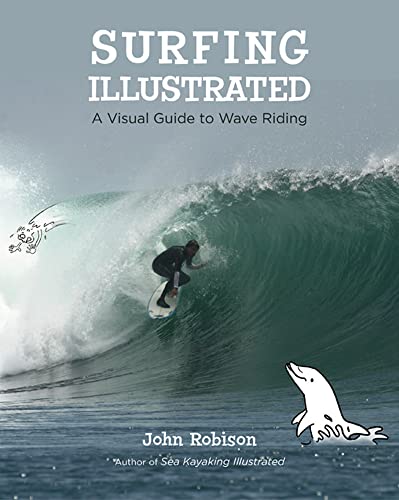
Author John Robison uses hundreds of pictures--comical, cartoon-like drawings--to clearly illustrateevery aspect of surfing: wave dynamics, riding techniques,etiquette, logistics, and more. This entertaining,easy-to-understand visual presentation makes it easyfor you to pick up his techniques and use themon the waves.
Robison covers every aspect of thesport, from paddling out through the surf zone andcatching and riding that first wave to nose riding, acrobatics,shortboard riding, and to equipment repairs.
Die Inhaltsangabe kann sich auf eine andere Ausgabe dieses Titels beziehen.
Über die Autorin bzw. den Autor
John Robison is a committed surfer and theauthor of the successful and similarly formatted Sea Kayaking Illustrated: A Visual Guide to Better Paddling.
Auszug. © Genehmigter Nachdruck. Alle Rechte vorbehalten.
Surfing Illustrated
AN ILLUSTRATED GUIDE TO WAVE RIDING
By JOHN ROBISONThe McGraw-Hill Companies, Inc.
Copyright © 2010 John Robison
All rights reserved.
ISBN: 978-0-07-147742-0All rights reserved.
Contents
| Acknowledgments | |
| Preface | |
| Introduction | |
| 1. Surfing, Surfboards, and Surfers | |
| 2. The Coast: A Beginning Surfer's Guide to Da Beach | |
| 3. Getting on the Water | |
| 4. Surf Etiquette | |
| 5. Reading and Catching Waves | |
| 6. Riding and Maneuvering | |
| 7. Surfer's Swag: A Grab Bag of Information | |
| Index |
Excerpt
CHAPTER 1
Surfing, Surfboards, and Surfers
No matter what your interests or abilities, the coast can be a fantasticplayground. First and foremost is surfing with a surfboard. Surfing can alsomean sliding any type of craft (a surfboard, boogie board, or even just yourbody) down the face of a wave. But if the waves are too small for surfing, youcan still go for a swim, paddle a paddleboard, outrigger canoe, or sea kayak, orgo fishing. If the wind is too strong for surfing, you can try sailing,boardsailing, or kiteboarding. If the water visibility is good, you can gosnorkeling or scuba diving. If the waves are too big, there is always shellcollecting, relaxing, sand castle construction and demolition with the kids, aswell as sex on the beach (the cocktail, that is). The more watersports you try,the better an overall surfer you become. The most respected surfers areproficient in a wide variety of surfing, from bodysurfing to outrigger canoesurfing to kiteboarding. So with all these other options, why surf? Becauseit's simply the most fun you can have.
"Listen: when someone tells me he or she wants to learn the athleticism, theart, of surfing, my first reaction is invariably, 'careful, it can changeeverything.'"
—Allan C. Weisbecker, In Search of Captain Zero
HOW SURFING WORKS
To really appreciate surfing, it helps to understand a little bit about thephysics of what's going on.
Gravity Sports: It's All Downhill from Here
Surfing is a gravity sport like downhill skiing or snowboarding, with the addedexcitement that the entire hill is moving with you. Mere humans are newcomers tothe sport of surfing. Dolphins and sea lions are the real experts and can surfwaves underwater, and pelicans can surf across the updraft on the face of acresting wave.
Planing
Most surfboards are not buoyant enough to support an upright person in flatwaterwithout sinking, so how is it that surfers are able to stand up and skim acrossthe surface of a moving wave? The difference between skipping a stone andploinking a pebble is speed across the surface of the water.
With enough speed, even large objects like water-skiers and jetboats stopplowing through the water and start skimming or planing across the surface.
Instead of using a motor, surfers use the speed generated by gravity as theydrop down the slope of a moving wave. Unlike a ski hill, a wave slope can changefrom too flat to too steep in a few seconds, so timing and placement arecritical.
Finding the Glide Zone
The glide zone is a constantly moving area where it is steep enough (butnot too steep) for your surfboard to start planing (surfer B). The idea is tosprint shoreward until the glide zone of a wave appears underneath you. If youstand up too soon, before the wave steepens enough, you will sink like a water-skierbehind a boat that has run out of gas (surfer A). If you are trying tocatch a wave that is too steep for your surfboard, the surfboard will nosedive,or pearl, sending you end over end (surfer C).
Catching Waves
Instead of thinking about catching the wave, think about the wave catching upwith you. With practice, you will be able to position yourself so the glide zoneappears directly beneath you just as the wave catches up with you.
Dropping In
Once you succeed in paddling into the glide zone and standing up (this may takesome time), you need to figure out what to do next. If you keep your boardpointed straight toward shore, you will speed ahead of the wave into theflats, where the avalanche of whitewater behind you will soon catch up.Although making drops is great fun, the rides are short, and thisroutine can become tiring after a while.
Trimming and The Glide
For longer rides you need to choose a wave that breaks gradually from one end tothe other (peels) so a new glide zone keeps forming to the side. If youpoint your board toward this new glide zone, you can enjoy a much longer ride.
Trimming is when you line up your board so it stays in the glide zoneall the way down the line, also known as The Glide. When conditions areright, surfers can ride diagonally across a wave face for a mile or more.
Although being in trim is great, from the glide zone you also can sprint outinto the flats for a bottom turn (see Chapter 6, page 140),launch up the wave crest for an off-thelip (see page 149), or carve outto the shoulder and back for a roundhouse cutback (see Chapter6, page 149). But always, at some point, you have to come back through theglide zone to regain your speed.
BEFORE YOU GRAB YOUR SURFBOARD
There are several basic ocean skills you should be comfortable with before yougrab a surfboard.
Swim Practice
Even though you may plan on doing all your stroking while on a surfboard, youneed to be comfortable swimming in the ocean without a surfboard in case youbecome separated from your surfboard. Although you don't have to be an Olympicswimmer to surf (but it helps!), you should be able to swim in a pool for atleast thirty minutes and tread water for twenty minutes without difficulty. Itis perfectly okay to take a touch-up swim lesson to improve your efficiency.
Once your flutter kick is fluttering and your crawl is more than crawling, youshould gain some experience swimming in the ocean next to the shore in mildconditions. In general, though, places to surf don't make good places to swim.So before you go, read Chapter 2 about rip currents and check with alifeguard for recommendations!
Dealing with Waves by Ducking (and Not Diving)
Once you've found a good swimming spot, the next step is to become comfortablewith the ins and outs of the shore break. The shore break can change from aClass I to a Class V rapid and back again in just a few seconds, so time yourentry and exit to avoid the waves. As you wade out and encounter an oncomingwave, you can either stand sideways on your tiptoes to pass through it, duckunder it, or just act like a tourist and let it smack you. Once the water is toodeep or the waves are too big to wade through, the safest option is to duckunderwater and swim under the turbulence. If you choose to, you can do a low-speed,sinking belly flop and then swim to the bottom. Never dive if there mightbe any obstacles (such as the bottom) to bump into with your head or torso.
Swimming in Open Water
Now that you are beyond the shore break, take a moment to float, relax, and geta sense of the circular motion of passing waves. As you float next to the beach,you will feel a surge toward shore alternating with a backwash away from...
„Über diesen Titel“ kann sich auf eine andere Ausgabe dieses Titels beziehen.
Suchergebnisse für Surfing Illustrated: A Visual Guide to Wave Riding

Beispielbild für diese ISBN
Surfing Illustrated
Verlag:
International Marine Publishing Co, 2010
ISBN 10: 007147742X
ISBN 13: 9780071477420
Gebraucht
Paperback
Anbieter: World of Books (was SecondSale), Montgomery, IL, USA
Verkäuferbewertung 5 von 5 Sternen

Paperback. Zustand: Good. Expert instruction beginning and intermediate surfers need to take their skills from kook to boss. Artikel-Nr. 00105330206
Gebraucht kaufen
EUR 6,56
Versand gratis
Versand innerhalb von USA
Versand innerhalb von USA
Anzahl: 3 verfügbar
Beispielbild für diese ISBN
Surfing Illustrated : A Visual Guide to Wave Riding
Verlag:
McGraw-Hill Professional Publishing, 2010
ISBN 10: 007147742X
ISBN 13: 9780071477420
Gebraucht
Softcover
Anbieter: Better World Books: West, Reno, NV, USA
Verkäuferbewertung 5 von 5 Sternen
Zustand: Good. Pages intact with minimal writing/highlighting. The binding may be loose and creased. Dust jackets/supplements are not included. Stock photo provided. Product includes identifying sticker. Better World Books: Buy Books. Do Good. Artikel-Nr. 7975112-6
Gebraucht kaufen
EUR 6,57
Versand gratis
Versand innerhalb von USA
Versand innerhalb von USA
Anzahl: 1 verfügbar
Beispielbild für diese ISBN
Surfing Illustrated : A Visual Guide to Wave Riding
Verlag:
McGraw-Hill Professional Publishing, 2010
ISBN 10: 007147742X
ISBN 13: 9780071477420
Gebraucht
Softcover
Anbieter: Better World Books, Mishawaka, IN, USA
Verkäuferbewertung 5 von 5 Sternen
Zustand: Good. Pages intact with minimal writing/highlighting. The binding may be loose and creased. Dust jackets/supplements are not included. Stock photo provided. Product includes identifying sticker. Better World Books: Buy Books. Do Good. Artikel-Nr. 7975112-6
Gebraucht kaufen
EUR 6,57
Versand gratis
Versand innerhalb von USA
Versand innerhalb von USA
Anzahl: 2 verfügbar
Beispielbild für diese ISBN
Surfing Illustrated: A Visual Guide to Wave Riding
Verlag:
International Marine Publishing, 2010
ISBN 10: 007147742X
ISBN 13: 9780071477420
Gebraucht
Paperback
Anbieter: ThriftBooks-Atlanta, AUSTELL, GA, USA
Verkäuferbewertung 5 von 5 Sternen
Paperback. Zustand: Good. No Jacket. Pages can have notes/highlighting. Spine may show signs of wear. ~ ThriftBooks: Read More, Spend Less. Artikel-Nr. G007147742XI3N00
Gebraucht kaufen
EUR 6,62
Versand gratis
Versand innerhalb von USA
Versand innerhalb von USA
Anzahl: 1 verfügbar
Beispielbild für diese ISBN
Surfing Illustrated: A Visual Guide to Wave Riding
Verlag:
International Marine Publishing, 2010
ISBN 10: 007147742X
ISBN 13: 9780071477420
Gebraucht
Paperback
Anbieter: ThriftBooks-Reno, Reno, NV, USA
Verkäuferbewertung 5 von 5 Sternen
Paperback. Zustand: Fair. No Jacket. Readable copy. Pages may have considerable notes/highlighting. ~ ThriftBooks: Read More, Spend Less. Artikel-Nr. G007147742XI5N00
Gebraucht kaufen
EUR 6,62
Versand gratis
Versand innerhalb von USA
Versand innerhalb von USA
Anzahl: 1 verfügbar
Beispielbild für diese ISBN
Surfing Illustrated: A Visual Guide to Wave Riding
Verlag:
International Marine Publishing, 2010
ISBN 10: 007147742X
ISBN 13: 9780071477420
Gebraucht
Paperback
Anbieter: ThriftBooks-Phoenix, Phoenix, AZ, USA
Verkäuferbewertung 5 von 5 Sternen
Paperback. Zustand: Good. No Jacket. Pages can have notes/highlighting. Spine may show signs of wear. ~ ThriftBooks: Read More, Spend Less. Artikel-Nr. G007147742XI3N00
Gebraucht kaufen
EUR 6,62
Versand gratis
Versand innerhalb von USA
Versand innerhalb von USA
Anzahl: 1 verfügbar
Beispielbild für diese ISBN
Surfing Illustrated: A Visual Guide to Wave Riding
Verlag:
International Marine Publishing, 2010
ISBN 10: 007147742X
ISBN 13: 9780071477420
Gebraucht
Paperback
Anbieter: ThriftBooks-Atlanta, AUSTELL, GA, USA
Verkäuferbewertung 5 von 5 Sternen
Paperback. Zustand: Fair. No Jacket. Readable copy. Pages may have considerable notes/highlighting. ~ ThriftBooks: Read More, Spend Less. Artikel-Nr. G007147742XI5N00
Gebraucht kaufen
EUR 6,62
Versand gratis
Versand innerhalb von USA
Versand innerhalb von USA
Anzahl: 1 verfügbar
Beispielbild für diese ISBN
Surfing Illustrated: A Visual Guide to Wave Riding
Verlag:
International Marine Publishing, 2010
ISBN 10: 007147742X
ISBN 13: 9780071477420
Gebraucht
Paperback
Anbieter: ThriftBooks-Dallas, Dallas, TX, USA
Verkäuferbewertung 5 von 5 Sternen
Paperback. Zustand: Good. No Jacket. Former library book; Pages can have notes/highlighting. Spine may show signs of wear. ~ ThriftBooks: Read More, Spend Less. Artikel-Nr. G007147742XI3N10
Gebraucht kaufen
EUR 6,63
Versand gratis
Versand innerhalb von USA
Versand innerhalb von USA
Anzahl: 1 verfügbar
Beispielbild für diese ISBN
Surfing Illustrated: A Visual Guide to Wave Riding
Verlag:
International Marine/Ragged Mountain Press (edition 1), 2010
ISBN 10: 007147742X
ISBN 13: 9780071477420
Gebraucht
Paperback
Anbieter: BooksRun, Philadelphia, PA, USA
Verkäuferbewertung 5 von 5 Sternen
Paperback. Zustand: Very Good. 1. It's a well-cared-for item that has seen limited use. The item may show minor signs of wear. All the text is legible, with all pages included. It may have slight markings and/or highlighting. Artikel-Nr. 007147742X-11-6
Gebraucht kaufen
EUR 7,03
Versand gratis
Versand innerhalb von USA
Versand innerhalb von USA
Anzahl: 1 verfügbar
Beispielbild für diese ISBN
Surfing Illustrated: A Visual Guide to Wave Riding
Verlag:
International Marine Publishing, Chicago, IL, 2010
ISBN 10: 007147742X
ISBN 13: 9780071477420
Gebraucht
paperback
Anbieter: Magers and Quinn Booksellers, Minneapolis, MN, USA
Verkäuferbewertung 5 von 5 Sternen
paperback. Zustand: Very Good. May have light to moderate shelf wear and/or a remainder mark. Complete. Clean pages. Artikel-Nr. 1524104
Gebraucht kaufen
EUR 6,20
EUR 3,56 Versand
Versand innerhalb von USA
Versand innerhalb von USA
Anzahl: 1 verfügbar