
Verwandte Artikel zu The Boatbuilder's Apprentice: The Ins and Outs...
The Boatbuilder's Apprentice: The Ins and Outs of Building Lapstrake, Carvel, Stitch-and-Glue, Strip-Planked, and Other Wooden Boa: The Ins and Outs ... Strip-planked, and Other Wooden Boats - Hardcover
Inhaltsangabe
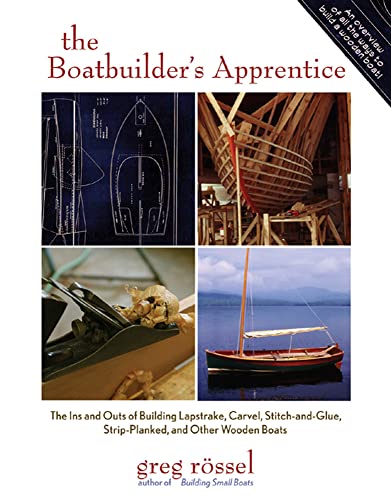
Learn the Ins and Outs of Building Lapstrake, Carvel, Stitch-and-Glue, Strip-Planked, and Other Wooden Boats
Whether you are contemplating your first-ever boatbuilding project or trying to decide what design you'd like to build next, Greg Rössel can help. Here's just a glimpse of what's inside this complete overview of wooden boatbuilding:
- How rowing, sailing, paddling, and powerboat designs perform, and how they compare in cost, time, and necessary skills for building
- How wooden boats are built, including the pros and cons of carvel, lapstrake, dory lap, stitch and glue, strip plank, and other methods
- How to choose the best boat and building method for your next project
- How to loft a hull, steam bend frames, scarf a joint, cut a rabbet, laminate stems, and spile planks
- How to take the lines off an old classic whose plans have been lost
- How to make oars, spars, coamings, knees, gaff jaws, cleats, and more
Greg Rössel writes with warmth, wit, and an engaging style. The Boatbuilder's Apprentice is a must guide for anyone planning or even dreaming about building a wooden boat.
“Greg Rössel is a Renaissance man. While there are many talented boatbuilders in the world, only a handful are also good teachers. Even fewer can write or illustrate effectively. Yet this author is highly skilled in each of these areas. . . . The Boatbuilder's Apprentice is a successful blend of technique and wisdom, and is, I believe, destined to become a classic.”-Karen Wales, WoodenBoat Review
Die Inhaltsangabe kann sich auf eine andere Ausgabe dieses Titels beziehen.
Über die Autorin bzw. den Autor
Greg Rössel is the author of Building Small Boats, coauthor of Kayaks You Can Build, and a long-time contributor to WoodenBoat magazine.
Von der hinteren Coverseite
There is a peculiar form of insomnia that afflicts amateur boatbuilders. It consists of lying awake at night, reviewing the details of a boatbuilding project and wondering, "How am I going to do that?" Greg Rössel helps answer those questions.
Wooden boats have been called "the most lifelike" of man's creations. Their beauty can inspire even inexperienced woodworkers to attempt their construction, but their complexity can bedevil the most determined. In The Boatbuilder's Apprentice, longtime WoodenBoat writer and professional boatbuilder Greg Rössel helps weekend builders choose the best boat design and construction method for their first, second, or twentieth project.
Beginning with the question, 'why wood?,' and focusing on wooden boats less than 20 feet long, Greg provides a complete overview of the methods used to build small wooden boats, from traditional carvel or lapstrake planking to modern stitch-and-glue, strip-planked, glued-lap, cold molding, and others. He discusses their pros and cons, their adaptability to different boat types, and their degrees of difficulty in both construction and maintenance. He explains the basics of boat design and of hull form and function and helps the beginner decide which type of boat will best suit his or her needs, skills, and desires.
Greg also covers the essentials of every boatbuilding project, including:
- Tools, wood types, fasteners, adhesives, and coatings;
- Shop setup and safety;
- Whether to build right-side up or upside down;
- How to go about steam bending, cutting rabbets, scarfing, and laminating;
- Oar and spar making;
- Building knees, gaff jaws, and cleats, and taking the lines off an old classic.
Writing with wit and an engaging style, Rössel makes light work of that most feared of all processes for the beginning boatbuilder-lofting. He shares his extensive experience on problem solving, shows you how to work efficiently, and offers hundreds of ingenious techniques for surmounting age-old difficulties. He also includes a glossary as well as an extensive appendix of sources for plans and materials.
Auszug. © Genehmigter Nachdruck. Alle Rechte vorbehalten.
the Boatbuilder's Apprentice
The Ins and Outs of Building Lapstrake, Carvel, Stitch-and-Glue, Strip-Planked, and Other Wooden Boats
By Greg RosselThe McGraw-Hill Companies, Inc.
Copyright © 2007 Greg Rossel
All rights reserved.
ISBN: 978-0-07-146405-5All rights reserved.
Contents
| Acknowledgments | |
| Preface | |
| Introduction: Selecting a Small Boat to Build | |
| Part One METHODS OF HULL CONSTRUCTION | |
| 1 Construction Systems | |
| 2 Carvel Planking | |
| 3 Lapstrake Planking | |
| 4 Dory-Lap Planking | |
| 5 Planking a Traditional Flat-Bottomed Boat | |
| 6 Batten Seam Construction | |
| 7 Strip Planking | |
| 8 Traditional Hard-Chined V-Bottomed Construction | |
| 9 Stitch-and-Glue Construction | |
| 10 Glued Lapstrake Planking | |
| 11 Cold Molding | |
| Part Two SETTING UP SHOP | |
| 12 Traditional Hull Materials | |
| 13 Plywood | |
| 14 Hull Knees | |
| 15 Selecting a Glue | |
| 16 Fastenings | |
| 17 Bedding Compounds | |
| 18 Boat Finishes | |
| 19 Tools | |
| 20 Setting Up Shop | |
| 21 Wood Dust | |
| Part Three BUILDING TECHNIQUES | |
| 22 Construction Planning | |
| 23 Lofting Basics | |
| 24 Let's Loft Some Boats | |
| 25 Construction Setup | |
| 26 The Backbone | |
| 27 Steaming Frames and Planks | |
| 28 Scarfs | |
| 29 Steam-Bent Coaming | |
| 30 Oars and Spars | |
| 31 Oarlocks, Pads, and Leathers | |
| 32 Bitts and Pieces | |
| Part Four BOATS TO BUILD | |
| 33 Pulling Boats | |
| 34 Canoes and Kayaks | |
| 35 Dories | |
| 36 Sailboats | |
| 37 Powerboats | |
| 38 Taking the Lines | |
| 39 Young Folks and Boatbuilding | |
| Appendix A: Tables, Lists, and Technical Specifications | |
| Appendix B: Resources | |
| Glossary | |
| Index |
Excerpt
CHAPTER 1
Construction Systems
One of the most important and intriguing considerations when deciding on a boatto build is what system to choose for hull construction. There is a vast rangeof styles to choose from. From the complex, time-and-material-consuming, to therelatively quick-and-easy, each of the systems has something tooffer—that's why they were developed in the first place.
Considering boatbuilding historically, the business has always been aboutinnovation, using the best from the past and embracing (albeit, many timesbegrudgingly) the latest in technology. New fangledness, however, does notnecessarily make the method or the product better than the old way. Is a steelwarehouse better than a post-and-beam barn? Both do the job they were intendedto do.
It's all about using technology that is appropriate for the job. A laminatedepoxy composite hull is great, but if you are in a remote locale where there isno way to manufacture the laminates and the glue is prohibitively expensive orimpossible to import, building in the older plank-on-frame methods withindigenous materials makes a lot of sense.
There is also the matter of intangibles and philosophy. For many, there is acertain mojo when working with natural wood and time-tested methods. There is asmell and a tactile satisfaction that comes with shaping a cedar plank from rawmaterial that was obviously a tree—bark, knots, and all—not thatlong ago. For others, building a boat from raw wood is about as up-to-date asgargoyle carving and as practical as deciding to build an automobile startingwith iron ore and rubber trees.
Take planking for example. Not every style lends itself to every design. Forexample, stitch-and-glue is a wonderful innovation, but the technique isrestricted by the constraints imposed by the manufactured material (i.e.,plywood) used. There aren't many Herreshoff 12½-style boats being built institch-and-glue, much less any Friendship sloops. The hull shapes are simply toocomplex. For those designs, the highly versatile yet somewhat archaic carvelplanking is the way to go. On the other hand, the simplicity of stitch-and-glueand the strength of plywood and epoxy make that technique a top choice forbuilding a kayak. You could build a kayak in carvel, but the additional expense,time, weight, and maintenance hardly make it a first choice.
Then there are the versatile hull designs that can be built with a number ofdifferent techniques. Take the traditional Whitehall-type pulling boat. Abeautiful and reliable hull can be fashioned using carvel, lapstrake (clinker),strip planking (either edge-nailed or glued-strip with fiberglass), glued lap,cold molding, or thoroughly modern, computer carved LapStitch planking.
You'll note that I'm referring to planking methods and construction methodsalmost interchangeably. In many ways, the two are nearly synonymous. Traditionalcarvel and lapstrake planking inevitably imply the use of plank-on-frameconstruction. Strip planking is also known as strip construction, or stripbuilding, and since there's almost no structure to a strip-built hull besidesthe planks, this makes sense. The same goes for stitch-and-glue: it's aconstruction method that relies upon stitched-and-glued panels (in place ofplanks, per se).
PLANKING METHODS
Lapstrake
For hundreds of years, mechanics have had access to a plethora of plankingmethods. One of the oldest is the lapstrake or clinker method where the top edgeof each plank is beveled, overlapped by, and fastened to the bottom edge of thenext one up. Lapstrake boats are strong, relatively lightweight, and generallyeasy to keep tight (at least when new) thanks to the overlapping planks. Dorylap is a variation that uses a bevel on both the top and bottom edges of theplank. This is done to reduce the thickness of the lap. The glued plywoodlapstrake method (or simply "glued lap") was introduced just a few years ago,taking advantage of the benefits of plywood and epoxy to increase the durabilityof the planking, eliminate leaks, and cut down on the number of frames required.
Lapstrake construction in general is best suited for a hull without a tremendousamount of shape or large changes in girth or circumference in the hull movingfore to aft. For a good-looking job and for easy planking, care must be taken tocarefully predetermine, or "line out," the plank locations. Curiously, lapstrakeboats are somewhat "noisy" or musical as the moving water chortles past thelaps.
Traditional lapstrake fares well out of the water for extendedperiods—that's why the method was often used for lifeboats.
Carvel Planking
Smooth or carvel planking has the classic look that is often associated withyachts. Any kind of hull can be built with edge-to-edge-fit carvel planking, aseach individual plank is patterned and sculpted to shape. Where...
„Über diesen Titel“ kann sich auf eine andere Ausgabe dieses Titels beziehen.
Suchergebnisse für The Boatbuilder's Apprentice: The Ins and Outs...

Beispielbild für diese ISBN
The Boatbuilder's Apprentice
Verlag:
International Marine Publishing Co, 2007
ISBN 10: 0071464050
ISBN 13: 9780071464055
Gebraucht
Hardcover
Anbieter: World of Books (was SecondSale), Montgomery, IL, USA
Verkäuferbewertung 5 von 5 Sternen

Hardback. Zustand: Good. Covers the essentials of boatbuilding projects - tools, wood, fasteners, adhesives, coatings, and safety - and shows how each construction method proceeds, how to overcome problems and challenges, and how to work efficiently. Artikel-Nr. 00109253184
Gebraucht kaufen
EUR 15,26
Versand gratis
Versand innerhalb von USA
Versand innerhalb von USA
Anzahl: 1 verfügbar
Beispielbild für diese ISBN
The Boatbuilder's Apprentice : The Ins and Outs of Building Lapstrake, Carvel, Stitch-And-Glue, Strip-Planked, and Other Wooden Boa
Verlag:
McGraw-Hill Professional Publishing, 2007
ISBN 10: 0071464050
ISBN 13: 9780071464055
Gebraucht
Hardcover
Anbieter: Better World Books, Mishawaka, IN, USA
Verkäuferbewertung 5 von 5 Sternen
Zustand: Very Good. Pages intact with possible writing/highlighting. Binding strong with minor wear. Dust jackets/supplements may not be included. Stock photo provided. Product includes identifying sticker. Better World Books: Buy Books. Do Good. Artikel-Nr. 7943594-20
Gebraucht kaufen
EUR 18,13
Versand gratis
Versand innerhalb von USA
Versand innerhalb von USA
Anzahl: 1 verfügbar
Beispielbild für diese ISBN
BOATBUILDER'S APPRENTICE : THE INS AND OUTS OF BUILDING LAPSTRAKE, CARVEL, STITCH-AND-GLUE, STRIP-PLANKED, AND OTHER WOODEN BOATS
Verlag:
International Marine/Ragged Mountain Press, 2007
ISBN 10: 0071464050
ISBN 13: 9780071464055
Gebraucht
Hardcover
Anbieter: Magers and Quinn Booksellers, Minneapolis, MN, USA
Verkäuferbewertung 5 von 5 Sternen
hardcover. Zustand: Acceptable. May have underlining, highlighting, margin notes, remainder marks, inscriptions, book plates, tears, significant wear, and/or a missing dust jacket, box, or discs. Damaged item. Artikel-Nr. 1508494
Gebraucht kaufen
EUR 30,88
EUR 3,55 Versand
Versand innerhalb von USA
Versand innerhalb von USA
Anzahl: 1 verfügbar
Beispielbild für diese ISBN
The Boatbuilder's Apprentice
Anbieter: Tools and Trades Books, Antrim, NH, USA
Verkäuferbewertung 5 von 5 Sternen
Hardcover. Zustand: As New. Zustand des Schutzumschlags: As New. How wooden boats are built, including the pros and cons of carvel, lapstrake, dory lap, stitch and glue, strip plank, and other methods. How to loft a hull, steam bend frames, scarf a joint, cut a rabbet, laminate stems, and spile planks. How to take the lines off an old classic whose plans have been lost. 342 pp. Artikel-Nr. ABE1529
Gebraucht kaufen
EUR 91,53
EUR 8,44 Versand
Versand innerhalb von USA
Versand innerhalb von USA
Anzahl: 1 verfügbar