
Verwandte Artikel zu Product Lifecycle Management: Driving the Next Generation...
Inhaltsangabe
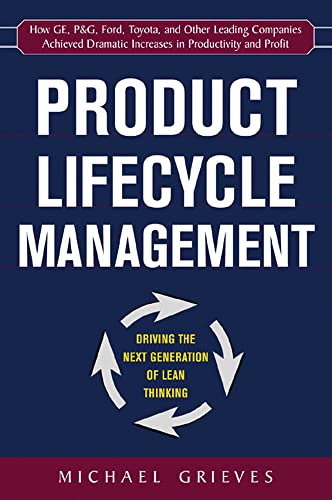
Product Lifecycle Management (PLM) is the newest wave in productivity. This revolutionary approach is an outcome of lean thinking; however, PLM eliminates waste and efficiency across all aspects of a product's life--from design to deployment--not just in its manufacture. By using people, product information, processes, and technology to reduce wasted time, energy, and material across an organization and into the supply chain, PLM drives the next generation of lean thinking.
Now PLM pioneer Michael Grieves offers everyone from Six Sigma and lean practitioners to supply chain managers, product developers, and consultants a proven framework for adopting this information-driven approach. Product Lifecycle Management shows you how to greatly enhance your firm's productivity by integrating the efforts of your entire organization.
Most companies are seeing the returns of their efforts in lean methods diminishing, as the most fruitful applications have already been addressed. Here, Grieves reveals how PLM gives you an opportunity to make improvements both within and across functional areas in order to increase agility, optimize efficiency, and reduce costs across the board. He gives you the most comprehensive view of PLM available, fully outlining its characteristics, method, and tools and helping you assess your organizational readiness.
There's also proven examples from the field, where PLM is being widely adopted by leading companies, including General Motors, General Electric, and Dell, that are widely adopting the approach. You'll see how PLM has saved these companies billions in unnecessary costs and shaved as much as 60% off cycle times. With this book you'll learn how to:
- Develop and implement your PLM strategy to support your corporate objectives
- Engage all your employees in using information to eliminate waste
- Enable improved information flow
- Better organize and utilize your intellectual capital
- Foster an environment that drives PLM
Lean manufacturing can only take your organization so far. To bring your productivity to the next level and save remarkable amounts of time, money, and resources, Product Lifecycle Management is your one-stop, hands-on guide to implementing this powerful methodology.
Die Inhaltsangabe kann sich auf eine andere Ausgabe dieses Titels beziehen.
Über die Autorin bzw. den Autor
Dr. Michael Grieves founded the Product Lifecycle Management Development Consortium, University of Michigan's College of Engineering and served as its Co-Director. He developed the first on-line Product Lifecycle Management Overview course for College's Center for Professional Development and organizes and chairs the annual University of Michigan AUTOe IT Conference. Grieves also is affiliated with the University of Arizona's internationally ranked MIS Department. Grieves works with PLM users and suppliers to companies such as General Electric, IBM, and Toyota on PLM strategies and implementations. With 35 years industry experience, Grieves is a principal in the international management and IT consulting firm Core Strategies Inc., and serves on the boards of a number of technology companies.
Von der hinteren Coverseite
The first guide to this revolutionary productivity-enhancing system
This groundbreaking book introduces the next evolution of lean thinking: Product Lifecycle Management (PLM). PLM expert Michael Grieves shows how to roll out this integrated, information-driven approach across an entire company--to increase organizational agility, optimize efficiency and drastically reduce time-to-market.
Praise for
Product Lifecycle Management
"The depth with which Michael Grieves explores PLM and the manner in which he describes its origin is exceptional. As we see new markets emerging for PLM, the universe of possibilities is limitless. This book should be considered a staple in business." --Tony Affuso, Chairman, CEO and President, UGS
"Michael Grieves has captured the "big idea" of PLM. Michael expertly explains how information and digital modeling can reduce cost, improve quality, and ignite innovation. 'Do you really understand the nature of information and your products?' Michael's book is a terrific source to expand your knowledge and begin the PLM journey!" --Lorie Buckingham, Senior Vice President and CIO, Visteon Corporation
"If you want to know precisely the proper way to use the product information in your company, this is the book to explain the whys and wherefores and the specific steps to complete that process. Mike Grieves' book Product Lifecycle Management just raised the bar to a new level!" --John Crary, CIO, Lear Corporation
"Product Lifecycle Management is an innovative book that will be highly useful tool when integrating all the business processes of a product's life cycle." --Mohan Tanniru, MIS Dept Head, University of Arizona
Auszug. © Genehmigter Nachdruck. Alle Rechte vorbehalten.
PRODUCT LIFECYCLE MANAGEMENT
DRIVING THE NEXT GENERATION OF LEAN THINKING
By MICHAEL GRIEVESThe McGraw-Hill Companies, Inc.
Copyright © 2006 The McGraw-Hill Companies, Inc.
All rights reserved.
ISBN: 978-0-07-145230-4All rights reserved.
Contents
| Acknowledgments | |
| Chapter 1: Introduction—The Path to PLM | |
| Chapter 2: Constructing PLM | |
| Chapter 3: Characteristics of PLM | |
| Chapter 4: The Environment Driving PLM | |
| Chapter 5: PLM Elements | |
| Chapter 6: Collaborative Product Development—Starting the Digital Lifecycle | |
| Chapter 7: Digital Manufacturing—PLM in the Factory | |
| Chapter 8: Outside the Factory Door | |
| Chapter 9: Developing a PLM Strategy | |
| Chapter 10: Conducting a PLM Readiness Assessment | |
| Chapter 11: The Real World and the Universe of Possibilities for PLM | |
| Index |
Excerpt
CHAPTER 1
Introduction—The Path to PLM
Productivity is driven in waves. We create new ways of doing things or newthings to do that drive a new wave of productivity. Some waves of productivityare driven by a seminal invention such as the steam engine, the automobile, orthe computer. Other waves are driven by our approach to the way we do things,such as the assembly line, the multidivisional or M-form corporation, or leanmanufacturing.
As the newest wave in productivity, Product Lifecycle Management—popularlyreferred to as PLM—emerged in the last few years fully formed, or so itseemed. PLM was first piloted in the automotive and aerospace industries: twosectors with complex, manufactured products. The electronics industry, which hasproduct management issues that focus more on software configuration than thecomplex product configurations of the automotive and aerospace industries, wasalso an early adopter of PLM or PLM-like technologies. With the success of PLMin these three industries, interest in PLM has spread to businesses as diverseas consumer packaged goods (CPG), industrial goods, medical devices, and evenpharmaceuticals.
PLM is an outcome of lean thinking—a continuation of the philosophy thatproduced lean manufacturing. However, unlike lean manufacturing, PLM eliminateswaste and inefficiency across all aspects of a product's life, not solely in itsmanufacture. PLM is focused on using the power of information and computers todeliberately pare inefficiencies from the design, manufacture, support, andultimate disposal of a product. Wherever possible, PLM enables the movement ofinexpensive information bits in place of expensive physical atoms, a conceptpopularized by Nicholas Negroponte.
In doing this, PLM takes "lean" to the next level. Lean manufacturing is acontinual process that works at taking out the inefficiencies in themanufacturing process. However, as lean manufacturing efforts find and eliminatewaste, products are being produced less efficiently at other phases ofdevelopment. PLM uses product information, computers, software, and simulationsto produce the first product as efficiently and as productively as the lastproduct throughout the design, development, and delivery process.
Lean manufacturing requires considerable resources because changes that improveproduction cause equipment to be reconfigured, machines rearranged, and materialrelocated as the lean manufacturing engineers test their hypothesis that thisnew method will decrease waste. Once the system is set in place, PLM uses littlein the way of resources, since this same process is done digitally.
Testing lean approaches is time intensive, so only the most promising ideas forstreamlining the manufacturing process can be tried. The wall clock ticks awayas the new configurations are set up, production commences, and the results areevaluated. PLM does not operate under the same time constraint. PLM can simulatewall clock time, and it can do multiple versions of it simultaneously, so allhypotheses can be tested, not just the most promising.
Finally, lean manufacturing can only take an organization so far. The mostefficiently produced product resulting from the best lean manufacturingprocesses can be flawed as a result of design failure or failure in actual use.It is nothing more than efficiently produced scrap that is a waste of time,energy, and material. Productivity increases in the production of scrap are adisappointing, but logical, result of a limited approach to lean manufacturing.
Lean Thinking–Globally!
Seeing what lean thinking can do on the manufacturing floor has left companieseager to extend these benefits of lean into other parts of the organization.But, to do so, lean will have to be accompanied by an integrated approach toproduct information and the tools and techniques needed to enable thatintegrated approach. The level of productivity that PLM can drive promises to beenormous, as evidenced by the attention it has received in a short period oftime.
PLM has attracted worldwide attention on a global basis; it is not solely anAmerican or European initiative. It is being adopted by organizationseverywhere. We expect organizations based in the more industrial Asian countriessuch as Japan and Korea to be early adopters of PLM. However, organizations insuch diverse countries as India, Malaysia, and China are also not only adopters,but innovators of PLM.
PLM is able to raise the bar on productivity because it allows for the completeintegration of everything related to a product or service—both internaland external—into the organization producing it. As you'll learn as youread this book, PLM uses information technology and organizational practices andprocesses to improve efficiencies both within and across functional areas.Dividing work along functional areas, such as engineering, manufacturing, sales,and service, is an organization's method of dividing tasks in order to simplifycomplexity.
In the past, a great deal of effort and focus has been placed on increasingefficiencies within these functional areas. Although improvements can always bemade within the various functional areas, these initiatives suffer from the lawof diminishing returns. The high-return projects have been identified andremediated. This is especially true of those companies that have embraced SixSigma project teams, where their mantra is continual improvement.
In fact, PLM initiatives are becoming an option for Six Sigma teams looking forareas of improvement. Because PLM generally originates in a specificdepartmental area, it may be natural simply to view PLM as a functional areainitiative. PLM projects can naturally start in engineering, because that iswhere product information originates, and there are a substantial number ofopportunities to make improvements through better organization of productinformation. However, as we shall see throughout this book, the biggeropportunity is to use PLM to enable better information flow across the entireorganization.
Functional areas can easily become isolated silos, with little communication orcoordination among them. Attempts to optimize performance within these silos canactually lead to substantial underperformance across the whole organization andits related supply chain.
PLM holds the promise of improving productivity through a cross-functionalapproach, using product information. By linking different functional...
„Über diesen Titel“ kann sich auf eine andere Ausgabe dieses Titels beziehen.
Suchergebnisse für Product Lifecycle Management: Driving the Next Generation...

Beispielbild für diese ISBN
Product Lifecycle Management: Driving the Next Generation of Lean Thinking
Verlag:
McGraw-Hill Education - Europe, 2005
ISBN 10: 0071452303
ISBN 13: 9780071452304
Gebraucht
Hardcover
Anbieter: World of Books (was SecondSale), Montgomery, IL, USA
Verkäuferbewertung 5 von 5 Sternen

Hardback. Zustand: Good. Introduces Product Lifecycle Management (PLM), the productivity-enhancing system used by General Electric, Procter & Gamble, Toyota, and Ford. This methodology reduces time, energy, and material expenditures across an organization. This book shows business professionals how to roll out PLM across their entire organization. Artikel-Nr. 00108993689
Gebraucht kaufen
EUR 8,82
Versand gratis
Versand innerhalb von USA
Versand innerhalb von USA
Anzahl: 2 verfügbar
Beispielbild für diese ISBN
Product Lifecycle Management: Driving the Next Generation of Lean Thinking
Verlag:
McGraw Hill (edition 1), 2005
ISBN 10: 0071452303
ISBN 13: 9780071452304
Gebraucht
Hardcover
Anbieter: BooksRun, Philadelphia, PA, USA
Verkäuferbewertung 5 von 5 Sternen
Hardcover. Zustand: Very Good. 1. It's a well-cared-for item that has seen limited use. The item may show minor signs of wear. All the text is legible, with all pages included. It may have slight markings and/or highlighting. Artikel-Nr. 0071452303-11-1
Gebraucht kaufen
EUR 10,40
Versand gratis
Versand innerhalb von USA
Versand innerhalb von USA
Anzahl: 1 verfügbar
Beispielbild für diese ISBN
Product Lifecycle Management: Driving the Next Generation of Lean Thinking
Verlag:
McGraw-Hill Education - Europe, 2005
ISBN 10: 0071452303
ISBN 13: 9780071452304
Gebraucht
Hardcover
Anbieter: World of Books (was SecondSale), Montgomery, IL, USA
Verkäuferbewertung 5 von 5 Sternen
Hardback. Zustand: Very Good. Introduces Product Lifecycle Management (PLM), the productivity-enhancing system used by General Electric, Procter & Gamble, Toyota, and Ford. This methodology reduces time, energy, and material expenditures across an organization. This book shows business professionals how to roll out PLM across their entire organization. Artikel-Nr. CIN0071452303VG
Gebraucht kaufen
EUR 16,83
Versand gratis
Versand innerhalb von USA
Versand innerhalb von USA
Anzahl: 1 verfügbar
Beispielbild für diese ISBN
Product Lifecycle Management: Driving the Next Generation of Lean Thinking
Anbieter: medimops, Berlin, Deutschland
Verkäuferbewertung 5 von 5 Sternen
Zustand: good. Befriedigend/Good: Durchschnittlich erhaltenes Buch bzw. Schutzumschlag mit Gebrauchsspuren, aber vollständigen Seiten. / Describes the average WORN book or dust jacket that has all the pages present. Artikel-Nr. M00071452303-G
Gebraucht kaufen
EUR 35,33
EUR 10,00 Versand
Versand von Deutschland nach USA
Versand von Deutschland nach USA
Anzahl: 1 verfügbar
Beispielbild für diese ISBN
Product Lifecycle Management: Driving the Next Generation of Lean Thinking (BUSINESS BOOKS)
Anbieter: WorldofBooks, Goring-By-Sea, WS, Vereinigtes Königreich
Verkäuferbewertung 5 von 5 Sternen
Hardback. Zustand: Good. The book has been read but remains in clean condition. All pages are intact and the cover is intact. Some minor wear to the spine. Artikel-Nr. GOR007502048
Gebraucht kaufen
EUR 55,39
EUR 6,69 Versand
Versand von Vereinigtes Königreich nach USA
Versand von Vereinigtes Königreich nach USA
Anzahl: 1 verfügbar
Beispielbild für diese ISBN
Product Lifecycle Management: Driving the Next Generation of Lean Thinking (BUSINESS BOOKS)
Anbieter: WorldofBooks, Goring-By-Sea, WS, Vereinigtes Königreich
Verkäuferbewertung 5 von 5 Sternen
Hardback. Zustand: Very Good. The book has been read, but is in excellent condition. Pages are intact and not marred by notes or highlighting. The spine remains undamaged. Artikel-Nr. GOR007554101
Gebraucht kaufen
EUR 55,39
EUR 6,69 Versand
Versand von Vereinigtes Königreich nach USA
Versand von Vereinigtes Königreich nach USA
Anzahl: 1 verfügbar
Beispielbild für diese ISBN
Product Lifecycle Management
Anbieter: Majestic Books, Hounslow, Vereinigtes Königreich
Verkäuferbewertung 4 von 5 Sternen

Zustand: New. pp. xiii + 319 Illus. Artikel-Nr. 8283438
Neu kaufen
EUR 67,36
EUR 7,76 Versand
Versand von Vereinigtes Königreich nach USA
Versand von Vereinigtes Königreich nach USA
Anzahl: 1 verfügbar