
Verwandte Artikel zu The Toyota Way Fieldbook: A Practical Guide For Implementing...
Inhaltsangabe
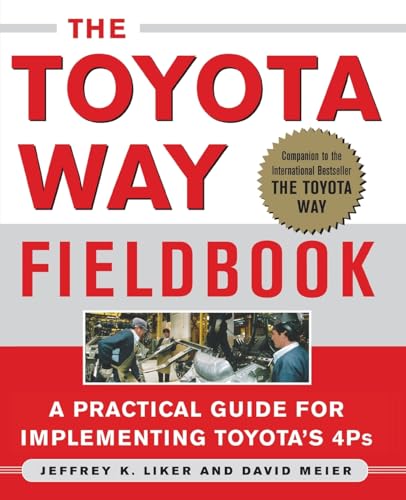
The Toyota Way Fieldbook is a companion to the international bestseller The Toyota Way. The Toyota Way Fieldbook builds on the philosophical aspects of Toyota's operating systems by detailing the concepts and providing practical examples for application that leaders need to bring Toyota's success-proven practices to life in any organization. The Toyota Way Fieldbook will help other companies learn from Toyota and develop systems that fit their unique cultures. The book begins with a review of the principles of the Toyota Way through the 4Ps model-Philosophy, Processes, People and Partners, and Problem Solving. Readers looking to learn from Toyota's lean systems will be provided with the inside knowledge they need to Define the companies purpose and develop a long-term philosophy Create value streams with connected flow, standardized work, and level production Build a culture to stop and fix problems Develop leaders who promote and support the system Find and develop exceptional people and partners Learn the meaning of true root cause problem solving Lead the change process and transform the total enterprise The depth of detail provided draws on the authors combined experience of coaching and supporting companies in lean transformation. Toyota experts at the Georgetown, Kentucky plant, formally trained David Meier in TPS. Combined with Jeff Liker's extensive study of Toyota and his insightful knowledge the authors have developed unique models and ideas to explain the true philosophies and principles of the Toyota Production System.
Die Inhaltsangabe kann sich auf eine andere Ausgabe dieses Titels beziehen.
Über die Autorin bzw. den Autor
Jeffrey K. Liker, Ph.D., author of the bestselling The Toyota Way, is Professor of Industrial and Operations Engineering at the University of Michigan and coowner of lean consulting firm Optiprise, Inc. His Shingo-Prize winning work has appeared in The Harvard Business Review, Sloan Management Review, and other leading publications.
Von der hinteren Coverseite
Your hands-on guide to the secrets of Toyota's success!
Jeffrey Liker first revealed the management principles Toyota's worldwide reputation for quality and reliability in the international bestseller The Toyota Way.
Now, he and Toyota veteran David Meier take those lessons a step further with The Toyota Way Fieldbook. You'll receive the diagnostic tools, worksheets, and exercises--many adapted from Toyota originals--so you can craft the most effective approach for your organization.
Learn how to develop a long-term philosophy of cost reduction, build a culture that stops to fix problems quickly, develop leaders that live your system, and transform your company into a true lean learning organization that continuously improves, meets the needs of its customers, and positions itself for long-term success.
Most importantly, you'll understand the thinking behind lean tools and approaches so you can implement Toyota's 4P Model for success in your organization:
Philosophy--The company is a vehicle for adding value to customers, society, the community, and its associates.
Process--When leaders follow the right process they get the right results, including long-term cost-reduction and quality improvement.
People and Partners--Add value to an organization by challenging its people and partners to grow and become more skilled and confident.
Problem solving--Continuously solve root problems to drive organizational learning.
Auszug. © Genehmigter Nachdruck. Alle Rechte vorbehalten.
The Toyota Way Fieldbook
A Practical Guide for Implementing Toyota's 4PsBy Jeffrey K. Liker David MeierMcGraw-Hill
Copyright © 2006 The McGraw-Hill Companies, Inc.All right reserved.
ISBN: 978-0-07-144893-2
Contents
Chapter One
Background to the Fieldbook
Why The Toyota Way Fieldbook?
Toyota's success as a company has been well documented. It has a well-earned reputation for excellence in quality, cost reduction, and hitting the market with vehicles that sell. The result has been a highly profitable company by any standards. Earning billions of dollars per year and amassing at any point in time $30 to $50 billion in cash reserves would be enough to convince anyone this company must be doing something right. Since The Toyota Way initially hit the shelves in January 2004, Toyota has continued to break records, earning over ¥10 trillion (about $10 billion) that year and becoming the most profitable company in the history of Japan. That pattern continues into 2005 breaking continuing profitability records while many of its competitors are losing market share and struggling to earn a profit. In 2005 Toyota in North America also won top honors in the coveted J.D. Power Initial Quality Award winning first place in 10 of 18 categories. Toyota then was recognized by Harbour Associates as having the most productive plants in North America. All this was accomplished while steadily increasing sales volume in North America at a time while its domestic competitors were losing volume.
But Toyota's impact on the world has gone beyond making money. It has even gone beyond making excellent vehicles people can enjoy driving. Toyota has contributed a new paradigm of manufacturing. "Lean production," a term coined in The Machine That Changed the World, is widely considered the next big step in the evolution of manufacturing beyond Ford's mass production. Who would have thought that Sakichi Toyoda, working in the rural hinterlands of what is now Toyota City in Japan, would have wrought a global powerhouse that has changed the face of manufacturing? And it has gone way beyond mass production of automobiles to all types of manufacturing: chemical processing, pharmaceuticals, nuclear fuel, ship and aircraft construction, medical products, building construction, shoemaking, sewing, defense bases that repair planes and ships and tanks, and on and on. And if that's not enough, there is a revolution in service industries working to apply lean thinking to drive out waste, including banks, insurance companies, hospitals, post offices, and more.
The Toyota Way became an international best-seller beyond expectations. We knew that those who were already committed to adopting lean manufacturing and to spreading lean beyond the shop floor would find something of interest in the book. But we did not realize how far lean thinking was spreading and how many people simply admired Toyota and wanted to see what they could learn from this corporate icon. Readers described feeling in awe when reading the book, inspired to go out and improve their organizations and their own personal lives. People read the book in just a few sittings and did not want to put it down. And all this for a business book?
The most common feedback from people who read the book was that it opened their eyes to a much broader view of what they could learn from Toyota. For them, it was more than the tools and methodologies of lean production or even lean applied to the office. They realized that Toyota had created an entire system of organization that focused on adding value to customers through people.
The sum total of Toyota's approach creates a unique culture that people throughout the world in many different kinds of organizations believe they can learn from. An overwhelming number of business leaders have written saying that they are adopting The Toyota Way as a blueprint for remaking their organizations. While they have reported taking away many different kinds of lessons, we cannot help wondering if the original book is enough to provide that blueprint. Our purpose had been to describe Toyota's management principles with case examples to bring them to life. The book was not written as a guide on how to apply the principles to your organization.
A fieldbook is intended to provide practical recipes for success, right? It should have tools, techniques, and methods that you can follow step by step. Well, maybe by some definitions. But then that posed a dilemma for us. On the one hand, the whole premise of The Toyota Way was that Toyota's system was much more than tools and techniques. Those tools and techniques—cells, kanban, mistake proofing, and quick changeover, among others—have already been well documented, and there is no shortage of detailed technical descriptions of these methods. On the other hand, the punch line of the book was that Toyota's main contribution has been to create a true learning organization. And the way they pass on the DNA of this learning organization as they expand globally is through dedicated sensei who act as personal tutors to new associates.
The Toyota Way is about tacit knowledge, not explicit procedural knowledge. "Tacit" knowledge is the craft type of knowledge that you gain from experience and reflection, not from reading a recipe. This tacit knowledge includes know-how and a philosophy of continuous improvement that is learned by doing with a coach who already has been enlightened through hard work and experience. The obvious implication is that the book should be reduced to one sentence: Go find a sensei to learn from and enjoy the journey!
We thought there was still value to writing a "fieldbook," but we struggled to define its purpose. We began by ruling out writing a "how-to" book that gives checklists and assessment instruments and step-by-step procedures. There are some in here, but those by themselves would not do justice to the profound insights we have gotten from our experiences with Toyota. Jeffrey Liker has spent over 20 years visiting and studying Toyota. David Meier spent almost 10 years with personal Japanese mentors at Toyota's Georgetown, Kentucky plant and could easily imagine their disapproving grunts and head shaking if he reduced Toyota's way to a cookbook format.
So we decided to take a different approach. The Toyota Way documented Toyota's Way. We decided the fieldbook should provide practical advice to those attempting to learn from The Toyota Way. We have both had years of experience in teaching Toyota's methods and philosophies to thousands of companies by lecture and hands-on consulting. We are constantly learning what works and what does not work. We are constantly facing misunderstandings about how to learn from Toyota. We also occasionally have the good fortune of seeing the light-bulbs go on, and people do amazingly innovative things based on what they learn. So we decided to share our experiences from hands-on efforts to help companies learn from Toyota.
We still realize this book is a long way from a how-to guide. We have many examples from Toyota to bring the concepts to life. And we can share many lessons we have had the good fortune to learn. But we've taken our understanding of Toyota one step further, providing advice on how to learn from the Toyota Way. The learning journey must be your own personal journey. Treat this book as picking up on the lessons of the Toyota Way and applying it to how you can learn from Toyota. But these are just ideas. You have to apply the ideas in...
„Über diesen Titel“ kann sich auf eine andere Ausgabe dieses Titels beziehen.
Suchergebnisse für The Toyota Way Fieldbook: A Practical Guide For Implementing...

Foto des Verkäufers
The Toyota Way Fieldbook
Anbieter: Dream Books Co., Denver, CO, USA
Verkäuferbewertung 5 von 5 Sternen

Zustand: good. Gently used with minimal wear on the corners and cover. A few pages may contain light highlighting or writing, but the text remains fully legible. Dust jacket may be missing, and supplemental materials like CDs or codes may not be included. May be ex-library with library markings. Ships promptly! Artikel-Nr. 4EKGLF0087XY_ns
Gebraucht kaufen
EUR 5,88
Versand gratis
Versand innerhalb von USA
Versand innerhalb von USA
Anzahl: 1 verfügbar
Beispielbild für diese ISBN
The Toyota Way Fieldbook
Verlag:
McGraw-Hill Education - Europe, 2005
ISBN 10: 0071448934
ISBN 13: 9780071448932
Gebraucht
Paperback
Anbieter: World of Books (was SecondSale), Montgomery, IL, USA
Verkäuferbewertung 5 von 5 Sternen
Paperback. Zustand: Fair. Helps learn how to develop a long-term philosophy of cost reduction, build a culture that stops to fix problems quickly, and develop leaders that live your system. This title helps transform your company into a true lean learning organization that continuously improves, meets the needs of its customers, and positions itself for long-term success. Artikel-Nr. 00109250332
Gebraucht kaufen
EUR 5,91
Versand gratis
Versand innerhalb von USA
Versand innerhalb von USA
Anzahl: 2 verfügbar
Beispielbild für diese ISBN
The Toyota Way Fieldbook
Verlag:
McGraw-Hill Education - Europe, 2005
ISBN 10: 0071448934
ISBN 13: 9780071448932
Gebraucht
Paperback
Anbieter: World of Books (was SecondSale), Montgomery, IL, USA
Verkäuferbewertung 5 von 5 Sternen
Paperback. Zustand: Good. Helps learn how to develop a long-term philosophy of cost reduction, build a culture that stops to fix problems quickly, and develop leaders that live your system. This title helps transform your company into a true lean learning organization that continuously improves, meets the needs of its customers, and positions itself for long-term success. Artikel-Nr. 00108527369
Gebraucht kaufen
EUR 5,91
Versand gratis
Versand innerhalb von USA
Versand innerhalb von USA
Anzahl: 9 verfügbar
Beispielbild für diese ISBN
The Toyota Way Fieldbook
Anbieter: Better World Books: West, Reno, NV, USA
Verkäuferbewertung 5 von 5 Sternen
Zustand: Very Good. Former library copy. Pages intact with possible writing/highlighting. Binding strong with minor wear. Dust jackets/supplements may not be included. Includes library markings. Stock photo provided. Product includes identifying sticker. Better World Books: Buy Books. Do Good. Artikel-Nr. 10033105-6
Gebraucht kaufen
EUR 6,38
Versand gratis
Versand innerhalb von USA
Versand innerhalb von USA
Anzahl: 1 verfügbar
Beispielbild für diese ISBN
The Toyota Way Fieldbook
Anbieter: Better World Books, Mishawaka, IN, USA
Verkäuferbewertung 5 von 5 Sternen
Zustand: Good. Pages intact with minimal writing/highlighting. The binding may be loose and creased. Dust jackets/supplements are not included. Stock photo provided. Product includes identifying sticker. Better World Books: Buy Books. Do Good. Artikel-Nr. 4199490-6
Gebraucht kaufen
EUR 6,38
Versand gratis
Versand innerhalb von USA
Versand innerhalb von USA
Anzahl: 7 verfügbar
Beispielbild für diese ISBN
The Toyota Way Fieldbook
Anbieter: Better World Books: West, Reno, NV, USA
Verkäuferbewertung 5 von 5 Sternen
Zustand: Good. Pages intact with minimal writing/highlighting. The binding may be loose and creased. Dust jackets/supplements are not included. Stock photo provided. Product includes identifying sticker. Better World Books: Buy Books. Do Good. Artikel-Nr. 4199490-6
Gebraucht kaufen
EUR 6,38
Versand gratis
Versand innerhalb von USA
Versand innerhalb von USA
Anzahl: 4 verfügbar
Beispielbild für diese ISBN
The Toyota Way Fieldbook
Verlag:
McGraw Hill (edition 1), 2005
ISBN 10: 0071448934
ISBN 13: 9780071448932
Gebraucht
Paperback
Anbieter: BooksRun, Philadelphia, PA, USA
Verkäuferbewertung 5 von 5 Sternen
Paperback. Zustand: Very Good. 1. It's a well-cared-for item that has seen limited use. The item may show minor signs of wear. All the text is legible, with all pages included. It may have slight markings and/or highlighting. Artikel-Nr. 0071448934-11-1
Gebraucht kaufen
EUR 6,47
Versand gratis
Versand innerhalb von USA
Versand innerhalb von USA
Anzahl: 1 verfügbar
Beispielbild für diese ISBN
The Toyota Way Fieldbook
Anbieter: ThriftBooks-Atlanta, AUSTELL, GA, USA
Verkäuferbewertung 5 von 5 Sternen
Paperback. Zustand: Good. No Jacket. Pages can have notes/highlighting. Spine may show signs of wear. ~ ThriftBooks: Read More, Spend Less. Artikel-Nr. G0071448934I3N00
Gebraucht kaufen
EUR 6,55
Versand gratis
Versand innerhalb von USA
Versand innerhalb von USA
Anzahl: 3 verfügbar
Beispielbild für diese ISBN
The Toyota Way Fieldbook
Anbieter: ThriftBooks-Dallas, Dallas, TX, USA
Verkäuferbewertung 5 von 5 Sternen
Paperback. Zustand: Fair. No Jacket. Readable copy. Pages may have considerable notes/highlighting. ~ ThriftBooks: Read More, Spend Less. Artikel-Nr. G0071448934I5N00
Gebraucht kaufen
EUR 6,55
Versand gratis
Versand innerhalb von USA
Versand innerhalb von USA
Anzahl: 2 verfügbar
Beispielbild für diese ISBN
The Toyota Way Fieldbook
Anbieter: ThriftBooks-Dallas, Dallas, TX, USA
Verkäuferbewertung 5 von 5 Sternen
Paperback. Zustand: Good. No Jacket. Pages can have notes/highlighting. Spine may show signs of wear. ~ ThriftBooks: Read More, Spend Less. Artikel-Nr. G0071448934I3N00
Gebraucht kaufen
EUR 6,55
Versand gratis
Versand innerhalb von USA
Versand innerhalb von USA
Anzahl: 4 verfügbar