
Verwandte Artikel zu INSPECTING THE AGING SAILBOAT (The International Marine...
INSPECTING THE AGING SAILBOAT (The International Marine Sailboat Library) - Softcover
Buch 1 von 2: International Marine Sailboat Library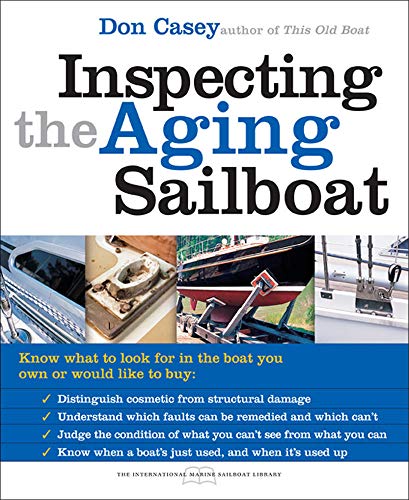
Inhaltsangabe
". . . the perfect place to begin, or continue, your education." --Sailing Whether you are shopping for a used fiberglass boat or prioritizing maintenance tasks on the one you already own, this book saves money--and perhaps even disaster. With clear step-by-step drawings and instructions, Don Casey explains how to recognize problems--both surface and hidden--and how to separate cosmetic flaws from serious faults.
Die Inhaltsangabe kann sich auf eine andere Ausgabe dieses Titels beziehen.
Über die Autorin bzw. den Autor
Don Casey abandoned his career in banking in 1983 to devote more time to cruising and writing. His work combining these two passions soon began to appear in many popular sailing and boating magazines. He is the author of the best-selling This Old Boat, and six other International Marine titles. He and his wife, Olga, are currently cruising and living aboard their boat. HOMETOWN: Miami, Florida
Von der hinteren Coverseite
Become an Expert Judge of Used Sailboats
Step by step, the author of the bestselling This Old Boat shows you how to evaluate the condition of an older fiberglass sailboat—the one you own or the one you'd like to purchase. Don Casey's expert advice helps you:
- Assess the condition of a used sailboat in 30 minutes
- Prioritize maintenance and repair tasks for a boat you already own
- Catch potential problems early
- Know where to look and what to look for (and how to interpret what you see)
A professional survey is recommended before purchasing a boat—and usually required for financing—but with Inspecting the Aging Sailboat, you can consider and reject any number of boats before settling on "the one." This book will streamline your used-boat shopping while saving you hundreds or even thousands of dollars in professional survey fees.
"The perfect place to begin, or to continue your education. . . . As a reviewer of both new and used boats, I own many books filled with advice. I strongly suspect that Inspecting the Aging Sailboat is the one I will consult most."—Sailing
"A complete reference for the boatowner or prospective boat buyer on evaluating the condition of fiberglass sailboats using common sense and proven advice."—GAM on Yachting Magazine (Canada)
Don Casey is one of today's best and most trusted do-it-yourself boating writers. His nine books include the bestselling This Old Boat and Sailboat Electrics Simplified. He writes the long-running "Ask Don Casey" column for BoatUS.com and is a monthly columnist for Sailnet.com and a regular SAIL magazine contributor.
Auszug. © Genehmigter Nachdruck. Alle Rechte vorbehalten.
INSPECTING THE AGING SAILBOAT
By DON CASEYThe McGraw-Hill Companies, Inc.
Copyright © 1997 International Marine, a division of The McGraw-Hill Companies
All rights reserved.
ISBN: 978-0-07-144545-0All rights reserved.
Contents
| Introduction | |
| Hull | |
| Deck | |
| Rig | |
| Interior | |
| Engine and Steering | |
| Electrical System | |
| Other Considerations | |
| Boat-Buyer's 30-Minute Survey | |
| Appendix: Hiring a Professional | |
| Index | |
| Copyright page |
Excerpt
CHAPTER 1
HULL
The hull is the most important component of any boat. It keeps the water out andthe boat afloat, and it provides the foundation for all other components. Acondemned mast, engine, or deck can be replaced, but a condemned hull dooms theboat. Always start your survey with the hull.
A fair number of wood hulls are still around, but the number gets smaller everyyear. While well-cared-for wood hulls are remarkably long lived, such care issadly rare. An aging wood hull is infinitely more likely to have seriousproblems than one constructed of fiberglass. Effectively surveying a wood hullrequires specialized techniques not covered here, but some guidance in probingwood for rot can be found in "Interior."
Metal is primarily a custom boat material in the United States, but a number ofEuropean production boats have been constructed of steel or aluminum. The mainrisk with metal hulls is corrosion. Determining their condition essentiallyrequires examining every square inch for telltale signs—pitting andscaling, bubbled paint, or a powdery coating. A surveyor will bang suspiciousspots vigorously with a hammer.
Fiberglass is the construction material of virtually all production sailboatsbuilt in the United States. If you own a sailboat or are looking to buy one lessthan 35 years old, there is an overwhelming likelihood that the boat's hull willbe fiberglass. Unlike wood or metal, the troubles found in fiberglass hulls arerarely natural decomposition. More often they stem from poor constructiontechniques or impact damage.
Determining with a high degree of certainty the condition of a fiberglass hullrequires little more than good observation skills and a basic understanding ofthe conditions you're looking for. Laboratory tests to determine the internalcondition of the laminate are rarely employed, even by professional surveyors,because they rarely reveal conditions inconsistent with the surveyor's fieldobservations.
Look, listen, and wonder. Sharp eyes, sensitive ears, and a deductive mind arethe most important tools in the fiberglass-boat surveyor's kit.
FAIR AND TRUE?
Fair means smooth and regular—without humps or flat spots. True meansaccurately shaped—true to her designed lines. Both are good indicators ofquality and may also reveal repairs.
HULL SIDES
Standing at the stern, position your eye near the hull, then slowly movesideways so you see more and more of the hull. Concentrate on the "horizon" ofthe hull, watching for it to jump or dip instead of move away smoothly. Glossyhulls are more revealing; wet the hull if it is dull, but don't confuse waves inthe layer of water with irregularities in the hull. A flexible batten can helpyou position a flaw precisely.
Hardspots. Hardspots reveal themselves as bumps or ridges in the hull. Insidethe boat you will generally find a bulkhead or other structural member at thehardspot. The hardspot is caused by the hull flexing over the rigid member. Mostboats reveal hardspots to the observant eye, but if the bump is pronounced, thehinging may have broken the glass fibers. Suspect some weakening of the hull.
Flat spots. Because thin fiberglass depends upon curvature to make it stiff,designed flat areas of the hull will be thicker and/or stiffened to compensate.Flat spots in the curved parts of a hull indicate trouble. They occasionallyoccur because the manufacturer removed the hull from the mold too soon, but moreoften they indicate weakness, damage, or a poorly executed repair. Riggingtension can dimple a flimsy hull around the chainplate attachment points. A weakhull may permanently deflect if stored in a cradle or supported by screw standsfor a long time. Any impact that flattens the hull has broken or delaminated thefiberglass. Amateur repairs often "bridge" a hole rather than matching theoriginal contour of the hull. All of these require corrective measures.
Print-through. Often the weave of the underlying fabric is visible in thesurface of the hull, especially if the gelcoat still has its gloss. Dark colorsshow print-through more. A light print-through is probably not serious, butanything more than that suggests poor layup technique. Hull construction beginswith a layer of gelcoat sprayed into the polished mold, then one or two layersof chopped-strand mat (CSM) begins the laminate schedule. Mat is importantbecause it is the most watertight fabric and it provides the best foundation fora strong gelcoat bond. That it also yields the smoothest surface is an ancillarybenefit, so if you see significant print-through, the manufacturer failed to putsufficient mat between the woven fabric and the gelcoat. Premature gelcoatfailure is a likely consequence.
LINES
Walk (or row) away from the hull, then circle it slowly, looking at the shape ofthe hull.
Symmetry. From directly forward and astern, the hull should appear symmetricaland the keel perpendicular to the deck. Sighting the hull through the gridworkof a plastic plotter simplifies this determination. Any detectable differencefrom one side to the other suggests major trouble.
Distortion. From either side, look for any change in the flow of the sheer.Overtight stays can permanently distort the hull, revealed by a break in thesheerline, usually at the mast station. Improper support during storage can alsocause permanent hull distortion.
SCANTLINGS
Older fiberglass hulls are generally of consistent thickness, but hulls built inthe last 15 years are likely to be thinner above the waterline than below. Thislowers costs and may improve performance, but it makes a weaker hull. Currentmodels may be more than 1 inch thick near the keel and less than ¼ that at therail. Whether or not the loss in strength matters depends on how the boat willbe used.
Without special equipment, you need a hole in the hull to determine itsthickness. Any through-bolted hardware on the hull provides an opportunity toobserve the hull thickness because you can extract a bolt. You can measure thethickness at through-hull fittings by dismantling just the hose connection.Hulls sometimes have extra thickness at through-hull locations, but you shouldbe able to determine this by examining the inside of the hull around thethrough-hull. Except in extreme cases, determining the hull thickness haslimited absolute value, but comparative hull thicknesses can be useful inevaluating boats from different manufacturers.
SIGNS OF STRESS OR TRAUMA
Fiberglass generally reveals stress problems with cracks in the gelcoat. Thecracks can be very fine and hard to see; get close to the hull and lay yourfinger against the spot you are examining to ensure that your eyes focusproperly. A dye penetrant such as Spot Check (available from auto-partssuppliers) can highlight hairline...
„Über diesen Titel“ kann sich auf eine andere Ausgabe dieses Titels beziehen.
Suchergebnisse für INSPECTING THE AGING SAILBOAT (The International Marine...

Beispielbild für diese ISBN
Inspecting the Aging Sailboat
Verlag:
McGraw-Hill Education - Europe, 2004
ISBN 10: 0071445455
ISBN 13: 9780071445450
Gebraucht
Paperback
Anbieter: World of Books (was SecondSale), Montgomery, IL, USA
Verkäuferbewertung 5 von 5 Sternen

Paperback. Zustand: Good. Shows you how to evaluate the condition of an older fiberglass sailboat - the one you own or the one you'd like to purchase. this book helps you: assess the condition of a used sailboat in 30 minutes; prioritize maintenance and repair tasks for a boat you already own; and, catch potential problems early. Artikel-Nr. 00107783423
Gebraucht kaufen
EUR 6,47
Versand gratis
Versand innerhalb von USA
Versand innerhalb von USA
Anzahl: 6 verfügbar
Beispielbild für diese ISBN
Inspecting the Aging Sailboat
Verlag:
International Marine Publishing, 2004
ISBN 10: 0071445455
ISBN 13: 9780071445450
Gebraucht
Paperback
Anbieter: ThriftBooks-Phoenix, Phoenix, AZ, USA
Verkäuferbewertung 5 von 5 Sternen
Paperback. Zustand: Good. No Jacket. Pages can have notes/highlighting. Spine may show signs of wear. ~ ThriftBooks: Read More, Spend Less. Artikel-Nr. G0071445455I3N00
Gebraucht kaufen
EUR 6,80
Versand gratis
Versand innerhalb von USA
Versand innerhalb von USA
Anzahl: 1 verfügbar
Beispielbild für diese ISBN
Inspecting the Aging Sailboat
Verlag:
International Marine Publishing, 2004
ISBN 10: 0071445455
ISBN 13: 9780071445450
Gebraucht
Paperback
Anbieter: ThriftBooks-Reno, Reno, NV, USA
Verkäuferbewertung 5 von 5 Sternen
Paperback. Zustand: Fair. No Jacket. Readable copy. Pages may have considerable notes/highlighting. ~ ThriftBooks: Read More, Spend Less. Artikel-Nr. G0071445455I5N00
Gebraucht kaufen
EUR 6,80
Versand gratis
Versand innerhalb von USA
Versand innerhalb von USA
Anzahl: 1 verfügbar
Beispielbild für diese ISBN
Inspecting the Aging Sailboat
Verlag:
International Marine Publishing, 2004
ISBN 10: 0071445455
ISBN 13: 9780071445450
Gebraucht
Paperback
Anbieter: ThriftBooks-Atlanta, AUSTELL, GA, USA
Verkäuferbewertung 5 von 5 Sternen
Paperback. Zustand: Good. No Jacket. Pages can have notes/highlighting. Spine may show signs of wear. ~ ThriftBooks: Read More, Spend Less. Artikel-Nr. G0071445455I3N00
Gebraucht kaufen
EUR 6,80
Versand gratis
Versand innerhalb von USA
Versand innerhalb von USA
Anzahl: 2 verfügbar
Beispielbild für diese ISBN
Inspecting the Aging Sailboat
Verlag:
International Marine Publishing, 2004
ISBN 10: 0071445455
ISBN 13: 9780071445450
Gebraucht
Paperback
Anbieter: ThriftBooks-Phoenix, Phoenix, AZ, USA
Verkäuferbewertung 5 von 5 Sternen
Paperback. Zustand: Fair. No Jacket. Readable copy. Pages may have considerable notes/highlighting. ~ ThriftBooks: Read More, Spend Less. Artikel-Nr. G0071445455I5N00
Gebraucht kaufen
EUR 6,80
Versand gratis
Versand innerhalb von USA
Versand innerhalb von USA
Anzahl: 1 verfügbar
Beispielbild für diese ISBN
Inspecting the Aging Sailboat
Verlag:
International Marine Publishing, 2004
ISBN 10: 0071445455
ISBN 13: 9780071445450
Gebraucht
Paperback
Anbieter: ThriftBooks-Atlanta, AUSTELL, GA, USA
Verkäuferbewertung 5 von 5 Sternen
Paperback. Zustand: Fair. No Jacket. Readable copy. Pages may have considerable notes/highlighting. ~ ThriftBooks: Read More, Spend Less. Artikel-Nr. G0071445455I5N00
Gebraucht kaufen
EUR 6,80
Versand gratis
Versand innerhalb von USA
Versand innerhalb von USA
Anzahl: 2 verfügbar
Beispielbild für diese ISBN
Inspecting the Aging Sailboat
Verlag:
International Marine Publishing, 2004
ISBN 10: 0071445455
ISBN 13: 9780071445450
Gebraucht
Paperback
Anbieter: ThriftBooks-Dallas, Dallas, TX, USA
Verkäuferbewertung 5 von 5 Sternen
Paperback. Zustand: Very Good. No Jacket. May have limited writing in cover pages. Pages are unmarked. ~ ThriftBooks: Read More, Spend Less. Artikel-Nr. G0071445455I4N00
Gebraucht kaufen
EUR 6,80
Versand gratis
Versand innerhalb von USA
Versand innerhalb von USA
Anzahl: 2 verfügbar
Beispielbild für diese ISBN
Inspecting the Aging Sailboat
Verlag:
International Marine Publishing, 2004
ISBN 10: 0071445455
ISBN 13: 9780071445450
Gebraucht
Paperback
Anbieter: ThriftBooks-Reno, Reno, NV, USA
Verkäuferbewertung 5 von 5 Sternen
Paperback. Zustand: Good. No Jacket. Pages can have notes/highlighting. Spine may show signs of wear. ~ ThriftBooks: Read More, Spend Less. Artikel-Nr. G0071445455I3N00
Gebraucht kaufen
EUR 6,80
Versand gratis
Versand innerhalb von USA
Versand innerhalb von USA
Anzahl: 1 verfügbar
Beispielbild für diese ISBN
Inspecting the Aging Sailboat
Verlag:
International Marine Publishing, 2004
ISBN 10: 0071445455
ISBN 13: 9780071445450
Gebraucht
Paperback
Anbieter: ThriftBooks-Dallas, Dallas, TX, USA
Verkäuferbewertung 5 von 5 Sternen
Paperback. Zustand: Fair. No Jacket. Readable copy. Pages may have considerable notes/highlighting. ~ ThriftBooks: Read More, Spend Less. Artikel-Nr. G0071445455I5N00
Gebraucht kaufen
EUR 6,80
Versand gratis
Versand innerhalb von USA
Versand innerhalb von USA
Anzahl: 1 verfügbar
Beispielbild für diese ISBN
Inspecting the Aging Sailboat
Verlag:
International Marine Publishing, 2004
ISBN 10: 0071445455
ISBN 13: 9780071445450
Gebraucht
Paperback
Anbieter: ThriftBooks-Atlanta, AUSTELL, GA, USA
Verkäuferbewertung 5 von 5 Sternen
Paperback. Zustand: Very Good. No Jacket. May have limited writing in cover pages. Pages are unmarked. ~ ThriftBooks: Read More, Spend Less. Artikel-Nr. G0071445455I4N00
Gebraucht kaufen
EUR 6,80
Versand gratis
Versand innerhalb von USA
Versand innerhalb von USA
Anzahl: 2 verfügbar