
Verwandte Artikel zu What the Best MBAs Know: How to Apply the Greatest...
What the Best MBAs Know: How to Apply the Greatest Ideas Taught in the Best Business Schools - Hardcover
Buch 19 von 26: Career (Exclude VGM)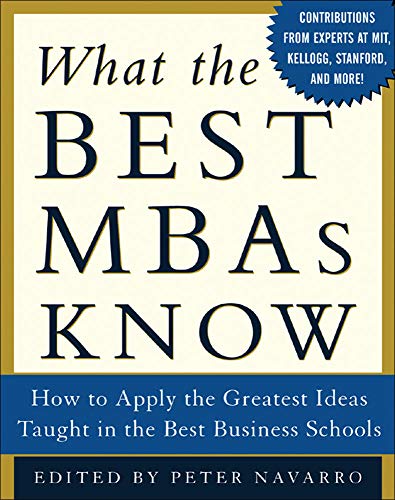
Inhaltsangabe
Easy access to the essential knowledge and skills of a top-level M.B.A. program--without having to attend a lecture What the Best MBAs Know provides professionals who don't have the coveted M.B.A. designation with the skills and knowledge taught in today's finest programs. Professors from Stanford, MIT, Northwestern, and other influential programs contribute detailed chapters on broad-scope topics such as strategy, functional areas including accounting, and key disciplines from managerial economics to decision analysis. The resulting application-based book gives readers complete mastery over the most important concepts of an M.B.A. education, leveling the playing field between M.B.A. and non-M.B.A. professionals. Organized according to the subject matter of the core M.B.A. curriculum, this unique and valuable book features: Fascinating boxes discussing real-world situations and applications Companion website with interactive exercises, key links, and more Focused review questions and exercises for each chapter and area Contributors Charles P. Bonini, Graduate School of Business, Stanford University Leslie K. Breitner, Daniel J. Evans School of Public Affairs at the University of Washington Richard J. Lutz, Warrington College of Business Administration at the University of Florida Steven L. McShane, Graduate School of Management at the University of Western Australia Steven Nahmias, Leavey School of Business at Santa Clara University Stephen A. Ross, Sloan School of Management, Massachusetts Institute of Technology Daniel F. Spulber, Kellogg School of Management, Northwestern University
Die Inhaltsangabe kann sich auf eine andere Ausgabe dieses Titels beziehen.
Über die Autorin bzw. den Autor
Peter Navarro, Ph.D. (Irvine, CA) received his Ph.D. in Economics from Harvard University and is an associate professor of economics and public policy at the Graduate School of Management, University of California-Irvine. Dr. Navarro's work has appeared in publications including Harvard Business Review, BusinessWeek, The Wall Street Journal, and The Washington Post.
Von der hinteren Coverseite
Get the knowledge and skills taught in today's top MBA programs--without ever setting foot inside a classroom
What the Best MBAs Know presents the key concepts, tools, and wisdom being taught in leading MBA programs from Northwestern's Kellogg School and the Wharton School to Stanford and USC. Featuring contributions from the most accomplished business school professors, each chapter takes you inside their classrooms for a detailed look at topics from marketing, finance, and managerial economics to leadership, corporate strategy, and more. Theoretically solid and applications-based, What the Best MBAs Know is both a valuable resource and a ready reference to the core knowledge obtained with an MBA.
Includes contributions by:
- Charles P. Bonini, Graduate School of Business, Stanford University
- Leslie K. Breitner, Daniel J. Evans School of Public Affairs, University of Washington
- Jeffrey F. Jaffe, The Wharton School of Business, University of Pennsylvania
- Richard J. Lutz, Warrington College of Business Administration, University of Florida
- Steven L. McShane, Graduate School of Management, University of Western Australia
- Steven Nahmias, Leavey School of Business, Santa Clara University
- Peter Navarro, Graduate School of Management, University of California, Irvine
- Stephen A. Ross, Sloan School of Management, Massachusetts Institute of Technology
- Daniel F. Spulber, Kellogg School of Management, Northwestern University
- Mary Ann Von Glinow, Florida International University
- Barton Weitz, Warrington College of Business Administration, University of Florida
- Randolph W. Westerfield, Marshall School of Business, University of Southern California
What the Best MBAs Know covers the breakthrough strategies, techniques, and ideas that are being taught in the classrooms of today's top MBA programs. University of California business professor Peter Navarro joins more than a dozen of his colleagues--including Stephen A. Ross of MIT's Sloan School, Daniel Spulber of Northwestern's Kellogg School, and Charles P. Bonini of Stanford University's Graduate School of Business--to provide you with the key concepts, tools, and knowledge that, until now, could only be obtained through an MBA degree. This comprehensive book--as engaging as it is informative--covers virtually every subject taught in an intensive MBA program, including:
- The Big Picture: An Overview of the MBA Curriculum
- Management Strategy: Five Steps to Successful Strategic Analysis
- Macroeconomics & the Well-Timed Business Strategy
- Strategic Marketing: Delivering Customer Value
- Operations and Supply Chain Management: Getting the Stuff Out the Door
- Financial Accounting: "Doing the Numbers" for Investors, Regulators and Other External Users
- Managerial Accounting: "Doing the Numbers" for Decision Making and Control
- Corporate Finance: Big Questions and Key Concepts
- Organizational Behavior: The Power of People and Leadership
- Statistics, Decision Analysis, and Modeling: How the Numbers Help Us Manage
- Managerial Economics: Microeconomics for Managers
In each chapter, What the Best MBAs Know first identifies the key concepts of a subject like strategy or finance. One of the world's top business professors then illustrates how these concepts are applied on a daily basis in the rough-and-ready world of international business. The insights of these top professors throw open the doors of the best business schools as they highlight the latest strategies and tactics driving today's intensely competitive landscape.
Whether you are currently pursuing an MBA, already have an MBA but need to refresh and update your information, or simply want to arm yourself with MBA-level knowledge without the time and financial commitments involved in obtaining the degree,
Auszug. © Genehmigter Nachdruck. Alle Rechte vorbehalten.
WHAT THE BEST MBAs KNOW
How to Apply the Greatest Ideas Taught in the Best Business Schools
By PETER NAVARROThe McGraw-Hill Companies, Inc.
Copyright © 2005 The McGraw-Hill Companies, Inc.
All rights reserved.
ISBN: 978-0-07-142275-8All rights reserved.
Contents
| Dedication | |
| Contributors | |
| PART ONE THE BIG MBA PICTURE | |
| Chapter 1 Who Should Read This Book? | |
| Chapter 2 The Big Picture—An Overview of the MBA Curriculum | |
| PART TWO THE STRATEGIC AND TACTICAL MBA | |
| Chapter 3 Management Strategy—Five Steps to Successful Strategic Analysis | |
| Chapter 4 Macroeconomics and the Well-Timed Business Strategy | |
| PART THREE THE FUNCTIONAL MBA | |
| Chapter 5 Strategic Marketing—Delivering Customer Value | |
| Chapter 6 Operations and Supply Chain Management—Getting the Stuff Out the Door | |
| Chapter 7 Financial Accounting—"Doing the Numbers" for Investors, Regulators and Other External Users | |
| Chapter 8 Managerial Accounting—"Doing the Numbers" for Internal Decision Making and Control | |
| Chapter 9 Corporate Finance—The Big Questions and Key Concepts | |
| PART FOUR THE ORGANIZATIONAL AND LEADERSHIP MBA | |
| Chapter 10 Organizational Behavior—The Power of People and Leadership | |
| PART FIVE THE MBA TOOLBOX | |
| Chapter 11 Statistics, Decision Analysis, and Modeling—How the Numbers Help Us Manage | |
| Chapter 12 Managerial Economics—Microeconomics for Managers | |
| Chapter 13 Concluding Thoughts | |
| Index |
Excerpt
CHAPTER 1
Who Should Read This Book?
Each year, from the ivy-covered halls of Harvard and Wharton and the sun-drenchedcampuses of Stanford and USC to the intellectual vineyards of France'sINSEAD, the fabled London School of Business, and the teeming campus of HongKong University of Science and Technology, more than 100,000 students graduatefrom full or part-time regular and executive MBA programs. As Table 1-1indicates for a typical year, this is more than three times the number of lawdegrees, more than four times the number of engineering degrees, and more thanseven times the number of medical degrees.
There is a very good reason why the Masters of Business Administration (MBA)degree is so popular. The big questions that are addressed, the key conceptsthat are taught, the skills that are honed, the tools that are developed, andindeed the wisdom that is conveyed in the core MBA curriculum provide businessexecutives from all walks of life and in every layer of management with the mostpowerful arsenal of analytical weapons ever assembled to fight the corporatewars.
The purpose of this book is to attempt the near impossible: compress thesequestions, concepts, tools, skills, and wisdom into one of the most useful andeminently readable management books ever assembled.
Ultimately, you will be the judge as to whether the crack team of businessschool professors that I have assembled to write this book are up to the task.But my promise to you is this: we are going to give you our absolutely besteffort in illustrating, in the most practical of terms, just how useful the corecurriculum elements of the MBA degree can be in your everyday business life. Asfor who should read this book, we have at least four different audiences inmind.
First, you may be considering pursuing an MBA degree and may want to learn moreabout the degree. This book will show you how the typical MBA curriculum isorganized along "bread and butter" functional areas such as accounting, finance,and marketing, "toolbox" topics such as managerial economics and decisionmodeling, leadership topics such as organizational behavior, and the broaderstrategic areas of macroeconomics and corporate strategy.
Secondly, you may have already applied and been accepted to an MBA degreeprogram. Accordingly, you may want to get a leg up on your classroom competitorsby familiarizing yourself with the subjects you will be studying as well as thestyle in which the material will be presented. In fact, this book absolutelyexcels at this task because of its "big picture" approach to the core curriculumand coursework.
Thirdly, you may be close to graduating or have already graduated from an MBAdegree program. However, you may now realize that many of the concepts, tools,and skills that you acquired during your studies have begun to grow a bit fuzzy.This book can serve as both a capstone to your MBA experience as well as a handylittle reference volume to keep near your desk.
Finally, you may already be a busy and seasoned business executive who hasalways wanted to go back and get your MBA degree but never had the time. You mayhave pressing family commitments. You may have too many responsibilities withinyour company to afford the time to go back to school. Or, no doubt in somecases, you simply do not want to incur what is typically a very hefty expense.If any of these particular shoes fit you, the good news here is that this bookcan serve as a very able substitute for the physical classroom. In this regard,the always down-to-earth and often entertaining conversational lecture style ofeach chapter will get you as close to being in an MBA classroom as you can getwithout actually sitting in a seat!
That said, I want to be lightning quick in pointing out that this book can neverbe a perfect substitute for the MBA experience. Indeed, there are at least twomain benefits that every good business school serves up to its students. Thefirst, of course, is the set of key concepts, tools, and skills that wehopefully will convey quite ably in this book. The second, however, is theinvaluable set of networks that most students develop as part of their MBAexperience. For many MBA graduates, these networks turn out, over time, to bealmost as valuable as the knowledge embedded in the degree itself.
With that caveat, I now urge you to plunge into these pages with the greatestenthusiasm and intellectual curiosity that you can muster. Indeed, I hope youwill be as excited about reading these pages as the absolutely top-notchprofessors within these pages have been motivated to bring you this book.
CHAPTER 2
The Big Picture—An Overview of the MBA Curriculum
In both business and in life, I have always found it useful to first look verycarefully at the forest before examining each of the individual trees. That isprecisely the philosophy we are going to use in this book as we begin, in thischapter, with a big picture overview of the MBA core curriculum. Then, insucceeding chapters, and with the help of some of the top business professorsfrom schools around the world, we will look much more closely at each of thecourses in that curriculum.
USING A "CONCEPTUAL FRAMEWORK"
Let us start, then, by looking very carefully at the list of core MBA courses inthe conceptual framework in Table 2-1. The conceptual framework is one of themost common learning devices you will encounter in business school.
This particular conceptual framework provides an overview of the MBA corecurriculum at the "Top 50" business...
„Über diesen Titel“ kann sich auf eine andere Ausgabe dieses Titels beziehen.
Suchergebnisse für What the Best MBAs Know: How to Apply the Greatest...

Beispielbild für diese ISBN
What the Best MBAs Know: How to Apply the Greatest Ideas Taught in the Best Business Schools
Anbieter: World of Books (was SecondSale), Montgomery, IL, USA
Verkäuferbewertung 5 von 5 Sternen

Zustand: Good. Item in good condition. Textbooks may not include supplemental items i.e. CDs, access codes etc. Artikel-Nr. 00104101643
Gebraucht kaufen
EUR 4,67
Versand gratis
Versand innerhalb von USA
Versand innerhalb von USA
Anzahl: 1 verfügbar
Beispielbild für diese ISBN
What the Best MBAs Know: How to Apply the Greatest Ideas Taught in the Best Business Schools
Anbieter: World of Books (was SecondSale), Montgomery, IL, USA
Verkäuferbewertung 5 von 5 Sternen
Zustand: Very Good. Item in very good condition! Textbooks may not include supplemental items i.e. CDs, access codes etc. Artikel-Nr. 00102179441
Gebraucht kaufen
EUR 4,67
Versand gratis
Versand innerhalb von USA
Versand innerhalb von USA
Anzahl: 1 verfügbar
Beispielbild für diese ISBN
What the Best MBAs Know: How to Apply the Greatest Ideas Taught in the Best Business Schools
Verlag:
McGraw Hill (edition 1), 2005
ISBN 10: 0071422757
ISBN 13: 9780071422758
Gebraucht
Hardcover
Anbieter: BooksRun, Philadelphia, PA, USA
Verkäuferbewertung 5 von 5 Sternen
Hardcover. Zustand: Very Good. 1. With dust jacket. It's a well-cared-for item that has seen limited use. The item may show minor signs of wear. All the text is legible, with all pages included. It may have slight markings and/or highlighting. Artikel-Nr. 0071422757-11-1-29
Gebraucht kaufen
EUR 5,55
Versand gratis
Versand innerhalb von USA
Versand innerhalb von USA
Anzahl: 1 verfügbar
Beispielbild für diese ISBN
What the Best MBAs Know: How to Apply the Greatest Ideas Taught in the Best Business Schools
Anbieter: ThriftBooks-Phoenix, Phoenix, AZ, USA
Verkäuferbewertung 5 von 5 Sternen
Hardcover. Zustand: Very Good. No Jacket. May have limited writing in cover pages. Pages are unmarked. ~ ThriftBooks: Read More, Spend Less. Artikel-Nr. G0071422757I4N00
Gebraucht kaufen
EUR 6,39
Versand gratis
Versand innerhalb von USA
Versand innerhalb von USA
Anzahl: 1 verfügbar
Beispielbild für diese ISBN
What the Best MBAs Know: How to Apply the Greatest Ideas Taught in the Best Business Schools
Anbieter: ThriftBooks-Reno, Reno, NV, USA
Verkäuferbewertung 5 von 5 Sternen
Hardcover. Zustand: Very Good. No Jacket. May have limited writing in cover pages. Pages are unmarked. ~ ThriftBooks: Read More, Spend Less. Artikel-Nr. G0071422757I4N00
Gebraucht kaufen
EUR 6,39
Versand gratis
Versand innerhalb von USA
Versand innerhalb von USA
Anzahl: 1 verfügbar
Beispielbild für diese ISBN
What the Best MBAs Know: How to Apply the Greatest Ideas Taught in the Best Business Schools
Anbieter: ThriftBooks-Dallas, Dallas, TX, USA
Verkäuferbewertung 5 von 5 Sternen
Hardcover. Zustand: Very Good. No Jacket. May have limited writing in cover pages. Pages are unmarked. ~ ThriftBooks: Read More, Spend Less. Artikel-Nr. G0071422757I4N00
Gebraucht kaufen
EUR 6,40
Versand gratis
Versand innerhalb von USA
Versand innerhalb von USA
Anzahl: 1 verfügbar
Beispielbild für diese ISBN
What the Best MBAs Know: How to Apply the Greatest Ideas Taught in the Best Business Schools
Anbieter: ThriftBooks-Atlanta, AUSTELL, GA, USA
Verkäuferbewertung 5 von 5 Sternen
Hardcover. Zustand: Very Good. No Jacket. May have limited writing in cover pages. Pages are unmarked. ~ ThriftBooks: Read More, Spend Less. Artikel-Nr. G0071422757I4N00
Gebraucht kaufen
EUR 6,40
Versand gratis
Versand innerhalb von USA
Versand innerhalb von USA
Anzahl: 1 verfügbar
Beispielbild für diese ISBN
What the Best MBAs Know: How to Apply the Greatest Ideas Taught in the Best Business Schools
Anbieter: ThriftBooks-Dallas, Dallas, TX, USA
Verkäuferbewertung 5 von 5 Sternen
Hardcover. Zustand: Good. No Jacket. Former library book; Pages can have notes/highlighting. Spine may show signs of wear. ~ ThriftBooks: Read More, Spend Less. Artikel-Nr. G0071422757I3N10
Gebraucht kaufen
EUR 6,40
Versand gratis
Versand innerhalb von USA
Versand innerhalb von USA
Anzahl: 1 verfügbar
Beispielbild für diese ISBN
What the Best MBAs Know: How to Apply the Greatest Ideas Taught in the Best Business Schools
Anbieter: ThriftBooks-Dallas, Dallas, TX, USA
Verkäuferbewertung 5 von 5 Sternen
Hardcover. Zustand: As New. No Jacket. Pages are clean and are not marred by notes or folds of any kind. ~ ThriftBooks: Read More, Spend Less. Artikel-Nr. G0071422757I2N00
Gebraucht kaufen
EUR 6,40
Versand gratis
Versand innerhalb von USA
Versand innerhalb von USA
Anzahl: 1 verfügbar
Beispielbild für diese ISBN
What the Best MBAs Know: How to Apply the Greatest Ideas Taught in the Best Business Schools
Anbieter: ThriftBooks-Atlanta, AUSTELL, GA, USA
Verkäuferbewertung 5 von 5 Sternen
Hardcover. Zustand: Good. No Jacket. Pages can have notes/highlighting. Spine may show signs of wear. ~ ThriftBooks: Read More, Spend Less. Artikel-Nr. G0071422757I3N00
Gebraucht kaufen
EUR 6,40
Versand gratis
Versand innerhalb von USA
Versand innerhalb von USA
Anzahl: 1 verfügbar