
Inhaltsangabe
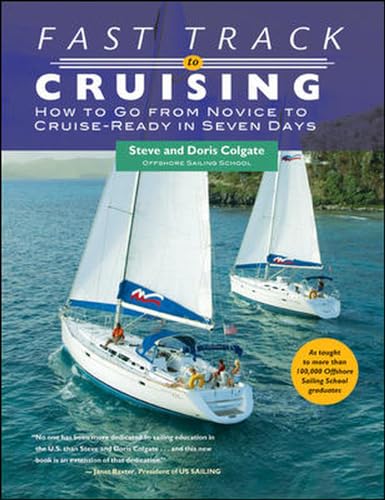
From first sail to cruising a mid-sized sailboat, here is a how-to book tailored to would-be sailors with big dreams and little time
Like the "Fast Track to Cruising" course, this book starts with the basics of sailing and moves the reader quickly through days ailing to cruising. The first half covers all the steps from learning to sail to live-a-board cruising in outline format, offering synopses of key information along that path.
Each key point is cross-linked to a fuller exposition in the second half of the book, helping the reader to a fuller understanding of the concepts behind the techniques.
Die Inhaltsangabe kann sich auf eine andere Ausgabe dieses Titels beziehen.
Über die Autorin bzw. den Autor
Steve Colgate founded the Offshore Sailing School in 1964. He has participated in two America's Cup trials, seventeen Newport–Bermuda races, seven Fastnet Races, the Pan American Games, the Olympics, and six transatlantic races. Doris Colgate is president of the Offshore Sailing School and founder of the National Women's Sailing Association. In 2003, US SAILING awarded the Colgates the Timothea Larr Trophy in recognition of their outstanding leadership and excellence in sailing education.
Von der hinteren Coverseite
Learn how to handle a cruising sailboat in as little as seven days—even if you’ve never sailed before!
Who says you have to be an experienced daysailor before you can think about cruising? Steve and Doris Colgate know that most of us don’t have that kind of time. At the Offshore Sailing School, the Colgates have helped more than 100,000 adults—three-quarters of whom started as beginning sailors or complete newcomers--take the helm of a midsize cruising sailboat. Now Fast Track to Cruising offers these proven instructional methods to all aspiring sailors with big dreams and little time.
This is the very first guide that teaches sailing and cruising together, taking you from your first sail to independent cruising in one leap. You can make that leap in as little as seven days—as in the Colgates’ “Fast Track to Cruising” course—or you can get there at a more leisurely pace. Either way, no other book will take you from your first tacking or docking maneuver to a mastery of navigation and diesel engines as efficiently as this one.
"America's most experienced sailing instructors present a thorough and easy to understand look at cruising. Leisure time is precious. Safety is paramount. The Colgates will help you maximize your time on the water."--Gary Jobson, ESPN's lead sailing analyst and editor at large for Cruising World and Sailing World
“Doris and Steve Colgate understand that people want to reach their sailing goals as quickly as possible and they've built the excellent Fast Track program to accomplish it.”--Bernadette Bernon, former editorial director of Cruising World magazine
"Together Steve and Doris Colgate have been teaching beginners to sail for over half a century. In Fast Track to Cruising they have included every concept and procedure you need to get yourself from a want-to-be sailor to one who is knowledgeable and competent to take the helm--with confidence and a smile."--Charles Mason, Executive Editor, SAIL magazine
Steve Colgate founded the Offshore Sailing School in 1964. He has participated in two America's Cup trials, seventeen Newport–Bermuda races, seven Fastnet Races, the Pan American Games, the Olympics, and six transatlantic races. Doris Colgate is president of the Offshore Sailing School and founder of the National Women's Sailing Association. In 2003, US SAILING awarded the Colgates the Timothea Larr Trophy in recognition of their outstanding leadership and excellence in sailing education.
Auszug. © Genehmigter Nachdruck. Alle Rechte vorbehalten.
FAST TRACK to CRUISING
HOW TO GO FROM NOVICE TO CRUISE READY IN SEVEN DAYS
By STEVE COLGATE, Doris ColgateThe McGraw-Hill Companies, Inc.
Copyright © 2005 Steve and Doris Colgate
All rights reserved.
ISBN: 978-0-07-140672-7All rights reserved.
Contents
| FOREWORD | |
| ACKNOWLEDGMENTS | |
| INTRODUCTION | |
| DAY ONE GETTING TO KNOW YOUR BOAT | |
| CHAPTER 1 The Language of Sailing | |
| CHAPTER 2 Start Sailing | |
| CHAPTER 3 The Points of Sail | |
| DAY TWO BUILDING CONFIDENCE AND SKILLS | |
| CHAPTER 4 Wind and Sails: A Powerful Team | |
| CHAPTER 5 Balance and Stability | |
| CHAPTER 6 Handling Heavy Weather and Rescuing Crew | |
| DAY THREE GOING AND COMING WITH EASE | |
| CHAPTER 7 Mooring, Docking, and Anchoring Under Sail | |
| CHAPTER 8 Right-of-Way Rules and Navigation | |
| DAY FOUR GETTING FAMILIAR WITH BIGGER BOATS | |
| CHAPTER 9 Transition to a Cruising Boat | |
| CHAPTER 10 Getting Underway | |
| CHAPTER 11 Basic Maneuvers Under Sail | |
| DAY FIVE SETTLING DOWN FOR THE NIGHT | |
| CHAPTER 12 Docking and Mooring a Cruising Boat | |
| CHAPTER 13 Anchoring Your Cruising Boat | |
| DAY SIX TECHNIQUES FOR SUCCESSFUL CRUISING | |
| CHAPTER 14 Sail Trim for Cruising | |
| CHAPTER 15 Safety and Health Tips for Cruising | |
| DAY SEVEN GONE CRUISING! | |
| CHAPTER 16 Navigation: Knowing Where You Are and Where You Are Going | |
| CHAPTER 17 Creature Comforts and Other Tips for Cruising | |
| CHAPTER 18 Cruise Ready! | |
| APPENDIX 1: SEVEN-DAY STUDY PROGRAM | |
| APPENDIX 2: TIPS AND CHECKLISTS | |
| GLOSSARY | |
| INDEX |
Excerpt
CHAPTER 1
THE LANGUAGE OF SAILING
The language of the sea is deeply rooted in the era of square-rigged ships, andtoday sailors around the world use a kind of shorthand that has evolved fromthat period. We were reminded of the importance of sailing language when weraced our 54-footer with crew from various countries. We could all communicateeasily during those races—even though we didn't share a common tongue.
To the uninitiated, sailor-talk may sound strange. But it's an essentiallanguage to learn. There are times on a boat when the correct action must betaken quickly and at the right moment, or problems will result. You can't affordto say, "Let go of that thing over there!" when you really mean, "Free thejibsheet!" Through repetition, you will learn the necessary sailing terms tohelp you sail well.
Although there are many types and sizes of sailboats, the learn-to-sail sectionsin the first part of this book are focused on one type of boat—the Colgate26, a family sport boat designed for training, racing, and family fun. TheColgate 26 is characterized as a sloop-rigged keelboat. The word sloop refers toa boat with one mast; the keel is a heavy fixed fin beneath the boat thatprovides stability. What you learn on this boat can be applied to any sailboat.
IMPORTANT WORDS TO KNOW
This chapter covers some key terms that are important to learn, along withsummary lists that will serve as an easy reference.
If you are standing on a sailboat facing forward, you are looking at the bow,with the starboard side on your right and the port side on your left.Conversely, if you are facing the back end of the boat, you are facing aft andlooking at the stern, with the starboard side on your left and port to yourright. The widest part of a boat is called the beam. Some people confuse stern(the whole back end of the boat) with the word transom, which is the vertical orslanted part that goes from the deck to the water.
When identifying a direction, another boat, or something you need to take noteof, the words ahead, astern, and abeam come in handy. A buoy you're looking formay be ahead, or forward of the boat. The dinghy you are towing is astern, orbehind the boat. A lighthouse ashore might be abeam, at a right angle off theleft or right side of the boat. "Abeam" is a word that takes on specialimportance when you learn to identify the proximity of other boats, especiallyat night, as you'll learn later.
SAILING LINGO
* Bow: forward end of boat
* Stern: back end of boat
* Port: left side when facing thebow
* Starboard: right sidewhen facing the bow
* Beam: widest part of boat
* Ahead: in front of boat
* Astern: behind boat
* Abeam: at right angles fromboat.
HOW TO MEASURE A SAILBOAT
Open any sailing magazine and you will find a list of dimensions, usuallyabbreviated, alongside sailboat designs. These are the terms you use indescribing the length, depth, and width of a sailboat.
LOA stands for length overall. This is the total length of the boat from the bowto the end of the stern in a straight line. LOA does not include the bowsprit(if your boat has one), which is a pole that extends beyond the bow of a boat.When you rent or buy a sailboat, LOA is a very common specification—ascommon as MPG is to a car shopper.
LWL is the load waterline length, or simply waterline length. This is thestraight-line distance from the point where the bow emerges from the water tothe point where the stern emerges from the water. Sailors need to know the LWLwhen calculating the potential speed of a sailboat.
Draft is the vertical distance from the water surface to the deepest part of theboat (the bottom of the keel). This measurement will tell you where you can andcannot sail. If your boat touches bottom in 3 feet of water, its draft is 3feet. Stated differently, your boat draws 3 feet. When you ask a marina for aslip to rent you will probably be asked, "How much does your boat draw?" Youwill also be asked the LOA of your boat, because slip fees are calculated indollars per foot.
Instead of a keel, some boats have a centerboard—a relatively thin panelmade out of wood, fiberglass, or metal that can be raised or lowered to changethe draft of the boat. In this case, you might hear someone describe the boat ashaving two drafts: "My boat draws 6 inches with the board up and 4 feet with theboard down."
The freeboard of a boat, which is measured vertically from the edge of the deckto the waterline, is an important determinant of its interior space. The morefreeboard a boat has, the more headroom there will be in its cabin (assuming theboat has one). Some sailors erroneously use freeboard interchangeably with thetopsides of the boat, but the latter term actually refers to the sides of thehull above the waterline.
The beam of the boat described earlier is its maximum width, not its width atdeck level as one might expect. The topsides on some boats curve outward fromthe deck and back in at the waterline. In this case, the beam is measured at thewidest part of that curve.
SAILING LINGO
* LOA: length...
„Über diesen Titel“ kann sich auf eine andere Ausgabe dieses Titels beziehen.
Suchergebnisse für Fast Track To Cruising: How To Go From Novice To Cruise...

Beispielbild für diese ISBN
Fast Track to Cruising: How to Go from Novice to Cruise-Ready in Seven Days
Verlag:
International Marine/Ragged Mountain Press, 2004
ISBN 10: 0071406727
ISBN 13: 9780071406727
Gebraucht
Softcover
Anbieter: World of Books (was SecondSale), Montgomery, IL, USA
Verkäuferbewertung 5 von 5 Sternen

Zustand: Good. Item in good condition. Textbooks may not include supplemental items i.e. CDs, access codes etc. Artikel-Nr. 00093472422
Gebraucht kaufen
EUR 3,88
Versand gratis
Versand innerhalb von USA
Versand innerhalb von USA
Anzahl: 4 verfügbar
Beispielbild für diese ISBN
Fast Track to Cruising: How to Go from Novice to Cruise-Ready in Seven Days
Verlag:
International Marine/Ragged Mountain Press, 2004
ISBN 10: 0071406727
ISBN 13: 9780071406727
Gebraucht
Softcover
Anbieter: World of Books (was SecondSale), Montgomery, IL, USA
Verkäuferbewertung 5 von 5 Sternen
Zustand: Very Good. Item in very good condition! Textbooks may not include supplemental items i.e. CDs, access codes etc. Artikel-Nr. 00095159399
Gebraucht kaufen
EUR 3,88
Versand gratis
Versand innerhalb von USA
Versand innerhalb von USA
Anzahl: 2 verfügbar
Beispielbild für diese ISBN
Fast Track to Cruising: How to Go from Novice to Cruise-Ready in Seven Days
Verlag:
International Marine Publishing, 2004
ISBN 10: 0071406727
ISBN 13: 9780071406727
Gebraucht
Paperback
Anbieter: ThriftBooks-Atlanta, AUSTELL, GA, USA
Verkäuferbewertung 5 von 5 Sternen
Paperback. Zustand: Very Good. No Jacket. May have limited writing in cover pages. Pages are unmarked. ~ ThriftBooks: Read More, Spend Less. Artikel-Nr. G0071406727I4N00
Gebraucht kaufen
EUR 6,21
Versand gratis
Versand innerhalb von USA
Versand innerhalb von USA
Anzahl: 1 verfügbar
Beispielbild für diese ISBN
Fast Track to Cruising: How to Go from Novice to Cruise-Ready in Seven Days
Verlag:
International Marine Publishing, 2004
ISBN 10: 0071406727
ISBN 13: 9780071406727
Gebraucht
Paperback
Anbieter: ThriftBooks-Dallas, Dallas, TX, USA
Verkäuferbewertung 5 von 5 Sternen
Paperback. Zustand: As New. No Jacket. Pages are clean and are not marred by notes or folds of any kind. ~ ThriftBooks: Read More, Spend Less. Artikel-Nr. G0071406727I2N00
Gebraucht kaufen
EUR 6,21
Versand gratis
Versand innerhalb von USA
Versand innerhalb von USA
Anzahl: 1 verfügbar
Beispielbild für diese ISBN
Fast Track to Cruising: How to Go from Novice to Cruise-Ready in Seven Days
Verlag:
International Marine Publishing, 2004
ISBN 10: 0071406727
ISBN 13: 9780071406727
Gebraucht
Paperback
Anbieter: ThriftBooks-Dallas, Dallas, TX, USA
Verkäuferbewertung 5 von 5 Sternen
Paperback. Zustand: Very Good. No Jacket. May have limited writing in cover pages. Pages are unmarked. ~ ThriftBooks: Read More, Spend Less. Artikel-Nr. G0071406727I4N00
Gebraucht kaufen
EUR 6,21
Versand gratis
Versand innerhalb von USA
Versand innerhalb von USA
Anzahl: 1 verfügbar
Beispielbild für diese ISBN
Fast Track to Cruising: How to Go from Novice to Cruise-Ready in Seven Days
Verlag:
International Marine Publishing, 2004
ISBN 10: 0071406727
ISBN 13: 9780071406727
Gebraucht
Paperback
Anbieter: ThriftBooks-Reno, Reno, NV, USA
Verkäuferbewertung 5 von 5 Sternen
Paperback. Zustand: Very Good. No Jacket. May have limited writing in cover pages. Pages are unmarked. ~ ThriftBooks: Read More, Spend Less. Artikel-Nr. G0071406727I4N00
Gebraucht kaufen
EUR 6,21
Versand gratis
Versand innerhalb von USA
Versand innerhalb von USA
Anzahl: 1 verfügbar
Beispielbild für diese ISBN
Fast Track to Cruising : How to Go from Novice to Cruise-Ready in Seven Days
Verlag:
McGraw-Hill Professional Publishing, 2004
ISBN 10: 0071406727
ISBN 13: 9780071406727
Gebraucht
Softcover
Erstausgabe
Anbieter: Better World Books, Mishawaka, IN, USA
Verkäuferbewertung 5 von 5 Sternen
Zustand: Good. 1st Edition. Pages intact with minimal writing/highlighting. The binding may be loose and creased. Dust jackets/supplements are not included. Stock photo provided. Product includes identifying sticker. Better World Books: Buy Books. Do Good. Artikel-Nr. 7521605-6
Gebraucht kaufen
EUR 6,35
Versand gratis
Versand innerhalb von USA
Versand innerhalb von USA
Anzahl: 2 verfügbar
Beispielbild für diese ISBN
Fast Track to Cruising: How to Go from Novice to Cruise-Ready in Seven Days
Verlag:
International Marine/Ragged Mountain Press, 2004
ISBN 10: 0071406727
ISBN 13: 9780071406727
Gebraucht
Softcover
Anbieter: Wonder Book, Frederick, MD, USA
Verkäuferbewertung 5 von 5 Sternen
Zustand: Very Good. Very Good condition. A copy that may have a few cosmetic defects. May also contain light spine creasing or a few markings such as an owner's name, short gifter's inscription or light stamp. Artikel-Nr. E05B-01542
Gebraucht kaufen
EUR 6,79
Versand gratis
Versand innerhalb von USA
Versand innerhalb von USA
Anzahl: 2 verfügbar
Beispielbild für diese ISBN
Fast Track to Cruising: How to Go from Novice to Cruise-Ready in Seven Days (INTERNATIONAL MARINE-RMP)
Verlag:
International Marine/Ragged Mountain Press, 2004
ISBN 10: 0071406727
ISBN 13: 9780071406727
Gebraucht
Paperback
Anbieter: WorldofBooks, Goring-By-Sea, WS, Vereinigtes Königreich
Verkäuferbewertung 5 von 5 Sternen
Paperback. Zustand: Very Good. The book has been read, but is in excellent condition. Pages are intact and not marred by notes or highlighting. The spine remains undamaged. Artikel-Nr. GOR004869835
Gebraucht kaufen
EUR 4,63
EUR 6,48 Versand
Versand von Vereinigtes Königreich nach USA
Versand von Vereinigtes Königreich nach USA
Anzahl: 1 verfügbar
Beispielbild für diese ISBN
Fast Track to Cruising: How to Go from Novice to Cruise- Ready in Seven Days
Anbieter: AwesomeBooks, Wallingford, Vereinigtes Königreich
Verkäuferbewertung 5 von 5 Sternen
Paperback. Zustand: Very Good. Fast Track to Cruising: How to Go from Novice to Cruise- Ready in Seven Days This book is in very good condition and will be shipped within 24 hours of ordering. The cover may have some limited signs of wear but the pages are clean, intact and the spine remains undamaged. This book has clearly been well maintained and looked after thus far. Money back guarantee if you are not satisfied. See all our books here, order more than 1 book and get discounted shipping. Artikel-Nr. 7719-9780071406727
Gebraucht kaufen
EUR 11,21
EUR 5,78 Versand
Versand von Vereinigtes Königreich nach USA
Versand von Vereinigtes Königreich nach USA
Anzahl: 2 verfügbar