
Verwandte Artikel zu Harry Potter Page to Screen: The Complete Filmmaking...
Inhaltsangabe
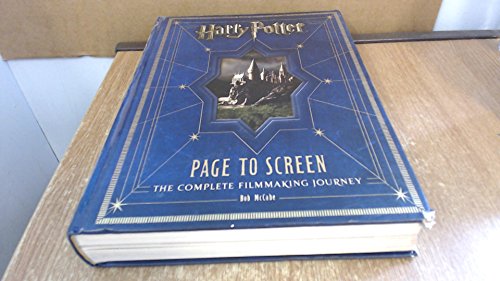
Harry Potter: Page to Screen, the follow-up to the New York Times bestseller Harry Potter: Film Wizardry, is a lavish and personal look at the entire filmmaking process that transformed J. K. Rowling’s fantasy series into a blockbuster movie franchise. Featuring all-new interviews with Daniel Radcliffe, Emma Watson, Rupert Grint, and Michael Gambon, behind-the-scenes anecdotes from producer David Heyman, production designer Stuart Craig, and director David Yates, and hundreds of never-before-seen photographs and concept illustrations, this book is the ultimate compendium for Potter fans young and old.
Die Inhaltsangabe kann sich auf eine andere Ausgabe dieses Titels beziehen.
Über die Autorin bzw. den Autor
Bob McCabe is a noted author, film critic, broadcaster, and screenwriter. He has written over twenty books, including the celebrated Pythons’ Autobiography by the Pythons; Dreams and Nightmares: Terry Gilliam, the Brothers Grimm & Other Cautionary Tales of Hollywood; and The Rough Guide to Comedy Movies. He has written extensively for British periodicals such as Empire magazine, Sight & Sound, and the Sunday Times, and has appeared on numerous BBC film-related radio broadcasts. His screenwriting credits include Küssen verboten, baggern erlaubt and Out on a Limb. He lives in London.
Von der hinteren Coverseite
Harry Potter: Page to Screen opens the doors to Hogwarts castle and the wizarding world of Harry Potter to reveal the complete behind-the-scenes secrets, techniques, and over-the-top artistry that brought J.K. Rowling’s acclaimed novels to cinematic life. Developed in collaboration with the creative team behind the celebrated movie series, this deluxe, 500-plus page compendium features exclusive stories from the cast and crew, hundreds of never-before-seen photographs and concept illustrations sourced from the closed film sets, and rare memorabilia. As the definitive look at the magic that made cinematic history, Page to Screen is the ultimate collectible, perfect for Muggles everywhere.
Auszug. © Genehmigter Nachdruck. Alle Rechte vorbehalten.
Harry Potter Page to Screen
The Complete Filmmaking JourneyBy Bob McCabeHarper Design
Copyright © 2011 Bob McCabeAll right reserved.
ISBN: 9780062101891
Chapter One
SETTINGA year after of negotiations, David Heyman and Warner Bros. I acquired the rights to
Harry Potter and the Philosopher’s Stone and the subsequent books in the
series. The deal was finalized on the very day that the first book was
published in the United States as Harry Potter and the Sorcerer's Stone.
The books 'weren't yet the phenomenon they would become, so the studio viewed the
acquisition as simply a prom-ising option deal with a talented first time
writer. However, J.K. Rowling's book would soon duplicate its British
publishing success with American readers, eventually rising to the top of The
New York Times best-seller list. The acquisition by Warner Bros., on behalf of
Heyday Films, would be one of the most astute in the company's long and
celebrated history.
With the rights in place, producer and author finally met for the first time, at a lunch
also attended by Tanya Seghatchian and Rowling's agent, Christopher Little—the
man who had accepted Rowling's first Harry Potter manuscript a couple of years
earlier. Heyman had imagined that Rowling would be a little older and a little
more conservative than she was. Instead, he found her to be "very funny,
very bright, and very approachable. And she's still that [way] today. Very
little has changed."
The meeting went very well. "I don't think she had any sense that her book was going
to attract such interest from a filmmaker," Heyman continues. "She
was very excited." He notes that while Rowling never discussed the overall
plan for the future of the Harry Potter book series, "she knew that she
was going to write seven books. And we had made a deal for all seven books."
When rumors began circulating that the filmmakers thought the books were too parochial and
that Hogwarts might be relocated to America, Heyman assured Rowling that he
would do all he could to protect her vision and that
he would keep the book's British roots intact. "I expressed to her that we'd be
faithful to the books," he says. It was a promise he would keep.
While David Heyman and J.K. Rowling met in London's West End, Daniel Jacob Radcliffe had
just turned nine years old and was beginning to establish a career as a young
actor. He was only mildly aware of the boy wizard with whom he would come to
share his life.
"I have a very distinct memory of the first time I heard about Harry Potter"
Radcliffe recalls. "We were on a beach at Ramsgate, and my mum was reading
a newspaper article to me that had come out a few months after the first book
was published. The article said that kids were absolutely going nuts about this
surprise hit book. And while my mum was reading, I remember being quite . . .
um . . . not bothered by it. I wasn't a big reader; I found reading quite hard.
I eventually got the first book, and my dad read it to me. Then he read the
second one to me. And then we didn't read any more, for whatever reason."
Like David Heyman, Radcliffe was born into a theatrical family. Both parents had begun
their careers as actors. His mother, Marcia, eventually became a casting agent, and
his father, Alan, became a successful theatrical and literary agent (in which capacity he had
already met David Heyman). So it was not too surprising when, while attending a London based
school, five year old Daniel expressed an interest in acting. Three years or so later,
he audi-tioned for the title role in a new television adaptation of one of Charles Dickens's
perennials.
"I was sent up for David Copperfield because I was more or less crap academically and
pretty rubbish at sports at that time," remembers Radcliffe. "Sue Latimer,
who is my agent now, has been a friend of my dad's since they went to drama school together years ago.
She said, 'Well, look, they're doing auditions for David Copperfield at the moment. Why
don't you send Dan up for it, because it'll be something that none of the other kids in the class
will have experienced. He won't get the part, but, hey, send him up for it.' So I auditioned without
any-body thinking that I might get it. Then I did. I was one of the first boys they saw,
apparently, and they sort of took a liking to me."
Radcliffe proved to be a natural talent in front of the camera, and he swiftly followed
his television debut with his first big screen performance in The Tailor of Panama
(2001), opposite Pierce Brosnan. "That was great fun. Never read the script—I only got my
pages because it was a bit raunchy for my age. I wasn't allowed to see it when it came out, and
actually, I have never seen the film."
As pre-production for the first film geared up, the global success of the Harry
Potter books. continued to increase, and Heyman knew that they needed to make the movie right.
He began searching for a screenwriter to adapt J.K. Rowling's first novel—but never
approached the author herself. "Jo never expressed an interest," notes Heyman.
"She wanted to write the books. We didn't even talk about it."
Heyman and Warner Bros, first tried to recruit the team behind one of the most suc-cessful
British movies of all time: comedy writer Richard Curtis and leading British direc-tor
Mike Newell. Curtis had created the popular television series Black Adder (alongside
his longtime collaborator Rowan Atkinson), and when he teamed up with Newell for the big
screen, the result was a film that would define the British romantic comedy genre, 1994's
Four Weddings and a Funeral. Both Curtis and Newell decided to pass, forcing Heyman
to look elsewhere.
"In the beginning," Heyman says, "we were somewhat under the radar, and
we had to try to generate interest in the project." Several first editions of the book were
sent to prospective screenwriters—all of whom passed. Of course, "as the books became more
successful," he adds, "there were more incoming calls."
Although the plan was to keep the films British, eventually American screen-writers
were considered, because, as Heyman explains, "This story was 'big
entertainment' and there weren't that many British screenwriters who were writing 'big entertain-ment.'"
Very quickly, the field was narrowed down to two writers: Michael Goldenberg
and Steve Kloves. In the end, Kloves got the job. (Over the next decade, Kloves
would adapt six of the seven books. When he took a break during Harry Potter and the Order of The Phoenix,
Goldenberg stepped in.)
Kloves had been recommended to Heyman by a young agent at Creative Artists Agency-
Scott Greenberg. While Heyman thought the suggestion was brilliant, he initially ques-tioned
whether someone like Kloves would even be interested in this style of project. Kloves
had established himself as both writer and director with 1989's The Fabulous Baker
Boys, followed by the very dark and critically acclaimed Flesh and Bone. He had also adapted
rot J.K. Rowling has said that the idea for Harry Potter came to her, appropriately, on
a train. When the time came...
„Über diesen Titel“ kann sich auf eine andere Ausgabe dieses Titels beziehen.
Suchergebnisse für Harry Potter Page to Screen: The Complete Filmmaking...

Foto des Verkäufers
Harry Potter Page to Screen: The Complete Filmmaking Journey
Anbieter: Dream Books Co., Denver, CO, USA
Verkäuferbewertung 5 von 5 Sternen

Zustand: acceptable. This copy has clearly been enjoyedâ"expect noticeable shelf wear and some minor creases to the cover. Binding is strong, and all pages are legible. May contain previous library markings or stamps. Artikel-Nr. DBV.0062101897.A
Gebraucht kaufen
EUR 8,16
Versand gratis
Versand innerhalb von USA
Versand innerhalb von USA
Anzahl: 1 verfügbar
Beispielbild für diese ISBN
Harry Potter Page to Screen : The Complete Filmmaking Journey
Verlag:
HarperCollins Publishers, 2011
ISBN 10: 0062101897
ISBN 13: 9780062101891
Gebraucht
Hardcover
Anbieter: Better World Books: West, Reno, NV, USA
Verkäuferbewertung 5 von 5 Sternen
Zustand: Very Good. Pages intact with possible writing/highlighting. Binding strong with minor wear. Dust jackets/supplements may not be included. Stock photo provided. Product includes identifying sticker. Better World Books: Buy Books. Do Good. Artikel-Nr. 4926877-6
Gebraucht kaufen
EUR 14,42
Versand gratis
Versand innerhalb von USA
Versand innerhalb von USA
Anzahl: 1 verfügbar
Beispielbild für diese ISBN
Harry Potter Page to Screen: The Complete Filmmaking Journey
Anbieter: Magers and Quinn Booksellers, Minneapolis, MN, USA
Verkäuferbewertung 5 von 5 Sternen
hardcover. Zustand: Very Good. May have light to moderate shelf wear and/or a remainder mark. Complete. Clean pages. hardcover. Artikel-Nr. 886345
Gebraucht kaufen
EUR 20,65
EUR 3,56 Versand
Versand innerhalb von USA
Versand innerhalb von USA
Anzahl: 1 verfügbar
Beispielbild für diese ISBN
Harry Potter Page to Screen: The Complete Filmmaking Journey
Anbieter: Jackson Street Booksellers, Omaha, NE, USA
Verkäuferbewertung 5 von 5 Sternen
Hardcover. Zustand: Fine. No Jacket. 4th Edition. Fine in Hardcover. 4th Printing. Artikel-Nr. 155861
Gebraucht kaufen
EUR 36,73
EUR 5,79 Versand
Versand innerhalb von USA
Versand innerhalb von USA
Anzahl: 1 verfügbar
Beispielbild für diese ISBN
Harry Potter Page to Screen: The Complete Filmmaking Journey
Anbieter: medimops, Berlin, Deutschland
Verkäuferbewertung 5 von 5 Sternen
Zustand: good. Befriedigend/Good: Durchschnittlich erhaltenes Buch bzw. Schutzumschlag mit Gebrauchsspuren, aber vollständigen Seiten. / Describes the average WORN book or dust jacket that has all the pages present. Artikel-Nr. M00062101897-G
Gebraucht kaufen
EUR 39,61
EUR 10,00 Versand
Versand von Deutschland nach USA
Versand von Deutschland nach USA
Anzahl: 2 verfügbar
Beispielbild für diese ISBN
Harry Potter Page to Screen: The Complete Filmmaking Journey
Anbieter: medimops, Berlin, Deutschland
Verkäuferbewertung 5 von 5 Sternen
Zustand: very good. Gut/Very good: Buch bzw. Schutzumschlag mit wenigen Gebrauchsspuren an Einband, Schutzumschlag oder Seiten. / Describes a book or dust jacket that does show some signs of wear on either the binding, dust jacket or pages. Artikel-Nr. M00062101897-V
Gebraucht kaufen
EUR 40,58
EUR 10,00 Versand
Versand von Deutschland nach USA
Versand von Deutschland nach USA
Anzahl: 4 verfügbar
Foto des Verkäufers
Harry Potter Page to Screen: The Complete Filmmaking Journey
Anbieter: diakonia secondhand, München, Deutschland
Verkäuferbewertung 5 von 5 Sternen
Zustand: Sehr gut. 532 S. Einband an Ecken leicht berieben. Seiten sauber. 1023 Sprache: Englisch Gewicht in Gramm: 3350 Gebundene Ausgabe, Maße: 24.77 cm x 4.45 cm x 33.02 cm. Artikel-Nr. 42521
Gebraucht kaufen
EUR 32,00
EUR 35,00 Versand
Versand von Deutschland nach USA
Versand von Deutschland nach USA
Anzahl: 1 verfügbar
Beispielbild für diese ISBN
Harry Potter Page to Screen: The Complete Filmmaking Journey
Anbieter: Revaluation Books, Exeter, Vereinigtes Königreich
Verkäuferbewertung 5 von 5 Sternen
Hardcover. Zustand: Brand New. 540 pages. 13.00x9.75x1.75 inches. In Stock. Artikel-Nr. 0062101897
Neu kaufen
EUR 64,67
EUR 29,46 Versand
Versand von Vereinigtes Königreich nach USA
Versand von Vereinigtes Königreich nach USA
Anzahl: 1 verfügbar
Foto des Verkäufers
Harry Potter Page to Screen The Complete Filmmaking Journey
Anbieter: Leipziger Antiquariat, Leipzig, Deutschland
Verkäuferbewertung 5 von 5 Sternen
33,0 x 24,0 cm, Pappband. Zustand: Sehr gut. 531 Seiten Zustand: sauber & frisch. // Mit zahlreichen Abbildungen. Text in Englisch. Unser Produktfoto entspricht dem hier angebotenen Artikel. Alle Artikel befinden sich stets in gebrauchsfähigem Zustand. Gebrauchte Bücher sparen Ressourcen gegenüber Neuware und schonen die Umwelt. /// Versand gratis Innerhalb Deutschlands - Portofrei in Deutschland- ab 20 Euro mit Post ID - Gratisversand deutschlandweit innerhalb Deutschlands gratis Versand -Versandkostenfrei innerhalb Deutschlands /// Sprache: Englisch Gewicht in Gramm: 3320. Artikel-Nr. 351748
Gebraucht kaufen
EUR 28,98
EUR 93,20 Versand
Versand von Deutschland nach USA
Versand von Deutschland nach USA
Anzahl: 1 verfügbar
Beispielbild für diese ISBN
Harry Potter Page to Screen: The Complete Filmmaking Journey
Anbieter: Buchmarie, Darmstadt, Deutschland
Verkäuferbewertung 5 von 5 Sternen
Zustand: Very Good. Artikel-Nr. 3859132_dd0
Gebraucht kaufen
EUR 37,71
EUR 105,00 Versand
Versand von Deutschland nach USA
Versand von Deutschland nach USA
Anzahl: 1 verfügbar