
Verwandte Artikel zu The Man in the Ceiling
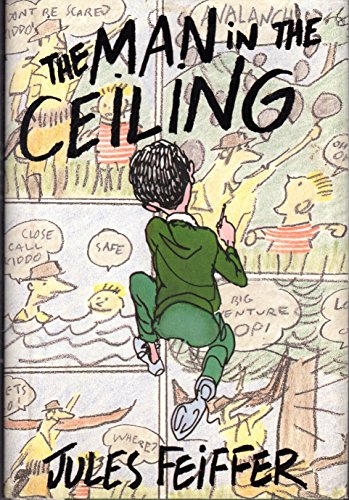
Inhaltsangabe
Now planned as a Broadway musical from the Tony Award-winning producer of “Hamilton” and “Rent”!
From the Pulitzer Prize-winning cartoonist, playwright, screenwriter, and illustrator of The Phantom Tollbooth, Jules Feiffer, comes a witty story about following your dreams.
Jimmy is bad at sports and not much better at school, but he sure can draw terrific cartoons. And his dream, like that of his Uncle Lester who writes flop Broadway musicals, is to be recognized for what he loves doing most.
“Wickedly funny… reminiscent of Roald Dahl's edgy lampoons." —ALA Booklist (starred review)
“A witty story that combines a comfortably oldfangled tone with up-to-the-minute characterizations and a playful use of graphics.” —Publishers Weekly (starred review)
Die Inhaltsangabe kann sich auf eine andere Ausgabe dieses Titels beziehen.
Über die Autorin bzw. den Autor
Jules Feiffer has won a number of prizes for his cartoons, plays, and screenplays, including the Pulitzer Prize for editorial cartooning. His books for children include The Man in the Ceiling; A Barrel of Laughs, A Vale of Tears; I Lost My Bear; Bark, George; and Meanwhile... He lives in Richfield Springs, New York.
In His Own Words...
"I have been writing and drawing comic strips all my life, first as a six-year-old, when I'd try to draw like my heroes: Alex Raymond, who did Flash Gordon, E. C. Segar, who did Popeye, Milton Caniff, who did Terry and the Pirates. The newspaper strip back in the 1940s was a glorious thing to behold. Sunday pages were full-sized and colored broadsheets that created a universe that could swallow a boy whole.
"I was desperate to be a cartoonist. One of my heroes was Will Eisner, who did a weekly comic book supplement to the Sunday comics. One day I walked into his office and showed him my samples. He said they were lousy, but he hired me anyway. And I began my apprenticeship.
"Later I was drafted out of Eisner's office into the Korean War. Militarism, regimentation, and mindless authority combined to squeeze the boy cartoonist out of me and bring out the rebel. There was no format at the time to fit the work I raged and screamed to do, so I had to invent one. Cartoon satire that commented on the military, the bomb, the cold war, the hypocrisy of grown-ups, the mating habits of urban young men and women: These were my subjects. After four years of trying to break into print and getting nowhere, the Village Voice, the first alternative newspaper, offered to publish me. Only one catch: They couldn't pay me. What did I care?
"My weekly satirical strip, Sick Sick Sick, later renamed Feiffer, started appearing in late 1956. Two years later, Sick Sick Sick came out in book form and became a bestseller. The following years saw a string of cartoon collections, syndication, stage and screen adaptations of the cartoon. One, Munro, won an Academy Award.
"This was heady stuff, taking me miles beyond my boyhood dreams. The only thing that got in the way of my enjoying it was the real world: the Cuban missile crisis, the assassination of President Kennedy, the Vietnam War, the civil rights revolution. The country was coming unglued, and my weekly cartoons didn't seem to be an adequate way of handling it. So I started writing plays: Little Murders, The White House Murder Case, Carnal Knowledge, Grown Ups. All the themes of my comic strips expanded theatrically and, later, cinematically to give me the time and space I needed to explain the times to myself and to my audience.
"I grew older. I had a family and, late in life, a very young family. I started thinking, as old guys will, about what I wanted these children to read, to learn. I read them E. B. White and Beverly Cleary and Roald Dahl, and, one day, I thought, Hey, I can do this."
"Writing for young readers connects me professionally to a part of myself that I didn't know how to let out until I was sixty: that kid who lived a life of innocence, mixed with confusion and consternation, disappointment and dopey humor. And who drew comic strips and needed friends—and found them—in cartoons and children's books that told him what the grown-ups in his life had left out. That's what reading did for me when I was a kid. Now I try to return the favor."
Von der hinteren Coverseite
He's bad at sports and not much better at school, but Jimmy sure can draw terrific cartoons. And his dream'like that of his Uncle Lester, who writes flop Broadway musicals'is to be recognized for what he loves doing most.
1993 Books for Youth Editors' Choices (BL)
1993 Choices: The Year's Best Books (Publishers Weekly)
Children's Books of 1993 (Library of Congress)
1994 Books for the Teen Age (NY Public Library)
100 Books for Reading and Sharing 1993 (NY Public Library)
Auszug. © Genehmigter Nachdruck. Alle Rechte vorbehalten.
The Man in the Ceiling
By Jules FeifferHarperCollins Publishers
Copyright © 1993 Jules FeifferAll right reserved.
ISBN: 9780062050359
Chapter One
Sometimes Jimmy imagined his father carrying a canoe on his shoulder and sometimes not. The trouble Jimmy had with the canoe idea was that, if they were trekking through these thick woods, wasn't the canoe likely to bang into trees, knocking his father off balance, possibly into a swamp with live alligators? Actually, not a bad idea. Or this: What if the canoe got tangled in the branches of a tree, high off the ground, and just hung there? Jimmy liked that even better than the alligator idea. He had to laugh as he drew it.
Jimmy's father called him "kiddo" in the stories that Jimmy made up. Jimmy didn't entirely mind that his actual father didn't call him "kiddo" or take him camping in the woods. First of all, it wouldn't have been as much fun, and second, his father was too busy and overworked to take him camping in the woods. The word Jimmy heard most about his father was "overworked". The way his mother said it, "overworked" sounded important, even a little mysterious, something that perhaps Jimmy should grow up to be.
Father always brought home a pile of papers from the aircraft plant where he overworked, not far from where Jimmy and his family lived in Upper Montclair. "Don't touch my papers," Father said every time, although neither Jimmy nor his mother or sisters ever dreamed of going near his papers. just to look at them was enough to know that these were papers not meant to be touched. They had equations. Father might just as well have said, "Don't touch my atom bomb". Why in the world did he think that Jimmy would be tempted?
At times, Jimmy drew on the floor just behind the metal desk where Father worked on his papers. It made him feel that they were colleagues of sorts, two men-the only two in the family-busily making mysterious marks on sheets of paper. I say "mysterious" because Father no more understood Jimmy's drawings than Jimmy understood Father's equations. Jimmy felt self-conscious drawing with Father nearby. He pretended that Father was not really working on his equations but watching Jimmy out of the corner of his eye. So every line Jimmy drew was a line for Father. Not that Father got it. Mother sometimes got it, but she was an artist herself, so it was to be expected. His older sister, Lisi, got it, but she was Jimmy's biggest fan, so big deal! But Father? Father never got it.
The effort it took to make a good Indiana Jones drawing made Jimmy grunt. The grunts were for Father's benefit. Jimmy hoped that just once Father would look up and say, "Not as easy as it looks, right, kiddo?" But Father didn't hear Jimmy's grunts. He was lost in thought over his equations. Sometimes Jimmy invented things to say to get his attention. Like one time he asked, "If you love, I mean really love your job, isn't it fair that you should be paid less?"
This was on his mind because, while he intended to grow up to draw cartoons (which he loved), still and all, he had to make money to support a family. So the question was not frivolous. Jimmy continued: "If a job is fun, maybe you shouldn't get paid-or O.K., paid, but food and carfare and something for the movies. I mean, shouldn't you get paid more for a job you hate?"
Father's pen hand stopped jotting down numbers. His eyes lost focus and his face took on a funny, pinched look. It was as if he were trying to translate Jimmy's words into his own native tongue. But that couldn't be, because Father was born in Columbus, Ohio.
"Don't bother your father, he's busy," said Jimmy's mother, who seemed never to be there except to stop Jimmy from bothering his father. At other times she said, "Don't bother your father, he's resting," which simply wasn't true. Jimmy never saw Father rest. Even asleep, he looked like it was a job.
So, between a busy father and a resting father (as if!), Jimmy chose to create a father he could bother. And this father-his Indiana Jones of a father-was so ideal that Jimmy wouldn't have wanted his actual father to be like that. It would confuse things. He didn't mind sharing his actual father with his two sisters, Lisi and Susu, but his Indiana Jones of a father? No way!
Continues...
Excerpted from The Man in the Ceilingby Jules Feiffer Copyright © 1993 by Jules Feiffer. Excerpted by permission.
All rights reserved. No part of this excerpt may be reproduced or reprinted without permission in writing from the publisher.
Excerpts are provided by Dial-A-Book Inc. solely for the personal use of visitors to this web site.
„Über diesen Titel“ kann sich auf eine andere Ausgabe dieses Titels beziehen.
Suchergebnisse für The Man in the Ceiling

Beispielbild für diese ISBN
The Man in the Ceiling
Verlag:
HarperCollins Publishers Inc, 1993
ISBN 10: 0062050354
ISBN 13: 9780062050359
Gebraucht
Hardcover
Anbieter: World of Books (was SecondSale), Montgomery, IL, USA
Verkäuferbewertung 5 von 5 Sternen

Hardback. Zustand: Good. Feiffer, Jules (illustrator). Now planned as a Broadway musical from the Tony Award-winning producer of "Hamilton" and "Rent"! From the Pulitzer Prize-winning cartoonist, playwright, screenwriter, and illustrator of The Phantom Tollbooth, Jules Feiffer, comes a witty story about following your dreams. Jimmy is bad at sports and not much better at school, but he sure can draw terrific cartoons. And his dream, like that of his Uncle Lester who writes flop Broadway musicals, is to be recognized for what he loves doing most. "Wickedly funny. reminiscent of Roald Dahl's edgy lampoons." --ALA Booklist (starred review) "A witty story that combines a comfortably oldfangled tone with up-to-the-minute characterizations and a playful use of graphics." --Publishers Weekly (starred review). Artikel-Nr. 00098865866
Gebraucht kaufen
EUR 4,92
Versand gratis
Versand innerhalb von USA
Versand innerhalb von USA
Anzahl: 1 verfügbar
Beispielbild für diese ISBN
The Man in the Ceiling
Verlag:
HarperCollins Publishers Inc, 1993
ISBN 10: 0062050354
ISBN 13: 9780062050359
Gebraucht
Hardcover
Anbieter: World of Books (was SecondSale), Montgomery, IL, USA
Verkäuferbewertung 5 von 5 Sternen
Hardback. Zustand: Very Good. Feiffer, Jules (illustrator). Now planned as a Broadway musical from the Tony Award-winning producer of "Hamilton" and "Rent"! From the Pulitzer Prize-winning cartoonist, playwright, screenwriter, and illustrator of The Phantom Tollbooth, Jules Feiffer, comes a witty story about following your dreams. Jimmy is bad at sports and not much better at school, but he sure can draw terrific cartoons. And his dream, like that of his Uncle Lester who writes flop Broadway musicals, is to be recognized for what he loves doing most. "Wickedly funny. reminiscent of Roald Dahl's edgy lampoons." --ALA Booklist (starred review) "A witty story that combines a comfortably oldfangled tone with up-to-the-minute characterizations and a playful use of graphics." --Publishers Weekly (starred review). Artikel-Nr. 00099360184
Gebraucht kaufen
EUR 4,92
Versand gratis
Versand innerhalb von USA
Versand innerhalb von USA
Anzahl: 1 verfügbar
Beispielbild für diese ISBN
The Man in the Ceiling
Verlag:
HarperCollins (edition First Edition), 1993
ISBN 10: 0062050354
ISBN 13: 9780062050359
Gebraucht
Hardcover
Erstausgabe
Anbieter: BooksRun, Philadelphia, PA, USA
Verkäuferbewertung 5 von 5 Sternen
Hardcover. Zustand: Very Good. Feiffer, Jules (illustrator). First Edition. It's a well-cared-for item that has seen limited use. The item may show minor signs of wear. All the text is legible, with all pages included. It may have slight markings and/or highlighting. Artikel-Nr. 0062050354-8-1
Gebraucht kaufen
EUR 4,93
Versand gratis
Versand innerhalb von USA
Versand innerhalb von USA
Anzahl: 1 verfügbar
Beispielbild für diese ISBN
The Man in the Ceiling
Anbieter: ThriftBooks-Phoenix, Phoenix, AZ, USA
Verkäuferbewertung 5 von 5 Sternen
Hardcover. Zustand: Very Good. No Jacket. Feiffer, Jules (illustrator). May have limited writing in cover pages. Pages are unmarked. ~ ThriftBooks: Read More, Spend Less. Artikel-Nr. G0062050354I4N00
Gebraucht kaufen
EUR 5,97
Versand gratis
Versand innerhalb von USA
Versand innerhalb von USA
Anzahl: 1 verfügbar
Beispielbild für diese ISBN
The Man in the Ceiling
Anbieter: ThriftBooks-Dallas, Dallas, TX, USA
Verkäuferbewertung 5 von 5 Sternen
Hardcover. Zustand: Very Good. No Jacket. Feiffer, Jules (illustrator). May have limited writing in cover pages. Pages are unmarked. ~ ThriftBooks: Read More, Spend Less. Artikel-Nr. G0062050354I4N00
Gebraucht kaufen
EUR 5,97
Versand gratis
Versand innerhalb von USA
Versand innerhalb von USA
Anzahl: 1 verfügbar
Beispielbild für diese ISBN
The Man in the Ceiling
Anbieter: ThriftBooks-Reno, Reno, NV, USA
Verkäuferbewertung 5 von 5 Sternen
Hardcover. Zustand: Very Good. No Jacket. Feiffer, Jules (illustrator). May have limited writing in cover pages. Pages are unmarked. ~ ThriftBooks: Read More, Spend Less. Artikel-Nr. G0062050354I4N00
Gebraucht kaufen
EUR 5,97
Versand gratis
Versand innerhalb von USA
Versand innerhalb von USA
Anzahl: 1 verfügbar
Beispielbild für diese ISBN
The Man in the Ceiling
Anbieter: ThriftBooks-Atlanta, AUSTELL, GA, USA
Verkäuferbewertung 5 von 5 Sternen
Hardcover. Zustand: Very Good. No Jacket. Feiffer, Jules (illustrator). May have limited writing in cover pages. Pages are unmarked. ~ ThriftBooks: Read More, Spend Less. Artikel-Nr. G0062050354I4N00
Gebraucht kaufen
EUR 5,97
Versand gratis
Versand innerhalb von USA
Versand innerhalb von USA
Anzahl: 1 verfügbar
Beispielbild für diese ISBN
The Man in the Ceiling
Anbieter: Wonder Book, Frederick, MD, USA
Verkäuferbewertung 5 von 5 Sternen
Zustand: Good. Feiffer, Jules (illustrator). Good condition. Very Good dust jacket. A copy that has been read but remains intact. May contain markings such as bookplates, stamps, limited notes and highlighting, or a few light stains. Artikel-Nr. R02C-03150
Gebraucht kaufen
EUR 6,43
Versand gratis
Versand innerhalb von USA
Versand innerhalb von USA
Anzahl: 1 verfügbar
Beispielbild für diese ISBN
The Man in the Ceiling
Verlag:
HarperCollins Publishers, 1993
ISBN 10: 0062050354
ISBN 13: 9780062050359
Gebraucht
Hardcover
Anbieter: Better World Books, Mishawaka, IN, USA
Verkäuferbewertung 5 von 5 Sternen
Zustand: Very Good. Feiffer, Jules (illustrator). Former library copy. Pages intact with possible writing/highlighting. Binding strong with minor wear. Dust jackets/supplements may not be included. Includes library markings. Stock photo provided. Product includes identifying sticker. Better World Books: Buy Books. Do Good. Artikel-Nr. 38968825-6
Gebraucht kaufen
EUR 7,40
Versand gratis
Versand innerhalb von USA
Versand innerhalb von USA
Anzahl: 1 verfügbar
Beispielbild für diese ISBN
The Man in the Ceiling
Verlag:
HarperCollins Publishers, 1993
ISBN 10: 0062050354
ISBN 13: 9780062050359
Gebraucht
Hardcover
Anbieter: Better World Books: West, Reno, NV, USA
Verkäuferbewertung 5 von 5 Sternen
Zustand: Very Good. Feiffer, Jules (illustrator). Former library copy. Pages intact with possible writing/highlighting. Binding strong with minor wear. Dust jackets/supplements may not be included. Includes library markings. Stock photo provided. Product includes identifying sticker. Better World Books: Buy Books. Do Good. Artikel-Nr. 38968825-6
Gebraucht kaufen
EUR 7,40
Versand gratis
Versand innerhalb von USA
Versand innerhalb von USA
Anzahl: 1 verfügbar