
Verwandte Artikel zu Escape Velocity: Free Your Company's Future from the...
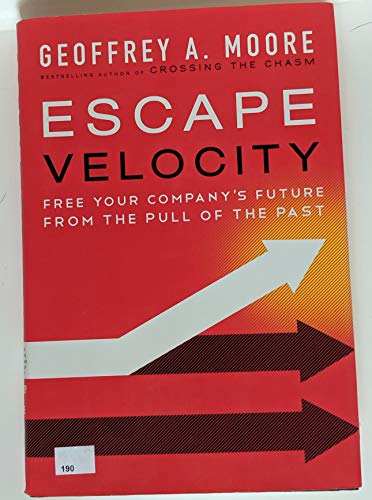
Escape Velocity: Free Your Company's Future from the Pull of the Past – A Strategic Guide for Executives on Next-Generation Category Leadership - Hardcover
Inhaltsangabe
“Readthis book to learn how to create a company as powerful as Apple.”—Guy Kawasaki,former chief evangelist of Apple
InEscape Velocity Geoffrey A. Moore, author of the marketing masterwork Crossingthe Chasm, teaches twenty-first century enterprises how to overcome thepull of the past and reorient their organizations to meet a new era ofcompetition. The world’s leading high-tech business strategist, Moore connectsthe dots between bold strategies and effective execution, with an action planthat elucidates the link between senior executives and every other branch of acompany. For readers of Larry Bossidy’s Execution,Clay Christensen’s Innovator’s Solution, and Gary Vaynerchuck’sCrush It!, and for anyone aiming for the pinnacle of business success, EscapeVelocity is an irreplaceable roadmap to the top.
This essential guide for senior executives lays out a new playbook for corporate strategy:
- The Hierarchy of Powers: Master a five-level framework—from Category Power to Execution Power—to diagnose challenges and align your entire organization for market leadership.
- Strategic Portfolio Management: Apply the Three Horizons model to escape the innovator’s dilemma, rebalance your company’s portfolio, and fund the next generation of growth.
- Sustainable Competitive Advantage: Learn how to make asymmetrical bets on your company’s crown jewels to create unmatchable offers that leave the competition behind.
- High-Impact Execution: Go beyond theory with a concrete action plan that connects bold strategies with effective execution, ensuring your vision becomes a reality from the top down.
Die Inhaltsangabe kann sich auf eine andere Ausgabe dieses Titels beziehen.
Über die Autorin bzw. den Autor
Geoffrey A. Moore is the author of Escape Velocity, Inside the Tornado, and Living on the Fault Line.
Von der hinteren Coverseite
From the world’s leading high-tech strategist comes the definitive road map to help established companies create next-generation growth.
Geoffrey Moore’s now-classic Crossing the Chasm became a must-read book by presenting an innovative framework to address the make-or-break obstacle facing all high-tech companies: how to gain market share from early adopters and from mainstream consumers.
Based on twenty years’ experience advising the top leaders of many of the world’s most successful enterprises, Moore’s Escape Velocity offers a pragmatic plan to engage the most critical challenge that established enterprises face in the twenty-first-century economy: how to move beyond past success and drive next-generation growth from new lines of business.
As he worked with senior management teams, Moore repeatedly found that executives were trapped by short-term performance-based compensation schemes. The result was critical decision-makers overweighting their legacy commitments, an embarrassingly low success rate in new-product launches, and a widespread failure to sustain any kind of next-generation business at scale.
In Escape Velocity, Moore presents a cogent strategy for generating future growth within an established enterprise. Organized around a hierarchy of powers—category power, company power, market power, offer power, and execution power—this insightful work shows how each level of power can be orchestrated to achieve overall success. Moore explains
- how to use mergers and acquisitions as well as organic innovation to systematically migrate an enterprise’s portfolio out of lower-growth and into higher-growth categories;
- how to reallocate resources across an enterprise in deliberately asymmetrical ways to create a powerful and sustainable foundation for a long-term competitive advantage;
- how to leverage target-market initiatives as accelerants to growth and as stepping-stones to broad overall category success;
- how to create unmatchable offerings by being swift to neutralize competitors’ innovations and laser-focused on driving in-house innovations to make a business impervious to competitors;
- how to fundamentally change the execution cadence of an organization, pushing change from innovation to broad deployment, creating an irreversible tipping point along the way.
Drawing from thousands of hours spent face-to-face with CEOs and their teams, Moore presents case examples and best practices. While his experience is deeply rooted in the high-tech sector, his models and techniques apply well beyond this arena, including to the public sector.
At a time when the world is looking to established enterprises for growth and stability, Moore’s analysis is penetrating and his prescriptions are right on the mark. Escape Velocity gives executives and their teams a practical way forward to take advantage of the opportunities amid industry and economic disruptions.
Auszug. © Genehmigter Nachdruck. Alle Rechte vorbehalten.
Escape Velocity
Free Your Company's Future from the Pull of the PastBy Geoffrey A. MooreHarperBusiness
Copyright © 2011 Geoffrey A. MooreAll right reserved.
ISBN: 9780062040893
Chapter One
Escape Velocity and the Hierarchy of PowersTo free your company?s future from the pull of the past,
to escape the gravitational field of your prior year?s operating
plan, and to complete the round trip by returning
with next year?s operating plan, you need to apply a force
that is greater than the inertial momentum of current
operations. No experienced executive is likely to underestimate
the amount of force required. It is, as we like to say in Silicon
Valley, ginormous.
Newton taught us several centuries ago in his first law of
motion, the one that covers inertia, that an object at rest tends
to stay at rest and an object in motion tends to continue in the
direction in which it is currently moving. The same goes for
resource allocation.
When organizations begin their strategic planning effort
by circulating last year?s operating plan, they reinforce the
inertial properties of the resources as currently allocated.
This is not a good outcome, but to be frank, there is no help
for it. You cannot really zero-base the budget every year,
not in an enterprise of any size. So you have to assume this
inertial force will be introduced into the process at some
point.
What you can do, however, is get yourself and your
colleagues out in front of it. Specifically, you can take the time
to develop and bring to the table an outside-in, market-centric
perspective that is so compelling and so well informed that it
can counterbalance the inside-out company-centric orientation
of last year?s operating plan. This will help correct for
the one huge, glaring flaw in that plan?the fact that it?s all
about you!
It is not about the world or the market or your customers
or your partners or even your competitors. It is exclusively
and solely about you and your revenue and earnings targets
and your desired return on equity and your management
objectives, and your operating metrics and your internal
disposition of resources, and perhaps most influentially, about
your comp plan. But step back and take stock. The world is
more powerful than you. The market is more powerful than
you. Your customers are more powerful than you. And the
sum of all your partners and competitors?the ecosystem?is
more powerful than you. And just to put the cap on it, nobody
really cares about you except you. So given the enormous
challenge of counterbalancing the inertial momentum of last
year?s plan, what do you say we tap into some of these external
sources of power to give your company a boost?
To do this you must conduct a series of dialogues before
opening resource-allocation discussions. In them you
profile trends and opportunities that can create new sources of
wealth for your customers and your company and can stake
out the positions of power you want to occupy. This is not a
new idea. What is new is the mechanism by which we
propose to do it.
Most strategy dialogues end up with executives talking at
cross-purposes because?and this is one of the dirty secrets
of enterprise management?nobody knows exactly what is
meant by vision and strategy, and no two people ever quite
agree on which topics belong where. That is why, when you
ask members of an executive team to describe and explain
the corporate strategy, you so frequently get wildly different
answers. We just don?t have a good business discipline for
converging on issues this abstract. And that does not bode
well for setting a clear trajectory to achieve escape velocity.
This book intends to change that. Leveraging a model we
call the Hierarchy of Powers, it will provide a map that will
engage you and your colleagues in the various domains of
power in a systematic and structured way, ensuring that the
right questions get the right kind of answers at the right time
and in the right sequence.
THE HIERARCHY OF POWERS
The Hierarchy of Powers is a framework of frameworks. It
sizes up all economic competitions in relation to five types of
economic power, organized in descending order from most
general to most specific, as follows:
1. Category power
2. Company power
3. Market power
4. Offer power
5. Execution power
This hierarchy derives from taking an investor view of
your company. The first decision investors make is what
categories to invest in. Once they have determined that, then
they choose specific companies. Once they hold stock in a
company, they dig into the dynamics of the markets it serves,
the competitiveness of its offers, and its track record for
executing to the forecasts it provides. That covers the hierarchy
top to bottom and explains why it is in the order it is.
Within this framework, think of each type of power as
being made up of a set of vectors, arrows of force, each arrow
headed in its own direction. Taken together, combining both
within and across the various levels in the model, these
vectors can align with one another to reinforce the sum total
of power, or they can cancel each other out to reduce power
to near zero. Thus you can be in a hot category and fail to
execute, producing a near-zero result. Similarly, you can
execute like crazy in a dying category and have an equally
disappointing outcome. But when you get the powers aligned,
when each is reinforcing the others, then the magic they call
synergy appears, and very good things can happen indeed.
In this chapter we are going to summarize the forces
incorporated at each level of the Hierarchy of Powers frame work
and call out the management issues that get addressed
at that level. This will provide a road map for the rest of the
book. Each of the subsequent five chapters will drill down
into the dynamics of one of the five levels of power and
present specific models to address the issues that pertain to that
level, illustrating how they apply to particular situations and
concluding with an extended case example to pull everything
together. A concluding chapter will recap this material and
describe how it can be integrated into an annual planning
process that, yes, does include circulating last year?s operating
plan, but in the proper place and at the proper time.
For the rest of this introductory chapter, just sit back and
get the lay of the land. As you read along, take some time to
register how each type of power influences economic performance
and think about the impact it might be having on your
enterprise.
CATEGORY POWER
Category power is a function of the demand for a given
class of products or services relative to all other classes.
Categories in high demand, like smart phones, storage systems,
and cloud computing, are more successful than their peers
in securing customer budgets to fund them. Thus they grow
faster and typically enjoy better profit margins. So participating
in a powerful category is a very good thing indeed.
Conversely, participating in a low-power category, such as
desktop computers, wire-line phone services, or e-mail, is an
exercise in playing on the margins....
„Über diesen Titel“ kann sich auf eine andere Ausgabe dieses Titels beziehen.
Weitere beliebte Ausgaben desselben Titels

Suchergebnisse für Escape Velocity: Free Your Company's Future from the...

Beispielbild für diese ISBN
Escape Velocity Free Your Comp
Anbieter: World of Books (was SecondSale), Montgomery, IL, USA
Verkäuferbewertung 5 von 5 Sternen

Zustand: Good. Item in good condition. Textbooks may not include supplemental items i.e. CDs, access codes etc. Artikel-Nr. 00086045909
Gebraucht kaufen
EUR 3,94
Versand gratis
Versand innerhalb von USA
Versand innerhalb von USA
Anzahl: 9 verfügbar
Beispielbild für diese ISBN
Escape Velocity Free Your Comp
Anbieter: World of Books (was SecondSale), Montgomery, IL, USA
Verkäuferbewertung 5 von 5 Sternen
Zustand: Very Good. Item in very good condition! Textbooks may not include supplemental items i.e. CDs, access codes etc. Artikel-Nr. 00088097235
Gebraucht kaufen
EUR 3,94
Versand gratis
Versand innerhalb von USA
Versand innerhalb von USA
Anzahl: 4 verfügbar
Beispielbild für diese ISBN
Escape Velocity Free Your Comp
Anbieter: World of Books (was SecondSale), Montgomery, IL, USA
Verkäuferbewertung 5 von 5 Sternen
Zustand: Acceptable. Item in acceptable condition! Textbooks may not include supplemental items i.e. CDs, access codes etc. Artikel-Nr. 00101150205
Gebraucht kaufen
EUR 3,94
Versand gratis
Versand innerhalb von USA
Versand innerhalb von USA
Anzahl: 1 verfügbar
Beispielbild für diese ISBN
Escape Velocity: Free Your Company's Future from the Pull of the Past
Anbieter: ThriftBooks-Dallas, Dallas, TX, USA
Verkäuferbewertung 5 von 5 Sternen
Hardcover. Zustand: Very Good. No Jacket. Former library book; May have limited writing in cover pages. Pages are unmarked. ~ ThriftBooks: Read More, Spend Less. Artikel-Nr. G0062040898I4N10
Gebraucht kaufen
EUR 5,88
Versand gratis
Versand innerhalb von USA
Versand innerhalb von USA
Anzahl: 1 verfügbar
Beispielbild für diese ISBN
Escape Velocity: Free Your Company's Future from the Pull of the Past
Anbieter: ThriftBooks-Dallas, Dallas, TX, USA
Verkäuferbewertung 5 von 5 Sternen
Hardcover. Zustand: Very Good. No Jacket. May have limited writing in cover pages. Pages are unmarked. ~ ThriftBooks: Read More, Spend Less. Artikel-Nr. G0062040898I4N00
Gebraucht kaufen
EUR 5,88
Versand gratis
Versand innerhalb von USA
Versand innerhalb von USA
Anzahl: 1 verfügbar
Beispielbild für diese ISBN
Escape Velocity: Free Your Company's Future from the Pull of the Past
Anbieter: ThriftBooks-Atlanta, AUSTELL, GA, USA
Verkäuferbewertung 5 von 5 Sternen
Hardcover. Zustand: As New. No Jacket. Pages are clean and are not marred by notes or folds of any kind. ~ ThriftBooks: Read More, Spend Less. Artikel-Nr. G0062040898I2N00
Gebraucht kaufen
EUR 5,88
Versand gratis
Versand innerhalb von USA
Versand innerhalb von USA
Anzahl: 1 verfügbar
Beispielbild für diese ISBN
Escape Velocity: Free Your Company's Future from the Pull of the Past
Anbieter: ThriftBooks-Dallas, Dallas, TX, USA
Verkäuferbewertung 5 von 5 Sternen
Hardcover. Zustand: Very Good. No Jacket. Missing dust jacket; May have limited writing in cover pages. Pages are unmarked. ~ ThriftBooks: Read More, Spend Less. Artikel-Nr. G0062040898I4N01
Gebraucht kaufen
EUR 5,88
Versand gratis
Versand innerhalb von USA
Versand innerhalb von USA
Anzahl: 1 verfügbar
Beispielbild für diese ISBN
Escape Velocity : Free Your Company's Future from the Pull of the Past
Verlag:
HarperCollins Publishers, 2011
ISBN 10: 0062040898
ISBN 13: 9780062040893
Gebraucht
Hardcover
Anbieter: Better World Books: West, Reno, NV, USA
Verkäuferbewertung 5 von 5 Sternen
Zustand: Very Good. Pages intact with possible writing/highlighting. Binding strong with minor wear. Dust jackets/supplements may not be included. Stock photo provided. Product includes identifying sticker. Better World Books: Buy Books. Do Good. Artikel-Nr. 4413306-75
Gebraucht kaufen
EUR 6,01
Versand gratis
Versand innerhalb von USA
Versand innerhalb von USA
Anzahl: 2 verfügbar
Beispielbild für diese ISBN
Escape Velocity : Free Your Company's Future from the Pull of the Past
Verlag:
HarperCollins Publishers, 2011
ISBN 10: 0062040898
ISBN 13: 9780062040893
Gebraucht
Hardcover
Anbieter: Better World Books: West, Reno, NV, USA
Verkäuferbewertung 5 von 5 Sternen
Zustand: Good. Former library copy. Pages intact with minimal writing/highlighting. The binding may be loose and creased. Dust jackets/supplements are not included. Includes library markings. Stock photo provided. Product includes identifying sticker. Better World Books: Buy Books. Do Good. Artikel-Nr. 5024801-6
Gebraucht kaufen
EUR 6,01
Versand gratis
Versand innerhalb von USA
Versand innerhalb von USA
Anzahl: 1 verfügbar
Beispielbild für diese ISBN
Escape Velocity : Free Your Company's Future from the Pull of the Past
Verlag:
HarperCollins Publishers, 2011
ISBN 10: 0062040898
ISBN 13: 9780062040893
Gebraucht
Hardcover
Anbieter: Better World Books, Mishawaka, IN, USA
Verkäuferbewertung 5 von 5 Sternen
Zustand: Very Good. Pages intact with possible writing/highlighting. Binding strong with minor wear. Dust jackets/supplements may not be included. Stock photo provided. Product includes identifying sticker. Better World Books: Buy Books. Do Good. Artikel-Nr. 4413306-75
Gebraucht kaufen
EUR 6,01
Versand gratis
Versand innerhalb von USA
Versand innerhalb von USA
Anzahl: 3 verfügbar