
Inhaltsangabe
“Schama is a masterful stylist and storyteller.”
—Boston Globe
“A writer of gorgeous prose.”
—Washington Post
The ever erudite, always delightfully curious Simon Schama returns with Scribble, Scribble, Scribble, a wonderful compendium of thirty provocative, witty, enlightening, and stimulating essays previously published but collected in a single volume for the first time. One of our most distinguished historians and commentators, Schama, the acclaimed author of The American Future: A History, explores an amazing diversity of topics—from the political to the personal, from the earth-shaking to the mundane, from ice cream to Churchill to Hurricane Katrina and everything in-between. In Scribble, Scribble, Scribble, Simon Schama opens up his—and our—wide world to us.
Die Inhaltsangabe kann sich auf eine andere Ausgabe dieses Titels beziehen.
Über die Autorin bzw. den Autor
Simon Schama is University Professor of Art History and History at Columbia University in New York. His award-winning books include Scribble, Scribble, Scribble; The American Future: A History; National Book Critics Circle Award winner Rough Crossings; The Power of Art; The Embarrassment of Riches: An Interpretation of Dutch Culture in the Golden Age; Citizens: A Chronicle of the French Revolution; Dead Certainties (Unwarranted Speculations); Landscape and Memory; Rembrandt's Eyes; and the History of Britain trilogy. He has written and presented forty television documentary films for the BBC, PBS, and The History Channel, including the Emmy-winning Power of Art, on subjects that range from John Donne to Tolstoy.
Von der hinteren Coverseite
The New York Times has hailed renowned historian and social commentator Simon Schama as a writer who "entwine[s] past and present into a meaningful, continuous whole." His deeply thoughtful and vastly knowledgeable books such as The Power of Art, The American Future, and the National Book Critics Circle Award finalist Rough Crossings have won acclaim for their intellectually rich and entertaining studies of the individuals and influences that have shaped the human condition, from the French Revolution to the political past and future of America, from the power of art to the role of nature in Western civilization.
Now, in this passionate and provocative collection, this brilliant observer brings his keen critical sensibility to a wide range of topics, both broad and intimate. Captivating and informative, Scribble, Scribble, Scribble offers a lighter, playful Simon Schama on a diverse range of subjects, from food and family to Winston Churchill, from Martin Scorsese and Richard Avedon to Rubens and Rembrandt, from his travels in Brazil and Amsterdam to New Orleans and Katrina. This selection of essays—originally published in magazines and newspapers including the New Yorker, Vogue, the New York Review of Books, and the Guardian—is a treasure trove of surprises that highlight Schama's sense of humor, curiosity, and idiosyncrasies. Never predictable, always stimulating, Scribble, Scribble, Scribble allows us to view the world, in all its diversity, through the eyes of one of its most intelligent, witty, and original inhabitants.
Auszug. © Genehmigter Nachdruck. Alle Rechte vorbehalten.
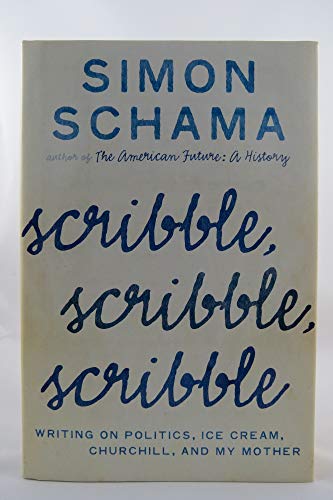
Scribble, Scribble, Scribble
Writing on Politics, Ice Cream, Churchill, and My MotherBy Simon SchamaEcco
Copyright © 2011 Simon SchamaAll right reserved.
ISBN: 978-0-06-200986-9
Chapter One
Sail Away: Six Days to New York on the Queen Mary 2
New Yorker, 31 May 2004
Overlooked ? literally ? by the seventeen-deck Queen Mary 2, as she
slid into her berth at Pier 92 on 22 April 2004, was the dead white
bird. Laid out on its funeral barge beside the USS Intrepid, as flight-
less and obsolete as the dodo, Concorde wasn?t going anywhere. The
sleek dream of supersonic speed, the princess of whoosh, which got
you there before you?d started, was now, officially, a museum piece.
The future ? as the mayoral bloviations greeting the ship?s midtown
docking affirmed ? belonged to 150,000 tons of steel capable of grind-
ing through the ocean at all of thirty knots (that?s around thirty-five
m.p.h. to you landlubbers). The latest and most massive of the
transatlantic liners takes twenty times as long to carry you from New
York to England as a Boeing or an Airbus. And that?s the good news
? the reason, in fact, for Commodore Ronald Warwick, the master of
the Queen Mary 2, to brag, at the quayside ceremonies, that Cunard
was poised to compete with the airlines for a serious share of the
transatlantic business.
Like those of us who had sailed with him through Force 10 gales and
thirty-foot swells, the Commodore may have been pardonably giddy
at coming through the worst that the feisty ocean could throw his way
on a maiden North Atlantic voyage and still getting to the Statue of
Liberty on schedule. But could this be the start of something really
big and really slow? We take for granted the appeal of velocity, that
there is money to be made and pleasure to be had from the gratification
of the instantaneous: the three-gulp Happy Meal, the lightning
download, the vital mobile phone message that I am here and are you
there? And where has this culture of haste got us? Baghdad, apparently,
where the delusions of the get-it-over-with war are being compounded
by the unseemly rush to exit, leaving the whole gory mess for some
other loser to sort out.
It has been thus, as Stephen Kern, in The Culture of Time and
Space 1880?1918, points out, ever since the orgiasts of speed at the turn
of the twentieth century made acceleration the necessary modern
ecstasy. In 1909, the Italian writer and artist Filippo Marinetti
declared, in his Futurist Manifesto, that ?the world?s magnificence has
been enriched by a new beauty: the beauty of speed?. On an after-
noon two years later, a sixteen-frames-a-second movie of the
investiture of the Prince of Wales was developed in a darkroom on
a British express train and taken to London, where it was shown the
same night. Translated into military strategy by the overarmed Great
Powers, as the historian A. J. P. Taylor liked to note, the imperatives
of railway timetables drove the logistics of pre-emptive mobilisation.
A pause to ponder was already a defeat. So modernity bolted out of
the starting gate in 1914: Archduke shot, millions of men in grey and
khaki precipitately herded into railway carriages, carnage begun right
on cue ? before the Flemish mire slowed everything down and
millions plodded to their doom.
For much of its history, Cunard has been part of this feverish hurry-
up. In 1907 its flagship, the Mauretania, captured the Blue Riband for
fastest transatlantic crossing, and kept it for twenty-two years, spurring
jealous ? and fatal ? competition. A novel by Morgan Robertson, The
Wreck of the Titan; or, Futility, appearing in 1898, had featured a liner
named Titan that cuts another ship in two simply ?for the sake of speed?.
And the captain of the Titanic was blamed for sailing full steam, even
in an area notorious for ice floes, in deference to the White Star Line?s
determination to wrest the Blue Riband from Cunard.
Abraham Cunard, a Philadelphia shipwright, had settled in Nova
Scotia, in the loyalist diaspora, after the American Revolution. The
loyalists, severed from not only their homes but the mother country,
had good reason to want their mail delivery to take less than six
weeks, the time often needed for sailing ships to cross from Britain
to Canada or the West Indies. Abraham and his son Samuel prospered
with a small mail fleet, and in the 1830s Samuel, watching George
Stephenson?s locomotive the Rocket hurtle along the tracks at thirty
m.p.h., became convinced that on the oceans, too, steam propulsion
was about to replace sail.
Paddle-driven steamers had been in common use in both American
and British coastal waters and rivers since the early nineteenth century,
and steam-assisted masted ships had crossed the Atlantic since 1819. But
it was only in 1838 that the first full steam crossing was made, by the
St George Steam Packet Company?s ship Sirius. Immediately the jour-
ney was cut to two weeks (twelve days to Halifax, fourteen to Boston).
The Siriuswas followed by Isambard Kingdom Brunel?s GreatWestern,
which added style to speed. It boasted 128 staterooms, bell ropes to
summon stewards, a ladies? stewardess and a seventy-five-foot saloon,
decorated with panels celebrating ?the arts and sciences?.
Disdaining both opulence and reckless speed, Samuel Cunard
offered something else when, in 1839, he made a tender to the Admi-
ralty for the conveyance of Her Majesty?s Mail: dependability,
guaranteed by the novel presence of an on-board engineer. In July
1840 the Britannia, the first of Cunard?s packets, docked at Boston after
a two-week crossing. A wooden-hulled ship with two masts and a
central funnel, it was a footling 1,150 tons and about 200 feet long
(compared with the QM 2?s 150,000 tons and quarter-mile length).
In the port where the American Revolution began, Britannia was
greeted with gun salutes, a performance of ?God Save the Queen? and
the declaration of Cunard Festival Day.
The word ?historic? was much repeated over the public-address system
last 16 April, as the Queen Mary 2 moved out into the Solent from its
Southampton berth under a classically grey English spring sky. The
maiden North Atlantic crossing was hugely subscribed, and, despite
the famous superstitiousness of sailors, no one aboard seemed to have
been deterred by, or even to have spoken of, the tragedy that cast a
shadow over the ship?s prospects even before she had been formally
launched. On 15 November 2003, while theQM2was still in the ship-
yard at Saint-Nazaire, in Brittany, where it was being built, a gangway,
bearing fifty people, collapsed, throwing some of them fifty feet to
the concrete bed of the dry dock. Fiftee nwere killed and twenty-eight
injured. Many of the dead and injured were shipyard workers and
family members and friends, who were visiting the liner before its sail
to Southampton.
In defiance of ill omens, the transatlantic send-off was exuberant;
for those braving the raw breezes there was sparkling wine on the
upper-deck terrace. But anxieties about the target of opportunity
presented by a mass of slowly moving Anglo-American steel precluded
all but a vigilantly screened handful from the dockside ?sailaway?. A
spirited band did what it could with ?Rule Britannia? and...
„Über diesen Titel“ kann sich auf eine andere Ausgabe dieses Titels beziehen.
Weitere beliebte Ausgaben desselben Titels

Suchergebnisse für Scribble, Scribble, Scribble: Writing on Politics,...

Beispielbild für diese ISBN
Scribble, Scribble, Scribble:
Anbieter: World of Books (was SecondSale), Montgomery, IL, USA
Verkäuferbewertung 5 von 5 Sternen

Zustand: Good. Good condition ex-library book with usual library markings and stickers. Artikel-Nr. 00101982773
Gebraucht kaufen
EUR 5,82
Versand gratis
Versand innerhalb von USA
Versand innerhalb von USA
Anzahl: 1 verfügbar
Beispielbild für diese ISBN
Scribble, Scribble, Scribble : Writing on Politics, Ice Cream, Churchill, and My Mother
Verlag:
HarperCollins Publishers, 2011
ISBN 10: 0062009869
ISBN 13: 9780062009869
Gebraucht
Hardcover
Anbieter: Better World Books, Mishawaka, IN, USA
Verkäuferbewertung 5 von 5 Sternen
Zustand: Very Good. Pages intact with possible writing/highlighting. Binding strong with minor wear. Dust jackets/supplements may not be included. Stock photo provided. Product includes identifying sticker. Better World Books: Buy Books. Do Good. Artikel-Nr. 5024293-6
Gebraucht kaufen
EUR 5,83
Versand gratis
Versand innerhalb von USA
Versand innerhalb von USA
Anzahl: 1 verfügbar
Beispielbild für diese ISBN
Scribble, Scribble, Scribble : Writing on Politics, Ice Cream, Churchill, and My Mother
Verlag:
HarperCollins Publishers, 2011
ISBN 10: 0062009869
ISBN 13: 9780062009869
Gebraucht
Hardcover
Anbieter: Better World Books, Mishawaka, IN, USA
Verkäuferbewertung 5 von 5 Sternen
Zustand: Good. Pages intact with minimal writing/highlighting. The binding may be loose and creased. Dust jackets/supplements are not included. Stock photo provided. Product includes identifying sticker. Better World Books: Buy Books. Do Good. Artikel-Nr. 3086030-75
Gebraucht kaufen
EUR 5,83
Versand gratis
Versand innerhalb von USA
Versand innerhalb von USA
Anzahl: 1 verfügbar
Beispielbild für diese ISBN
Scribble, Scribble, Scribble: Writing on Politics, Ice Cream, Churchill, and My Mother
Anbieter: ThriftBooks-Atlanta, AUSTELL, GA, USA
Verkäuferbewertung 5 von 5 Sternen
Hardcover. Zustand: Very Good. No Jacket. Former library book; May have limited writing in cover pages. Pages are unmarked. ~ ThriftBooks: Read More, Spend Less. Artikel-Nr. G0062009869I4N10
Gebraucht kaufen
EUR 5,85
Versand gratis
Versand innerhalb von USA
Versand innerhalb von USA
Anzahl: 1 verfügbar
Beispielbild für diese ISBN
Scribble, Scribble, Scribble: Writing on Politics, Ice Cream, Churchill, and My Mother
Anbieter: ThriftBooks-Atlanta, AUSTELL, GA, USA
Verkäuferbewertung 5 von 5 Sternen
Hardcover. Zustand: As New. No Jacket. Pages are clean and are not marred by notes or folds of any kind. ~ ThriftBooks: Read More, Spend Less. Artikel-Nr. G0062009869I2N00
Gebraucht kaufen
EUR 5,85
Versand gratis
Versand innerhalb von USA
Versand innerhalb von USA
Anzahl: 1 verfügbar
Beispielbild für diese ISBN
Scribble, Scribble, Scribble: Writing on Politics, Ice Cream, Churchill, and My Mother
Verlag:
Ecco (edition First Edition), 2011
ISBN 10: 0062009869
ISBN 13: 9780062009869
Gebraucht
Hardcover
Erstausgabe
Anbieter: BooksRun, Philadelphia, PA, USA
Verkäuferbewertung 5 von 5 Sternen
Hardcover. Zustand: Fair. First Edition. With dust jacket. The item might be beaten up but readable. May contain markings or highlighting, as well as stains, bent corners, or any other major defect, but the text is not obscured in any way. Artikel-Nr. 0062009869-7-1-29
Gebraucht kaufen
EUR 6,17
Versand gratis
Versand innerhalb von USA
Versand innerhalb von USA
Anzahl: 1 verfügbar
Beispielbild für diese ISBN
Scribble, Scribble, Scribble: Writing on Politics, Ice Cream, Churchill, and My Mother
Anbieter: Wonder Book, Frederick, MD, USA
Verkäuferbewertung 5 von 5 Sternen
Zustand: Good. Good condition. Good dust jacket. A copy that has been read but remains intact. May contain markings such as bookplates, stamps, limited notes and highlighting, or a few light stains. Artikel-Nr. L15B-03550
Gebraucht kaufen
EUR 7,01
Versand gratis
Versand innerhalb von USA
Versand innerhalb von USA
Anzahl: 1 verfügbar
Beispielbild für diese ISBN
Scribble, Scribble, Scribble: Writing on Politics, Ice Cream, Churchill, and My Mother
Anbieter: Wonder Book, Frederick, MD, USA
Verkäuferbewertung 5 von 5 Sternen
Zustand: Very Good. Very Good condition. Like New dust jacket. A copy that may have a few cosmetic defects. May also contain light spine creasing or a few markings such as an owner's name, short gifter's inscription or light stamp. Artikel-Nr. K11A-04206
Gebraucht kaufen
EUR 7,01
Versand gratis
Versand innerhalb von USA
Versand innerhalb von USA
Anzahl: 1 verfügbar
Beispielbild für diese ISBN
Scribble, Scribble, Scribble: Writing on Politics, Ice Cream, Churchill, and My Mother
Anbieter: WorldofBooks, Goring-By-Sea, WS, Vereinigtes Königreich
Verkäuferbewertung 5 von 5 Sternen
Paperback. Zustand: Very Good. The book has been read, but is in excellent condition. Pages are intact and not marred by notes or highlighting. The spine remains undamaged. Artikel-Nr. GOR007604053
Gebraucht kaufen
EUR 2,60
EUR 6,46 Versand
Versand von Vereinigtes Königreich nach USA
Versand von Vereinigtes Königreich nach USA
Anzahl: 1 verfügbar
Foto des Verkäufers
Scribble, Scribble, Scribble: Writing on Politics, Ice Cream, Churchill, and My Mother
Anbieter: WeBuyBooks, Rossendale, LANCS, Vereinigtes Königreich
Verkäuferbewertung 5 von 5 Sternen
Zustand: Good. Most items will be dispatched the same or the next working day. A copy that has been read but remains in clean condition. All of the pages are intact and the cover is intact and the spine may show signs of wear. The book may have minor markings which are not specifically mentioned. Artikel-Nr. wbb0024679351
Gebraucht kaufen
EUR 3,08
EUR 11,94 Versand
Versand von Vereinigtes Königreich nach USA
Versand von Vereinigtes Königreich nach USA
Anzahl: 1 verfügbar