
Verwandte Artikel zu The Invention of Science: A New History of the Scientific...
The Invention of Science: A New History of the Scientific Revolution – A Groundbreaking Narrative of Galileo, Newton, and the Birth of Modernity - Softcover
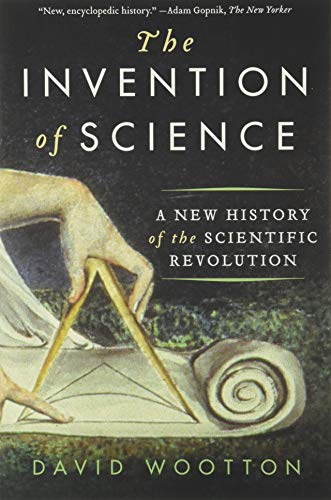
Inhaltsangabe
"Captures the excitement of the scientific revolution and makes a point of celebrating the advances it ushered in." —Financial Times
A companion to such acclaimed works as The Age of Wonder, A Clockwork Universe, and Darwin’s Ghosts—a groundbreaking examination of the greatest event in history, the Scientific Revolution, and how it came to change the way we understand ourselves and our world.
We live in a world transformed by scientific discovery. Yet today, science and its practitioners have come under political attack. In this fascinating history spanning continents and centuries, historian David Wootton offers a lively defense of science, revealing why the Scientific Revolution was truly the greatest event in our history.
The Invention of Science goes back five hundred years in time to chronicle this crucial transformation, exploring the factors that led to its birth and the people who made it happen. Wootton argues that the Scientific Revolution was actually five separate yet concurrent events that developed independently, but came to intersect and create a new worldview. Here are the brilliant iconoclasts—Galileo, Copernicus, Brahe, Newton, and many more curious minds from across Europe—whose studies of the natural world challenged centuries of religious orthodoxy and ingrained superstition.
From gunpowder technology, the discovery of the new world, movable type printing, perspective painting, and the telescope to the practice of conducting experiments, the laws of nature, and the concept of the fact, Wotton shows how these discoveries codified into a social construct and a system of knowledge. Ultimately, he makes clear the link between scientific discovery and the rise of industrialization—and the birth of the modern world we know.
Die Inhaltsangabe kann sich auf eine andere Ausgabe dieses Titels beziehen.
Über die Autorin bzw. den Autor
David Wootton is the Anniversary Professor at the University of York. His previous books include Paolo Sarpi, Bad Medicine, and Galileo. He gave the Raleigh Lectures at the British Academy in 2008, the Carlyle Lectures at the University of Oxford in 2014, and the Benedict Lecture at Boston University in 2014.
Von der hinteren Coverseite
Before 1492, all significant knowledge was believed to be already available; there was no concept of progress, as people looked to the past, not the future, for understanding. David Wootton argues that the discovery of America demonstrated new knowledge was possible: indeed, it introduced the very concept of discovery and opened the way to the invention of science.
The first crucial discovery was Tycho Brahe’s nova of 1572: proof that there could be change in the heavens. The invention of the telescope in 1608 rendered the old astronomy obsolete. Evangelista Torricelli’s experiment with the vacuum, in 1643 directly led to the triumph of the experimental method used in the Royal Society by Robert Boyle and Isaac Newton. By 1750, Newtonianism was being celebrated throughout Europe.
This innovative science relied on a new understanding of what knowledge may be, and with this came a fresh language: discovery, progress, fact, experiment, hypothesis, theory, and laws of nature. Although almost all these terms existed before 1492, their meanings were radically transformed, and they became tools to think scientifically. Now we all speak this language of science that was invented during the Scientific Revolution.
The new culture led to a new rationalism, repudiating alchemy, astrology, and the belief in witchcraft. It also led to the invention of the steam engine and to the first Industrial Revolution. Wootton’s landmark work changes our understanding of how this great transformation came about, and of what science is.
„Über diesen Titel“ kann sich auf eine andere Ausgabe dieses Titels beziehen.
Suchergebnisse für The Invention of Science: A New History of the Scientific...

Beispielbild für diese ISBN
The Invention of Science: A New History of the Scientific Revolution
Anbieter: World of Books (was SecondSale), Montgomery, IL, USA
Verkäuferbewertung 5 von 5 Sternen

Zustand: Good. Item in good condition. Textbooks may not include supplemental items i.e. CDs, access codes etc. Artikel-Nr. 00102264809
Gebraucht kaufen
EUR 6,92
Versand gratis
Versand innerhalb von USA
Versand innerhalb von USA
Anzahl: 2 verfügbar
Beispielbild für diese ISBN
The Invention of Science: A New History of the Scientific Revolution
Anbieter: ThriftBooks-Dallas, Dallas, TX, USA
Verkäuferbewertung 5 von 5 Sternen
Paperback. Zustand: Fair. No Jacket. Readable copy. Pages may have considerable notes/highlighting. ~ ThriftBooks: Read More, Spend Less. Artikel-Nr. G0061759538I5N00
Gebraucht kaufen
EUR 7,49
Versand gratis
Versand innerhalb von USA
Versand innerhalb von USA
Anzahl: 1 verfügbar
Beispielbild für diese ISBN
The Invention of Science: A New History of the Scientific Revolution
Anbieter: ThriftBooks-Dallas, Dallas, TX, USA
Verkäuferbewertung 5 von 5 Sternen
Paperback. Zustand: Good. No Jacket. Former library book; Pages can have notes/highlighting. Spine may show signs of wear. ~ ThriftBooks: Read More, Spend Less. Artikel-Nr. G0061759538I3N10
Gebraucht kaufen
EUR 7,49
Versand gratis
Versand innerhalb von USA
Versand innerhalb von USA
Anzahl: 1 verfügbar
Beispielbild für diese ISBN
The Invention of Science: A New History of the Scientific Revolution
Anbieter: Revaluation Books, Exeter, Vereinigtes Königreich
Verkäuferbewertung 5 von 5 Sternen
Paperback. Zustand: Brand New. reprint edition. 769 pages. 8.00x5.50x1.50 inches. In Stock. Artikel-Nr. x-0061759538
Neu kaufen
EUR 27,94
EUR 14,58 Versand
Versand von Vereinigtes Königreich nach USA
Versand von Vereinigtes Königreich nach USA
Anzahl: 2 verfügbar
Foto des Verkäufers
The Invention of Science: A New History of the Scientific Revolution
Anbieter: moluna, Greven, Deutschland
Verkäuferbewertung 5 von 5 Sternen
Zustand: New. Über den AutorrnrnDavid Wootton is the Anniversary Professor at the University of York. His previous books include Paolo Sarpi, Bad Medicine, and Galileo. He gave the Raleigh Lectures at the British Academy in . Artikel-Nr. 897354219
Neu kaufen
EUR 24,60
EUR 48,99 Versand
Versand von Deutschland nach USA
Versand von Deutschland nach USA
Anzahl: Mehr als 20 verfügbar
Foto des Verkäufers
The Invention of Science : A New History of the Scientific Revolution
Anbieter: AHA-BUCH GmbH, Einbeck, Deutschland
Verkäuferbewertung 5 von 5 Sternen
Taschenbuch. Zustand: Neu. Neuware - 'Captures the excitement of the scientific revolution and makes a point of celebrating the advances it ushered in.' Financial TimesA companion to such acclaimed works as The Age of Wonder, A Clockwork Universe, and Darwin's Ghostsa groundbreaking examination of the greatest event in history, the Scientific Revolution, and how it came to change the way we understand ourselves and our world.We live in a world transformed by scientific discovery. Yet today, science and its practitioners have come under political attack. In this fascinating history spanning continents and centuries, historian David Wootton offers a lively defense of science, revealing why the Scientific Revolution was truly the greatest event in our history.The Invention of Science goes back five hundred years in time to chronicle this crucial transformation, exploring the factors that led to its birth and the people who made it happen. Wootton argues that the Scientific Revolution was actually five separate yet concurrent events that developed independently, but came to intersect and create a new worldview. Here are the brilliant iconoclastsGalileo, Copernicus, Brahe, Newton, and many more curious minds from across Europewhose studies of the natural world challenged centuries of religious orthodoxy and ingrained superstition.From gunpowder technology, the discovery of the new world, movable type printing, perspective painting, and the telescope to the practice of conducting experiments, the laws of nature, and the concept of the fact, Wotton shows how these discoveries codified into a social construct and a system of knowledge. Ultimately, he makes clear the link between scientific discovery and the rise of industrializationand the birth of the modern world we know. Artikel-Nr. 9780061759536
Neu kaufen
EUR 29,00
EUR 62,98 Versand
Versand von Deutschland nach USA
Versand von Deutschland nach USA
Anzahl: 2 verfügbar