
Verwandte Artikel zu What Would Google Do?: Reverse Engineering Business...
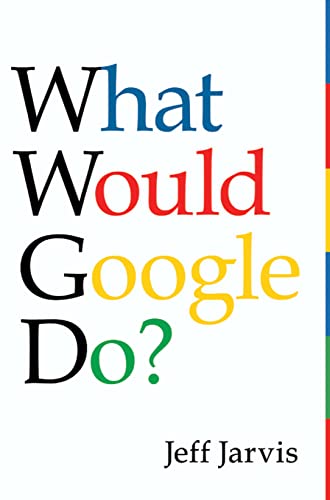
What Would Google Do?: Reverse Engineering Business Strategies for Survival and Success in the Internet Era - Hardcover
Inhaltsangabe
“Eye-opening, thought-provoking, and enlightening.”
—USA Today
“An indispensable guide to the business logic of the networked era.”
—Clay Shirky, author of Here Comes Everybody
“A stimulating exercise in thinking really, really big.”
—San Jose Mercury News
What Would Google Do? is an indispensable manual for survival and success in today’s internet-driven marketplace. By “reverse engineering the fastest growing company in the history of the world,” author Jeff Jarvis, proprietor of Buzzmachine.com, one of the Web’s most widely respected media blogs, offers indispensible strategies for solving the toughest new problems facing businesses today. With a new afterword from the author, What Would Google Do? is the business book that every leader or potential leader in every industry must read.
Die Inhaltsangabe kann sich auf eine andere Ausgabe dieses Titels beziehen.
Über die Autorin bzw. den Autor
Jeff Jarvis is the proprietor of one of the web’s most popular and respected blogs about media, Buzzmachine.com. He heads the Tow-Knight Center for Entrepreneurial Journalism at the City University of New York. He was named one of a hundred worldwide media leaders by the World Economic Forum at Davos in 2007–11 and was the creator and founding editor of Entertainment Weekly magazine. He is the author of the forthcoming book Public Parts: How Sharing in the Digital Age Improves the Way We Work and Live.
Von der hinteren Coverseite
A bold and vital book that asks and answers the most urgent question of today: What Would Google Do?
In a book that's one part prophecy, one part thought experiment, one part manifesto, and one part survival manual, internet impresario and blogging pioneer Jeff Jarvis reverse-engineers Google—the fastest-growing company in history—to discover forty clear and straightforward rules to manage and live by. At the same time, he illuminates the new worldview of the internet generation: how it challenges and destroys, but also opens up vast new opportunities. His findings are counterintuitive, imaginative, practical, and above all visionary, giving readers a glimpse of how everyone and everything—from corporations to governments, nations to individuals—must evolve in the Google era.
Along the way, he looks under the hood of a car designed by its drivers, ponders a worldwide university where the students design their curriculum, envisions an airline fueled by a social network, imagines the open-source restaurant, and examines a series of industries and institutions that will soon benefit from this book's central question.
The result is an astonishing, mind-opening book that, in the end, is not about Google. It's about you.
Auszug. © Genehmigter Nachdruck. Alle Rechte vorbehalten.
What Would Google Do?
By Jeff JarvisHarperCollins Publishers, Inc.
Copyright © 2009 Jeff JarvisAll right reserved.
ISBN: 9780061709715
Chapter One
WWGD?
It seems as if no company, executive, or institution truly understands how to survive and prosper in the internet age.
Except Google.
So, faced with most any challenge today, it makes sense to ask: WWGD? What would Google do?
In management, commerce, news, media, manufacturing, marketing, service industries, investing, politics, government, and even education and religion, answering that question is a key to navigating a world that has changed radically and forever.
That world is upside-down, inside-out, counterintuitive, and confusing. Who could have imagined that a free classified service could have had a profound and permanent effect on the entire newspaper industry, that kids with cameras and internet connections could gather larger audiences than cable networks could, that loners with keyboards could bring down politicians and companies, and that dropouts could build companies worth billions? They didn't do it by breaking rules. They operate by new rules of a new age, among them:
- Customers are now in charge. They can be heard around the globe and have an impact on huge institutions in an instant.
- People can find each other anywhere and coalesce around you—or against you.
- The mass market is dead, replaced by the mass of niches.
- "Markets are conversations," decreed The Cluetrain Manifesto, the seminal work of the internet age, in 2000. That means the key skill in any organization today is no longer marketing but conversing.
- We have shifted from an economy based on scarcity to one based on abundance. The control of products or distribution will no longer guarantee a premium and a profit.
- Enabling customers to collaborate with you—in creating, distributing, marketing, and supporting products—is what creates a premium in today's market.
- The most successful enterprises today are networks—which extract as little value as possible so they can grow as big as possible—and the platforms on which those networks are built.
- Owning pipelines, people, products, or even intellectual property is no longer the key to success. Openness is.
Google's founders and executives understand the change brought by the internet. That is why they are so successful and powerful, running what The Times of London dubbed "the fastest growing company in the history of the world." The same is true of a few disruptive capitalists and quasi-capitalists such as Mark Zuckerberg, founder of Facebook; Craig Newmark, who calls himself founder and customer service representative—no joke—at craigslist; Jimmy Wales, cofounder of Wikipedia; Jeff Bezos, founder of Amazon; and Kevin Rose, creator of Digg. They see a different world than the rest of us and make different decisions as a result, decisions that make no sense under old rules of old industries that are now blown apart thanks to these new ways and new thinkers.
That is why the smart response to all this change is to ask what these disrupters—what Mark, Craig, Jimmy, Jeff, Kevin, and, of course, Google—would do. Google generously shares its own philosophy on its web site, setting out the "10 things Google has found to be true." They are smart but obvious PowerPoint lines helpful in employee indoctrination (especially necessary when your headcount explodes by 50 percent in a year—to 16,000 at the end of 2007 and to 20,000 before the end of the following year): "Focus on the user and all else will follow," Google decrees. "It's best to do one thing really, really well. . . . Fast is better than slow. . . . You can make money without doing evil. . . . There's always more information out there. . . . The need for information crosses all borders.?.?.?." These are useful, but they don't tell the entire story. There's more to learn from watching Google.
The question I ask in the title is about thinking in new ways, facing new challenges, solving problems with new solutions, seeing new opportunities, and understanding a different way to look at the structure of the economy and society. I try to see the world as Google sees it, analyzing and deconstructing its success from a distance so we can apply what we learn to our own companies, institutions, and careers. Together, we will reverse-engineer Google. You can bring this same discipline to other competitors, companies, and leaders whose success you find puzzling but admirable. In fact, you must.
Google is our model for thinking in new ways because it is so singularly successful. Hitwise, which measures internet traffic, reported that Google had 71 percent share of searches in the United States and 87 percent in the United Kingdom in 2008. With its acquisition of ad-serving company DoubleClick in 2008, Google controlled 69 percent of online ad serving, according to Attributor, and 24 percent of online ad revenue, according to IDC. In the U.K., Google's ad revenue grew past the largest single commercial TV entity, ITV, in 2008, and it is next expected to surpass the revenue of all British national newspapers combined. It is still exploding: Google's traffic in 2007 was up 22.4 percent in a year. Google no longer says how many servers its runs—estimates run into the millions—and it has stopped saying how many pages it monitors, but when it started in 1998, it indexed 26 million pages; by 2000, it tracked one billion; and in mid-2008 it said it followed one trillion web addresses. In 2007 and again in 2008, says the Millward Brown BrandZ Top 100, Google was the number one brand in the world.
By contrast, Yahoo and AOL, each a former king of the online hill, are already has-beens. They operate under the old rules. They control content and distribution and think they can own customers, relationships, and attention. They create destinations and have the hubris to think customers should come to them. They spend a huge proportion of their revenue on marketing to get those people there and work hard to keep them there. Yahoo! is the last old-media company.
Google is the first post-media company. Unlike Yahoo, Google is not a portal. It is a network and a platform. Google thinks in distributed ways. It goes to the people. There are bits of Google spread all over the web. About a third of Google's revenue—expected to total $20 billion in 2008—is earned not at Google.com but at sites all over the internet. Here's how they do it: The Google AdSense box on the home page of my blog, Buzzmachine.com, makes me part of Google's empire. Google sends me money for those ads. Google sends me readers via search. Google benefits by showing those readers more of its ads, which it can make more relevant, effective, and profitable because it knows what my site is about. I invited Google in because Google helps me do what I want to do.
Continues...
Excerpted from What Would Google Do?by Jeff Jarvis Copyright © 2009 by Jeff Jarvis. Excerpted by permission.
All rights reserved. No part of this excerpt may be reproduced or reprinted without permission in writing from the publisher.
Excerpts are provided by Dial-A-Book Inc. solely for the personal use of visitors to this web site.
„Über diesen Titel“ kann sich auf eine andere Ausgabe dieses Titels beziehen.
Suchergebnisse für What Would Google Do?: Reverse Engineering Business...

Beispielbild für diese ISBN
What Would Google Do?: Reverse Engineering Business Strategies for Survival and Success in the Internet Era
Anbieter: World of Books (was SecondSale), Montgomery, IL, USA
Verkäuferbewertung 5 von 5 Sternen

Zustand: Very Good. Item in very good condition! Textbooks may not include supplemental items i.e. CDs, access codes etc. Artikel-Nr. 00073754871
Gebraucht kaufen
EUR 4,46
Versand gratis
Versand innerhalb von USA
Versand innerhalb von USA
Anzahl: 2 verfügbar
Beispielbild für diese ISBN
What Would Google Do?: Reverse Engineering Business Strategies for Survival and Success in the Internet Era
Anbieter: World of Books (was SecondSale), Montgomery, IL, USA
Verkäuferbewertung 5 von 5 Sternen
Zustand: Good. Item in good condition. Textbooks may not include supplemental items i.e. CDs, access codes etc. Artikel-Nr. 00020641599
Gebraucht kaufen
EUR 4,46
Versand gratis
Versand innerhalb von USA
Versand innerhalb von USA
Anzahl: 5 verfügbar
Beispielbild für diese ISBN
What Would Google Do?
Verlag:
Harper Business (edition First Edition first Printing), 2009
ISBN 10: 0061709719
ISBN 13: 9780061709715
Gebraucht
Hardcover
Anbieter: BooksRun, Philadelphia, PA, USA
Verkäuferbewertung 5 von 5 Sternen
Hardcover. Zustand: Fair. First Edition first Printing. The item might be beaten up but readable. May contain markings or highlighting, as well as stains, bent corners, or any other major defect, but the text is not obscured in any way. Artikel-Nr. 0061709719-7-1-13
Gebraucht kaufen
EUR 5,14
Versand gratis
Versand innerhalb von USA
Versand innerhalb von USA
Anzahl: 1 verfügbar
Beispielbild für diese ISBN
What Would Google Do?
Verlag:
Harper Business (edition First Edition first Printing), 2009
ISBN 10: 0061709719
ISBN 13: 9780061709715
Gebraucht
Hardcover
Anbieter: BooksRun, Philadelphia, PA, USA
Verkäuferbewertung 5 von 5 Sternen
Hardcover. Zustand: Very Good. First Edition first Printing. It's a well-cared-for item that has seen limited use. The item may show minor signs of wear. All the text is legible, with all pages included. It may have slight markings and/or highlighting. Artikel-Nr. 0061709719-11-1
Gebraucht kaufen
EUR 5,63
Versand gratis
Versand innerhalb von USA
Versand innerhalb von USA
Anzahl: 1 verfügbar
Beispielbild für diese ISBN
What Would Google Do?
Anbieter: ThriftBooks-Atlanta, AUSTELL, GA, USA
Verkäuferbewertung 5 von 5 Sternen
Hardcover. Zustand: As New. No Jacket. Pages are clean and are not marred by notes or folds of any kind. ~ ThriftBooks: Read More, Spend Less. Artikel-Nr. G0061709719I2N00
Gebraucht kaufen
EUR 6,08
Versand gratis
Versand innerhalb von USA
Versand innerhalb von USA
Anzahl: 1 verfügbar
Beispielbild für diese ISBN
What Would Google Do?
Anbieter: ThriftBooks-Dallas, Dallas, TX, USA
Verkäuferbewertung 5 von 5 Sternen
Hardcover. Zustand: As New. No Jacket. Pages are clean and are not marred by notes or folds of any kind. ~ ThriftBooks: Read More, Spend Less. Artikel-Nr. G0061709719I2N00
Gebraucht kaufen
EUR 6,08
Versand gratis
Versand innerhalb von USA
Versand innerhalb von USA
Anzahl: 1 verfügbar
Beispielbild für diese ISBN
What Would Google Do?
Anbieter: Wonder Book, Frederick, MD, USA
Verkäuferbewertung 5 von 5 Sternen
Zustand: Very Good. Very Good condition. Very Good dust jacket. A copy that may have a few cosmetic defects. May also contain light spine creasing or a few markings such as an owner's name, short gifter's inscription or light stamp. Artikel-Nr. H01D-01661
Gebraucht kaufen
EUR 6,35
Versand gratis
Versand innerhalb von USA
Versand innerhalb von USA
Anzahl: 3 verfügbar
Beispielbild für diese ISBN
What Would Google Do?
Anbieter: Wonder Book, Frederick, MD, USA
Verkäuferbewertung 5 von 5 Sternen
Zustand: As New. Like New condition. Like New dust jacket. A near perfect copy that may have very minor cosmetic defects. Artikel-Nr. L07B-02832
Gebraucht kaufen
EUR 6,35
Versand gratis
Versand innerhalb von USA
Versand innerhalb von USA
Anzahl: 1 verfügbar
Beispielbild für diese ISBN
What Would Google Do?
Verlag:
HarperCollins Publishers, 2009
ISBN 10: 0061709719
ISBN 13: 9780061709715
Gebraucht
Hardcover
Anbieter: Better World Books, Mishawaka, IN, USA
Verkäuferbewertung 5 von 5 Sternen
Zustand: Very Good. Pages intact with possible writing/highlighting. Binding strong with minor wear. Dust jackets/supplements may not be included. Stock photo provided. Product includes identifying sticker. Better World Books: Buy Books. Do Good. Artikel-Nr. GRP87229038
Gebraucht kaufen
EUR 6,49
Versand gratis
Versand innerhalb von USA
Versand innerhalb von USA
Anzahl: 1 verfügbar
Beispielbild für diese ISBN
What Would Google Do?
Verlag:
HarperCollins Publishers, 2009
ISBN 10: 0061709719
ISBN 13: 9780061709715
Gebraucht
Hardcover
Anbieter: Better World Books, Mishawaka, IN, USA
Verkäuferbewertung 5 von 5 Sternen
Zustand: Good. Pages intact with minimal writing/highlighting. The binding may be loose and creased. Dust jackets/supplements are not included. Stock photo provided. Product includes identifying sticker. Better World Books: Buy Books. Do Good. Artikel-Nr. 230852-6
Gebraucht kaufen
EUR 6,49
Versand gratis
Versand innerhalb von USA
Versand innerhalb von USA
Anzahl: 1 verfügbar