
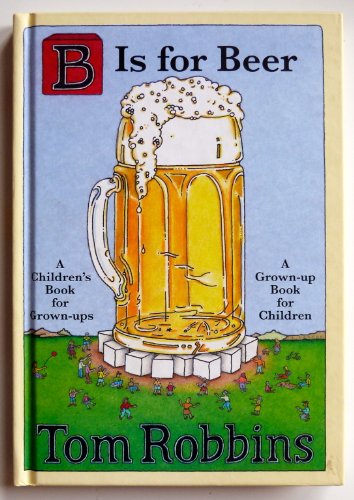
B Is for Beer: A Philosophical Investigation for Adults and Children into Reality and Beer - Hardcover
Inhaltsangabe
A Children's Book About Beer?
Yes, believe it or not—but B Is for Beer is also a book for adults, and bear in mind that it's the work of maverick bestselling novelist Tom Robbins, inter-nationally known for his ability to both seriously illuminate and comically entertain.
nce upon a time (right about now) there was a planet (how about this one?) whose inhabitants consumed thirty-six billion gallons of beer each year (it's a fact, you can Google it). Among those affected, each in his or her own way, by all the bubbles, burps, and foam, was a smart, wide-eyed, adventurous kindergartner named Gracie; her distracted mommy; her insensitive dad; her non-conformist uncle; and a magical, butt-kicking intruder from a world within our world.
Populated by the aforementioned characters—and as charming as it may be subversive—B Is for Beer involves readers, young and old, in a surprising, far-reaching investigation into the limits of reality, the transformative powers of children, and, of course, the ultimate meaning of a tall, cold brewski.
Die Inhaltsangabe kann sich auf eine andere Ausgabe dieses Titels beziehen.
Über die Autorin bzw. den Autor
Tom Robbins was born in North Carolina in 1932 and raised in Virginia. A graduate of Virginia Commonwealth University, he moved to Seattle to do graduate work at the University of Washington. His internationally bestselling works include Still Life With Woodpecker, Fierce Invalids Home From Hot Climates, Jitterbug Perfume, Skinny Legs and All, Half Asleep in Frog Pajamas, Villa Incognito, and B Is For Beer. Robbins lives with his wife, Alexa D'Avalon, and their dog, Blini Tomato Titanium, in Washington State.
Von der hinteren Coverseite
A Children's Book About Beer?
Yes, believe it or not—but B Is for Beer is also a book for adults, and bear in mind that it's the work of maverick bestselling novelist Tom Robbins, inter-nationally known for his ability to both seriously illuminate and comically entertain.
nce upon a time (right about now) there was a planet (how about this one?) whose inhabitants consumed thirty-six billion gallons of beer each year (it's a fact, you can Google it). Among those affected, each in his or her own way, by all the bubbles, burps, and foam, was a smart, wide-eyed, adventurous kindergartner named Gracie; her distracted mommy; her insensitive dad; her non-conformist uncle; and a magical, butt-kicking intruder from a world within our world.
Populated by the aforementioned characters—and as charming as it may be subversive—B Is for Beer involves readers, young and old, in a surprising, far-reaching investigation into the limits of reality, the transformative powers of children, and, of course, the ultimate meaning of a tall, cold brewski.
Auszug. © Genehmigter Nachdruck. Alle Rechte vorbehalten.
B Is for Beer
By Tom RobbinsHarperCollins Publishers, Inc.
Copyright © 2009 Tom RobbinsAll right reserved.
ISBN: 9780061687273
Chapter One
Daddy Beer Presents Daddy Time Football
Have you ever wondered why your daddy likes beer so much? Have you wondered, before you fall asleep at night, why he sometimes acts kind of "funny" after he's been drinking beer? Maybe you've even wondered where beer comes from, because you're pretty sure it isn't from a cow. Well, Gracie Perkel wondered those same things.
"Mommy," Gracie asked one afternoon, "what's that stuff Daddy drinks?" "You mean coffee, sweetie?"
"Not coffee. Ick! That other stuff that's yellow and looks like pee-pee."
"Gracie!"
"You say pee-pee."
"Well, when I'm talking about potty time I might. But I don't say it about somebody's beverage."
Gracie giggled. Her mother, who was busy loading clothes in the washer, suggested without looking up, "I believe, dear, you're talking about beer."
"Oh!" squealed Gracie. "That's right. Beer. That stuff that's always on TV." She deepened her voice. " 'Better tasting!' 'Less filling!' 'Better tasting!' 'Less filling!' " She giggled again. "Is it kinda like Pepsi for silly old men?"
Mrs. Perkel smiled, but it was such a weak, wimpy smile a kitten could have knocked it halfway to Milwaukee. She paused in her work to stare out of the laundry room window. The clouds themselves looked like a big pile of dirty laundry. That was not unusual because, you see, the Perkel family lived in Seattle.
Do you know about drizzle, that thin, soft rain that could be mistaken for a mean case of witch measles? Seattle is the world headquarters of drizzle, and in autumn it leaves a damp gray rash on everything, as though the city were a baby that had been left too long in a wet diaper and then rolled in newspaper. When there is also a biting wind, as there was this day, Seattle people sometimes feel like they're trapped in a bad Chinese restaurant; one of those drafty, cheaply lit places where the waiters are gruff, the noodles soggy, the walls a little too green, and although there's a mysterious poem inside every fortune cookie, tea is invariably spilt on your best sweater. Mrs. Perkel must have been feeling that way, for she sighed at the limp pork dumplings (or were they wadded Pampers?) in the sky and said to Gracie, "If you want to know about beer you should go ask your father."
Never mind that she was wearing fluffy fuzzy bunny slippers, Gracie still tiptoed into the den. Her daddy was watching football on their new flat plasma screen, and if the University of Washington was losing again, he'd be in a grumpy mood. Uh-oh. She overheard a naughty word. UW was losing. Gracie was relieved, however, when she noticed that Uncle Moe had dropped by to watch the game and, of course, to mooch a few beers from her dad.
Uncle Moe didn't take sports very seriously. He called himself a philosopher, if you know what that is. He'd graduated from about a dozen colleges, seldom ever seemed to work, and had traveled just about every place a person could go without getting his head chopped off. Mrs. Perkel said he was a "nut job," but Gracie liked him. It didn't bother her that he had a face like a sinkful of last night's dinner dishes or that his mustache resembled a dead sparrow.
Timidly, Gracie tapped Mr. Perkel on the elbow. Her voice was shy and squeaky when she asked, "Daddy, can I please taste your beer?"
"No way," her father snorted over his shoulder. His eyes never left the screen. "Beer's for grown-ups."
Gracie turned toward Uncle Moe, who grinned and beckoned her over, as she had suspected he might. Uncle Moe extended his can—and just like that, behind her daddy's back, little Gracie Perkel took her first sip of beer. "Ick!" She made a face. "It's bitter."
"The better to quench your thirst, my dear."
"What makes it bitter, Uncle Moe?"
"Well, it's made from hops."
Gracie made another face. "You mean them jumpy bugs that . . . ?
"No, pumpkin, beer isn't extracted from grasshoppers. Nor hop toads, either. A hop is some funky vegetable that even vegans won't eat. Farmers dry the flowers of this plant and call them 'hops.' I should mention that only the female hop plants are used in making beer, which may be why men are so attracted to it. It's a mating instinct."
"Moe!"
The uncle ignored Gracie's father. "In any event," he went on, "when brewers combine hops with yeast and grain and water, and allow the mixture to ferment—to rot—it magically produces an elixir so gassy with blue-collar cheer, so regal with glints of gold, so titillating with potential mischief, so triumphantly refreshing, that it seizes the soul and thrusts it toward that ethereal plateau where, to paraphrase Baudelaire, all human whimsies float and merge."
"Don't be talking that crap to her. She's five years old."
"Almost six," chimed Gracie.
"In Italy and France, a child Gracie's age could walk into an establishment, order a beer, and be served."
"Yeah, well those people are crazy."
"Perhaps so—but there's far fewer alcohol problems in their countries than in safe and sane America."
Mr. Perkel muttered something vague before focusing his frown on UW's latest boo-boo. Uncle Moe removed another beer from the cooler, holding it up for Gracie to admire. "Beer was invented by the ancient Egyptians," he said.
"The ones who made the mummies?"
"Exactly, although I don't believe there's any connection. At least I hope not. The point is, the Egyptians could have invented lemonade—but they chose to invent beer instead."
While Gracie thought this over, Uncle Moe pulled the metal tab on the top of his beer can. There was a snap, followed by a spritzy hiss and a small discharge of foam. Uncle Moe took a long drink, wiped foam from his tragic mustache, and said, "Speaking of inventions, did you know that the tin can was invented in 1811, but can openers weren't invented until 1855? It's a fact. During the forty-four years in between, hungry citizens had to access their pork 'n' beans with a hammer and chisel. They were pretty lucky, don't you think, that in those days beer didn't come in cans?"
Continues...
Excerpted from B Is for Beerby Tom Robbins Copyright © 2009 by Tom Robbins. Excerpted by permission.
All rights reserved. No part of this excerpt may be reproduced or reprinted without permission in writing from the publisher.
Excerpts are provided by Dial-A-Book Inc. solely for the personal use of visitors to this web site.
„Über diesen Titel“ kann sich auf eine andere Ausgabe dieses Titels beziehen.
Weitere beliebte Ausgaben desselben Titels

Suchergebnisse für B Is for Beer: A Philosophical Investigation for Adults...

Beispielbild für diese ISBN
B Is for Beer
Anbieter: World of Books (was SecondSale), Montgomery, IL, USA
Verkäuferbewertung 5 von 5 Sternen

Zustand: Very Good. Item in very good condition! Textbooks may not include supplemental items i.e. CDs, access codes etc. Artikel-Nr. 00102241076
Gebraucht kaufen
EUR 3,56
Versand gratis
Versand innerhalb von USA
Versand innerhalb von USA
Anzahl: 1 verfügbar
Beispielbild für diese ISBN
B Is for Beer
Anbieter: World of Books (was SecondSale), Montgomery, IL, USA
Verkäuferbewertung 5 von 5 Sternen
Zustand: Good. Item in good condition. Textbooks may not include supplemental items i.e. CDs, access codes etc. Artikel-Nr. 00095019162
Gebraucht kaufen
EUR 3,56
Versand gratis
Versand innerhalb von USA
Versand innerhalb von USA
Anzahl: 16 verfügbar
Beispielbild für diese ISBN
B Is for Beer
Anbieter: World of Books (was SecondSale), Montgomery, IL, USA
Verkäuferbewertung 5 von 5 Sternen
Zustand: Acceptable. Item in acceptable condition! Textbooks may not include supplemental items i.e. CDs, access codes etc. Artikel-Nr. 00098558141
Gebraucht kaufen
EUR 3,56
Versand gratis
Versand innerhalb von USA
Versand innerhalb von USA
Anzahl: 1 verfügbar
Foto des Verkäufers
B Is for Beer: A Philosophical Investigation for Adults and Children into Reality and Beer
Anbieter: Dream Books Co., Denver, CO, USA
Verkäuferbewertung 5 von 5 Sternen
Zustand: very_good. Pages are clean with no markings. May show minor signs of wear or cosmetic defects marks, cuts, bends, or scuffs on the cover, spine, pages, or dust jacket. May have remainder marks on edges. Artikel-Nr. DBV.0061687278.VG
Gebraucht kaufen
EUR 4,19
Versand gratis
Versand innerhalb von USA
Versand innerhalb von USA
Anzahl: 1 verfügbar
Beispielbild für diese ISBN
B Is for Beer
Anbieter: ThriftBooks-Dallas, Dallas, TX, USA
Verkäuferbewertung 5 von 5 Sternen
Hardcover. Zustand: Good. No Jacket. Former library book; Missing dust jacket; Pages can have notes/highlighting. Spine may show signs of wear. ~ ThriftBooks: Read More, Spend Less. Artikel-Nr. G0061687278I3N11
Gebraucht kaufen
EUR 5,64
Versand gratis
Versand innerhalb von USA
Versand innerhalb von USA
Anzahl: 1 verfügbar
Beispielbild für diese ISBN
B Is for Beer
Anbieter: ThriftBooks-Phoenix, Phoenix, AZ, USA
Verkäuferbewertung 5 von 5 Sternen
Hardcover. Zustand: Very Good. No Jacket. May have limited writing in cover pages. Pages are unmarked. ~ ThriftBooks: Read More, Spend Less. Artikel-Nr. G0061687278I4N00
Gebraucht kaufen
EUR 5,64
Versand gratis
Versand innerhalb von USA
Versand innerhalb von USA
Anzahl: 6 verfügbar
Beispielbild für diese ISBN
B Is for Beer
Anbieter: ThriftBooks-Dallas, Dallas, TX, USA
Verkäuferbewertung 5 von 5 Sternen
Hardcover. Zustand: Fair. No Jacket. Former library book; Readable copy. Pages may have considerable notes/highlighting. ~ ThriftBooks: Read More, Spend Less. Artikel-Nr. G0061687278I5N10
Gebraucht kaufen
EUR 5,64
Versand gratis
Versand innerhalb von USA
Versand innerhalb von USA
Anzahl: 2 verfügbar
Beispielbild für diese ISBN
B Is for Beer
Anbieter: ThriftBooks-Atlanta, AUSTELL, GA, USA
Verkäuferbewertung 5 von 5 Sternen
Hardcover. Zustand: Very Good. No Jacket. Missing dust jacket; May have limited writing in cover pages. Pages are unmarked. ~ ThriftBooks: Read More, Spend Less. Artikel-Nr. G0061687278I4N01
Gebraucht kaufen
EUR 5,64
Versand gratis
Versand innerhalb von USA
Versand innerhalb von USA
Anzahl: 2 verfügbar
Beispielbild für diese ISBN
B Is for Beer
Anbieter: ThriftBooks-Dallas, Dallas, TX, USA
Verkäuferbewertung 5 von 5 Sternen
Hardcover. Zustand: Good. No Jacket. Former library book; Pages can have notes/highlighting. Spine may show signs of wear. ~ ThriftBooks: Read More, Spend Less. Artikel-Nr. G0061687278I3N10
Gebraucht kaufen
EUR 5,64
Versand gratis
Versand innerhalb von USA
Versand innerhalb von USA
Anzahl: 1 verfügbar
Beispielbild für diese ISBN
B Is for Beer
Anbieter: ThriftBooks-Reno, Reno, NV, USA
Verkäuferbewertung 5 von 5 Sternen
Hardcover. Zustand: Very Good. No Jacket. May have limited writing in cover pages. Pages are unmarked. ~ ThriftBooks: Read More, Spend Less. Artikel-Nr. G0061687278I4N00
Gebraucht kaufen
EUR 5,64
Versand gratis
Versand innerhalb von USA
Versand innerhalb von USA
Anzahl: 6 verfügbar