
Verwandte Artikel zu The Secret of the Great Pyramid: How One Man's...
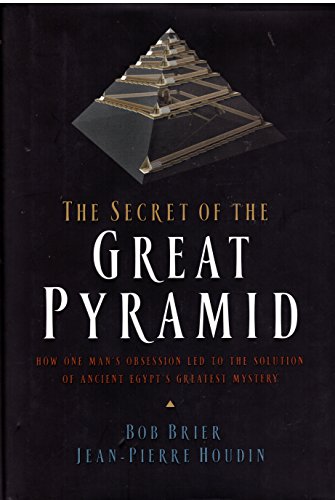
The Secret of the Great Pyramid: How One Man's Obsession Led to the Solution of Ancient Egypt's Greatest Mystery - Hardcover
Inhaltsangabe
The Secret of the Great Pyramid is a thrilling intellectual adventure story about the most exciting discovery in Egyptology in decades. Bob Brier, along with French architect Jean-Pierre Houdin, tells the remarkable true story of Houdin’s obsession with Egypt’s Great Pyramid, one of the Seven Wonders of the World: how, in an ancient agrarian society not long removed from the Stone Age, such a remarkable structure could have been envisioned and constructed. At once the story of Houdin’s determined search for answers to the puzzle that have eluded scientist and Egyptologists for centuries and a fascinating history of the planning and building of the magnificent edifice, The Secret of the Great Pyramid is an extraordinary work that puts the mystery to rest, once and for all.
Die Inhaltsangabe kann sich auf eine andere Ausgabe dieses Titels beziehen.
Über die Autorinnen und Autoren
Bob Brier is a world-famous Egyptologist who has conducted research on pyramids and tombs in fifteen countries. A senior research fellow at the C.W. Post campus of Long Island University, he is the author of seven books, including The Murder of Tutankhamen, and hosted the Great Egyptian series for the Learning Channel.
Jean-Pierre Houdin left his Parisian architecture firm in 1999 to devote himself to solving the mystery of the Great Pyramid. He has been awarded the Montgolfier Prize for his research.
Von der hinteren Coverseite
Nine years ago, French architect Jean-Pierre Houdin became obsessed by the centuries-old mystery of how the Great Pyramid was built. For ten hours a day, he labored at his computer to create exquisitely detailed 3-D models of the interior of the Great Pyramid. After five years of effort, the images rotating on his computer screen provided evidence of an astonishing secret. Corkscrewing up the inside of the Great Pyramid is a mile-long ramp, unseen for 4,500 years. The pyramid was built from the inside. This revelation casts a fresh light on the minds that conceived one of the wonders of the ancient world.
The Secret of the Great Pyramid moves between the ancient and the modern. The ancient story chronicles, step-by-step, how a nation of farmers only recently emerged from the Stone Age could construct one of the Seven Wonders of the Ancient World. To execute something as complex and massive as the Great Pyramid, Egypt needed architects, mathematicians, boat builders, stone masons, and metallurgists. It took twenty years to build the Great Pyramid. By the time its capstone was laid in 2560 B.C., the innovations born of the building quest had transformed agrarian Egypt into the world's most modern, most powerful nation.
As we follow the progress of Hemienu, the innovative architect who planned, organized, and oversaw construction of the Great Pyramid, we also follow Houdin working to discover how and why the ancient architect designed the Pyramid as he did. Houdin works as a forensic architect, aiming to reconstruct the lessons Hemienu had learned from construction of three previous pyramids and to visualize his blueprint for the massive stone building. In the process, Houdin also discovers the answers to other questions that have bedeviled Egyptologists for centuries: such as what was the purpose of the mysterious Grand Gallery and when did the Pyramid crack? Along the way, Houdin receives the support of a pathbreaking French software company, which helps him validate his theory virtually—a first in archaeology!
The story of genius and obsession in the ancient and modern world, this archaeological mystery will appeal to anyone who has ever been captivated by this magnificent edifice.
Auszug. © Genehmigter Nachdruck. Alle Rechte vorbehalten.
The Secret of the Great Pyramid
How One Man's Obsession Led to the Solution of Ancient Egypt's Greatest MysteryBy Bob BrierHarperCollins Publishers, Inc.
Copyright © 2008 Bob BrierAll right reserved.
ISBN: 9780061655524
Chapter One
The Man in Black
Almost all Egyptologists receive mail from strangers. Sometimes it is from reincarnated pharaohs; sometimes it is from prospective tourists who want to know if they can drink the water. (You can't.) Because my specialty is mummies, I receive hundreds of letters and e-mails from sixth graders who have been studying Egypt in school and want to mummify their recently deceased parakeets. About twice a year I receive offers from people who want to donate their bodies for mummification when they die. To these good folks I reply that I did that once, as a research project, and have now moved on.
No matter what our Egyptological specialty, we all receive communications from retired engineers with theories of how the pyramids were built. Usually there is an obvious flaw that even I can spot. On June 16, 2003 I received an e-mail from a French architect, Jean-Pierre Houdin, who had his own theory of how the Great Pyramid of Giza had been built. My friend Jack Josephson, an art historian who also has a degree in engineering, had suggested he contact me. Jack is a no-nonsense type of guy; I knew that if he told Houdin to contact me, it would be worthwhile to meet him. So I invited Jean-Pierre for dinner. Also coming was my friend Armand, an engineer who had been to Egypt, and his wife, as well as another friend, Jack Scaparro, who was working on a novel set in Egypt. My Egyptologist wife, Pat, rounded out a receptive audience of five.
Jean-Pierre arrived at precisely 4:00 P.M., as suggested. We wanted time to hear and discuss his theory before dinner at seven, but would soon discover that three hours was not nearly enough time. This was not your ordinary pyramid theory. Our guest was dressed all in black, including a fashionable black leather jacket—in New York in June. A well-manicured gray-haired man of fifty, he had a pleasant smile and spoke heavily accented but good English. We were soon gathered around the coffee table as Jean-Pierre set up his laptop. He explained that he had given up his architectural practice five years ago so he could devote himself to the puzzle of how the Great Pyramid was built. Working out of his Paris apartment, he spent six or seven hours a day creating elaborate 3-D computer simulations of the interior and exterior of the Great Pyramid. As his computer models progressed he became more and more obsessed with the Pyramid, until it was all he thought about.
Jean-Pierre's interest in the Great Pyramid began in 1999 when his father, an engineer, watched a television documentary on the pyramids and realized the program's presentation of how the Great Pyramid was built was all wrong. He had another idea of how the huge blocks were raised to the top, a revolutionary idea, different from anything anyone had ever proposed, so he called his son Jean-Pierre and laid it out.
The father-son team was ideal to tackle this mystery. Henri Houdin had earned a PhD in engineering from Paris's prestigious École des Arts et Métiers. In 1950, as a twenty-seven-year-old engineer, he was sent to Ivory Coast to build their infrastructure. When he arrived there were eight kilometers of paved roads; when he left there were highways, bridges, and power plants. For decades Jean-Pierre had designed houses and office buildings; he knew about planning big projects. The two were equipped to answer the question how the Great Pyramid was built, but it would not be easy. Eventually the search for the answer would take over both their lives.
While his laptop booted up, Jean-Pierre explained how his computer graphics helped him understand the interior and exterior of the Great Pyramid. With new, sophisticated software developed for architects, he created 3-D images of the chambers inside the Great Pyramid. Then, on his computer screen, he could rotate the images to see the spatial relationships between the rooms—what features were on the same level, what parts had to have been built first, where the largest stones in the Pyramid were placed.
As he clicked the keypad, beautiful diagrams of the Pyramid appeared and we realized we were in the presence of a man who knew the Great Pyramid intimately. He explained why some blocks in the Pyramid were limestone and others granite; why the patterns of stone in some walls were different from others. I have friends who are pyramid experts, but I had never heard anything from them as detailed as Jean-Pierre's explanation. I was astounded by the quality of his graphics. Little figures hauled blocks up inclined ramps and put them in place with ingenious lifting devices. He even had topographical maps of the Giza Plateau to show how the architects of the Great Pyramid took advantage of the natural contours of the land to move huge blocks of stone. The images weren't just informative, they were beautiful. I had just completed a high-budget documentary for The Learning Channel on pyramids around the world. We'd spent thousands and thousands of dollars on our graphics, and Jean-Pierre's were better!
Jean-Pierre explained the difficulties with the two competing theories of how the blocks in the Pyramid were raised to the top. The single ramp theory, so often shown in television documentaries, could be easily discredited. The basic idea is that blocks were hauled up a long ramp constructed against one of the sides of the Pyramid. As the Pyramid grew, the ramp was raised and extended. The problem is that to keep the slope gentle enough so men could haul blocks, the ramp would have to be a mile long. If the Pyramid were being built on the site of New York's Empire State Building, the ramp would extend all the way into Central Park, about twenty-five city blocks. Building just the ramp would have taken thousands of men decades. Also, there would have been a tremendous amount of debris from such a ramp, and rubble doesn't just disintegrate in the desert; but huge piles of rubble have never been found. Perhaps most damaging to the single ramp theory is the fact that there is practically no place to put such a long ramp on the Giza Plateau.
Continues...
Excerpted from The Secret of the Great Pyramidby Bob Brier Copyright © 2008 by Bob Brier. Excerpted by permission.
All rights reserved. No part of this excerpt may be reproduced or reprinted without permission in writing from the publisher.
Excerpts are provided by Dial-A-Book Inc. solely for the personal use of visitors to this web site.
„Über diesen Titel“ kann sich auf eine andere Ausgabe dieses Titels beziehen.
Suchergebnisse für The Secret of the Great Pyramid: How One Man's...

Beispielbild für diese ISBN
The Secret of the Great Pyramid: How One Man's Obsession Led to the Solution of Ancient Egypt's Greatest Mystery
Verlag:
HarperCollins Publishers Inc, 2008
ISBN 10: 006165552X
ISBN 13: 9780061655524
Gebraucht
Hardcover
Anbieter: World of Books (was SecondSale), Montgomery, IL, USA
Verkäuferbewertung 5 von 5 Sternen

Hardback. Zustand: Good. The Secret of the Great Pyramid is a thrilling intellectual adventure story about the most exciting discovery in Egyptology in decades. Bob Brier, along with French architect Jean-Pierre Houdin, tells the remarkable true story of Houdin's obsession with Egypt's Great Pyramid, one of the Seven Wonders of the World: how, in an ancient agrarian society not long removed from the Stone Age, such a remarkable structure could have been envisioned and constructed. At once the story of Houdin's determined search for answers to the puzzle that have eluded scientist and Egyptologists for centuries and a fascinating history of the planning and building of the magnificent edifice, The Secret of the Great Pyramid is an extraordinary work that puts the mystery to rest, once and for all. Artikel-Nr. 00110932359
Gebraucht kaufen
EUR 5,51
Versand gratis
Versand innerhalb von USA
Versand innerhalb von USA
Anzahl: 1 verfügbar
Beispielbild für diese ISBN
The Secret of the Great Pyramid: How One Man's Obsession Led to the Solution of Ancient Egypt's Greatest Mystery
Anbieter: ThriftBooks-Dallas, Dallas, TX, USA
Verkäuferbewertung 5 von 5 Sternen
Hardcover. Zustand: Good. No Jacket. Former library book; Pages can have notes/highlighting. Spine may show signs of wear. ~ ThriftBooks: Read More, Spend Less. Artikel-Nr. G006165552XI3N10
Gebraucht kaufen
EUR 6,10
Versand gratis
Versand innerhalb von USA
Versand innerhalb von USA
Anzahl: 1 verfügbar
Beispielbild für diese ISBN
The Secret of the Great Pyramid: How One Man's Obsession Led to the Solution of Ancient Egypt's Greatest Mystery
Anbieter: ThriftBooks-Reno, Reno, NV, USA
Verkäuferbewertung 5 von 5 Sternen
Hardcover. Zustand: Good. No Jacket. Former library book; Pages can have notes/highlighting. Spine may show signs of wear. ~ ThriftBooks: Read More, Spend Less. Artikel-Nr. G006165552XI3N10
Gebraucht kaufen
EUR 6,10
Versand gratis
Versand innerhalb von USA
Versand innerhalb von USA
Anzahl: 1 verfügbar
Beispielbild für diese ISBN
The Secret of the Great Pyramid: How One Man's Obsession Led to the Solution of Ancient Egypt's Greatest Mystery
Anbieter: ThriftBooks-Atlanta, AUSTELL, GA, USA
Verkäuferbewertung 5 von 5 Sternen
Hardcover. Zustand: Very Good. No Jacket. May have limited writing in cover pages. Pages are unmarked. ~ ThriftBooks: Read More, Spend Less. Artikel-Nr. G006165552XI4N00
Gebraucht kaufen
EUR 6,10
Versand gratis
Versand innerhalb von USA
Versand innerhalb von USA
Anzahl: 1 verfügbar
Beispielbild für diese ISBN
The Secret of the Great Pyramid: How One Man's Obsession Led to the Solution of Ancient Egypt's Greatest Mystery
Anbieter: ThriftBooks-Dallas, Dallas, TX, USA
Verkäuferbewertung 5 von 5 Sternen
Hardcover. Zustand: Very Good. No Jacket. May have limited writing in cover pages. Pages are unmarked. ~ ThriftBooks: Read More, Spend Less. Artikel-Nr. G006165552XI4N00
Gebraucht kaufen
EUR 6,10
Versand gratis
Versand innerhalb von USA
Versand innerhalb von USA
Anzahl: 1 verfügbar
Beispielbild für diese ISBN
The Secret of the Great Pyramid: How One Man's Obsession Led to the Solution of Ancient Egypt's Greatest Mystery
Anbieter: ThriftBooks-Reno, Reno, NV, USA
Verkäuferbewertung 5 von 5 Sternen
Hardcover. Zustand: Good. No Jacket. Pages can have notes/highlighting. Spine may show signs of wear. ~ ThriftBooks: Read More, Spend Less. Artikel-Nr. G006165552XI3N00
Gebraucht kaufen
EUR 6,10
Versand gratis
Versand innerhalb von USA
Versand innerhalb von USA
Anzahl: 1 verfügbar
Beispielbild für diese ISBN
The Secret of the Great Pyramid: How One Man's Obsession Led to the Solution of Ancient Egypt's Greatest Mystery
Anbieter: ThriftBooks-Atlanta, AUSTELL, GA, USA
Verkäuferbewertung 5 von 5 Sternen
Hardcover. Zustand: Fair. No Jacket. Former library book; Readable copy. Pages may have considerable notes/highlighting. ~ ThriftBooks: Read More, Spend Less. Artikel-Nr. G006165552XI5N10
Gebraucht kaufen
EUR 6,10
Versand gratis
Versand innerhalb von USA
Versand innerhalb von USA
Anzahl: 1 verfügbar
Beispielbild für diese ISBN
The Secret of the Great Pyramid: How One Man's Obsession Led to the Solution of Ancient Egypt's Greatest Mystery
Anbieter: ThriftBooks-Atlanta, AUSTELL, GA, USA
Verkäuferbewertung 5 von 5 Sternen
Hardcover. Zustand: Very Good. No Jacket. Former library book; May have limited writing in cover pages. Pages are unmarked. ~ ThriftBooks: Read More, Spend Less. Artikel-Nr. G006165552XI4N10
Gebraucht kaufen
EUR 6,10
Versand gratis
Versand innerhalb von USA
Versand innerhalb von USA
Anzahl: 1 verfügbar
Beispielbild für diese ISBN
The Secret of the Great Pyramid: How One Man's Obsession Led to the Solution of Ancient Egypt's Greatest Mystery
Anbieter: ThriftBooks-Dallas, Dallas, TX, USA
Verkäuferbewertung 5 von 5 Sternen
Hardcover. Zustand: Good. No Jacket. Pages can have notes/highlighting. Spine may show signs of wear. ~ ThriftBooks: Read More, Spend Less. Artikel-Nr. G006165552XI3N00
Gebraucht kaufen
EUR 6,10
Versand gratis
Versand innerhalb von USA
Versand innerhalb von USA
Anzahl: 1 verfügbar
Beispielbild für diese ISBN
The Secret of the Great Pyramid: How One Man's Obsession Led to the Solution of Ancient Egypt's Greatest Mystery
Anbieter: ThriftBooks-Reno, Reno, NV, USA
Verkäuferbewertung 5 von 5 Sternen
Hardcover. Zustand: Very Good. No Jacket. Former library book; May have limited writing in cover pages. Pages are unmarked. ~ ThriftBooks: Read More, Spend Less. Artikel-Nr. G006165552XI4N10
Gebraucht kaufen
EUR 6,10
Versand gratis
Versand innerhalb von USA
Versand innerhalb von USA
Anzahl: 1 verfügbar