
Verwandte Artikel zu American Eden: From Monticello to Central Park to Our...
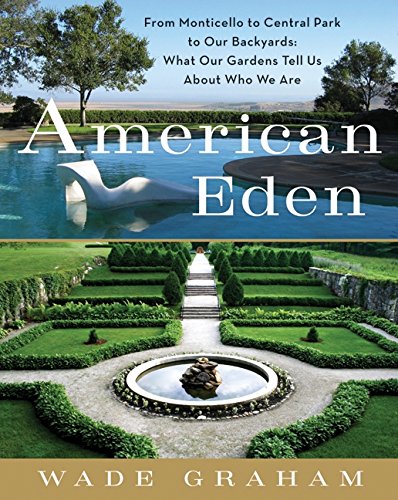
American Eden: From Monticello to Central Park to Our Backyards: What Our Gardens Tell Us About Who We Are - Hardcover
Inhaltsangabe
“American Eden moves luminously through landscapes of history, literature, biography, and design theory. . . . fusing sharp-edged analysis and graceful American prose.” —Kevin Starr, author of Golden Gate: The Life and Times of America's Greatest Bridge
“Informative and absolutely engrossing.” —Ross King, author of Brunelleschi's Dome
Garden designer and historian Wade Graham offers a unique vision of the story of America in this riveting exploration of the nation’s gardens and the visionaries behind them, from Thomas Thomas Jefferson’s Monticello to Michelle Obama’s vegetable garden, Fredrick Law Olmsted’s expansive Central Park to Martha Stewart’s how-to landscaping guides. In the tradition of Mark Kurlansky, Simon Schama, and Michael Pollan, Graham delivers a sweeping social history that examines our nation’s history from an overlooked vantage point, illuminating anew the living drama of American self-creation.
Die Inhaltsangabe kann sich auf eine andere Ausgabe dieses Titels beziehen.
Über die Autorin bzw. den Autor
Wade Graham is a Los Angeles–based garden designer, historian, and writer whose work on the environment, landscape, urbanism, and the arts has appeared in the New Yorker, Harper’s, the Los Angeles Times, Outside, and other publications. An adjunct professor of public policy at Pepperdine University, he is the author of American Eden: From Monticello to Central Park to Our Backyards: What Our Gardens Tell Us About Who We Are.
Von der hinteren Coverseite
The story of our nation and ourselves—as told through our country's most significant gardens and their creators
From Frederick Law Olmsted to Richard Neutra, Michelle Obama to our neighbors, Americans throughout history have revealed something of themselves—their personalities, desires, and beliefs—in the gardens they create. Rooted in the time and place of their making, as much as in the minds and identities of their makers, gardens mirror the struggles and energies of a changing society. Melding biography, history, and cultural commentary in a one-of-a-kind narrative, American Eden presents a dynamic, sweeping look at this country's landscapes and the visionaries behind them.
Monticello's gardens helped Jefferson reconcile his conflicted feelings about slavery—and take his mind off his increasing debt. Edith Wharton's gardens made her feel more European and superior to her wealthy but insufficiently sophisticated countrymen. Martha Stewart's how-to instructions helped bring Americans back into their gardens, while at the same time stoking and exploiting our anxieties about social class. Isamu Noguchi's and Robert Smithson's experiments reinvigorated the age-old exchange between art and the garden.
American Eden offers an inclusive definition of the garden, considering intentional landscapes that range from domestic kitchen gardens to city parks and national parks, suburban backyards and golf courses, public plazas and Manhattan's High Line park, reclaimed from freight train tracks. And it exposes the overlap between garden-making and painting, literature, and especially architecture—the garden's inseparable sibling—to reveal the deep interconnections between the arts and their most inspired practitioners.
Moving deftly through time and place across America's diverse landscapes—from Revolutionary-era Virginia to turn-of-the-century Chicago to 1960s suburban California—and featuring a diverse cast of landscape-makers—whether artists, architects, or housewives, amateurs or professionals, robber barons, politicians, reformers, or dreamers—Wade Graham vividly unfolds the larger cultural history through more personal dramas.
Beautifully illustrated with color and black-and-white images, American Eden is at once a different kind of garden book and a different kind of American history, one that offers a compelling, untold story—a saga that mirrors and illuminates our nation's invention, and constant reinvention, of itself.
„Über diesen Titel“ kann sich auf eine andere Ausgabe dieses Titels beziehen.
Suchergebnisse für American Eden: From Monticello to Central Park to Our...

Beispielbild für diese ISBN
American Eden: From Monticello
Anbieter: World of Books (was SecondSale), Montgomery, IL, USA
Verkäuferbewertung 5 von 5 Sternen

Zustand: Very Good. Item in very good condition! Textbooks may not include supplemental items i.e. CDs, access codes etc. Artikel-Nr. 00101931541
Gebraucht kaufen
EUR 4,54
Versand gratis
Versand innerhalb von USA
Versand innerhalb von USA
Anzahl: 2 verfügbar
Beispielbild für diese ISBN
American Eden: From Monticello to Central Park to Our Backyards: What Our Gardens Tell Us about Who We Are
Anbieter: ThriftBooks-Atlanta, AUSTELL, GA, USA
Verkäuferbewertung 5 von 5 Sternen
Hardcover. Zustand: Very Good. No Jacket. May have limited writing in cover pages. Pages are unmarked. ~ ThriftBooks: Read More, Spend Less. Artikel-Nr. G0061583421I4N00
Gebraucht kaufen
EUR 6,05
Versand gratis
Versand innerhalb von USA
Versand innerhalb von USA
Anzahl: 1 verfügbar
Beispielbild für diese ISBN
American Eden: From Monticello to Central Park to Our Backyards: What Our Gardens Tell Us about Who We Are
Anbieter: ThriftBooks-Atlanta, AUSTELL, GA, USA
Verkäuferbewertung 5 von 5 Sternen
Hardcover. Zustand: Very Good. No Jacket. Former library book; May have limited writing in cover pages. Pages are unmarked. ~ ThriftBooks: Read More, Spend Less. Artikel-Nr. G0061583421I4N10
Gebraucht kaufen
EUR 6,05
Versand gratis
Versand innerhalb von USA
Versand innerhalb von USA
Anzahl: 1 verfügbar
Beispielbild für diese ISBN
American Eden: From Monticello to Central Park to Our Backyards: What Our Gardens Tell Us About Who We Are
Verlag:
Harper (edition First Edition), 2011
ISBN 10: 0061583421
ISBN 13: 9780061583421
Gebraucht
Hardcover
Erstausgabe
Anbieter: BooksRun, Philadelphia, PA, USA
Verkäuferbewertung 5 von 5 Sternen
Hardcover. Zustand: Very Good. First Edition. With dust jacket. It's a well-cared-for item that has seen limited use. The item may show minor signs of wear. All the text is legible, with all pages included. It may have slight markings and/or highlighting. Artikel-Nr. 0061583421-11-1-29
Gebraucht kaufen
EUR 6,81
Versand gratis
Versand innerhalb von USA
Versand innerhalb von USA
Anzahl: 1 verfügbar
Beispielbild für diese ISBN
American Eden : From Monticello to Central Park to Our Backyards: What Our Gardens Tell Us about Who We Are
Verlag:
HarperCollins Publishers, 2011
ISBN 10: 0061583421
ISBN 13: 9780061583421
Gebraucht
Hardcover
Erstausgabe
Anbieter: Better World Books, Mishawaka, IN, USA
Verkäuferbewertung 5 von 5 Sternen
Zustand: Good. First Edition. Former library copy. Pages intact with minimal writing/highlighting. The binding may be loose and creased. Dust jackets/supplements are not included. Includes library markings. Stock photo provided. Product includes identifying sticker. Better World Books: Buy Books. Do Good. Artikel-Nr. 2193183-75
Gebraucht kaufen
EUR 6,81
Versand gratis
Versand innerhalb von USA
Versand innerhalb von USA
Anzahl: 3 verfügbar
Beispielbild für diese ISBN
American Eden: From Monticello to Central Park to Our Backyards: What Our Gardens Tell Us About Who We Are
Anbieter: Wonder Book, Frederick, MD, USA
Verkäuferbewertung 5 von 5 Sternen
Zustand: Good. Good condition. Good dust jacket. A copy that has been read but remains intact. May contain markings such as bookplates, stamps, limited notes and highlighting, or a few light stains. Artikel-Nr. Q18G-01976
Gebraucht kaufen
EUR 7,79
Versand gratis
Versand innerhalb von USA
Versand innerhalb von USA
Anzahl: 1 verfügbar
Beispielbild für diese ISBN
American Eden: From Monticello to Central Park to Our Backyards: What Our Gardens Tell Us About Who We Are
Anbieter: Wonder Book, Frederick, MD, USA
Verkäuferbewertung 5 von 5 Sternen
Zustand: Very Good. Very Good condition. Very Good dust jacket. A copy that may have a few cosmetic defects. May also contain light spine creasing or a few markings such as an owner's name, short gifter's inscription or light stamp. Artikel-Nr. L12D-03490
Gebraucht kaufen
EUR 7,79
Versand gratis
Versand innerhalb von USA
Versand innerhalb von USA
Anzahl: 1 verfügbar
Beispielbild für diese ISBN
American Eden: From Monticello to Central Park to Our Backyards - What Our Gardens Tell Us About Who We Are
Verlag:
Harper, New York, 2011
ISBN 10: 0061583421
ISBN 13: 9780061583421
Gebraucht
Hardcover
Erstausgabe
Anbieter: Abacus Bookshop, Pittsford, NY, USA
Verkäuferbewertung 5 von 5 Sternen
hardcover. Zustand: Fine copy in fine dust jacket. Well-illustrated (illustrator). 1st. Tall 8vo, 459 pp. Artikel-Nr. 093435
Gebraucht kaufen
EUR 13,73
EUR 3,55 Versand
Versand innerhalb von USA
Versand innerhalb von USA
Anzahl: 1 verfügbar
Beispielbild für diese ISBN
American Eden: From Monticello to Central Park to Our Backyards: What Our Gardens Tell Us About Who We Are
Anbieter: Sell Books, Elland, YORKS, Vereinigtes Königreich
Verkäuferbewertung 5 von 5 Sternen
hardcover. Zustand: Good. Our good condition books are generally good for reading but not for gifting or collecting. They could have imperfections such as creasing, fanning, inscriptions, margin notes, yellowing, staining on edge or cover or pages, bumps, scuffs, etc etc (sometimes multiple of these). It's a wide category that encompasses anything that isn't almost-new down to anything that is slightly better than poor. We would NOT recommend gifting Good books - these should be considered reading copies. Our books are dispatched from a Yorkshire former cotton mill. We list via barcode/ISBN so please note that the images are stock images and may not be the exact copy you receive, furthermore the details about edition and year might not be accurate as many publishers reuse the same ISBN for multiple editions and as we simply scan a barcode or enter an ISBN we do not check the validity of the edition data when listing. If you're looking for an exact edition please don't order (at least not without checking with us first, although we don't always have time to check). We aim to dispatch prompty, the service used will depend on order value and book size. We can ship to most countries, see our shipping policies. Payment is via Abe only. Artikel-Nr. L-BKC00509-RAG-20250618-G
Gebraucht kaufen
EUR 15,54
EUR 14,30 Versand
Versand von Vereinigtes Königreich nach USA
Versand von Vereinigtes Königreich nach USA
Anzahl: 1 verfügbar
Beispielbild für diese ISBN
American Eden: From Monticello to Central Park to Our Backyards: What Our Gardens Tell Us about Who We Are
Anbieter: The Guru Bookshop, Hereford, Vereinigtes Königreich
Verkäuferbewertung 5 von 5 Sternen
Hardcover. Zustand: Fine. FIRST EDITION with dust jacket plus owners stamp(s) / signature - will send out 1st class post within 12 hours of receipt of order. Artikel-Nr. mon0000109890
Gebraucht kaufen
EUR 14,78
EUR 28,24 Versand
Versand von Vereinigtes Königreich nach USA
Versand von Vereinigtes Königreich nach USA
Anzahl: 1 verfügbar