
Verwandte Artikel zu The Happiness Project: Or, Why I Spent a Year Trying...
The Happiness Project: Or, Why I Spent a Year Trying to Sing in the Morning, Clean My Closets, Fight Right, Read Aristotle, and Generally Have More Fun - Softcover
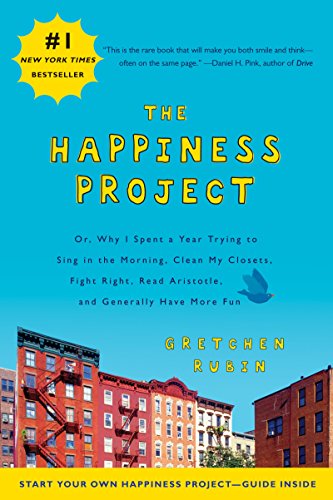
Inhaltsangabe
Gretchen Rubin had an epiphany one rainy afternoon in the unlikeliest of places: a city bus. "The days are long, but the years are short," she realized. "Time is passing, and I'm not focusing enough on the things that really matter." In that moment, she decided to dedicate a year to her happiness project.
In this lively and compelling account, Rubin chronicles her adventures during the twelve months she spent test-driving the wisdom of the ages, current scientific research, and lessons from popular culture about how to be happier. Among other things, she found that novelty and challenge are powerful sources of happiness; that money can help buy happiness, when spent wisely; that outer order contributes to inner calm; and that the very smallest of changes can make the biggest difference.
Die Inhaltsangabe kann sich auf eine andere Ausgabe dieses Titels beziehen.
Über die Autorin bzw. den Autor
I'm the author of the New York Times bestsellers "The Happiness Project," “Happier at Home” and “Better Than Before.” I write about my experiences as I test-drive the wisdom of the ages, current scientific studies, and lessons from popular culture about happiness, habits, and human nature. My next book will hit the shelves in summer 2017: “The Four Tendencies: The Surprising Truth about the Four Hidden Personality Types That Drive Everything We Do.”
Find out your Tendency—are you an Upholder, Questioner, Obliger, or Rebel?—when you take the free quiz at GretchenRubin.com.
Subscribe to my award-winning weekly podcast “Happier with Gretchen Rubin” (more than 1 million downloads each month) and hear my sister and I discuss strategies and tips for how to make your daily life happier. I also created an app to help people harness the power of the Four Tendencies. Learn more at BetterApp.us or search the app store for “Better Gretchen Rubin.”
My previous books include a bestselling biography of Winston Churchill, "Forty Ways to Look at Winston Churchill,” and one of John Kennedy, “Forty Ways to Look at JFK.” My first book, “Power Money Fame S..: A User's Guide,” is social criticism in the guise of a user's manual. I wrote “Profane Waste” in collaboration with artist Dana Hoey. I've also written three dreadful novels that are safely locked away in a drawer.
Before turning to writing, I had a career in law. A graduate of Yale and Yale Law School, I clerked for Justice Sandra Day O'Connor and was editor-in-chief of the Yale Law Journal. I live in New York City with my husband and two daughters.
Von der hinteren Coverseite
“Wonderful. . . . Rubin shows how you can be happier, starting right now, with small, actionable steps accessible to everyone.” —Julie Morgenstern, New York Times bestselling author of Organizing from the Inside Out
Gretchen Rubin had an epiphany one rainy afternoon in the unlikeliest of places: a city bus. “The days are long, but the years are short,” she realized. “Time is passing, and I’m not focusing enough on the things that really matter.” In that moment, she decided to dedicate a year to her happiness project.
In this lively and compelling account—now updated with new material by the author—Rubin chronicles her adventures during the twelve months she spent test-driving the wisdom of the ages, current scientific research, and lessons from popular culture about how to be happier. Among other things, she found that novelty and challenge are powerful sources of happiness; that money can help buy happiness, when spent wisely; that outer order contributes to inner calm; and that the very smallest of changes can make the biggest difference.
“An enlightening, laugh-aloud read.”—Christian Science Monitor
This updated edition includes:
· A new extensive interview with the author
· Secrets of Adulthood
· An excerpt from Gretchen Rubin’s new book, Better Than Before: What I Learned About Making and Breaking Habits—to Sleep More, Quit Sugar, Procrastinate Less, and Generally Build a Happier Life
Auszug. © Genehmigter Nachdruck. Alle Rechte vorbehalten.
The Happiness Project
Or, Why I Spent a Year Trying to Sing in the Morning, Clean My Closets, Fight Right, Read Aristotle, and Generally Have More FunBy Gretchen RubinHarper Paperbacks
Copyright © 2011 Gretchen RubinAll right reserved.
ISBN: 9780061583261
Chapter One
Like 44 percent of Americans, I makeNew Year?s resolutions?and usually
don?t keep them for long. How many times
had I resolved to exercise more, eat better, and
keep up with my e-mail in-box? This year,
though, I was making my resolutions in the
context of my happiness project, and I hoped
that would mean that I?d do a better job of
keeping them. To launch the new year and
my happiness project, I decided to focus on
boosting my energy. More vitality, I hoped,
would make it easier for me to stick to all
my happiness project resolutions in future
months.
¦ Go to sleep earlier.
¦ Exercise better.
¦ Toss, restore, organize.
¦ Tackle a nagging task.
¦ Act more energetic.
In a virtuous circle, research shows, being happy energizes you, and at the same time,
having more energy makes it easier for you to engage in activities?
like socializing and exercise?that
boost happiness. Studies also show that when you feel energetic, your self
esteem rises. Feeling tired, on the other hand, makes everything seem
arduous. An activity that you?d ordinarily find fun, like putting up holiday
decorations, feels difficult, and a more demanding task, like learning a new
software program, feels overwhelming.
I know that when I feel energetic, I find it much easier to behave in
ways that make me happy. I take the time to e-mail the grandparents with
a report from the pediatrician?s checkup. I don?t scold when Eliza drops her
glass of milk on the rug just as we?re leaving for school. I have the perseverance
to figure out why my computer screen is frozen. I take the time to put
my dishes in the dishwasher.
I decided to tackle both the physical and mental aspects of energy.
For my physical energy: I needed to make sure that I got enough
sleep and enough exercise. Although I?d already known that sleep and
exercise were important to good health, I?d been surprised to learn that
happiness? which can seem like a complex, lofty, and intangible goal?was
quite influenced by these straightforward habits. For my mental energy: I
needed to tackle my apartment and office, which felt oppressively messy
and crowded. Outer order, I hoped, would bring inner peace. What?s more,
I needed to clear away metaphorical clutter; I wanted to cross tasks off my
to do list. I added one last resolution that combined the mental and the
physical. Studies show that by acting as if you feel more energetic, you can
become more energetic. I was skeptical, but it seemed worth a try.
GO TO SLEEP EARLIER.
First: bodily energy.
A glamorous friend with a tendency to make sweeping pronouncements
had told me that ?Sleep is the new sex,? and I?d recently been at a
dinner party where each person at the table detailed the best nap he or she
had ever had, in lascivious detail, while everyone moaned in appreciation.
Millions of people fail to get the recommended seven to eight hours of
sleep a night, and one study revealed that along with tight work deadlines,
a bad night?s sleep was one of the top two factors that upset people?s daily
moods. Another study suggested that getting one extra hour of sleep each
night would do more for a person?s daily happiness than getting a $60,000
raise. Nevertheless, the average adult sleeps only 6.9 hours during the
week, and 7.9 on the weekend?20 percent less than in 1900. Although
people adjust to feeling sleepy, sleep deprivation impairs memory, weakens
the immune system, slows metabolism, and might, some studies suggest,
foster weight gain.
My new, not exactly startling resolution for getting more sleep was to
turn off the light. Too often I stayed up to read, answer e-mails, watch TV,
pay bills, or whatever, instead of going to bed.
Nevertheless, just a few days into the happiness project, although I
practically fell asleep on Eliza?s purple sheets as I was tucking her in, I
wavered for a moment when Jamie proposed watching our latest Netflix
DVD, The Conversation. I love movies; I wanted to spend time with Jamie;
9:30 P.M. seemed a ridiculously early hour to go to bed; and I knew from
experience that if I started watching, I?d perk up. On the other hand, I felt
exhausted.
Why does it often seem more tiring to go to bed than to stay up?
Inertia, I suppose. Plus there?s the pre-bed work of taking out my contact
lenses, brushing my teeth, and washing my face. But I?d made my resolution,
so resolutely I headed to bed. I slept eight solid hours and woke up
an hour early, at 5:30 A.M., so in addition to getting a good night?s sleep,
I had the chance to do a peaceful block of work while my family was still
in bed.
I?m a real know-it-all, so I was pleased when my sister called and
complained of insomnia. Elizabeth is five years younger than I am, but usually
I?m the one asking her for advice.
?I?m not getting any sleep,? she said. ?I?ve already given up caffeine.
What else can I do??
?Lots of things,? I said, prepared to rattle off the tips that I?d
uncovered in my research. ?Near your bedtime, don?t do any work that
requires alert thinking. Keep your bedroom slightly chilly. Do a few pre-bed
stretches. Also?this is important?because light confuses the body?s
circadian clock, keep the lights low around bedtime, say, if you go to the
bathroom. Also, make sure your room is very dark when the lights are out.
Like a hotel room.?
?Do you really think it can make a difference?? she asked.
?All the studies say that it does.?
I?d tried all these steps myself, and I?d found the last one?keeping
our bedroom dark?surprisingly difficult to accomplish.
?What are you doing?? Jamie had asked one night when he caught me
rearranging various devices throughout our room.
?I?m trying to block the light from all these gizmos,? I answered. ?I
read that even a tiny light from a digital alarm clock can disrupt a sleep
cycle, and it?s like a mad scientist?s lab in here. Our Blackberrys, the
computer, the cable box?everything blinks or glows bright green.?
?Huh? was all he said, but he did help me move some things on the
nightstand to block the light coming from our alarm clock.
These changes did seem to make falling asleep easier. But I often lost
sleep for another reason: I?d wake up in the middle of the night?
curiously, usually at 3:18 A.M.?and be unable to go back to sleep. For those
nights, I developed another set of tricks. I breathed deeply and slowly until
I couldn?t stand it anymore. When my mind was racing with a to do list,
I wrote everything down. There?s evidence that too little blood flow to
the extremities can keep you awake, so if my feet were cold, I put on wool
socks?which, though it made me feel frumpish, did seem to help.
Two of my most useful getting to sleep strategies were my own invention.
First, I tried to get ready for bed well before bedtime. Sometimes
I stayed up late because I was too tired to take out my contacts?plus,
putting on my glasses had an effect like putting the cover on...
„Über diesen Titel“ kann sich auf eine andere Ausgabe dieses Titels beziehen.
Suchergebnisse für The Happiness Project: Or, Why I Spent a Year Trying...

Beispielbild für diese ISBN
The Happiness Project Or Why I
Anbieter: World of Books (was SecondSale), Montgomery, IL, USA
Verkäuferbewertung 5 von 5 Sternen

Zustand: Good. Item in good condition. Textbooks may not include supplemental items i.e. CDs, access codes etc. Artikel-Nr. 00055998037
Gebraucht kaufen
EUR 3,72
Versand gratis
Versand innerhalb von USA
Versand innerhalb von USA
Anzahl: Mehr als 20 verfügbar
Beispielbild für diese ISBN
The Happiness Project Or Why I
Anbieter: World of Books (was SecondSale), Montgomery, IL, USA
Verkäuferbewertung 5 von 5 Sternen
Zustand: Acceptable. Item in good condition. Textbooks may not include supplemental items i.e. CDs, access codes etc. Artikel-Nr. 00062456387
Gebraucht kaufen
EUR 3,72
Versand gratis
Versand innerhalb von USA
Versand innerhalb von USA
Anzahl: 12 verfügbar
Beispielbild für diese ISBN
The Happiness Project: Or, Why I Spent a Year Trying to Sing in the Morning, Clean My Closets, Fight Right, Read Aristotle, and Generally Have More Fun
Verlag:
Harper Perennial (edition Reprint), 2011
ISBN 10: 006158326X
ISBN 13: 9780061583261
Gebraucht
Paperback
Anbieter: BooksRun, Philadelphia, PA, USA
Verkäuferbewertung 5 von 5 Sternen
Paperback. Zustand: Very Good. Reprint. It's a well-cared-for item that has seen limited use. The item may show minor signs of wear. All the text is legible, with all pages included. It may have slight markings and/or highlighting. Artikel-Nr. 006158326X-11-18
Gebraucht kaufen
EUR 3,81
Versand gratis
Versand innerhalb von USA
Versand innerhalb von USA
Anzahl: 3 verfügbar
Beispielbild für diese ISBN
The Happiness Project: Or, Why I Spent a Year Trying to Sing in the Morning, Clean My Closets, Fight Right, Read Aristotle, and Generally Have More Fun
Verlag:
Harper Perennial (edition Reprint), 2011
ISBN 10: 006158326X
ISBN 13: 9780061583261
Gebraucht
Paperback
Anbieter: BooksRun, Philadelphia, PA, USA
Verkäuferbewertung 5 von 5 Sternen
Paperback. Zustand: Fair. Reprint. The item might be beaten up but readable. May contain markings or highlighting, as well as stains, bent corners, or any other major defect, but the text is not obscured in any way. Artikel-Nr. 006158326X-7-1-13
Gebraucht kaufen
EUR 4,48
Versand gratis
Versand innerhalb von USA
Versand innerhalb von USA
Anzahl: 1 verfügbar
Beispielbild für diese ISBN
The Happiness Project: Or, Why I Spent a Year Trying to Sing in the Morning, Clean My Closets, Fight Right, Read Aristotle, and Generally Have More Fun
Verlag:
Harper Perennial (edition Reprint), 2011
ISBN 10: 006158326X
ISBN 13: 9780061583261
Gebraucht
Paperback
Anbieter: BooksRun, Philadelphia, PA, USA
Verkäuferbewertung 5 von 5 Sternen
Paperback. Zustand: Very Good. Reprint. It's a well-cared-for item that has seen limited use. The item may show minor signs of wear. All the text is legible, with all pages included. It may have slight markings and/or highlighting. Artikel-Nr. 006158326X-11-1
Gebraucht kaufen
EUR 4,71
Versand gratis
Versand innerhalb von USA
Versand innerhalb von USA
Anzahl: 2 verfügbar
Beispielbild für diese ISBN
The Happiness Project: Or, Why I Spent a Year Trying to Sing in the Morning, Clean My Closets, Fight Right, Read Aristotle, and Generally Have More Fun
Verlag:
Harper Perennial (edition Reprint), 2011
ISBN 10: 006158326X
ISBN 13: 9780061583261
Gebraucht
Paperback
Anbieter: BooksRun, Philadelphia, PA, USA
Verkäuferbewertung 5 von 5 Sternen
Paperback. Zustand: Fair. Reprint. The item might be beaten up but readable. May contain markings or highlighting, as well as stains, bent corners, or any other major defect, but the text is not obscured in any way. Artikel-Nr. 006158326X-7-1
Gebraucht kaufen
EUR 4,93
Versand gratis
Versand innerhalb von USA
Versand innerhalb von USA
Anzahl: 2 verfügbar
Beispielbild für diese ISBN
The Happiness Project: Or, Why I Spent a Year Trying to Sing in the Morning, Clean My Closets, Fight Right, Read Aristotle, and Generally Have More Fun
Verlag:
Harper Perennial (edition Reprint), 2011
ISBN 10: 006158326X
ISBN 13: 9780061583261
Gebraucht
Paperback
Anbieter: BooksRun, Philadelphia, PA, USA
Verkäuferbewertung 5 von 5 Sternen
Paperback. Zustand: Fair. Reprint. The item might be beaten up but readable. May contain markings or highlighting, as well as stains, bent corners, or any other major defect, but the text is not obscured in any way. Artikel-Nr. 006158326X-7-18
Gebraucht kaufen
EUR 5,11
Versand gratis
Versand innerhalb von USA
Versand innerhalb von USA
Anzahl: 3 verfügbar
Beispielbild für diese ISBN
The Happiness Project: Or, Why I Spent a Year Trying to Sing in the Morning, Clean My Closets, Fight Right, Read Aristotle, and Generally Have More Fun
Anbieter: ThriftBooks-Dallas, Dallas, TX, USA
Verkäuferbewertung 5 von 5 Sternen
Paperback. Zustand: As New. No Jacket. Pages are clean and are not marred by notes or folds of any kind. ~ ThriftBooks: Read More, Spend Less. Artikel-Nr. G006158326XI2N00
Gebraucht kaufen
EUR 5,96
Versand gratis
Versand innerhalb von USA
Versand innerhalb von USA
Anzahl: 1 verfügbar
Beispielbild für diese ISBN
The Happiness Project: Or, Why I Spent a Year Trying to Sing in the Morning, Clean My Closets, Fight Right, Read Aristotle, and Generally Have More Fun
Anbieter: ThriftBooks-Phoenix, Phoenix, AZ, USA
Verkäuferbewertung 5 von 5 Sternen
Paperback. Zustand: As New. No Jacket. Pages are clean and are not marred by notes or folds of any kind. ~ ThriftBooks: Read More, Spend Less. Artikel-Nr. G006158326XI2N00
Gebraucht kaufen
EUR 5,96
Versand gratis
Versand innerhalb von USA
Versand innerhalb von USA
Anzahl: 1 verfügbar
Beispielbild für diese ISBN
The Happiness Project: Or, Why I Spent a Year Trying to Sing in the Morning, Clean My Closets, Fight Right, Read Aristotle, and Generally Have More Fun
Anbieter: ThriftBooks-Atlanta, AUSTELL, GA, USA
Verkäuferbewertung 5 von 5 Sternen
Paperback. Zustand: As New. No Jacket. Pages are clean and are not marred by notes or folds of any kind. ~ ThriftBooks: Read More, Spend Less. Artikel-Nr. G006158326XI2N00
Gebraucht kaufen
EUR 5,96
Versand gratis
Versand innerhalb von USA
Versand innerhalb von USA
Anzahl: 2 verfügbar