
Verwandte Artikel zu The First 30 Days: Your Guide to Any Change (and Loving...
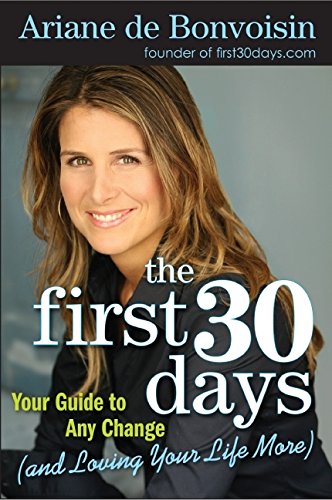
Inhaltsangabe
Has a change happened in your life that you are having trouble accepting? Is there a change you would like to make to help you love life more? If you answered yes to either of these questions, this is the book for you.
This year alone, many of us will fall in love, get in shape, and start new companies, while some of us will lose a job, deal with health complications, or get divorced. Although we often try to ignore change, whether good or bad, it is the one constant. Now, with The First 30 Days, we can learn how to embrace change, move through it, and successfully navigate the twists and turns of life.
The First 30 Days reveals how the beginning of any change is a pivotal time that can either leave us stressed and stuck or lead us forward in our lives with clarity and hope. Change coach Ariane de Bonvoisin provides the tools to make each change a new beginning, whether it is a change you want to make or one brought on by a situation out of your control. Ariane introduces nine principles that will help you develop an optimistic mind-set toward change, an attitude that encourages you to see that life is on your side and that good can come from even the most difficult circumstance. With real-life stories, practical exercises, and inspiring action points, The First 30 Days teaches the skills you need to face any change—skills that will help you today and for the rest of your life.
Inside, discover:
- How to develop a positive approach to change—it can make all the difference.
- The Change Guarantee—from any change, something good can come.
- Your Change Muscle—you have one! Find out where it is and how to use it.
- How to combat your Change Demons—the negative emotions that want to hold you back.
- How to build a Change Support Team—who and what makes the most difference.
Die Inhaltsangabe kann sich auf eine andere Ausgabe dieses Titels beziehen.
Über die Autorin bzw. den Autor
Ariane de Bonvoisin is the founder of first30days.com, a website that helps people transition through dozens of changes, whether the change involves a health diagnosis, going green, moving to a new city, or getting married. She has a degree in economics and international relations from the London School of Economics and an MBA from Stanford University. Ariane worked at the Boston Consulting Group and with media giants BMG, Sony, and Time Warner before pursuing her dream to make a difference in people's lives. First30days.com became her life's work in 2005. Ariane is based in New York City where her company is also headquartered.
Von der hinteren Coverseite
Has a change happened in your life that you are having trouble accepting? Is there a change you would like to make to help you love life more? If you answered yes to either of these questions, this is the book for you.
This year alone, many of us will fall in love, get in shape, and start new companies, while some of us will lose a job, deal with health complications, or get divorced. Although we often try to ignore change, whether good or bad, it is the one constant. Now, with The First 30 Days, we can learn how to embrace change, move through it, and successfully navigate the twists and turns of life.
The First 30 Days reveals how the beginning of any change is a pivotal time that can either leave us stressed and stuck or lead us forward in our lives with clarity and hope. Change coach Ariane de Bonvoisin provides the tools to make each change a new beginning, whether it is a change you want to make or one brought on by a situation out of your control. Ariane introduces nine principles that will help you develop an optimistic mind-set toward change, an attitude that encourages you to see that life is on your side and that good can come from even the most difficult circumstance. With real-life stories, practical exercises, and inspiring action points, The First 30 Days teaches the skills you need to face any change—skills that will help you today and for the rest of your life.
Inside, discover:
- How to develop a positive approach to change—it can make all the difference.
- The Change Guarantee—from any change, something good can come.
- Your Change Muscle—you have one! Find out where it is and how to use it.
- How to combat your Change Demons—the negative emotions that want to hold you back.
- How to build a Change Support Team—who and what makes the most difference.
Auszug. © Genehmigter Nachdruck. Alle Rechte vorbehalten.
The First 30 Days
Your Guide to Any Change (and Loving Your Life More)By Ariane de BonvoisinHarperCollins Publishers, Inc.
Copyright © 2008 Ariane de BonvoisinAll right reserved.
ISBN: 9780061472831
Chapter One
Change Your View of Change Beliefs Can Make All the Difference
Principle 1: People who successfully navigate change have positive beliefs
Your biggest need right now is to develop new beliefs: about yourself, about this change and about life in general. Nothing will have a bigger impact on the way you move through change.
What you believe about change—and about yourself—will be the major filter for how you get through your current transition, whether you're in day one, day thirty, or years past the start of the change. A belief is something you think is true. It can be very strongly ingrained, like a conviction; or weaker, like something you happen to think is correct. This means that if you believe that change is difficult and terrible, you will likely have a difficult and terrible time. The beliefs you have about who you are also directly affect how you feel during change. Are you strong and capable, or unsure and fearful?
There are some striking differences between people who are good at change and those who struggle. People who embrace change—the people I like to call change optimists—think: Change is good. Change is about growing, and something exciting may be waiting for me on the other side of this transition. They believe that change brings something new into their lives and that change always serves somehow. When change is thrust upon them or when they need to initiate a change on their own, these optimistic people try to make the best of the situation by looking for the positive.
The people I have met who fear change usually believe that change is hard, that it brings up all of their anxieties and insecurities, and that it takes forever. They also think that they are unlucky if tough change comes into their lives, and that they will be paralyzed, stressed, and unable to move past it.
Can you see the difference in these two ways of viewing the world?
Which one sounds familiar to you?
The quickest way to take control during change is first to become aware of what your mind is feeding you and then to make a concerted effort to choose better thoughts and beliefs. Start to notice what you most often think and say to yourself—and to others. For example, if you break up with someone, you may believe you will be single forever because you are not attractive or worthy of a committed partner. If you get sick, you may believe that the illness is permanent and that you will never feel better. If you try to lose weight, you may believe you will fail yet again. And if you lose your home in a hurricane, you may believe you will never be happy or comfortable again. These are all beliefs you have created in your own mind.
The good news is that we can identify and bust the myths and fears we have about change. We have a choice about what things mean to us. We create our distortions and our truths. They are part of the software that runs the computer inside our head. We all have the same hard drive, but each of us has unique programs that control our life. Once we have identified the most dominant programs (beliefs) running on our computer, we have the ability to drag the negative ones into the trash and replace them with programs that will serve us better. We can see this in the person who was fired and quickly moved on to a better job versus the person who wallowed for years in unemployed misery. Or the cancer survivor who used the illness to find a renewed love of life versus the survivor who is still full of fear and uncertainty. The difference between these people is the beliefs that they hold.
The Tribe: The Source of Your Current Beliefs
In a perfect world, our parents would teach us that change is the only guarantee in life and that it is therefore essential to be good at accepting change and moving through it. Wouldn't it have been great if your mom had asked you each evening, "What changed today, what is new, and what's good about that?" Acknowledging changes in this way would have helped us develop a view of change that would support us later in life, when we are faced time and time again with new situations and experiences.
Take a moment to think about why you have made the life choices that you have—whom to marry, what kind of work to pursue, where to live—and you'll see that we are often a walking imprint of the beliefs of our family and friends—what I like to call the tribe. Sometimes this loyalty to the tribe is conscious; but most often it is unconscious. This loyalty helps us feel connected to the people in our lives on a deeper level. Your tribe has probably helped shape the way you live, but it can also take away your ability to see and choose the best way to move through change. Every member of your tribe has his or her own model of the world and is all too eager to share it with you. Going against your tribe can be uncomfortable and threatening. If your family believes deeply in the institution of marriage, it takes courage to tell them that you choose to believe that divorce can be a good thing. Or maybe you dream of owning your own business, but your tribe always encouraged you to maintain a steady job. Who is in your tribe? Ask yourself who still has power and influence over your choices and the changes you want to make.
As a friend of mine, Kathy, once told me, "During change I've found that a lot of people have a tendency to hold on to other people's patterns. People need to look at themselves and ask, 'Who am I as an individual?' not 'Who am I as the daughter of my mother or father, the wife of my husband, or the mother to my kids?'?"
Continues...
Excerpted from The First 30 Daysby Ariane de Bonvoisin Copyright © 2008 by Ariane de Bonvoisin. Excerpted by permission.
All rights reserved. No part of this excerpt may be reproduced or reprinted without permission in writing from the publisher.
Excerpts are provided by Dial-A-Book Inc. solely for the personal use of visitors to this web site.
„Über diesen Titel“ kann sich auf eine andere Ausgabe dieses Titels beziehen.
Weitere beliebte Ausgaben desselben Titels

Suchergebnisse für The First 30 Days: Your Guide to Any Change (and Loving...

Beispielbild für diese ISBN
The First 30 Days: Your Guide to Any Change (and Loving Your Life More)
Anbieter: World of Books (was SecondSale), Montgomery, IL, USA
Verkäuferbewertung 5 von 5 Sternen

Zustand: Good. Good condition ex-library book with usual library markings and stickers. Artikel-Nr. 00101157135
Gebraucht kaufen
EUR 3,71
Versand gratis
Versand innerhalb von USA
Versand innerhalb von USA
Anzahl: 1 verfügbar
Beispielbild für diese ISBN
The First 30 Days: Your Guide to Any Change (and Loving Your Life More)
Anbieter: BooksRun, Philadelphia, PA, USA
Verkäuferbewertung 5 von 5 Sternen
Hardcover. Zustand: Very Good. With dust jacket. It's a well-cared-for item that has seen limited use. The item may show minor signs of wear. All the text is legible, with all pages included. It may have slight markings and/or highlighting. Artikel-Nr. 0061472832-11-1-29
Gebraucht kaufen
EUR 5,14
Versand gratis
Versand innerhalb von USA
Versand innerhalb von USA
Anzahl: 1 verfügbar
Beispielbild für diese ISBN
The First 30 Days: Your Guide to Any Change (and Loving Your Life More)
Anbieter: World of Books (was SecondSale), Montgomery, IL, USA
Verkäuferbewertung 5 von 5 Sternen
Zustand: Very Good. Item in very good condition! Textbooks may not include supplemental items i.e. CDs, access codes etc. Artikel-Nr. 00100241157
Gebraucht kaufen
EUR 5,15
Versand gratis
Versand innerhalb von USA
Versand innerhalb von USA
Anzahl: 2 verfügbar
Beispielbild für diese ISBN
The First 30 Days: Your Guide to Any Change (and Loving Your Life More)
Anbieter: World of Books (was SecondSale), Montgomery, IL, USA
Verkäuferbewertung 5 von 5 Sternen
Zustand: Good. Item in good condition. Textbooks may not include supplemental items i.e. CDs, access codes etc. Artikel-Nr. 00099435632
Gebraucht kaufen
EUR 5,15
Versand gratis
Versand innerhalb von USA
Versand innerhalb von USA
Anzahl: 2 verfügbar
Beispielbild für diese ISBN
The First 30 Days : Your Guide to Any Change (and Loving Your Life More)
Verlag:
HarperCollins Publishers, 2008
ISBN 10: 0061472832
ISBN 13: 9780061472831
Gebraucht
Hardcover
Anbieter: Better World Books, Mishawaka, IN, USA
Verkäuferbewertung 5 von 5 Sternen
Zustand: Very Good. Former library copy. Pages intact with possible writing/highlighting. Binding strong with minor wear. Dust jackets/supplements may not be included. Includes library markings. Stock photo provided. Product includes identifying sticker. Better World Books: Buy Books. Do Good. Artikel-Nr. 2868380-75
Gebraucht kaufen
EUR 6,01
Versand gratis
Versand innerhalb von USA
Versand innerhalb von USA
Anzahl: 2 verfügbar
Beispielbild für diese ISBN
The First 30 Days : Your Guide to Any Change (and Loving Your Life More)
Verlag:
HarperCollins Publishers, 2008
ISBN 10: 0061472832
ISBN 13: 9780061472831
Gebraucht
Hardcover
Anbieter: Better World Books, Mishawaka, IN, USA
Verkäuferbewertung 5 von 5 Sternen
Zustand: Good. Pages intact with minimal writing/highlighting. The binding may be loose and creased. Dust jackets/supplements are not included. Stock photo provided. Product includes identifying sticker. Better World Books: Buy Books. Do Good. Artikel-Nr. 7933519-6
Gebraucht kaufen
EUR 6,01
Versand gratis
Versand innerhalb von USA
Versand innerhalb von USA
Anzahl: 1 verfügbar
Beispielbild für diese ISBN
The First 30 Days : Your Guide to Any Change (and Loving Your Life More)
Verlag:
HarperCollins Publishers, 2008
ISBN 10: 0061472832
ISBN 13: 9780061472831
Gebraucht
Hardcover
Anbieter: Better World Books, Mishawaka, IN, USA
Verkäuferbewertung 5 von 5 Sternen
Zustand: Very Good. Pages intact with possible writing/highlighting. Binding strong with minor wear. Dust jackets/supplements may not be included. Stock photo provided. Product includes identifying sticker. Better World Books: Buy Books. Do Good. Artikel-Nr. 8624819-75
Gebraucht kaufen
EUR 6,01
Versand gratis
Versand innerhalb von USA
Versand innerhalb von USA
Anzahl: 1 verfügbar
Beispielbild für diese ISBN
The First 30 Days : Your Guide to Any Change (and Loving Your Life More)
Verlag:
HarperCollins Publishers, 2008
ISBN 10: 0061472832
ISBN 13: 9780061472831
Gebraucht
Hardcover
Anbieter: Better World Books, Mishawaka, IN, USA
Verkäuferbewertung 5 von 5 Sternen
Zustand: Good. Former library copy. Pages intact with minimal writing/highlighting. The binding may be loose and creased. Dust jackets/supplements are not included. Includes library markings. Stock photo provided. Product includes identifying sticker. Better World Books: Buy Books. Do Good. Artikel-Nr. GRP64722023
Gebraucht kaufen
EUR 6,01
Versand gratis
Versand innerhalb von USA
Versand innerhalb von USA
Anzahl: 1 verfügbar
Beispielbild für diese ISBN
The First 30 Days: Your Guide to Any Change (and Loving Your Life More)
Anbieter: ThriftBooks-Dallas, Dallas, TX, USA
Verkäuferbewertung 5 von 5 Sternen
Hardcover. Zustand: Good. No Jacket. Pages can have notes/highlighting. Spine may show signs of wear. ~ ThriftBooks: Read More, Spend Less. Artikel-Nr. G0061472832I3N00
Gebraucht kaufen
EUR 7,10
Versand gratis
Versand innerhalb von USA
Versand innerhalb von USA
Anzahl: 1 verfügbar
Beispielbild für diese ISBN
The First 30 Days: Your Guide to Any Change and Loving Your Life More
Anbieter: Revaluation Books, Exeter, Vereinigtes Königreich
Verkäuferbewertung 5 von 5 Sternen
Hardcover. Zustand: Brand New. 256 pages. 8.50x5.75x1.00 inches. In Stock. Artikel-Nr. 0061472832
Neu kaufen
EUR 33,36
EUR 11,70 Versand
Versand von Vereinigtes Königreich nach USA
Versand von Vereinigtes Königreich nach USA
Anzahl: 1 verfügbar