
Verwandte Artikel zu The Final Days of Jesus: The Archaeological Evidence
Inhaltsangabe
“No one knows more about the history and archaeology of ancient Jerusalem than Shimon Gibson.... This book is destined to become the standard in the field.” — Prof. James D. Tabor, author of The Jesus Dynasty
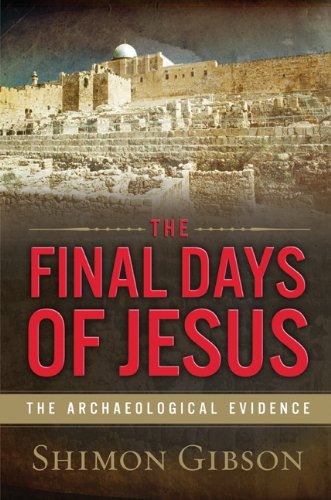
A world renowned archaeologist reveals the historic footprint of Jesus in Jerusalem and what really happened during the final days. Fans of Elaine Pagels and of John Dominic Crossan and Marcus J. Borg’s The Last Week will find a wealth of new information in The Final Days of Jesus, the first book of its kind to present a detailed archaeological footprint of Jesus.
Die Inhaltsangabe kann sich auf eine andere Ausgabe dieses Titels beziehen.
Über die Autorin bzw. den Autor
Shimon Gibson is a senior associate fellow at the W. F. Albright Institute of Archaeological Research in Jerusalem and an adjunct professor of archaeology at the University of North Carolina at Charlotte. During the past thirty years he has conducted numerous excavations and field surveys in different parts of Israel. He was the head of the research and scientific reports department of the Israel Antiquities Authority from 1995 to 1999.
Von der hinteren Coverseite
Ever since the gospels were written there have been questions about the momentous events that occurred during the final days of Jesus. Renowned archaeologist Shimon Gibson breaks new ground examining the critical last days of the life of Jesus using his extraordinary access to firsthand archaeological findings as principal evidence. Gibson explains: “The purpose of this book is to unravel once and for all the mystery surrounding the final days of Jesus in Jerusalem: why he went there; how he came to be arrested, tried, and crucified; and where his place of burial was located. There is no doubt that some of my conclusions regarding Jesus and Jerusalem may be controversial.”
Describing the events of the final days of Jesus chronologically, beginning with his entrance into Jerusalem on a donkey and ending with his burial in a tomb after having been crucified, Gibson unveils a vivid picture of first-century Jerusalem; its monuments, streets, and houses; and, of course, the Jewish Temple that was the jewel in the crown of the city. The Jesus that emerges in these pages is a teacher and healer who captures the fascination of the crowds. As a man from an accomplished and well-off rural background, trained in matters of ritual purification by John the Baptist, and as a believer in alternative healing methods, Jesus's speeches and teachings—made in the tinder-box atmosphere of Passover festivities in Jerusalem—scared the Jewish and Roman authorities to such a degree that they decided to have him put to death. Gibson reveals how archaeology has a major role to play not only in how the gospels should be read and understood, but also in understanding Jesus in his world.
Auszug. © Genehmigter Nachdruck. Alle Rechte vorbehalten.
The Final Days of Jesus
The Archaeological EvidenceBy Shimon GibsonHarperCollins Publishers, Inc.
Copyright © 2009 Shimon GibsonAll right reserved.
ISBN: 9780061458484
Chapter One
The road to Jerusalem
"Jerusalem, Jerusalem, the city that kills the prophets and stones those who are sent to it! How often have I desired to gather your children together as a hen gathers her brood under her wings, and you were not willing!"
(Luke 13:34)
No visitor to modern Jerusalem can ignore that it is the place where Jesus spent his final days and was ultimately crucified. Jesus's impact on the city of Jerusalem was major, perhaps more so than that of any other individual in history. Ever since the fourth century, when Christianity was recognized as the official religion in the Holy Land, millions of Christian pilgrims have poured into Jerusalem seeking out the places associated by tradition with Jesus's Passion week.
Almost 2,000 years later the formidable presence of Jesus still lingers over the Old City, whether at the Garden of Gethsemane and the Mount of Olives, at the Stations of the Cross along the Via Dolorosa, or at the various shrines within the Church of the Holy Sepulchre. Walking the city streets are Christian priests and monks of different denominations: Dominican, Franciscan, Greek Orthodox, Armenian, Ethiopian, and others. Souvenir shops have wall-to-wall icons and olive-wood carvings depicting the Nativity and Calvary and are stocked with crucifixes, large baskets heaped with incense and candles, and various mementoes such as guidebooks and postcards of the Holy Sites. Groups of Christian worshippers pass along the Via Dolorosa during Easter week carrying full-scale replica wooden crosses, singing and praying and with tears rolling down their cheeks. Jesus is on everyone's lips.
Jerusalem was and still is a city imbued with holiness and a sense of extreme tension, with ongoing battles between the liberal and free, the strict and authoritative. It is a place you thrive in or drown in; you can spout philosophy there or wander in lunacy. There is magic in its stones. Jerusalem is one of those special cities that many put on the list of places they most want to visit during their lifetime.
In Gospel accounts, Jesus first visited the city as a child with his parents during one of the major Jewish festivities held there. Jesus climbed the steps leading into the Temple precinct, establishing his footsteps firmly in the history of the city; some would say that from that moment his fate was sealed. At the time of Jesus it was a place dominated by the Temple of God, and this looming and majestic building was visible anywhere in the city. It was truly a City of the Temple. As a sensitive child fascinated with learning, Jesus would undoubtedly have been fully aware of the significance of Jerusalem as a place connected with some of the major events in Israelite history. It was here King David and King Solomon reigned; it was to this place that the Ark of the Covenant was brought; eventually the Temple of God was built on Mount Moriah; and it was in these city streets that the Israelite Prophets berated their people. As an adult, Jesus continued returning to Jerusalem to participate in the main Jewish festivities and to teach and heal, perhaps starting to gain a reputation as a man of "signs and wonders." Jerusalem became almost a forbidden magnet for Jesus: It was a place, we may surmise, he very much wanted to be in because of his Jewish upbringing and his need to be close to the Temple of God, but the city also drew out his anger and compassion, and eventually brought him into conflict with the Jewish and Roman authorities.
Finally, during Passover week in the year 30, Jesus's fate was sealed and he died on a wooden cross opposite one of the gates of the city. The crucifixion of Jesus was a traumatic event that eventually opened the door to the birth of Christianity. Archaeology, as we shall see, has been able to fill in the gaps regarding the appearance of Jesus's Jerusalem, the places where Jesus preached and healed, the whereabouts of his trial, the manner in which he was crucified, and the spot where he was ultimately buried.
But first, we need to pull back to an earlier time in Jesus's life, to establish something about his Galilean background and clarify the dates of his birth and death in order to place him within the correct historical context. We will then consider the archaeological facts regarding the road Jesus took on his final trip to Jerusalem and the places he probably visited or passed en route.
Jesus, son of Mary and Joseph, was known in Hebrew as Yeshua Ben Yoseph (?John 1:45: "Philip found Nathanael and said to him, ‘We have found him about whom Moses in the Law and also the prophets wrote, Jesus son of Joseph from Nazareth'"). What many know from the Gospels is that Jesus spent his childhood and much of his formative life in Nazareth, a somewhat modest, small village nestling in the hills of Lower Galilee, and it was from there he set forth on his mission to Jerusalem.1 But there is much yet unknown about Nazareth from the time of Jesus, except that it appears to have been an agricultural village, surrounded with terraced orchards and vineyards. Animal husbandry would have been practiced as well. A few burial caves of the period, wine presses, and a stone-vessel industry are known from the vicinity of the village. Nazareth was by no means isolated and remote; it existed near the large and thriving town of Sepphoris, the restored capital of the tetrarchy of Herod Antipas, though its name is not mentioned in the Gospels.2 Judging by the relative sizes of rural villages in Palestine at that time, Nazareth must have been quite small, perhaps with only a couple of hundred people living there. The bottom line is that everyone living in the village would have known each other.
Continues...
Excerpted from The Final Days of Jesusby Shimon Gibson Copyright © 2009 by Shimon Gibson. Excerpted by permission.
All rights reserved. No part of this excerpt may be reproduced or reprinted without permission in writing from the publisher.
Excerpts are provided by Dial-A-Book Inc. solely for the personal use of visitors to this web site.
„Über diesen Titel“ kann sich auf eine andere Ausgabe dieses Titels beziehen.
Suchergebnisse für The Final Days of Jesus: The Archaeological Evidence

Beispielbild für diese ISBN
The Final Days of Jesus: The Archaeological Evidence
Verlag:
HarperCollins Publishers Inc, 2009
ISBN 10: 0061458481
ISBN 13: 9780061458484
Gebraucht
Hardcover
Anbieter: World of Books (was SecondSale), Montgomery, IL, USA
Verkäuferbewertung 5 von 5 Sternen

Hardback. Zustand: Good. "No one knows more about the history and archaeology of ancient Jerusalem than Shimon Gibson. This book is destined to become the standard in the field." -- Prof. James D. Tabor, author of The Jesus Dynasty A world renowned archaeologist reveals the historic footprint of Jesus in Jerusalem and what really happened during the final days. Fans of Elaine Pagels and of John Dominic Crossan and Marcus J. Borg's The Last Week will find a wealth of new information in The Final Days of Jesus, the first book of its kind to present a detailed archaeological footprint of Jesus. Artikel-Nr. 00109480398
Gebraucht kaufen
EUR 13,52
Versand gratis
Versand innerhalb von USA
Versand innerhalb von USA
Anzahl: 1 verfügbar
Beispielbild für diese ISBN
The Final Days of Jesus : The Archaeological Evidence
Verlag:
HarperCollins Publishers, 2009
ISBN 10: 0061458481
ISBN 13: 9780061458484
Gebraucht
Hardcover
Erstausgabe
Anbieter: Better World Books, Mishawaka, IN, USA
Verkäuferbewertung 5 von 5 Sternen
Zustand: Good. 1st Edition. Former library copy. Pages intact with minimal writing/highlighting. The binding may be loose and creased. Dust jackets/supplements are not included. Includes library markings. Stock photo provided. Product includes identifying sticker. Better World Books: Buy Books. Do Good. Artikel-Nr. 4790885-6
Gebraucht kaufen
EUR 14,41
Versand gratis
Versand innerhalb von USA
Versand innerhalb von USA
Anzahl: 1 verfügbar
Beispielbild für diese ISBN
The Final Days of Jesus: The Archaeological Evidence
Anbieter: Revaluation Books, Exeter, Vereinigtes Königreich
Verkäuferbewertung 5 von 5 Sternen
Hardcover. Zustand: Brand New. 1st edition. 254 pages. 9.25x6.25x1.00 inches. In Stock. Artikel-Nr. 0061458481
Neu kaufen
EUR 45,32
EUR 11,87 Versand
Versand von Vereinigtes Königreich nach USA
Versand von Vereinigtes Königreich nach USA
Anzahl: 1 verfügbar