
Verwandte Artikel zu The Best American Science Writing 2007: Provocative...
The Best American Science Writing 2007: Provocative Explorations in Medicine and Scientific Discovery by Gina Kolata - Softcover
Buch 5 von 10: Best American Science Writing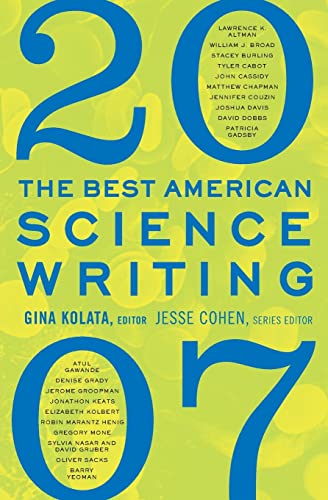
Inhaltsangabe
Provocative and engaging, this collection brings together the premiere science writing of the year. Featuring the imprimatur of bestselling author and New York Times reporter Gina Kolata, one of the nation's foremost voices in science and medicine, and with contributions from Atul Gawande, Elizabeth Kolbert, and Oliver Sacks, among others, The Best American Science Writing 2007 is a compelling anthology of our most advanced, and most relevant, scientific inquiries.
Die Inhaltsangabe kann sich auf eine andere Ausgabe dieses Titels beziehen.
Über die Autorinnen und Autoren
Gina Kolata is an award-winning senior writer for the New York Times. The winner of numerous writing awards, she has authored several books, including the bestselling Flu: The Story of the Great Influenza Pandemic of 1918 and the Search for the Virus that Caused It. Her latest book is Rethinking Thin: The New Science of Weight Loss—and the Myths and Realities of Dieting.
Jesse Cohen is a writer and freelance editor. He lives in New York City.
Von der hinteren Coverseite
Provocative and engaging, this collection brings together the premiere science writing of the year. Featuring the imprimatur of bestselling author and New York Times reporter Gina Kolata, one of the nation's foremost voices in science and medicine, and with contributions from Atul Gawande, Elizabeth Kolbert, and Oliver Sacks, among others, The Best American Science Writing 2007 is a compelling anthology of our most advanced, and most relevant, scientific inquiries.
Auszug. © Genehmigter Nachdruck. Alle Rechte vorbehalten.
The Best American Science Writing 2007
By Gina KolataHarperCollins Publishers, Inc.
Copyright © 2007 Gina KolataAll right reserved.
ISBN: 9780061345777
Chapter One
Tyler Cabot
The Theory of Everything
From Esquire
String theory. M-theory. Loop quantum gravity. The holographic universe. Several theories are competing for the solution to physics' ultimate problem: finding a single theory to unify all of the forces of nature—a theory of everything. Tyler Cabot looks in on what the contending theories' proponents are thinking as a new particle collider gets ready to test their hypotheses.
Eighteen months to go. And now some nights Nima Arkani-Hamed can't sleep. Because in eighteen months someone will flip a switch in something called the Large Hadron Collider in Switzerland. And when that switch is flipped, billions of protons will fly around a seventeen-mile loop at nearly the speed of light until they smash together hard, harder than any subatomic particles have ever been smashed together on earth. It's the greatest, most anticipated, most expensive experiment in the history of mankind. And if Arkani-Hamed is right, it could help prove that the laws that govern the universe at every scale—from the smallest quarks to the largest black holes—are one and the same. Or else, of course, it could prove that Arkani-Hamed is full of shit.
It's a fool's errand, this quest for a theory of everything. And Arkani-Hamed is only the most recent of thousands of theoretical physicists to embark on it. The idea seemed logical enough when Einstein first set out on it in the 1920s. If general relativity explains the universe from afar—why gravity pulls the earth around the sun—and quantum mechanics explains the world up close—how atoms, protons, and neutrons react to electromagnetism and the strong and weak forces—surely there must be a way to put the two theories together. After all, whether cosmic in size or minuscule, the particles and forces that govern our universe were all born at the same primordial moment. Yet Einstein failed. And in the interim, armies of physicists, equipped with similarly well-intentioned yet ultimately faulty or unprovable ideas, have followed him to the same well-trod dead end.
Since the mid?1980s, the leading contender for a grand unifying theory has been string theory. The idea is deceptively simple: At the core of every particle in the universe is a tiny thread of energy. Each of these filaments vibrates like a violin string, and its rate of vibration determines its vital characteristics, or tone. There are neutrino strings and electron strings, photon strings and graviton strings. When played together, they compose the symphony of the universe. Or at least, that's the theory.
There's a problem, though. The strings have too much range. So much, in fact, that for string theory to agree with the established laws of physics and mathematics, there must be not three but at least ten dimensions (including time) that are curled up and tucked away. And because each of these multidimensional landscapes requires a different string tuning, there are potentially billions and billions of different versions of string theory relating to billions and billions of different universes.
Then there's the problem of testing string theory. That's how science works. We hypothesize, then we test. And if a hypothesis passes muster, it becomes law. But the strings that supposedly make up our universe are so infinitesimal—one string is to an atom as a single atom is to the entire solar system—that critics argue that we may never be able to build a collider powerful enough to find them, even the collider that Arkani-Hamed stays up all night thinking about.
So here's the latest tally: Number of years since string theory became dominant: 20. Number of potential string-theory solutions: 10500 (the number of atoms in the galaxy squared and then squared again). Number of testable theories: 0. In other words, Arkani-Hamed better be at least partially right, because the natives are getting restless.
If the problem with string theory, as some critics claim, is that it's a closed-minded boys club whose lifetime members hopelessly shuffle and redeal the same deck of equations ad nauseam, then the solution may be found at the Jane Bond, a bar in the staid Canadian college town of Waterloo. The Jane Bond has a decidedly grungy 1970s flair. Tattooed hipsters talk with awed reverence of Brooklyn while DJs spin eclectic and esoteric music next to the bathroom, near the disco ball. And then there are the physicists from the Perimeter Institute for Theoretical Physics who have made the Jane Bond their watering hole. They talk theory sometimes. But mostly they just bullshit. "You want to know the true story?" goads a young postdoctoral researcher at that magical hour in any bar when only bad things can happen. "It's the post-9/11 theocons." Just like the rest of America, he continues, the science establishment is afraid of anything new. It doesn't want to consider any alternatives. "The string theorists just masturbate to their same ideas." At this, the rest of the table—a mixed group of young cosmologists, quantum-information theorists, and quantum-gravity buffs—breaks into nervous laughter. Yes, their friend is drunk. But he's right in a general sense, they concede. There is a growing fissure in the physics world between the haves (string theorists) and the have-nots (everyone else). But not at Perimeter, they caution. Perimeter is different.
The first thing you notice when walking through the concrete-and-glass hallways of PI are the lounges with blackboards. They are ubiquitous. And at each one there are usually two or three young physicists—mostly men, most in their late twenties or thirties—arguing over equations. The feeling is more dorm-room TA session than serious discussion about the origins of the universe. Sneakers and jeans rule. The researchers come and go as they please, and they work as they please. And when they grow too tired of drilling through equations and erasing equations and drilling through them some more, they might take a break. There's a squash court near the billiard table, a few floors below the bistro and bar. But don't get the wrong idea. Foosball aside, the physicists at PI are doing serious work.
Continues...
Excerpted from The Best American Science Writing 2007by Gina Kolata Copyright © 2007 by Gina Kolata. Excerpted by permission.
All rights reserved. No part of this excerpt may be reproduced or reprinted without permission in writing from the publisher.
Excerpts are provided by Dial-A-Book Inc. solely for the personal use of visitors to this web site.
„Über diesen Titel“ kann sich auf eine andere Ausgabe dieses Titels beziehen.
Suchergebnisse für The Best American Science Writing 2007: Provocative...

Beispielbild für diese ISBN
The Best American Science Writing
Verlag:
HarperCollins Publishers Inc, 2007
ISBN 10: 0061345776
ISBN 13: 9780061345777
Gebraucht
Paperback
Anbieter: World of Books (was SecondSale), Montgomery, IL, USA
Verkäuferbewertung 5 von 5 Sternen

Paperback. Zustand: Good. Provocative and engaging, this collection brings together the premiere science writing of the year. Featuring the imprimatur of bestselling author and New York Times reporter Gina Kolata, one of the nation's foremost voices in science and medicine, and with contributions from Atul Gawande, Elizabeth Kolbert, and Oliver Sacks, among others, The Best American Science Writing 2007 is a compelling anthology of our most advanced, and most relevant, scientific inquiries. Artikel-Nr. 00101344776
Gebraucht kaufen
EUR 4,54
Versand gratis
Versand innerhalb von USA
Versand innerhalb von USA
Anzahl: 3 verfügbar
Beispielbild für diese ISBN
The Best American Science Writing
Verlag:
HarperCollins Publishers Inc, 2007
ISBN 10: 0061345776
ISBN 13: 9780061345777
Gebraucht
Paperback
Anbieter: World of Books (was SecondSale), Montgomery, IL, USA
Verkäuferbewertung 5 von 5 Sternen
Paperback. Zustand: Very Good. Provocative and engaging, this collection brings together the premiere science writing of the year. Featuring the imprimatur of bestselling author and New York Times reporter Gina Kolata, one of the nation's foremost voices in science and medicine, and with contributions from Atul Gawande, Elizabeth Kolbert, and Oliver Sacks, among others, The Best American Science Writing 2007 is a compelling anthology of our most advanced, and most relevant, scientific inquiries. Artikel-Nr. 00102007356
Gebraucht kaufen
EUR 4,54
Versand gratis
Versand innerhalb von USA
Versand innerhalb von USA
Anzahl: 1 verfügbar
Beispielbild für diese ISBN
The Best American Science Writing 2007
Anbieter: ThriftBooks-Atlanta, AUSTELL, GA, USA
Verkäuferbewertung 5 von 5 Sternen
Paperback. Zustand: As New. No Jacket. Pages are clean and are not marred by notes or folds of any kind. ~ ThriftBooks: Read More, Spend Less. Artikel-Nr. G0061345776I2N00
Gebraucht kaufen
EUR 6,19
Versand gratis
Versand innerhalb von USA
Versand innerhalb von USA
Anzahl: 1 verfügbar
Beispielbild für diese ISBN
The Best American Science Writing 2007
Anbieter: ThriftBooks-Dallas, Dallas, TX, USA
Verkäuferbewertung 5 von 5 Sternen
Paperback. Zustand: As New. No Jacket. Pages are clean and are not marred by notes or folds of any kind. ~ ThriftBooks: Read More, Spend Less. Artikel-Nr. G0061345776I2N00
Gebraucht kaufen
EUR 6,19
Versand gratis
Versand innerhalb von USA
Versand innerhalb von USA
Anzahl: 1 verfügbar
Beispielbild für diese ISBN
The Best American Science Writing 2007
Anbieter: Wonder Book, Frederick, MD, USA
Verkäuferbewertung 5 von 5 Sternen
Zustand: Very Good. Very Good condition. A copy that may have a few cosmetic defects. May also contain light spine creasing or a few markings such as an owner's name, short gifter's inscription or light stamp. Artikel-Nr. W07K-01068
Gebraucht kaufen
EUR 6,42
Versand gratis
Versand innerhalb von USA
Versand innerhalb von USA
Anzahl: 2 verfügbar
Foto des Verkäufers
The Best American Science Writing 2007
Anbieter: WeBuyBooks, Rossendale, LANCS, Vereinigtes Königreich
Verkäuferbewertung 5 von 5 Sternen
paperback. Zustand: Good. Most items will be dispatched the same or the next working day. A copy that has been read but remains in clean condition. All of the pages are intact and the cover is intact and the spine may show signs of wear. The book may have minor markings which are not specifically mentioned. Artikel-Nr. rev5376514815
Gebraucht kaufen
EUR 1,46
EUR 6,59 Versand
Versand von Vereinigtes Königreich nach USA
Versand von Vereinigtes Königreich nach USA
Anzahl: 2 verfügbar
Beispielbild für diese ISBN
The Best American Science Writing 2007
Anbieter: Books From California, Simi Valley, CA, USA
Verkäuferbewertung 4 von 5 Sternen

Paperback. Zustand: Good. light amount of wear along the edges of the cover. Artikel-Nr. mon0002873445
Gebraucht kaufen
EUR 3,67
EUR 4,45 Versand
Versand innerhalb von USA
Versand innerhalb von USA
Anzahl: 1 verfügbar
Beispielbild für diese ISBN
The Best American Science Writing 2007
Verlag:
HarperCollins Publishers, 2007
ISBN 10: 0061345776
ISBN 13: 9780061345777
Gebraucht
Softcover
Anbieter: Better World Books, Mishawaka, IN, USA
Verkäuferbewertung 5 von 5 Sternen
Zustand: Very Good. Pages intact with possible writing/highlighting. Binding strong with minor wear. Dust jackets/supplements may not be included. Stock photo provided. Product includes identifying sticker. Better World Books: Buy Books. Do Good. Artikel-Nr. GRP73093376
Gebraucht kaufen
EUR 8,34
Versand gratis
Versand innerhalb von USA
Versand innerhalb von USA
Anzahl: 1 verfügbar
Beispielbild für diese ISBN
The Best American Science Writing 2007
Verlag:
HarperCollins Publishers, 2007
ISBN 10: 0061345776
ISBN 13: 9780061345777
Gebraucht
Softcover
Anbieter: Better World Books, Mishawaka, IN, USA
Verkäuferbewertung 5 von 5 Sternen
Zustand: Good. Former library copy. Pages intact with minimal writing/highlighting. The binding may be loose and creased. Dust jackets/supplements are not included. Includes library markings. Stock photo provided. Product includes identifying sticker. Better World Books: Buy Books. Do Good. Artikel-Nr. GRP16680626
Gebraucht kaufen
EUR 8,34
Versand gratis
Versand innerhalb von USA
Versand innerhalb von USA
Anzahl: 1 verfügbar
Beispielbild für diese ISBN
The Best American Science Writing
Anbieter: AwesomeBooks, Wallingford, Vereinigtes Königreich
Verkäuferbewertung 5 von 5 Sternen
Paperback. Zustand: Very Good. The Best American Science Writing This book is in very good condition and will be shipped within 24 hours of ordering. The cover may have some limited signs of wear but the pages are clean, intact and the spine remains undamaged. This book has clearly been well maintained and looked after thus far. Money back guarantee if you are not satisfied. See all our books here, order more than 1 book and get discounted shipping. Artikel-Nr. 7719-9780061345777
Gebraucht kaufen
EUR 3,61
EUR 4,89 Versand
Versand von Vereinigtes Königreich nach USA
Versand von Vereinigtes Königreich nach USA
Anzahl: 2 verfügbar