
Verwandte Artikel zu The Thinking Fan's Guide to the World Cup: 32 Essays...
The Thinking Fan's Guide to the World Cup: 32 Essays on Soccer and the Nations of the 2006 Tournament by Leading Writers - Softcover
Inhaltsangabe
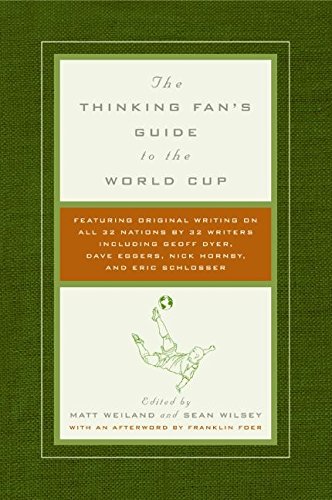
The Thinking Fan's Guide to the World Cup features original pieces by thirty-two leading writers and journalists about the thirty-two nations that have qualified for the world's greatest sporting event. In addition to all the essential information any fan needs—the complete 2006 match schedule, results from past tournaments, facts and figures about the nations, players, teams, and referees—here are essays that shine a whole new light on soccer and the world.
Former Foreign Minister of Mexico Jorge G. Castañeda invites George W. Bush to watch a game.
Novelist Robert Coover remembers soccer in Spain after the death of General Francisco Franco.
Dave Eggers on America, and the gym teachers who kept it free from communism.
Time magazine's Tokyo bureau chief Jim Frederick shows how soccer is displacing baseball in Japan.
Novelist Aleksandar Hemon proves, once and for all, that sex and soccer do not mix.
Novelist John Lanchester describes the indescribable: the beauty of Brazilian soccer.
The New Yorker's Cressida Leyshon on Trinidad and Tobago, 750-1 underdogs.
Fever Pitch author Nick Hornby on the conflicting call of club and country.
Plus an afterword by Franklin Foer on the form of government most likely to win the World Cup.
Die Inhaltsangabe kann sich auf eine andere Ausgabe dieses Titels beziehen.
Über die Autorinnen und Autoren
Matt Weiland is the Deputy Editor of The Paris Review. He has been an editor at Granta, The Baffler and The New Press, and he oversaw a documentary radio unit at NPR. His writing has appeared in the New York Times Book Review, New York Observer, The Nation and The New Republic. He is the co-editor, with Sean Wilsey, of The Thinking Fan's Guide to the World Cup and, with Thomas Frank, of Commodify Your Dissent: The Business of Culture in the New Gilded Age. He lives in Brooklyn with his wife and son.
SEAN WILSEY, the author of a memoir, Oh the Glory of It All, and an essay collection, More Curious, is at work on a translation of Luigi Pirandello’s Uno, Nessuno e Centomila for Archipelago Books and a documentary film about 9/11, IX XI, featuring Roz Chast, Griffin Dunne, and many others (www.ixxi.nyc).
Von der hinteren Coverseite
The Thinking Fan's Guide to the World Cup features original pieces by thirty-two leading writers and journalists about the thirty-two nations that have qualified for the world's greatest sporting event. In addition to all the essential information any fan needs—the complete 2006 match schedule, results from past tournaments, facts and figures about the nations, players, teams, and referees—here are essays that shine a whole new light on soccer and the world.
Former Foreign Minister of Mexico Jorge G. Castañeda invites George W. Bush to watch a game.
Novelist Robert Coover remembers soccer in Spain after the death of General Francisco Franco.
Dave Eggers on America, and the gym teachers who kept it free from communism.
Time magazine's Tokyo bureau chief Jim Frederick shows how soccer is displacing baseball in Japan.
Novelist Aleksandar Hemon proves, once and for all, that sex and soccer do not mix.
Novelist John Lanchester describes the indescribable: the beauty of Brazilian soccer.
The New Yorker's Cressida Leyshon on Trinidad and Tobago, 750-1 underdogs.
Fever Pitch author Nick Hornby on the conflicting call of club and country.
Plus an afterword by Franklin Foer on the form of government most likely to win the World Cup.
Auszug. © Genehmigter Nachdruck. Alle Rechte vorbehalten.
The Thinking Fan's Guide to the World Cup
By Matt WeilandHarperCollins Publishers, Inc.
Copyright © 2006 Matt WeilandAll right reserved.
ISBN: 0061132268
Chapter One
Recap
Sean Wilsey
The 2002 World Cup was unprecedented, but in highly predictable ways.
Held in Asia for the first time, the tournament was co-hosted by traditional enemies South Korea and Japan, who both cooperated with and attempted to outdo each other, first in stadium construction, and then in the competition itself. France, reigning world champions (1998) and European champions (2000), lost the opening game 1-0 to former colony and World Cup debutants Senegal, failed to score in their subsequent matches and went home after the group stage. It was a performance so ignominious that no one complained when FIFA subsequently abolished the longstanding tradition of automatic qualification for world champions.
In another first-round upset, Portugal was beaten 3-2 by the United States. For all the excitement surrounding Luis Figo, the star of Portugal's "Golden Generation," young Americans like Brian McBride and Landon Donovan were a more tangible menace. The U.S. carried on, drawing with South Korea and beating rival Mexico. Germany crushed Saudi Arabia 8-0 in the group stage, and met the U.S. in the quarterfinals. German goalkeeper Oliver Kahn's psy-ops denied Donovan a sure goal, and the U.S., despite dominating the match, was out. Franz Beckenbauer evaluated Germany's performance like this: "Kahn apart, you could take all of them, put them in a bag and hit them with a stick. Whoever got hit would deserve it."
Argentina, in the "Group of Death" with England, Nigeria and Sweden, was eliminated by a penalty kick from David Beckham (making restitution for his fatal mistakes against them in 1998) and went home with the Portuguese and the French.
Africa barely made an appearance after the group stage, with only Senegal continuing on; while of the Asian teams South Korea and Japan both made it into the knockout round. Japan fell first, to an occasionally thuggish, always inspired Turkey (the team that earned more red and yellow cards than any other), while South Korea eliminated Italy in the most exciting game of the tournament. After forcing the complacent Azzurri to run hard for nearly two hours, expat striker Ahn Jung Hwan, who played his club soccer for Perugia, won the match with a golden goal in the 117th minute. South Korea had a new national hero, and the hero's Italian boss, Luciano Gaucci, cancelled his contract: "I have no intention of paying a salary to someone who has ruined Italian football." Four days later, facing Spain, South Korea played another two hours, this time winning on penalties. Spain, with the last eight their second best finish since 1950, had to live with two disallowed goals. "I thought the referee would be fairer in a quarterfinal match like this," said coach Jose Antonio Camacho. "We fought to the end and went out because South Korea were luckier than us." In the semifinals, South Korea met Oliver Kahn's Germany. Michael Ballack scored the game's lone goal (only the third in six matches to make it past Lee Woon Jae), and ended their run in front of 66,625 of their drum-beating, crimson-clad, mass-choreographed fans. Guus Hiddink, South Korea's Dutch coach (and recipient of honorary citizenship), was sensibly appreciative: "They showed what support can be: a miracle mix of enthusiasm and non-violence."
Both the co-hosts were more than deserving of their success, persevering against storied sides, taking chances, defending with resolve and running harder than all the other nations in the seventeenth World Cup. If FIFA had put a pedometer on the South Korean and Japanese midfields the footfall count would have been twice that recorded by any of the fifteen European teams in the tournament. The one exception being Turkey. With the Netherlands absent (having been semifinalists under Hiddink in 1998), it fell to the Turks to play Dutch-style "total soccer." Despite a third-place finish Turkey was the second best team in the 2002 World Cup. (In consolation they got stadiums, bridges and streets named after them back home: a boulevard in Adana for left winger Hasan Sas, a park in Istanbul for coach Senol Günes and a stadium in the seaside town of Zonguldak for midfielder Ergün Penbe.)
The best match of the tournament was the quarterfinal between England and Brazil, which contained equal quantities of intensity, beauty and luck. Michael Owen scored with characteristic elegance on a blistering run after a Brazilian gaffe in the 22nd minute, and England led until first half injury time, when Rivaldo equalized on a Ronaldinho assist. A minute into the restart Ronaldinho delivered an incredible, foot-of-God-like goal from a free kick from midfield. Despite three substitutions, and another forty-seven minutes, England couldn't get through Roberto Carlos and the Brazilian defense.
After the game David Beckham visited the winners' locker room, and (according to Sports Illustrated) this exchange ensued:
Beckham: Hi, sorry. I just wanted to know if Ronaldo wanted to swap shirts with me.
Roberto Carlos (listening): I already traded shirts with him.
Ronaldo (returning with a jersey): Beckham just gave me his.
The game was so good, Beckham traded shirts twice.
Before the inevitable letdown of the final, some illuminating statistics:
Top foulers: Dietmar Hamann of Germany and Cafu of Brazil, tied at 19. Top tackler: Torsten Frings of Germany, who efficiently broke the flow of fifty-five opponents (though Slovenia's Zeljko Milinovic, eliminated at the group stage, had the most tackles per hour on the pitch: an astounding 7.33). Most goal saves: Rüstü Receber of Turkey: 34. Most goals allowed: Mohammad Al Deayea of Saudi Arabia: 12. Brazil's Ronaldo took the most shots on goal, 21, but couldn't claim a single assist. South Korea's Seol Ki Hyeon was most often tackled (79 times). Nobody took more shots than Paraguay's Nelson Cuevas, who averaged 8 per game. Italy's Francesco Totti was the tournament's least (and most!) disciplined player, with 18 fouls, 3 yellow cards and 1 red card.
The final was not only significant as the first meeting between the two most successful nations in World Cup history . . .
Continues...
Excerpted from The Thinking Fan's Guide to the World Cupby Matt Weiland Copyright © 2006 by Matt Weiland. Excerpted by permission.
All rights reserved. No part of this excerpt may be reproduced or reprinted without permission in writing from the publisher.
Excerpts are provided by Dial-A-Book Inc. solely for the personal use of visitors to this web site.
„Über diesen Titel“ kann sich auf eine andere Ausgabe dieses Titels beziehen.
Suchergebnisse für The Thinking Fan's Guide to the World Cup: 32 Essays...

Beispielbild für diese ISBN
The Thinking Fan's Guide to the World Cup
Verlag:
HarperCollins Publishers Inc, 2006
ISBN 10: 0061132268
ISBN 13: 9780061132261
Gebraucht
Paperback
Anbieter: World of Books (was SecondSale), Montgomery, IL, USA
Verkäuferbewertung 5 von 5 Sternen

Paperback. Zustand: Good. The Thinking Fan's Guide to the World Cup features original pieces by thirty-two leading writers and journalists about the thirty-two nations that have qualified for the world's greatest sporting event. In addition to all the essential information any fan needs--the complete 2006 match schedule, results from past tournaments, facts and figures about the nations, players, teams, and referees--here are essays that shine a whole new light on soccer and the world. Former Foreign Minister of Mexico Jorge G. Castañeda invites George W. Bush to watch a game. Novelist Robert Coover remembers soccer in Spain after the death of General Francisco Franco. Dave Eggers on America, and the gym teachers who kept it free from communism. Time magazine's Tokyo bureau chief Jim Frederick shows how soccer is displacing baseball in Japan. Novelist Aleksandar Hemon proves, once and for all, that sex and soccer do not mix. Novelist John Lanchester describes the indescribable: the beauty of Brazilian soccer. The New Yorker's Cressida Leyshon on Trinidad and Tobago, 750-1 underdogs. Fever Pitch author Nick Hornby on the conflicting call of club and country. Plus an afterword by Franklin Foer on the form of government most likely to win the World Cup. Artikel-Nr. 00046016946
Gebraucht kaufen
EUR 4,05
Versand gratis
Versand innerhalb von USA
Versand innerhalb von USA
Anzahl: 4 verfügbar
Beispielbild für diese ISBN
The Thinking Fan's Guide to the World Cup
Verlag:
HarperCollins Publishers Inc, 2006
ISBN 10: 0061132268
ISBN 13: 9780061132261
Gebraucht
Paperback
Anbieter: World of Books (was SecondSale), Montgomery, IL, USA
Verkäuferbewertung 5 von 5 Sternen
Paperback. Zustand: Very Good. The Thinking Fan's Guide to the World Cup features original pieces by thirty-two leading writers and journalists about the thirty-two nations that have qualified for the world's greatest sporting event. In addition to all the essential information any fan needs--the complete 2006 match schedule, results from past tournaments, facts and figures about the nations, players, teams, and referees--here are essays that shine a whole new light on soccer and the world. Former Foreign Minister of Mexico Jorge G. Castañeda invites George W. Bush to watch a game. Novelist Robert Coover remembers soccer in Spain after the death of General Francisco Franco. Dave Eggers on America, and the gym teachers who kept it free from communism. Time magazine's Tokyo bureau chief Jim Frederick shows how soccer is displacing baseball in Japan. Novelist Aleksandar Hemon proves, once and for all, that sex and soccer do not mix. Novelist John Lanchester describes the indescribable: the beauty of Brazilian soccer. The New Yorker's Cressida Leyshon on Trinidad and Tobago, 750-1 underdogs. Fever Pitch author Nick Hornby on the conflicting call of club and country. Plus an afterword by Franklin Foer on the form of government most likely to win the World Cup. Artikel-Nr. 00109131835
Gebraucht kaufen
EUR 4,05
Versand gratis
Versand innerhalb von USA
Versand innerhalb von USA
Anzahl: 1 verfügbar
Beispielbild für diese ISBN
The Thinking Fan's Guide to the World Cup
Anbieter: Wonder Book, Frederick, MD, USA
Verkäuferbewertung 5 von 5 Sternen
Zustand: Good. Good condition. A copy that has been read but remains intact. May contain markings such as bookplates, stamps, limited notes and highlighting, or a few light stains. Artikel-Nr. F16A-05094
Gebraucht kaufen
EUR 6,43
Versand gratis
Versand innerhalb von USA
Versand innerhalb von USA
Anzahl: 1 verfügbar
Beispielbild für diese ISBN
The Thinking Fan's Guide to the World Cup
Anbieter: Wonder Book, Frederick, MD, USA
Verkäuferbewertung 5 von 5 Sternen
Zustand: Good. Good condition. With remainder mark. A copy that has been read but remains intact. May contain markings such as bookplates, stamps, limited notes and highlighting, or a few light stains. Artikel-Nr. U01C-02655
Gebraucht kaufen
EUR 6,43
Versand gratis
Versand innerhalb von USA
Versand innerhalb von USA
Anzahl: 1 verfügbar
Beispielbild für diese ISBN
The Thinking Fan's Guide to the World Cup
Anbieter: ThriftBooks-Atlanta, AUSTELL, GA, USA
Verkäuferbewertung 5 von 5 Sternen
Paperback. Zustand: Good. No Jacket. Pages can have notes/highlighting. Spine may show signs of wear. ~ ThriftBooks: Read More, Spend Less. Artikel-Nr. G0061132268I3N00
Gebraucht kaufen
EUR 7,48
Versand gratis
Versand innerhalb von USA
Versand innerhalb von USA
Anzahl: 1 verfügbar
Beispielbild für diese ISBN
The Thinking Fan's Guide to the World Cup
Verlag:
HarperCollins Publishers, 2006
ISBN 10: 0061132268
ISBN 13: 9780061132261
Gebraucht
Softcover
Anbieter: Better World Books: West, Reno, NV, USA
Verkäuferbewertung 5 von 5 Sternen
Zustand: Very Good. Pages intact with possible writing/highlighting. Binding strong with minor wear. Dust jackets/supplements may not be included. Stock photo provided. Product includes identifying sticker. Better World Books: Buy Books. Do Good. Artikel-Nr. 52131257-6
Gebraucht kaufen
EUR 8,35
Versand gratis
Versand innerhalb von USA
Versand innerhalb von USA
Anzahl: 1 verfügbar
Beispielbild für diese ISBN
The Thinking Fan's Guide to the World Cup
Anbieter: AwesomeBooks, Wallingford, Vereinigtes Königreich
Verkäuferbewertung 5 von 5 Sternen
paperback. Zustand: Very Good. The Thinking Fan's Guide to the World Cup This book is in very good condition and will be shipped within 24 hours of ordering. The cover may have some limited signs of wear but the pages are clean, intact and the spine remains undamaged. This book has clearly been well maintained and looked after thus far. Money back guarantee if you are not satisfied. See all our books here, order more than 1 book and get discounted shipping. Artikel-Nr. 7719-9780061132261
Gebraucht kaufen
EUR 4,31
EUR 4,87 Versand
Versand von Vereinigtes Königreich nach USA
Versand von Vereinigtes Königreich nach USA
Anzahl: 2 verfügbar
Beispielbild für diese ISBN
The Thinking Fan's Guide to the World Cup
Verlag:
HarperCollins Publishers, 2006
ISBN 10: 0061132268
ISBN 13: 9780061132261
Gebraucht
Softcover
Anbieter: Better World Books Ltd, Dunfermline, Vereinigtes Königreich
Verkäuferbewertung 5 von 5 Sternen
Zustand: Good. Former library copy. Pages intact with minimal writing/highlighting. The binding may be loose and creased. Dust jackets/supplements are not included. Includes library markings. Stock photo provided. Product includes identifying sticker. Better World Books: Buy Books. Do Good. Artikel-Nr. 38664379-6
Gebraucht kaufen
EUR 5,72
EUR 5,91 Versand
Versand von Vereinigtes Königreich nach USA
Versand von Vereinigtes Königreich nach USA
Anzahl: 1 verfügbar
Beispielbild für diese ISBN
The Thinking Fan's Guide to the World Cup
Anbieter: Bahamut Media, Reading, Vereinigtes Königreich
Verkäuferbewertung 4 von 5 Sternen

paperback. Zustand: Very Good. This book is in very good condition and will be shipped within 24 hours of ordering. The cover may have some limited signs of wear but the pages are clean, intact and the spine remains undamaged. This book has clearly been well maintained and looked after thus far. Money back guarantee if you are not satisfied. See all our books here, order more than 1 book and get discounted shipping. Artikel-Nr. 6545-9780061132261
Gebraucht kaufen
EUR 5,22
EUR 8,25 Versand
Versand von Vereinigtes Königreich nach USA
Versand von Vereinigtes Königreich nach USA
Anzahl: 2 verfügbar
Beispielbild für diese ISBN
The Thinking Fan's Guide to the World Cup
Anbieter: WorldofBooks, Goring-By-Sea, WS, Vereinigtes Königreich
Verkäuferbewertung 5 von 5 Sternen
Paperback. Zustand: Very Good. The book has been read, but is in excellent condition. Pages are intact and not marred by notes or highlighting. The spine remains undamaged. Artikel-Nr. GOR003232055
Gebraucht kaufen
EUR 11,27
EUR 6,62 Versand
Versand von Vereinigtes Königreich nach USA
Versand von Vereinigtes Königreich nach USA
Anzahl: 1 verfügbar