
Verwandte Artikel zu Ground Zero (The X-files)
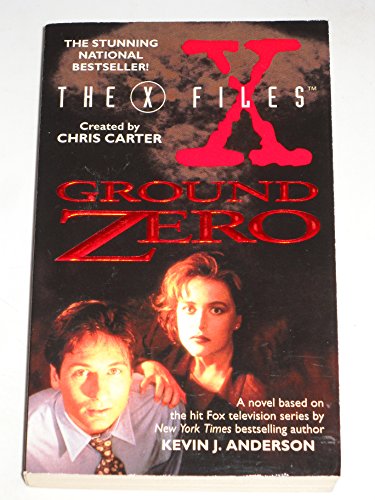
Inhaltsangabe
Dr. Gregory, a renowned nuclear weapons researcher, is not only dead--he's been charred to a radioactive cinder.
Since this is a death on Federal property, Mulder and Scully are hastily called in. As FBI agents who specialize in unexplained phenomena, they are the investigators of The X-Files, strange and inexplicable cases which are also mysteries that the FBI doesn't want solved.
When a second victim, completely unrelated to nuclear science or Dr. Gregory is obliterated in the New Mexico desert, and then a third dies the same way in Washington, DC, Mulder and Scully begin to focus on the frightening dimension of their task. The bizarre deaths cannot be a coincidence. And as they work to uncover the secret unifying element that unites these deaths, it becomes clear that this twisted puzzle has fatal consequences for the entire world.
Die Inhaltsangabe kann sich auf eine andere Ausgabe dieses Titels beziehen.
Über die Autorin bzw. den Autor
Kevin J. Anderson has published more than eighty novels, including twenty-nine national bestsellers. He has been nominated for the Nebula Award, the Bram Stoker Award, and the SFX Reader's Choice Award. His critically acclaimed original novels include Captain Nemo, Hopscotch, and Hidden Empire. He has also collaborated on numerous series novels, including Star Wars, The X-Files, and Dune. In his spare time, he also writes comic books. He lives in Wisconsin.
Auszug. © Genehmigter Nachdruck. Alle Rechte vorbehalten.
Ground Zero
By Kevin J. AndersonHarperEntertainment
Copyright © 1996 Kevin J. AndersonAll right reserved.
ISBN: 9780061056772
Chapter One
Teller Nuclear Research Facility,Pleasanton, CaliforniaMonday, 4:03 P.M.
X Even through the thick windows of his laboratorybuilding, the old man could hear theantinuke protesters outside. Chanting, singing,shouting--always fighting against the future,trying to stall progress. It baffled him more thanit angered him. The slogans hadn't changed from decade todecade. He didn't think the radicals would ever learn.
He fingered the laminated badge dangling from his labcoat. The five-year-old picture, showing him with an awkwardexpression, was worse than a driver's license photo.The Badge Office didn't like to retake snapshots--but then,ID photos never really looked like the subject in question,anyway. At least not in the past five decades. Not since hisdays as a minor technician for the Manhattan Project. Inhalf a century his face had grown more gaunt, moreseamed, especially over the past few years. His steel-grayhair had turned an unhealthy yellowish-white, where ithadn't fallen out in patches. But his eyes remained brightand inquisitive, fascinated by the mysteries hidden indim corners of the universe.
The badge identified him as Emil Gregory. He wasn't likemany of his younger colleagues who insisted on propertitles: Dr. Emil Gregory, or Emil Gregory, Ph.D., or even EmilGregory, Project Director. He had spent too much time in laid-back New Mexico and California to worry about suchformalities. Only scientists whose jobs were in questionconcerned themselves with trivialities like that. Dr. Gregorywas at the end of a long and highly successful career. Hiscolleagues knew his name.
Since much of his work had been classified, he was notassured of a place in the history books. But he had certainlymade his place in history, whether or not anybody hadheard about it.
His former assistant and prize student, Miriel Bremen,knew about his research--but she had turned her back onhim. In fact, she was probably standing outside right now,waving her signs and chanting slogans with the other protesters. She had organized them all. Miriel had alwaysbeen good at organizing unruly groups of people.
Outside, three more Protective Services cars drove up foran uneasy showdown with the protesters who paced backand forth in front of the gate, blocking traffic. Uninformedsecurity guards emerged from the squad cars, slammingdoors. They stood with shoulders squared and tried to lookintimidating. But they couldn't really take action, since theprotesters had carefully remained within the law. In the backof one of the white official cars, a trained German shepherdbarked through the screen mesh of the window; it was adrug- and explosive-sniffing dog, not an attack animal, butits loud growls no doubt made the protesters nervous.
Dr. Gregory finally decided to ignore the distractionsoutside the lab building. Moving slowly and painfully in hisseventy-two-year-old body--whose warranty had recentlyrun out, he liked to say--he went back to his computer simulations.The protesters and guards could keep up theirantics for the rest of the afternoon and into the night, for allhe cared. He turned up his radio to cover the noise from outsideso he could concentrate, though he didn't have toworry about his calculations. The supercomputers actuallydid most of the work.
The portable boom box tucked among books and technicalpapers on his shelf had never succeeded in picking upmore than one station through the thick concrete walls,despite the jury-rigged antenna of chained paper clips hehad hooked to the metal window frame. The lone AMstation, thank goodness, played primarily Oldies, songshe associated with happier days. Right now, Simon andGarfunkel were singing about Mrs. Robinson, and Dr.Gregory sang along with them.
The color monitors on his four supercomputer workstationsdisplayed the progress of his simultaneous hydrocodesimulations. The computers chugged through numerousvirtual experiments in their integrated-circuit imaginations,sorting through billions of iterations without requiring himto throw a single switch or hook up a single generator.
But Dr. Gregory still insisted on wearing his lab coat; hedidn't feel like a real scientist without it. If he wore comfortablestreet clothes and simply pounded on computer keyboardsall day long, he might as well be an accountantinstead of a well-respected weapons researcher at one of thelargest nuclear-design laboratories in the country.
Off in a separate building on the fenced-in lab site, powerfulCray-III supercomputers crunched data for complexsimulations of a major upcoming nuclear test. They werestudying intricate nuclear hydrodynamic models--imaginaryatomic explosions--of the radical new warhead conceptto which he had devoted the last four years of hiscareer.
Bright Anvil.
Because of cost limitations and the on-again/off-againpolitical treaties regarding nuclear testing, these hydrodynamicsimulations were now the only way to study certainsecondary effects, to analyze shock-front formations and fallout patterns. Aboveground atomic detonations had beenbanned by international treaty since 1963 . . . but Dr. Gregoryand his superiors believed they could succeed with the Bright Anvil Project--if all conditions turned out right.
The Department of Energy was eager to see that all conditionsturned out right.
He moved to the next simulation screen, watching the dance of contours, pressure waves, temperature graphs on a nanosecond-by-nanosecond scale. Already he could see that it would be a lovely explosion.
Classified reports and memos littered his desk, buriedunder sheafs of printouts spewed from the laser printer heshared with the rest of his Bright Anvil team members downthe hall. His deputy project head, "Bear" Dooley, postedregular weather reports and satellite photos, circling the interesting areas with a red felt-tip marker. The most recentpicture showed a large circular depression gathered over the central Pacific, like spoiled milk swirling down a drain--elicitinga great deal of excitement from Dooley.
"Storm brewing!" the deputy had scrawled on a Post-itnote stuck to the satellite photo. "Our best candidate so far!"
Dr. Gregory had to agree with the assessment. But they couldn't proceed to the next step until he finished the finalround of simulations. Though the Bright Anvil device hadalready been assembled except for its fissile core, Gregoryeschewed lazy shortcuts. With such incredible power at one's fingertips, caution was the watchword.
He whistled along to "Georgie Girl" as his computers simulatedwaves of mass destruction.
Somebody honked a car horn outside, either in support of the protesters, or just annoyed and trying to get past them.Since he planned to stay late, those demonstrators--wearyand self-self-satisfied--would be long gone by the time Gregoryheaded for his own car.
It didn't matter to him how many extra hours heremained in the lab, since research was the only thing left of his real life. Even if he went home, he would probably workanyway, in his too-quiet and too-empty house, surroundedby photos of the old 1950s hydrogen bomb shots out in the islands or atomic blasts at the Nevada Test Site. He hadaccess to better computers in his lab, though, so he might aswell work through dinner. He had a sandwich in the refrigerator down the hall, but his appetite had been unpredictable for the past few months.
At one time, Miriel Bremen would have stayed workingwith him. She was a sharp and imaginative young physicistwho looked up to the older scientist with something...
„Über diesen Titel“ kann sich auf eine andere Ausgabe dieses Titels beziehen.
Suchergebnisse für Ground Zero (The X-files)

Beispielbild für diese ISBN
Ground Zero
Verlag:
HarperCollins Publishers Inc, 1996
ISBN 10: 0061056774
ISBN 13: 9780061056772
Gebraucht
Softcover
Anbieter: World of Books (was SecondSale), Montgomery, IL, USA
Verkäuferbewertung 5 von 5 Sternen

Zustand: Good. Dr. Gregory, a renowned nuclear weapons researcher, is not only dead -- he's been charred to a radioactive cinder. Since this is a death on Federal property, Mulder and Scully are hastily called in. As FBI agents who specialize in unexplained phenomena, they are the investigators of The X-Files, strange and inexplicable cases which are also mysteries that the FBI doesn't want solved. When a second victim, completely unrelated to nuclear science or Dr. Gregory is obliterated in the New Mexico desert, and then a third dies the same way in Washington, DC, Mulder and Scully begin to focus on the frightening dimension of their task. The bizarre deaths cannot be a coincidence. And as they work to uncover the secret unifying element that unites these deaths, it becomes clear that this twisted puzzle has fatal consequences for the entire world. Artikel-Nr. 00110416565
Gebraucht kaufen
EUR 4,13
Versand gratis
Versand innerhalb von USA
Versand innerhalb von USA
Anzahl: 1 verfügbar
Beispielbild für diese ISBN
Ground Zero
Verlag:
HarperCollins Publishers Inc, 1996
ISBN 10: 0061056774
ISBN 13: 9780061056772
Gebraucht
Softcover
Anbieter: World of Books (was SecondSale), Montgomery, IL, USA
Verkäuferbewertung 5 von 5 Sternen
Zustand: Fair. Dr. Gregory, a renowned nuclear weapons researcher, is not only dead -- he's been charred to a radioactive cinder. Since this is a death on Federal property, Mulder and Scully are hastily called in. As FBI agents who specialize in unexplained phenomena, they are the investigators of The X-Files, strange and inexplicable cases which are also mysteries that the FBI doesn't want solved. When a second victim, completely unrelated to nuclear science or Dr. Gregory is obliterated in the New Mexico desert, and then a third dies the same way in Washington, DC, Mulder and Scully begin to focus on the frightening dimension of their task. The bizarre deaths cannot be a coincidence. And as they work to uncover the secret unifying element that unites these deaths, it becomes clear that this twisted puzzle has fatal consequences for the entire world. Artikel-Nr. 00107272199
Gebraucht kaufen
EUR 4,13
Versand gratis
Versand innerhalb von USA
Versand innerhalb von USA
Anzahl: 1 verfügbar
Beispielbild für diese ISBN
Ground Zero
Anbieter: ThriftBooks-Atlanta, AUSTELL, GA, USA
Verkäuferbewertung 5 von 5 Sternen
Paperback. Zustand: Fair. No Jacket. Readable copy. Pages may have considerable notes/highlighting. ~ ThriftBooks: Read More, Spend Less. Artikel-Nr. G0061056774I5N00
Gebraucht kaufen
EUR 5,86
Versand gratis
Versand innerhalb von USA
Versand innerhalb von USA
Anzahl: 1 verfügbar
Beispielbild für diese ISBN
Ground Zero
Anbieter: ThriftBooks-Atlanta, AUSTELL, GA, USA
Verkäuferbewertung 5 von 5 Sternen
Paperback. Zustand: As New. No Jacket. Pages are clean and are not marred by notes or folds of any kind. ~ ThriftBooks: Read More, Spend Less. Artikel-Nr. G0061056774I2N00
Gebraucht kaufen
EUR 5,86
Versand gratis
Versand innerhalb von USA
Versand innerhalb von USA
Anzahl: 1 verfügbar
Beispielbild für diese ISBN
Ground Zero
Anbieter: ThriftBooks-Dallas, Dallas, TX, USA
Verkäuferbewertung 5 von 5 Sternen
Paperback. Zustand: Fair. No Jacket. Readable copy. Pages may have considerable notes/highlighting. ~ ThriftBooks: Read More, Spend Less. Artikel-Nr. G0061056774I5N00
Gebraucht kaufen
EUR 5,86
Versand gratis
Versand innerhalb von USA
Versand innerhalb von USA
Anzahl: 1 verfügbar
Beispielbild für diese ISBN
The X-Files: Ground Zero
Anbieter: Wonder Book, Frederick, MD, USA
Verkäuferbewertung 5 von 5 Sternen
Zustand: Very Good. Very Good condition. A copy that may have a few cosmetic defects. May also contain light spine creasing or a few markings such as an owner's name, short gifter's inscription or light stamp. Artikel-Nr. Q22P-00175
Gebraucht kaufen
EUR 6,32
Versand gratis
Versand innerhalb von USA
Versand innerhalb von USA
Anzahl: 2 verfügbar
Beispielbild für diese ISBN
Ground Zero
Verlag:
HarperCollins Publishers, 1996
ISBN 10: 0061056774
ISBN 13: 9780061056772
Gebraucht
Softcover
Erstausgabe
Anbieter: Better World Books: West, Reno, NV, USA
Verkäuferbewertung 5 von 5 Sternen
Zustand: Fine. 1st Edition. Used book that is in almost brand-new condition. May contain a remainder mark. Better World Books: Buy Books. Do Good. Artikel-Nr. 57657324-75
Gebraucht kaufen
EUR 8,21
Versand gratis
Versand innerhalb von USA
Versand innerhalb von USA
Anzahl: 1 verfügbar
Beispielbild für diese ISBN
Ground Zero
Verlag:
HarperCollins Publishers, 1996
ISBN 10: 0061056774
ISBN 13: 9780061056772
Gebraucht
Softcover
Erstausgabe
Anbieter: Better World Books, Mishawaka, IN, USA
Verkäuferbewertung 5 von 5 Sternen
Zustand: Good. 1st Edition. Pages intact with minimal writing/highlighting. The binding may be loose and creased. Dust jackets/supplements are not included. Stock photo provided. Product includes identifying sticker. Better World Books: Buy Books. Do Good. Artikel-Nr. 16417592-6
Gebraucht kaufen
EUR 8,21
Versand gratis
Versand innerhalb von USA
Versand innerhalb von USA
Anzahl: 1 verfügbar
Beispielbild für diese ISBN
Ground zero
Anbieter: Robinson Street Books, IOBA, Binghamton, NY, USA
Verkäuferbewertung 4 von 5 Sternen

Mass Market Pa. Zustand: very good or better. Prompt Shipment, shipped in Boxes, Tracking PROVIDEDMystery fictionvery good or better minor creasing, clean pages, sturdy reading copy. Artikel-Nr. roundwhiterr14rmxmab0080
Gebraucht kaufen
EUR 12,21
EUR 8,34 Versand
Versand innerhalb von USA
Versand innerhalb von USA
Anzahl: 1 verfügbar
Beispielbild für diese ISBN
The X-Files: Ground Zero
Verlag:
HarperEntertainment, 1996
ISBN 10: 0061056774
ISBN 13: 9780061056772
Gebraucht
Mass Market Paperback
Anbieter: Robinson Street Books, IOBA, Binghamton, NY, USA
Verkäuferbewertung 4 von 5 Sternen
Mass Market Paperback. Zustand: Very Good. Prompt Shipment, shipped in Boxes, Tracking PROVIDEDVery good. Some creasing. *. Artikel-Nr. graypb34kr1537
Gebraucht kaufen
EUR 12,21
EUR 8,34 Versand
Versand innerhalb von USA
Versand innerhalb von USA
Anzahl: 1 verfügbar