
Verwandte Artikel zu Going Home: Nobel Laureate Doris Lessing's Travel...
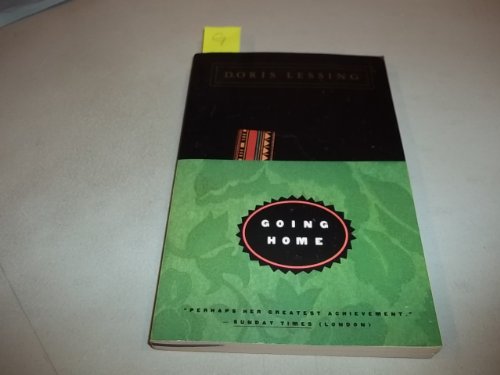
Going Home: Nobel Laureate Doris Lessing's Travel Memoir of Southern Rhodesia, Identity, and Colonial Legacy - Softcover
Inhaltsangabe
"Africa belongs to the Africans; the sooner they take it back the better. But―a country also belongs to those who feel at home in it. Perhaps it may be that love of Africa the country will be strong enough to link people who hate each other now. Perhaps..."
Going Home is Doris Lessing's powerful nonfiction memoir of her first journey back to Africa, the land in which she grew up and in which so much of her emotion and her concern are still invested. Returning to Southern Rhodesia in 1956, she found that her love of the country had remained as strong as her hatred of the idea of "white supremacy" espoused by its ruling class. Going Home evokes brilliantly the experience of the people, black and white, who have shaped and will shape a beloved country.
In this unflinching work of social commentary, Lessing explores the charged landscape of a nation on the brink:
- A Raw Portrait of Colonial Africa: Journey with Lessing back to 1956 Southern Rhodesia, a land she loves, ruled by a system of racial inequality she despises.
- Incisive Social Commentary: Witness through Lessing’s sharp, observant eye the daily realities of apartheid and the rigid structure of white supremacy.
- A Personal Memoir: A deeply personal account of returning to the place that shaped her, grappling with a complex sense of home, identity, and belonging.
- The Human Experience: Lessing evokes the lives of both black and white people, caught together in a system that pits them against each other, in a country beloved by all.
Die Inhaltsangabe kann sich auf eine andere Ausgabe dieses Titels beziehen.
Über die Autorinnen und Autoren
Winner of the 2007 Nobel Prize in Literature, Doris Lessing was one of the most celebrated and distinguished writers of our time, the recipient of a host of international awards. She wrote more than thirty books—among them the novels Martha Quest, The Golden Notebook, and The Fifth Child. She died in 2013.
David Diaz has illustrated numerous award-winning books for children, including smoky night by Eve Bunting, for which he was awarded the Caldecott Medal; The Wanderer by Sharon Creech, which received a Newbery Honor; and Me, Frida by Amy Novesky, a Pura Belpré Honor Award winner. Mr. Diaz lives in Southern California.
Von der hinteren Coverseite
"Africa belongs to the Africans; the sooner they take it back the better. But--a country also belongs to those who feel at home in it. Perhaps it may be that love of Africa the country will be strong enough to link people who hate each other now. Perhaps..."
Going Home is Doris Lessing's account of her first journey back to Africa, the land in which she grew up and in which so much of her emotion and her concern are still invested. Returning to Southern Rhodesia in 1956, she found that her love of Africa had remained as strong as her hatred of the idea of "white supremacy" espoused by its ruling class. Going Home evokes brilliantly the experience of thepeople, black and white, who have shaped and will shape a beloved country.
Auszug. © Genehmigter Nachdruck. Alle Rechte vorbehalten.
Going Home
By Doris LessingHarperCollins Publishers, Inc.
Copyright ©2007 Doris LessingAll right reserved.
ISBN: 9780060976309
Chapter One
Over the plains of Ethiopia the sun rose as I had not seen it in seven years. A big, cool, empty sky flushed a little above a rim of dark mountains. The landscape 20,000 feet below gathered itself from the dark and showed a pale gleam of grass, a sheen of water. The red deepened and pulsed, radiating streaks of fire. There hung the sun, like a luminous spider's egg, or a white pearl, just below the rim of the, mountains. Suddenly it swelled, turned red, roared over the horizon and drove up the sky like a train engine. I knew how far below in the swelling heat the birds were an orchestra in the trees about the villages of mud huts; how the long grass was straightening while dangling flocks of dewdrops dwindled and dried; how the people were moving out into the fields about the business of herding and hoeing.
Here is where the sun regulates living in a twelve-hour cycle. Here the sun is a creature of the same stuff as oneself; powerful and angry, but at least responsive, and no mere dispenser of pale candlepower.
When I was first in England I was disturbed all the time in my deepest sense of probability because the sun went down at four in the middle of an active afternoon, filling a cold, damp, remote sky with false pathos. Or, at eleven in the morning, instead of blazing down direct, a hand's-span from centre, it would appear on a slant and in the wrong place, at eight o'clock position, a swollen, misshapen, watery ghost of a thing peering behind chimney-pots. The sun in England should be feminine, as it is in Germany.
During that first year in England, I had a vision of London. I cannot recall now. Recently I found some pages I wrote then: it was a nightmare city that I lived in for a year; endless miles of heavy, damp, dead building on a dead, sour earth, inhabited by pale, misshapen, sonless creatures under a low sky of grey vapour.
Then, one evening, walking across the park, the light welded buildings, tress and scarlet buses into something familiar and beautiful, and I knew myself to be at home. Now London is to me the pleasantest of cities, full of the most friendly and companionable people. But that year of horrible estrangement from everything around me was real enough. It was because, bred in Africa, I needed to be in direct physical touch with what I saw; I needed the cycle of hot, strong light, of full, strong dark.
One does not look at London, but at a pretty house, a glimpse of trees over rooftops, the remains of an old street, a single block of flats. The eye learns to reject the intolerable burden of the repetition of commercialization. It is the variegated light of London which creates it; at night, the mauvish wet illumination of the city sky; or the pattern of black shadow-leaves on a wall; or, when the sun emerges, the instant gaiety of a pavement.
On that morning over Africa I learned that I had turned myself inwards, had become a curtain-drawer, a fire-hugger, the inhabitant of a cocoon. Easy enough to turn outwards I felt I had never, left at all. This was my air, my landscape, and above all, my sun.
Africa belongs to the Africans; the sooner they take it back the better. But-a country also belongs to those who feel at home in it. Perhaps it may be that the love of Africa the country will be strong enough to link people who hate each other now. Perhaps.
On this trip home a man with whom I had been arguing bitterly about politics said to me suddenly: Where did I come from? I said Lomagundi. He knew it well, he said. He liked the highveld, he remarked, defensively. For the highveld is reaches of pale, dry grass, studded with small, dry, stunted trees-wide, empty, barren country. I said yes, and the Kalahari, too. Yes, he said; and the Karroo. and the Kalahari and the Karroo are stages nearer desert of the highveld, full of bitter shrubs, cacti, lizards and hot stones. They are enormous, with a scarifying, barren beauty. They, too are almost empty.
For a moment we shared the understanding of people whohave been made by the same Iandscape.
But I am not sure whether this passion for emptiness, for space, I only has meaning in relation, to Europe. Africa is scattered all over with white men who push out and away from cities and people, to remote farms and outposts, seeking solitude. But perhaps all they need is to leave the seethe and the burden of Europe behind.
I remember an old prospector came to our farm one evening when I was a child. He had spent all his life wandering around Africa. He said he had just gone home to England for a holiday of six months, but left at the end of a week. Too many people, he said.; a tame little country, catching trains and keeping to time-tables. He had, learned his lesson; he would never leave the highveld again. 'People,' he said shouting at himself-for, he was certainly arguing against his own conscience--people are mad, wanting to change Africa. Why don't they leave it alone? A man can breathe here, he can be himself. And,' he went on, getting angrier and angrier, 'when we've filled Africa up, what then? The world is, only tolerable because of the empty places in it-millions of people all crowded together, fighting and struggling, but behind them, somewhere, enormous, empty places. I tell you what I think,' he said, 'when the world's filled up, we'll have to get hold of a star. Any star. Venus, or Mars. Get hold of it and leave it empty. Man needs an empty space somewhere for his spirit to rest in.'
Continues...
Excerpted from Going Homeby Doris Lessing Copyright ©2007 by Doris Lessing. Excerpted by permission.
All rights reserved. No part of this excerpt may be reproduced or reprinted without permission in writing from the publisher.
Excerpts are provided by Dial-A-Book Inc. solely for the personal use of visitors to this web site.
„Über diesen Titel“ kann sich auf eine andere Ausgabe dieses Titels beziehen.
Suchergebnisse für Going Home: Nobel Laureate Doris Lessing's Travel...

Beispielbild für diese ISBN
Going Home
Verlag:
HarperCollins Publishers, 1996
ISBN 10: 0060976306
ISBN 13: 9780060976309
Gebraucht
Softcover
Anbieter: Better World Books, Mishawaka, IN, USA
Verkäuferbewertung 5 von 5 Sternen

Zustand: Good. 1st HarperPerennial Ed. Former library copy. Pages intact with minimal writing/highlighting. The binding may be loose and creased. Dust jackets/supplements are not included. Includes library markings. Stock photo provided. Product includes identifying sticker. Better World Books: Buy Books. Do Good. Artikel-Nr. 9160988-6
Gebraucht kaufen
EUR 6,23
Versand gratis
Versand innerhalb von USA
Versand innerhalb von USA
Anzahl: 1 verfügbar
Beispielbild für diese ISBN
Going Home
Verlag:
HarperCollins Publishers, 1996
ISBN 10: 0060976306
ISBN 13: 9780060976309
Gebraucht
Softcover
Anbieter: Better World Books: West, Reno, NV, USA
Verkäuferbewertung 5 von 5 Sternen
Zustand: Very Good. 1st HarperPerennial Ed. Former library copy. Pages intact with possible writing/highlighting. Binding strong with minor wear. Dust jackets/supplements may not be included. Includes library markings. Stock photo provided. Product includes identifying sticker. Better World Books: Buy Books. Do Good. Artikel-Nr. 4436112-75
Gebraucht kaufen
EUR 6,23
Versand gratis
Versand innerhalb von USA
Versand innerhalb von USA
Anzahl: 1 verfügbar
Beispielbild für diese ISBN
Going Home
Anbieter: Wonder Book, Frederick, MD, USA
Verkäuferbewertung 5 von 5 Sternen
Zustand: Good. Good condition. With remainder mark. A copy that has been read but remains intact. May contain markings such as bookplates, stamps, limited notes and highlighting, or a few light stains. Artikel-Nr. S09E-01447
Gebraucht kaufen
EUR 6,27
Versand gratis
Versand innerhalb von USA
Versand innerhalb von USA
Anzahl: 1 verfügbar
Beispielbild für diese ISBN
Going Home
Anbieter: ThriftBooks-Dallas, Dallas, TX, USA
Verkäuferbewertung 5 von 5 Sternen
Paperback. Zustand: Very Good. No Jacket. May have limited writing in cover pages. Pages are unmarked. ~ ThriftBooks: Read More, Spend Less. Artikel-Nr. G0060976306I4N00
Gebraucht kaufen
EUR 6,71
Versand gratis
Versand innerhalb von USA
Versand innerhalb von USA
Anzahl: 1 verfügbar
Beispielbild für diese ISBN
Going Home
Anbieter: ThriftBooks-Atlanta, AUSTELL, GA, USA
Verkäuferbewertung 5 von 5 Sternen
Paperback. Zustand: Good. No Jacket. Pages can have notes/highlighting. Spine may show signs of wear. ~ ThriftBooks: Read More, Spend Less. Artikel-Nr. G0060976306I3N00
Gebraucht kaufen
EUR 6,71
Versand gratis
Versand innerhalb von USA
Versand innerhalb von USA
Anzahl: 1 verfügbar
Foto des Verkäufers
Going Home
Anbieter: WeBuyBooks, Rossendale, LANCS, Vereinigtes Königreich
Verkäuferbewertung 5 von 5 Sternen
paperback. Zustand: Good. Most items will be dispatched the same or the next working day. A copy that has been read but remains in clean condition. All of the pages are intact and the cover is intact and the spine may show signs of wear. The book may have minor markings which are not specifically mentioned. A tan to the pages. Artikel-Nr. rev6207341567
Gebraucht kaufen
EUR 1,96
EUR 5,93 Versand
Versand von Vereinigtes Königreich nach USA
Versand von Vereinigtes Königreich nach USA
Anzahl: 1 verfügbar
Beispielbild für diese ISBN
Going Home
Anbieter: Reuseabook, Gloucester, GLOS, Vereinigtes Königreich
Verkäuferbewertung 5 von 5 Sternen
paperback. Zustand: Used; Good. Dispatched, from the UK, within 48 hours of ordering. This book is in good condition but will show signs of previous ownership. Please expect some creasing to the spine and/or minor damage to the cover. Grubby book may have mild dirt or some staining, mostly on the edges of pages. Artikel-Nr. CHL10172168
Gebraucht kaufen
EUR 4,23
EUR 11,66 Versand
Versand von Vereinigtes Königreich nach USA
Versand von Vereinigtes Königreich nach USA
Anzahl: 1 verfügbar
Beispielbild für diese ISBN
Going Home
Anbieter: Majestic Books, Hounslow, Vereinigtes Königreich
Verkäuferbewertung 4 von 5 Sternen

Zustand: New. pp. 256. Artikel-Nr. 8260563
Neu kaufen
EUR 20,24
EUR 7,58 Versand
Versand von Vereinigtes Königreich nach USA
Versand von Vereinigtes Königreich nach USA
Anzahl: 1 verfügbar
Beispielbild für diese ISBN
Going Home
Anbieter: Kennys Bookstore, Olney, MD, USA
Verkäuferbewertung 5 von 5 Sternen
Zustand: New. 1996. Harperperennial. paperback. . . . . . Books ship from the US and Ireland. Artikel-Nr. V9780060976309
Neu kaufen
EUR 19,91
EUR 9,15 Versand
Versand innerhalb von USA
Versand innerhalb von USA
Anzahl: Mehr als 20 verfügbar
Beispielbild für diese ISBN
Going Home
Anbieter: Revaluation Books, Exeter, Vereinigtes Königreich
Verkäuferbewertung 5 von 5 Sternen
Paperback. Zustand: Brand New. 256 pages. 8.00x5.25x0.50 inches. In Stock. Artikel-Nr. x-0060976306
Neu kaufen
EUR 18,37
EUR 11,66 Versand
Versand von Vereinigtes Königreich nach USA
Versand von Vereinigtes Königreich nach USA
Anzahl: 2 verfügbar