
Verwandte Artikel zu Open Adoption Experience: Complete Guide for Adoptive...
Open Adoption Experience: Complete Guide for Adoptive and Birth Families - From Making the Decision Throug - Softcover
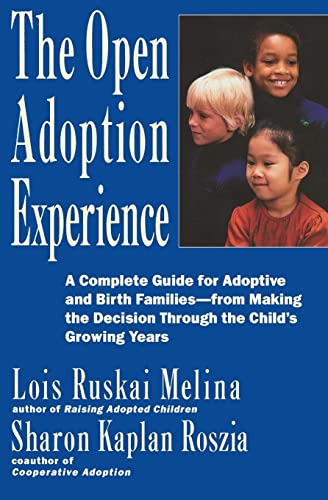
Inhaltsangabe
Two leading experts provide an authoritative and reassuring guide to the issues and concerns of adoptive and birth families through all stages of the open adoption relationship.
Die Inhaltsangabe kann sich auf eine andere Ausgabe dieses Titels beziehen.
Über die Autorin bzw. den Autor
Lois Ruskai Melina is the editor of Adopted Child newsletter and serves on the board of directors of the Evan B. Donaldson Adoption Institute, an organization dedicated to improving the quality of information about adoption and providing guidance for practice and policy change in the field. Melina speaks frequently about adoption to professional organizations and adoptive parents throughout the United States, Canada, and Australia. She is the author of Making Sense of Adoption and the coauthor of The Open Adoption Experience.
Von der hinteren Coverseite
Two leading experts provide an authoritative and reassuring guide to the issues and concerns of adoptive and birth families through all stages of the open adoption relationship.
Auszug. © Genehmigter Nachdruck. Alle Rechte vorbehalten.
Open Adoption Experience
Complete Guide for Adoptive and Birth Families - From Making the Decision ThrougBy Melina, Lois RuskaiPerennial
Copyright © 2004 Lois R. MelinaAll right reserved.
ISBN: 0060969571
A Realistic Lookat Open Adoption
The Reasons forOpen Adoption
Most of us grew up during the "clean break" period of adoption. Birth parents were to remain unknown to the adoptive parents and to the children who were adopted, and the adoptive parents and the children they adopted were to be unknown to the birth parents. Even when the adopted children became adults, or when everyone involved requested that their sealed adoption records be opened, identifying information remained confidential. Today's practice of birth and adoptive parents meeting, corresponding, exchanging identifying information, and having direct contact with each other seems like a radical change in adoption practice. If you are new to adoption, it is. But those who have followed changes in the field of adoption recognize that open adoptions represent an evolution in adoption thought and practice. They are the result of a growing belief that:
- Children have a connection to their birth parents that begins even before birth and cannot be changed or denied by legal documents;
- Children need information about their origins to help form a personal identity, and it is better for children to deal with reality--even harsh reality--than with a variety of fantasies;
- Children need to know that their birth families care about them and that the adoption didn't represent a rejection;
- Birth families need not represent a threat to their children or to the attachment between the children and their adoptive parents;
- Birth parents need to know the outcome of their pregnancy and adoption plan to feel at peace about it;
- Adoptive parents feel more authentic when they receive permission from the birth parents to be their child's parents and see that the birth parents' involvement with their family does not diminish their parent-child relationship.
- Family relationships are healthier in an atmosphere of openness and honesty.
To accept open adoption, it may be necessary for you to understand why adoptions became confidential and the limitations of confidential adoption, and how confidential adoption evolved into open adoption.
Why Confidential Adoptions BeganThroughout history, there have been various practices designed to provide infertile parents with heirs and to care for children whose parents were dead or unable to provide for them. During much of history and in many cultures, a child's move from one family to another was done openly and his original identity remained known.
In the United States, the first law "closing" adoptions was passed in Minnesota in 1917. By the 1930s, virtually all states had followed suit. With these confidential adoptions, new birth certificates were issued listing the adoptive parents, and documents pertaining to the adoption were forever sealed, including the child's original birth certificate. The primary reason for keeping the child's original identity a secret was to allow the child and her birth parents a fresh start. The birth mother, who was often young and unmarried, would be spared the stigma of being considered promiscuous and could be sure the child would never appear to call her past into question. The child would be spared the stigma of being born to parents who were assumed to be promiscuous or poor--conditions thought to be virtually inheritable--and would be given a more "desirable" identity.
This change in adoption practice occurred in a cultural climate that supported the idea of people making a clean break with their past and starting over. America was settled originally by outcasts who were unwanted in their homelands because of their religious beliefs or criminal pasts. Later, immigrants came to America because this was a place where it didn't matter who you were or where you came from--what mattered was what you made of yourself. In the United States, the ownership of property was determined less by inheritance than by hard work. Furthermore, by the 1930s, social scientists were stressing the importance of environmental factors in the development of children. It is not surprising that in this atmosphere we developed adoption practices in which adoptees were urged to leave the past behind and start over; in which birth parents were considered unimportant; in which adoptive parents required a "free and clear" claim to their children; and in which children "belonged" to the parents who did the work to raise them, regardless of any historical or cultural ties they may have had to other people.
In addition, confidential adoptions benefitted the growing field of social work. By serving as the intermediary between the birth parents and the adoptive parents, social workers became "providers" of children to families, giving social workers emotional rewards that were often lacking in other aspects of their professional service. Furthermore, as sociologist Harriet E. Gross, Ph.D., of Governors State University in Illinois, suggests, social workers promoted secrecy to ensure that their role wouldn't become obsolete. What distinguished adoption agencies from other professionals who were arranging adoptions independently was their offer of complete secrecy.
Confidential adoptions appeared to be a practice that benefitted everyone. The birth mother found a solution to her untimely pregnancy and could return to her life confident that the past would not come back to haunt her. The adoptee could get parents who were not only capable of raising her but who were probably more "respectable" and could provide her with a more advantageous environment. The adoptive parents could gain the child they wanted and raise the child as though she had been born to them, without fear that the birth parents would interfere with their parent-child attachment.
The Unexpected Cost Of Confidential AdoptionsWhat was not understood was that these gains did not come without a price. Because of the limited understanding at the time of loss and grief, adoption practitioners did not realize that by breaking with their pasts, adoptees and birth parents were experiencing significant losses. Birth parents lost a chance to know their offspring, to raise them, and to know what became of them. Adoptees lost the chance to know their ancestors, lost access to vital information about themselves or an opportunity to have that information updated, and lost the opportunity to know that the people who gave them life cared about them. And by pretending that these pasts didn't exist, they were not being given a chance to resolve those losses. Nor were the losses of adoptive parents recognized and resolved when they could pretend their child had been born to them. Adoptive parents lost the fantasy child to whom they would have given birth and they lost the hope of being biologically connected to the child they were raising.
Over the years confidential adoptions were widely practiced, it gradually became apparent through research, personal accounts, and case histories that the failure to recognize and grieve for these losses had long-term effects. Some adoptees had impaired self-esteem because they were unable to shake the belief that they were rejected by their mothers. Some had difficulty forming an identity because they did not have information about who they were. Some had difficulty forming relationships because they did not understand why they had lost a...
„Über diesen Titel“ kann sich auf eine andere Ausgabe dieses Titels beziehen.
Suchergebnisse für Open Adoption Experience: Complete Guide for Adoptive...

Beispielbild für diese ISBN
Open Adoption Experience: Complete Guide for Adoptive and Birth Families - From Making the Decision Throug
Verlag:
HarperCollins Publishers Inc, 2013
ISBN 10: 0060969571
ISBN 13: 9780060969578
Gebraucht
Paperback
Anbieter: World of Books (was SecondSale), Montgomery, IL, USA
Verkäuferbewertung 5 von 5 Sternen

Paperback. Zustand: Good. Two leading experts provide an authoritative and reassuring guide to the issues and concerns of adoptive and birth families through all stages of the open adoption relationship. Artikel-Nr. 00079050383
Gebraucht kaufen
EUR 4,06
Versand gratis
Versand innerhalb von USA
Versand innerhalb von USA
Anzahl: 5 verfügbar
Beispielbild für diese ISBN
Open Adoption Experience: Complete Guide for Adoptive and Birth Families - From Making the Decision Throug
Verlag:
HarperCollins Publishers Inc, 2013
ISBN 10: 0060969571
ISBN 13: 9780060969578
Gebraucht
Paperback
Anbieter: World of Books (was SecondSale), Montgomery, IL, USA
Verkäuferbewertung 5 von 5 Sternen
Paperback. Zustand: Fair. Two leading experts provide an authoritative and reassuring guide to the issues and concerns of adoptive and birth families through all stages of the open adoption relationship. Artikel-Nr. 00094069059
Gebraucht kaufen
EUR 4,06
Versand gratis
Versand innerhalb von USA
Versand innerhalb von USA
Anzahl: 2 verfügbar
Beispielbild für diese ISBN
The Open Adoption Experience - A Complete Guide for Adoptive and Birth Families
Verlag:
William Morrow Paperbacks (edition 1), 1993
ISBN 10: 0060969571
ISBN 13: 9780060969578
Gebraucht
Paperback
Anbieter: BooksRun, Philadelphia, PA, USA
Verkäuferbewertung 5 von 5 Sternen
Paperback. Zustand: Very Good. 1. It's a well-cared-for item that has seen limited use. The item may show minor signs of wear. All the text is legible, with all pages included. It may have slight markings and/or highlighting. Artikel-Nr. 0060969571-11-6
Gebraucht kaufen
EUR 5,12
Versand gratis
Versand innerhalb von USA
Versand innerhalb von USA
Anzahl: 1 verfügbar
Beispielbild für diese ISBN
The Open Adoption Experience - A Complete Guide for Adoptive and Birth Families
Verlag:
William Morrow Paperbacks, 1993
ISBN 10: 0060969571
ISBN 13: 9780060969578
Gebraucht
Softcover
Anbieter: Wonder Book, Frederick, MD, USA
Verkäuferbewertung 5 von 5 Sternen
Zustand: Good. Good condition. A copy that has been read but remains intact. May contain markings such as bookplates, stamps, limited notes and highlighting, or a few light stains. Artikel-Nr. L01E-00020
Gebraucht kaufen
EUR 6,43
Versand gratis
Versand innerhalb von USA
Versand innerhalb von USA
Anzahl: 1 verfügbar
Beispielbild für diese ISBN
Open Adoption Experience : Complete Guide for Adoptive and Birth Families - from Making the Decision Throug
Verlag:
HarperCollins Publishers, 1993
ISBN 10: 0060969571
ISBN 13: 9780060969578
Gebraucht
Softcover
Erstausgabe
Anbieter: Better World Books, Mishawaka, IN, USA
Verkäuferbewertung 5 von 5 Sternen
Zustand: Good. 1st Edition. Former library copy. Pages intact with minimal writing/highlighting. The binding may be loose and creased. Dust jackets/supplements are not included. Includes library markings. Stock photo provided. Product includes identifying sticker. Better World Books: Buy Books. Do Good. Artikel-Nr. 3081817-6
Gebraucht kaufen
EUR 6,57
Versand gratis
Versand innerhalb von USA
Versand innerhalb von USA
Anzahl: 1 verfügbar
Beispielbild für diese ISBN
Open Adoption Experience : Complete Guide for Adoptive and Birth Families - from Making the Decision Throug
Verlag:
HarperCollins Publishers, 1993
ISBN 10: 0060969571
ISBN 13: 9780060969578
Gebraucht
Softcover
Erstausgabe
Anbieter: Better World Books: West, Reno, NV, USA
Verkäuferbewertung 5 von 5 Sternen
Zustand: Good. 1st Edition. Pages intact with minimal writing/highlighting. The binding may be loose and creased. Dust jackets/supplements are not included. Stock photo provided. Product includes identifying sticker. Better World Books: Buy Books. Do Good. Artikel-Nr. 3081816-75
Gebraucht kaufen
EUR 6,57
Versand gratis
Versand innerhalb von USA
Versand innerhalb von USA
Anzahl: 1 verfügbar
Beispielbild für diese ISBN
Open Adoption Experience: Complete Guide for Adoptive and Birth Families - From Making the Decision Throug
Verlag:
William Morrow & Company, 1993
ISBN 10: 0060969571
ISBN 13: 9780060969578
Gebraucht
Paperback
Anbieter: ThriftBooks-Atlanta, AUSTELL, GA, USA
Verkäuferbewertung 5 von 5 Sternen
Paperback. Zustand: Fair. No Jacket. Readable copy. Pages may have considerable notes/highlighting. ~ ThriftBooks: Read More, Spend Less. Artikel-Nr. G0060969571I5N00
Gebraucht kaufen
EUR 6,73
Versand gratis
Versand innerhalb von USA
Versand innerhalb von USA
Anzahl: 1 verfügbar
Beispielbild für diese ISBN
Open Adoption Experience: Complete Guide for Adoptive and Birth Families - From Making the Decision Throug
Verlag:
William Morrow & Company, 1993
ISBN 10: 0060969571
ISBN 13: 9780060969578
Gebraucht
Paperback
Anbieter: ThriftBooks-Dallas, Dallas, TX, USA
Verkäuferbewertung 5 von 5 Sternen
Paperback. Zustand: Very Good. No Jacket. May have limited writing in cover pages. Pages are unmarked. ~ ThriftBooks: Read More, Spend Less. Artikel-Nr. G0060969571I4N00
Gebraucht kaufen
EUR 6,73
Versand gratis
Versand innerhalb von USA
Versand innerhalb von USA
Anzahl: 1 verfügbar
Beispielbild für diese ISBN
Open Adoption Experience: Complete Guide for Adoptive and Birth Families - From Making the Decision Throug
Verlag:
William Morrow & Company, 1993
ISBN 10: 0060969571
ISBN 13: 9780060969578
Gebraucht
Paperback
Anbieter: ThriftBooks-Reno, Reno, NV, USA
Verkäuferbewertung 5 von 5 Sternen
Paperback. Zustand: Very Good. No Jacket. May have limited writing in cover pages. Pages are unmarked. ~ ThriftBooks: Read More, Spend Less. Artikel-Nr. G0060969571I4N00
Gebraucht kaufen
EUR 6,73
Versand gratis
Versand innerhalb von USA
Versand innerhalb von USA
Anzahl: 1 verfügbar
Beispielbild für diese ISBN
Open Adoption Experience: Complete Guide for Adoptive and Birth Families - From Making the Decision Throug
Verlag:
William Morrow & Company, 1993
ISBN 10: 0060969571
ISBN 13: 9780060969578
Gebraucht
Paperback
Anbieter: ThriftBooks-Atlanta, AUSTELL, GA, USA
Verkäuferbewertung 5 von 5 Sternen
Paperback. Zustand: Very Good. No Jacket. May have limited writing in cover pages. Pages are unmarked. ~ ThriftBooks: Read More, Spend Less. Artikel-Nr. G0060969571I4N00
Gebraucht kaufen
EUR 6,73
Versand gratis
Versand innerhalb von USA
Versand innerhalb von USA
Anzahl: 1 verfügbar