
Verwandte Artikel zu Evolution: The Triumph of an Idea
Inhaltsangabe
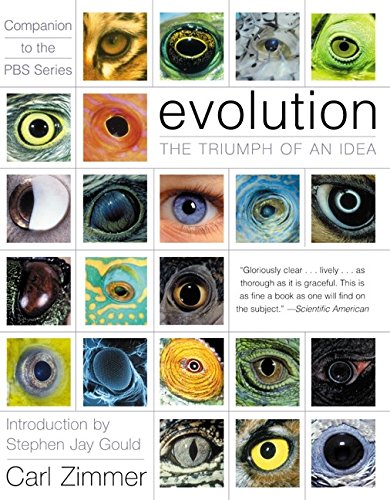
In this dazzling companion to the most important PBS television series this fall, award-winning journalist Carl Zimmer collaborates with leading scholars to tell the compelling story of the theory of evolution―from Darwin to 21st century science
Darwin’s The Origin of Species was breathtaking―beautifully written, staunchly defended, defiantly radical. Yet it emerged long before modern genetics, molecular biology, and contemporary findings in paleontology.
In this remarkable new book, a rich and up-to-date view of evolution is presented that explores the far-reaching implications of Darwin’s theory. At a time when controversies surrounding creationism and education are bursting into public consciousness, this book’s emphasis on the power, significance, and relevance of evolution will make it a catalyst for public debate. Evolution marks a turning point in the 150-year debate and will be an indispensable asset to any serious reader with an interest in the life sciences, a passion for truth in education, or a concern for the future of the planet.
Die Inhaltsangabe kann sich auf eine andere Ausgabe dieses Titels beziehen.
Über die Autorin bzw. den Autor
CARL ZIMMER, guest editor, writes the Origins column for the New York Times. He is the author of fourteen books, including Life’s Edge and She Has Her Mother’s Laugh, both of which were finalists for the PEN/E.O. Wilson Literary Science Writing Award. Zimmer has written for magazines including The Atlantic, National Geographic, Time, and Scientific American. He has won the American Association for the Advancement of Science’s Science Journalism Award three times, and is a two-time winner of the National Academies Communication Award. Zimmer is professor adjunct at Yale University
Von der hinteren Coverseite
This dazzling companion volume to one the most important series in PBS history tells the compelling story of the theory of evolution -- from Darwin to twenty-first-century science.
Charles Darwin's The Origin of Species was breathtaking, beautifully written, staunchly defended, defiantly radical. Yet it emerged long before paleontologists and geologists worked out the chronology of life on Earth, long before biologists uncovered the molecules that underlie heredity and natural selection. Not until the late twentieth century was the true scope of its power revealed.
This remarkable new book, featuring more than 150 color illustrations, presents a rich and up-to-date view of evolution that explores the far-reaching implications of Darwin's theory and emphasizes the power, significance, and relevance of evolution to our lives today. After all, we ourselves are the product of evolution, and we can tackle many of our gravest challenges -- from the lethal resurgence of antibiotic-resistant diseases to the wave of extinctions that looms before us -- with a sound understanding of the science. It can help us see our lives in connection to everything that has come before and to every form of life on Earth today.
Filled with rich narrative, award-winning science writing, and the most up-to-date information on topics ranging from Darwinian medicine and sexual selection to the origins of language, evolutionary psychology, and the controversies surrounding creationism, Evolution tells in riveting detail the story of a remarkable scientific journey, from the emergence to the triumph of an idea.
Auszug. © Genehmigter Nachdruck. Alle Rechte vorbehalten.
Evolution
The Triumph of an IdeaBy Zimmer, CarlPerennial
Copyright © 2004 Carl ZimmerAll right reserved.
ISBN: 0060958502
Chapter One
Darwin and the Beagle
In late October 1831 a 90-foot coaster named HMS Beagle lay docked at Plymouth, England. Its crew scrambled about it like termites in a nest. They were packing the ship as tightly as they could for a voyage around the world, one that would last five years. They rolled barrels of flour and rum into the hold and crammed the deck with wooden boxes that contained experimental clocks resting on beds of sawdust. The Beagle's voyage was a scientific one: its crew would be testing the clocks for the British navy, which depended on precise timekeeping to navigate. Exquisitely detailed maps would be drawn on the voyage as well, so mahogany lockers were installed in the poop cabin and packed with navigational charts. The crew replaced the ship's 10 steel cannons with brass ones so that not even the slightest interference could confuse the Beagle's compasses.
Amid the flurry of preparations, a 22-year-old man picked his way. He moved awkwardly around the ship, not only because his 6-foot frame was oversized for the cramped quarters, but also because he felt profoundly out of place. He had no official position on the ship, having been invited to keep the captain company during the voyage and act as an unofficial naturalist. It was usually up to a ship's surgeon to act as the naturalist for a voyage, but this awkward young man had no such practical skill. He was a medical school dropout who, for want of any other respectable line of work, was considering a career as a country parson when the voyage was over. Once he had stowed away his preserving jars, his microscope, and the rest of his equipment in the poop cabin, he had nothing more to do. He tried helping the assistant surveyor calibrate some of the timepieces, but he didn't even know enough math to do the most basic calculations.
The name of this awkward young man was Charles Darwin. By the time the Beagle returned to England five years later, he would be transformed into one of Britain's most promising young scientists. And out of his experiences on the journey, he would discover the single most important idea in the history of biology, one that would permanently alter humanity's perception of its place in the natural order. From clues that he collected aboard the Beagle, Darwin would show that nature had not been created in exactly the form it takes today. Life evolves: it changes gradually but perpetually over vast gulfs of time, driven through those changes thanks to the laws of heredity, without any need of direct divine intervention. And humans, far from being the pinnacle and destiny of God's creation, were but a single species among many, another product of evolution.
Darwin would send Victorian England into a crisis with his theory, but he would offer an alternative view of life that has turned out to have a grandeur of its own. It is clear today that evolution connects us to the dawn of Earth, to showers of comets and death-winds of stars. It produced the crops we eat and now helps insects destroy them. It illuminates the mysteries of medicine, such as how mindless bacteria can outwit the best minds in science. It holds a warning for those who would take from Earth without limits; it reveals how our minds were assembled among lonely bands of apes. We may still struggle with what evolution says about our place in the universe, but that universe is all the more remarkable.
The Beagle is remembered today only because of Darwin's experience on board the ship. But if you tried to tell that to the sailors rolling barrels aboard they might have laughed without even a glance at the young man who was pretending to know what he was doing.
"My chief employment," Darwin wrote to his family from Plymouth, "is to go on board the Beagle and try to look as much like a sailor as ever I can. I have no evidence of having taken in man, woman or child."
In Search of Beetles and Respectability
Darwin had grown up along the banks of the Severn River in Shropshire, collecting pebbles and birds, completely unaware of the fortunes that made his life pleasant. His mother, Susannah, came from the wealthy Wedgwood family, which made china of the same name. Although his father, Robert, came from less wealthy stock, he built up a fortune of his own by working as a doctor and discreetly lending money to his patients. He eventually became rich enough to build his family a large house, the Mount, on a hillside overlooking the Severn.
Charles and his older brother Erasmus had the close, practically telepathic connection that brothers sometimes have. As teenagers they built themselves a laboratory at the Mount where they would dabble in chemicals and crystals. When Charles was 16, Erasmus went to Edinburgh to study medicine. Their father sent Charles along with him to keep Erasmus company, and ultimately to go to medical school as well. Charles was happy to tag along, for the company of his brother and for the adventure.
When they arrived in Edinburgh, Charles and Erasmus were shocked by the squalor and spectacle of the city. These two boys, raised in the genteel countryside where Jane Austen set her novels, encountered slums for the first time. Politics raged around them as Scottish nationalists, Jacobites, and Calvinists jostled over church and country. At Edinburgh University they faced a rabble of rough students shouting and shooting off pistols in the middle of lectures. Charles and Erasmus recoiled into each other's company, spending their time talking together, walking along the shore, reading newspapers, and going to the theater.
Charles realized very quickly that he hated medicine. The lectures were dreary, the dissected corpses a nightmare, the operations -- often amputations without anesthesia -- terrifying. He kept himself busy with natural history. But although Charles knew that he could not become a doctor, he had no appetite for standing up to his father...
Continues...Excerpted from Evolutionby Zimmer, Carl Copyright © 2004 by Carl Zimmer. Excerpted by permission.
All rights reserved. No part of this excerpt may be reproduced or reprinted without permission in writing from the publisher.
Excerpts are provided by Dial-A-Book Inc. solely for the personal use of visitors to this web site.
„Über diesen Titel“ kann sich auf eine andere Ausgabe dieses Titels beziehen.
Suchergebnisse für Evolution: The Triumph of an Idea

Beispielbild für diese ISBN
Evolution: The Triumph of an Idea
Verlag:
HarperCollins Publishers Inc, 2002
ISBN 10: 0060958502
ISBN 13: 9780060958503
Gebraucht
Paperback
Anbieter: World of Books (was SecondSale), Montgomery, IL, USA
Verkäuferbewertung 5 von 5 Sternen

Paperback. Zustand: Good. In this dazzling companion to the most important PBS television series this fall, award-winning journalist Carl Zimmer collaborates with leading scholars to tell the compelling story of the theory of evolution--from Darwin to 21st century science Darwin's The Origin of Species was breathtaking--beautifully written, staunchly defended, defiantly radical. Yet it emerged long before modern genetics, molecular biology, and contemporary findings in paleontology. In this remarkable new book, a rich and up-to-date view of evolution is presented that explores the far-reaching implications of Darwin's theory. At a time when controversies surrounding creationism and education are bursting into public consciousness, this book's emphasis on the power, significance, and relevance of evolution will make it a catalyst for public debate. Evolution marks a turning point in the 150-year debate and will be an indispensable asset to any serious reader with an interest in the life sciences, a passion for truth in education, or a concern for the future of the planet. Artikel-Nr. 00107289345
Gebraucht kaufen
EUR 4,05
Versand gratis
Versand innerhalb von USA
Versand innerhalb von USA
Anzahl: 1 verfügbar
Beispielbild für diese ISBN
Evolution: The Triumph of an Idea
Anbieter: ThriftBooks-Atlanta, AUSTELL, GA, USA
Verkäuferbewertung 5 von 5 Sternen
Paperback. Zustand: Very Good. No Jacket. May have limited writing in cover pages. Pages are unmarked. ~ ThriftBooks: Read More, Spend Less. Artikel-Nr. G0060958502I4N00
Gebraucht kaufen
EUR 6,05
Versand gratis
Versand innerhalb von USA
Versand innerhalb von USA
Anzahl: 1 verfügbar
Beispielbild für diese ISBN
Evolution: The Triumph of an Idea
Anbieter: ThriftBooks-Atlanta, AUSTELL, GA, USA
Verkäuferbewertung 5 von 5 Sternen
Paperback. Zustand: Very Good. No Jacket. Former library book; May have limited writing in cover pages. Pages are unmarked. ~ ThriftBooks: Read More, Spend Less. Artikel-Nr. G0060958502I4N10
Gebraucht kaufen
EUR 6,05
Versand gratis
Versand innerhalb von USA
Versand innerhalb von USA
Anzahl: 1 verfügbar
Beispielbild für diese ISBN
Evolution : The Triumph of an Idea
Verlag:
HarperCollins Publishers, 2002
ISBN 10: 0060958502
ISBN 13: 9780060958503
Gebraucht
Softcover
Anbieter: Better World Books: West, Reno, NV, USA
Verkäuferbewertung 5 von 5 Sternen
Zustand: Good. Reprint. Pages intact with minimal writing/highlighting. The binding may be loose and creased. Dust jackets/supplements are not included. Stock photo provided. Product includes identifying sticker. Better World Books: Buy Books. Do Good. Artikel-Nr. 3081414-6
Gebraucht kaufen
EUR 6,81
Versand gratis
Versand innerhalb von USA
Versand innerhalb von USA
Anzahl: 1 verfügbar
Beispielbild für diese ISBN
Evolution : The Triumph of an Idea
Verlag:
HarperCollins Publishers, 2002
ISBN 10: 0060958502
ISBN 13: 9780060958503
Gebraucht
Softcover
Anbieter: Better World Books, Mishawaka, IN, USA
Verkäuferbewertung 5 von 5 Sternen
Zustand: Good. Reprint. Former library copy. Pages intact with minimal writing/highlighting. The binding may be loose and creased. Dust jackets/supplements are not included. Includes library markings. Stock photo provided. Product includes identifying sticker. Better World Books: Buy Books. Do Good. Artikel-Nr. 40269470-6
Gebraucht kaufen
EUR 6,81
Versand gratis
Versand innerhalb von USA
Versand innerhalb von USA
Anzahl: 1 verfügbar
Beispielbild für diese ISBN
Evolution: The Triumph of an Idea
Verlag:
Harper Perennial (edition ), 2002
ISBN 10: 0060958502
ISBN 13: 9780060958503
Gebraucht
Paperback
Anbieter: BooksRun, Philadelphia, PA, USA
Verkäuferbewertung 5 von 5 Sternen
Paperback. Zustand: Very Good. It's a well-cared-for item that has seen limited use. The item may show minor signs of wear. All the text is legible, with all pages included. It may have slight markings and/or highlighting. Artikel-Nr. 0060958502-11-1
Gebraucht kaufen
EUR 7,41
Versand gratis
Versand innerhalb von USA
Versand innerhalb von USA
Anzahl: 2 verfügbar
Beispielbild für diese ISBN
Evolution: The Triumph of an Idea
Anbieter: Wonder Book, Frederick, MD, USA
Verkäuferbewertung 5 von 5 Sternen
Zustand: Good. Good condition. A copy that has been read but remains intact. May contain markings such as bookplates, stamps, limited notes and highlighting, or a few light stains. Artikel-Nr. K15Q-00073
Gebraucht kaufen
EUR 7,68
Versand gratis
Versand innerhalb von USA
Versand innerhalb von USA
Anzahl: 1 verfügbar